Showing posts with label consumerism. Show all posts

Monday, August 30, 2010

Looking at Ourselves

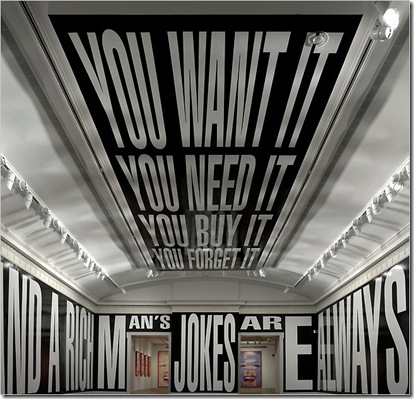
The "Plenty" exhibition at Guild Hall in East Hampton, N.Y. (Photo by Gary Mamay)

Excerpt from “Resurgent Agitprop in Capital Letters,” by Dorothy Spears, New York Times, August 29, 2010

“In broad term, much of [Barbara] Kruger’s recent art is similar to the work that made her famous 30 years ago, built around puckish, aphoristic bits of texts that are at once politically biting and coolly aloof. But the ideas behind them have changed with a culture that Ms. Kruger, now 65 and a self-declared news addict, monitors like an anthropologist…

Over the past two decades Ms. Kruger’s cut-and-paste method, and the archives of pictures she once used, have been replaced by digital technology. Her installations are now typically built electronically, and conveyed via digital files to printers and fabricators. Still, as much as technology has altered her process, she said, the most dramatic change in her work has been on the cultural front. In addition to reading three newspapers daily, she now avidly follows 24-hour news feeds and Web sites from all points on the political spectrum, as well as a constantly shifting stream of reality television shows. The changes she sees reflected there are the ones that interest her most.

“We don’t need mirrors anymore,” she observed. “We look at ourselves on YouTube. We look at ourselves on Twitter. It’s ‘This is what I’m doing now.’

“I look at that. And I make work about it.”

Sunday, June 20, 2010

A Plague of Insatiability

Excerpt from “Dysregulation Nation,” by Judith Warner, New York Times Sunday Magazine (June 20, 2010):

Running the Numbers: An American Self-Portrait  (Chris Jordan). Depicts 106,000 aluminum cans, the number used in the US every thirty seconds.

In the late 1970s, the historian Christopher Lasch famously described America as a culture of narcissism. Today we might well be called a nation of dysregulation. The signs that something is amiss in our inner mechanisms of control and restraint are everywhere. Eating disorders, “in general a disorder of self-regulation,” according to Darlene M. Atkins, director of the Eating Disorders Clinic at Children’s National Medical Center in Washington, grew epidemic in the past few decades, and in recent years have spread to minority communities, younger girls, older women and boys and men too. Obesity is viewed in many cases by mental-health experts as another form of self-dysregulation:a “pathologically intense drive for food consumption” akin to drug addiction, in the words of Nora D. Volkow, director of the National Institute on Drug Abuse, and Charles P. O’Brien, a professor in the department of psychiatry at the University of Pennsylvania, who have argued for including some forms of obesity as a mental disorder in the coming version of the psychiatric bible, the DSM-V.

In book publishing, addiction memoirs seem to have evolved into the bildungsromans of our time, their broad popularity suggesting that stories of self-destruction through excess can be counted upon to inspire a reliable there-but-for-the-grace-of-God affinity in readers. We read about dopamine fiends sitting enslaved to their screens, their brains hooked on the bursts of pleasure they receive from the ding of each new e-mail message or the arousing flash of a tweet. We see reports of young children so unable to control their behavior that they’re being expelled from preschool. And teenagers who, after years spent gorging on instant gratification (too-easy presents from eager-to-please parents, the thrill of the fast-changing screen), are restless, demanding, easily bored and said to be suffering from a plague of insatiability.

Mental-health professionals report seeing increasing numbers of kids who are all out of sync: they can’t sustain attention, regulate their rage, moderate their pain, tolerate normal types of sensory input. Some of this is biological; a problem of faulty brain wiring. But many of the problems — in both children and adults — according to Peter C. Whybrow, director of the Semel Institute for Neuroscience and Human Behavior at the University of California in Los Angeles, come from living in a culture of excess.

Under normal circumstances, the emotional, reward-seeking, selfish, “myopic” part of our brain is checked and balanced in its desirous cravings by our powers of cognition — our awareness of the consequences, say, of eating too much or spending too much. But after decades of never-before-seen levels of affluence and endless messages promoting instant gratification, Whybrow says, this self-regulatory system has been knocked out of whack. The “orgy of self-indulgence” that spread in our land of no-money-down mortgages, he wrote in his 2005 book, “American Mania: When More Is Not Enough,” has disturbed the “ancient mechanisms that sustain our physical and mental balance.”

More…

Friday, November 21, 2008

A Deer in the Target

By Robert Fanning

I only got a ten-second shot,
grainy footage of the huge deer
caught in the crosshairs
of a ceiling security camera, a scene
of utter chaos in a strip mall store,
shown on the late local news.
The beautiful beast clearly scared
to death in this fluorescent forest,
its once graceful legs giving out
on mopped floors, think Bambi
as a faun its first time standing.
Seeing the scattering shoppers,
you'd think a demon had barged
into this temple of commerce,
as they sacrificed their merchandise,
stranded full carts and dove for cover.
And when the aisles were emptied
of these bargain hunters, who was left
but an army of brave red-shirted
team members, mobilized by
the store manager over the intercom
to drive this wild animal out.
I wager there's nothing on this
in the How to Approach
an Unsatisfied Shopper

section in the Target employee handbook,
but there they were: the cashiers
and stockers, the Floor Supervisor,
the Assistant Floor Supervisor,
the Store Manager,
the Assistant Store Manager,
the District Associate Manager,
the District Supervisor,
the District Assistant Supervisor
and visiting members from
the Regional Corporate Office,
running after it, it running after
them, bull's eye logos on their red golf shirts,
everyone frenzied and panting: razor hooves
clattering on the mirror-white floor tiles,
nostrils heaving, its rack clearing
off-season clothes from clearance racks.
All of them, in Target,
chasing the almighty buck.


[Thanks Garrison Keillor!
More by Robert Fanning.]

Sunday, September 14, 2008

We're All Asked to be Performance Artists

Excerpt from "The couple who lived in the mall," Salon.com:

They never intended to undermine the mall or its corporate structure, or to make a spectacle of themselves. [Michael]Townsend describes himself as "wired for happiness" and [Adriana] Yoto's idea of a good time is cataloguing all the items in a store and rating their desirability from "gift-worthy" to "if-it-were-the-apocalypse-and-I-was-looting-I-would-take-it." Which is precisely what they did during their stint living at the mall. Every day.

Each of them voted in one item (a flashlight, space blanket, sketchbook and facecloth) and accepted an allowance of $20. "I had a lot of tea," said Yoto. They camouflaged themselves, carrying empty Nordstrom bags and wearing mall outfits -- nice slacks and button-down shirts. At night they had to skirt through a 2-foot-wide passage to the dark space Townsend had found, its walls and ceiling coated in what Yoto described as "opaque gray oatmeal mixed with the contents of a lint trap." They made a bed of cardboard and insulation tiles where they spent cold nights, not risking capture by using the mall off-hours. They washed up -- it was dusty -- in mall bathrooms, while Yoto arrived at the porcelain sink in the Origins store each morning, sampling its face cleansers. Occasionally, they leafed through books at Borders.

They were, after four days, both completely bored and totally ecstatic. "I felt this vacation-like euphoria that I've never felt till then or since then," Townsend said. "It was better for me than any nature walk I've every taken." Let's be clear: He's not being ironic -- this is wired-for-happiness talking. They felt they had subverted the mall's reason for existence by not buying anything, yet they had achieved what it promised: a release from the burdens of everyday life, within walking distance.

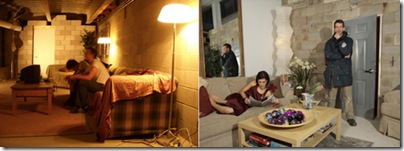
Adriana Yoto and Michael Townsend. Photographs by Stephanie Ewens. Stylist: Caroline Woodward

After their experimental week, Yoto and Townsend returned regularly for four years, attempting to transform that storage space into a luxury apartment furnished by the mall. They built a wall with 39-pound cinder blocks that they hauled in themselves -- there was plenty of hard physical labor involved in their attempt at the high life. They added sofas, tables, lamps, a TV, a china hutch and a Sony PlayStation (which was stolen while they lived there, which suggests their presence wasn't entirely secret), and stayed for days at a time. They planned to install pre-laminated wood flooring and a portable toilet.

Yoto says they played house to submit to the "demands to hyper-stylize." She's referring to the visions of decorating perfection in the Pottery Barn catalogs or Domino magazine that make their way to our mailboxes, to the pressure some internalize to make our homes match those images, to have them always ready for inspection. "We're all asked to be performance artists every day," she says. "We're all being watched."

In the mall -- perhaps the most heavily surveilled public arena we have, with security cameras and long lists of behavioral rules -- she lived a parallel existence in which she realized those hyper-stylizing dreams, performed for that invisible audience by placing tiny jars of sand on a decorative shelf and a cloth runner on the dining room table, flourishes she would excoriate in her real life, in her own loft a mile away.

Yet while Yoto and Townsend critiqued the mall as an agent of surveillance, they worked hard to make sure they were surveilled. They scanned their sketchbooks' pages onto their blogs. They uploaded handmade maps of the mall's undefined spaces. They posted video of their mall apartment on their Web site, which began to appear near the top of Google searches for Providence Place. They assume that's how security knew to search for them, finding Townsend one October afternoon behind the door they built. Townsend yelled "Surprise!" when they turned on the lights. He pleaded no contest, was sentenced to six months probation and was banned from the mall.

Tuesday, July 08, 2008

Digging In with Wendell Berry

Excerpts from a conversation between Jeff Fearnside and Wendell Berry from "Digging In," The Sun Magazine (July 2008):

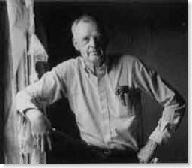
Photo by Andrea BurnsJeff Fearnside: I’ve noticed that the Amish seem less self-conscious than most Americans. Why do you think this is so?

Wendell Berry: I’d say that in their community, honesty is the norm. One of the most striking things about the Amish is that their countenances are open. We pity Muslim women for wearing veils, yet almost every face in this country is veiled by suspicion and fear. You can’t walk down a city street and get anybody to look at you. People’s countenances are undercover operations here.

...

JF: In your Sierra Club talk, you said that you would like conservationists to become more interested in “economic landscapes” — in working farms, ranches, and forests. Do you feel that most people’s definition of the natural world is too small?

WB: The human definition of the natural world is always going to be too small, because the world’s more diverse and complex than we can ever know. We’re not going to comprehend it; it comprehends us. The question is whether we can use it with respect. Some people in the past who knew very little biology were able to use the land without destroying it. We, who know a great deal of biology, are destroying our land in order to use it.

...

JF: I came to Kentucky after four years of living in Central Asia, and I was struck by how environmental disasters both here and there have the same causes: shortsightedness, greed, and the concentration of wealth among a powerful elite. Do you think these are simply part of human nature?

WB: Greed is a part of human nature, and greed is the root cause of these disasters. Once you have greed and the means of Wendell Berryexploitation, the high-toned rationalizations — in other words, the excuses — follow as a matter of course. A real culture functions to limit greed. Our culture functions to increase it, because, we are repeatedly told, it’s profitable to do so, though the majority of the profits go to only a few people.
JF: We’ve talked about what consumers and producers can do to change things. What should the role of government be?

WB: The appropriate role of government should be to see that power and money don’t accumulate in too few hands.

JF: But too often governments act in their own self-interest and harm the people they’re supposed to be working for and protecting.

WB: Unless a community consists entirely of like-minded individuals, the community must, to some extent, have laws, which means government. It’s the nature of an organization like a government — or a corporation — to be self-aggrandizing and self-perpetuating. Once it starts running, it aims to keep running. The real limit on government would be reasonably independent, self-sustaining localities and communities. But if there is no local independence, then governments and other organizations have a kind of freedom that they wouldn’t have otherwise.

If you’ve got 300 million people, most of whom produce nothing for themselves or for the community and to whom everything has to be brought from somewhere else, then there’s no way you’re going to have limited government, or limited anything. All organizations feed upon the helplessness and ignorance and passivity of the people.

More...

Saturday, November 17, 2007

What Would Jesus Buy?

Thursday, April 26, 2007

A Vast and Unsustainable Act of Taking

Cell phones, Orlando 2004

"The pervasiveness of our consumerism holds a seductive kind of mob mentality. Collectively we are committing a vast and unsustainable act of taking, but we each are anonymous and no one is in charge or accountable for the consequences. I fear that in this process we are doing irreparable harm to our planet and to our individual spirits."

Photographer Chris Jordan

Cell phones #2, Atlanta 2005
Thanks Kit!