
Equanimity Does Not Mean Fairness

~ Ken McLeod, from Rules for the Road



~ Ken McLeod, from Rules for the Road
“Be patient towards all that is unsolved in your heart and try to love the questions themselves like locked rooms and like books that are written in a very foreign tongue. Do not now seek the answers, which cannot be given you because you would not be able to live them. And the point is, to live everything. Live the questions now. Perhaps you will then gradually, without noticing it, live along some distant day into the answer.”
Norman Fischer speaking with Vince Horn on Buddhist Geeks (Episode129 -- Buddhism May Need a Plan B):

I mean that there is tremendous spike in research on meditation. Just in last three or four years. It’s exponentially increased and all the research is always showing the same thing that meditation is actually a effective, that it really works, and that it has all kind of benefits. So people seem to believe in research and scientific data, but just talk to your friends who do this practice and that’s probably enough to convince you even without the scientific data.
...It's funny, you know? I'm gone do a retreat for the army for 
[The conversation continues in Episode 130 -- Buddhism and the Evolution of Religion. Check out Norman Fischer’s article, “Why We Need a Plan B,” in the summer issue of Buddhadharma.]
Ce Soir is Montreal-based band Monogrenade's first music video. Directed by Christophe Collette, the video is entirely made in stop-motion.
See also Vidéomusique
[Thanks again JC!]
From The Story from the Static: On Writing and Painting by Audrey Niffenegger:
I have spent most of my life feeling like a woman trying to listen to the radio in a thunderstorm. I am trying to get an idea, something I can turn into a picture, or a novel, and occasionally such a thing does whiz into my brain and it's my job to pick it out from all the static of daily life and find out if it means anything.
Before I can think very hard about this idea I have to figure out if it's a word 
It takes me a long time to make things, and that's good. The more time I have, the more I can add and subtract, the better the thing will be.
My novel, The Time Traveler's Wife, began as a phrase that came to me while 
[More... ]
by Charles Bukowski
“—you know, I’ve either had a family, a job,
something has always been in the
way
but now
I’ve sold my house, I’ve found this
place, a large studio, you should see the space and
the light.
for the first time in my life I’m going to have
a place and the time to
create.”
no baby, if you’re going to create
you’re going to create whether you work
16 hours a day in a coal mine
or
you’re going to create in a small room with 3 children
while you’re on
welfare,
you’re going to create with part of your mind and your body blown
away,
you’re going to create blind
crippled
demented,
you’re going to create with a cat crawling up your
back while
the whole city trembles in earthquake, bombardment,
flood and fire.
baby, air and light and time and space
have nothing to do with it
and don’t create anything
except maybe a longer life to find
new excuses
for.
[Thanks JC!]
From The Week (July 24, 2009):

Trouble
by Matthew Dickman, from All-American Poem
Marilyn Monroe took all her sleeping pills
to bed when she was thirty-six, and Marlon Brando’s daughter
hung in the Tahitian bedroom
of her mother’s house,
while Stanley Adams shot himself in the head. Sometimes
you can look at the clouds or the trees
and they look nothing like clouds or trees or the sky or the ground.
The performance artist Kathy Change
set herself on fire while Bing Crosby’s sons shot themselves
out of the music industry forever.
I sometimes wonder about the inner lives of polar bears. The French
philosopher Gilles Deleuze jumped
from an apartment window into the world
and then out of it. Peg Entwistle, an actress with no lead roles, leaped from the “H” in the HOLLYWOOD sign
when everything looked black and white
and David O. Selznick was king, circa 1932. Ernest Hemingway
put a shotgun to his head in Ketchum, Idaho
while his granddaughter, a model and actress, climbed the family tree
and overdosed on phenobarbital. My brother opened thirteen fentanyl patches and stuck them on his body
until it wasn’t his body anymore. I like
the way geese sound above the river. I like
the little soaps you find in hotel bathrooms because they’re beautiful.
Sarah Kane hanged herself, Harold Pinter
brought her roses when she was still alive,
and Louis Lingg, the German anarchist, lit a cap of dynamite
in his own mouth
though it took six hours for him
to die, 1887. Ludwig II of Bavaria drowned
and so did Hart Crane, John Berryman, and Virginia Woolf. If you are
traveling, you should always bring a book to read, especially
on a train. Andrew Martinez the nude activist, died
in prison, naked, a bag
around his head, while in 1815 the Polish aristocrat and writer
Jan Potocki shot himself with a silver bullet.
Sara Teasdale swallowed a bottle of blues
after drawing a hot bath,
in which dozens of Roman senators opened their veins beneath the water.
Larry Walters became famous
for flying in a Sears patio chair and forty-five helium-filled weather balloons. He reached an altitude of 16,000 feet
and then he landed. He was a man who flew.
He shot himself in the heart. In the morning I get out of bed, I brush
my teeth, I wash my face, I get dressed in the clothes I like best.
I want to be good to myself.
KCRW Bookworm (June 25, 2009)

Economics professor Paul Zak in conversation with Krista Tippett on "The Science of Trust: Economics and Virtue," Speaking of Faith, July 9 2009:
"Economists talk of the cleansing effect of recessions. So recessions are necessary because they kind of cull out the companies that are not providing the best customer service, that are not making a profit, that are not providing some product or service that people need. And when those businesses go out of business, then those resources are redeployed to more important uses. The machines are reused; the people get different jobs. And so this keeps the economy kind of efficient. We don't want to kind of limp along and have high levels of inefficiency just because we love the name General Motors or love the name of some company if they can't kind of keep up with the herd. So competition drives that and that's an important part of maintaining efficiency.
But I think the same thing can happen in individual lives. I think as we get towards the end of every boom period, today or two years ago, the end of the 1990s and dot-com bubble, the end of the '80s and this kind of me generation, I think we do get out of whack because human beings are adaptable and we are watching what other humans are doing. We also become adaptable to this sort of yuppie, more stuff for me lifestyle.
I think, from a spiritual perspective, that recessions are also cleansing. So I think it's very important that we don't shy away from recessions and we don't try to outlaw them. I think we should say, 'Hey, there were excesses. This is how the excesses are corrected. And the excesses were both kind of on the macro level and even perhaps in my own life. Maybe I got a little over-excited about the extra bonuses I was getting and the bigger car. And now I want to sit down and reevaluate what's really important to me.' So I think there are great analogies between the micro and the macro, and we should embrace that.
Having said that, the stress issues are strong. One of the pieces of advice I like to give is: Turn off your TV. Don't listen to the pessimistic news every second of the day...
...Appropriate levels of stress are very good for human beings...There's sort of this misnomer that stress is bad. Too much stress is bad, but also too little stress is bad. So there's sort of this inverted U-curve...this sweet spot for stress that focuses your attention. So I think that when we're in that sweet spot, when we're focused, our memory's better and we're thinking clearly and we've got to figure out what to do next, that's actually very good for human beings and actually all other animals as well."

Pink and White
by Deborah Garrison, from The Second Child
Peonies are the only flower I care for
and when I saw them from the window
yesterday, tumbled and heavy along
a fence, fully exploded, nodding
at the ground, hanging their heads but not
yet spoiled, I remembered
a summer (maybe seven years
ago, or was it ten?) I wasn't sure
our love would come again,
and here I am, almost
kissing the grass like that,
bursting and rich, cracked
all over like broken cake—
makes you cry but still sweet.
[Thanks Garrison!]
“I think this idea that we meet one person and you stay with them your whole life until you die, for me, is unrealistic. I’ve loved a lot of people at many different times in my life. And the love doesn’t stop when we’re not together. And I feel as though, I’ve come to a place in my life, where the climax isn’t watching the love arrive, it’s watching the love in full. Just like our life goes in a cycle, that song has a descension which is just as beautiful as the middle. And in fact, the metaphor that I gave was the same. It was, arrive to a place in the middle where you watch everything in its radiance, you watch the beauty, it unfolds like a flower. And then, you watch it descend. And there’s just as much beauty in watching something recede into the soil as there is watching it come back because that’s full. And I feel the same way about love. So I feel no loss when love leaves because it truly never goes anywhere, and I feel no joy when it sticks around because honestly I kind of like to sleep alone now and then.”
~ Melody Gardot, in conversation with Bob Edwards (July 11, 2009)

“I'm a composer, orchestrally-trained, and the inventor of the AlloSphere. With my visual artist colleagues, we map complex mathematical algorithms that unfold in time and space, visually and sonically. Our scientist colleagues are finding new patterns in the information. And our engineering colleagues are making one of the largest dynamically varying computers in the world for this kind of data exploration. I'm going to fly you into five research projects in the AlloSphere that are going to take you from biological macroscopic data all the way down to electron spin.”
~ Composer JoAnn Kuchera-Morin, founder of the Center for Research in Electronic Art Technology (CREATE)

From Thinking in Pictures: and Other Reports from My Life With Autism by Temple Grandin:

…I hated the second law of thermodynamics because I believed that the universe should be orderly. Over the years I have collected many articles about spontaneous order and pattern formation in nature. Susumu Ohno, a geneticist, has found classical music in slime and mouse genes. He converted the genetic code of four nucleotide bases in our DNA is not random, and when the order is played, it sounds like something by Bach or a Chopin nocturne. Patterns in flowers and leaf growth in plants develop in mathematical sequence of the Fibonacci numbers and the golden mean of the Greeks.
Patterns spontaneously arise in many purely physical systems. Convection patterns in heated fluids sometimes resemble a pattern of cells. Scientists at the University of California have discovered that silver atoms deposited on a platinum surface spontaneously form ordered patterns. The temperature of the platinum determines the type of pattern, and order can be created from random motion. A small change in temperature totally changes the pattern. At one temperature triangles are formed, and at another temperature hexagons form, and further heating of the surface makes the silver atoms revert to triangles in a different orientation. Another interesting finding is that everything in the universe, ranging from amino acids and bacteria to plants and shells, has handedness. The universe is full of self-ordering systems.”
* * * * *
Genome Music Demo
from Todd Baron


More audio clips at GarageBand


“My life for the last twenty-eight years is tied up with this like it was for eighteen years being an astronaut or eight years before that being a Navy pilot. I believe in doing what you can, cause I’ll be gone in another ten or fifteen years. Your listeners need to think about this, they’re only going to be here once. Sometimes we think there’s other people around that will make up for what we don’t do. Sure they can. They can mow a lawn. They can drive a car. They can take a job and write an article or something. But they cannot do what’s in the heart of each of your listeners. And if they don’t do it, it will never be done again until time ends. Who knows when that is?”
~ Alan Bean, the fourth man to walk on the moon, from “Moon Artist,” PRI’s The World, July 8, 2009.
Therefore rejoice, oh thou living one, blest in thy love-lighted homestead,
Ere the dark Lethe's sad wave wetteth thy fugitive foot.
~ Goethe, from Roman Elegies

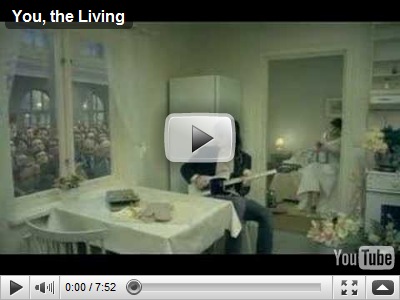
You, The Living
(A film about the grandeur of existing)
by Roy Andersson
“Man is the fascination of man, in big things and small. Life itself bears witness to this. Art confirms it. Spectacular and dramatic events and destinies captivate us. But so does sitting at a street café and watching people wordlessly go by. As compelling as Delacroix's passionate depictions of battle scenes are the paintings by Millet or van Gogh of peasants at work, of a pair taking an afternoon nap in the shade of a haystack, or a family sitting in a kitchen eating potatoes -- pictures that are so precise, empathetic and carefully executed as to give you the feeling that there is nothing more important to relate than this.”
I Was Always Leaving
by Jean Nordhaus
I was always leaving, I was
about to get up and go, I was
on my way, not sure where.
Somewhere else. Not here.
Nothing here was good enough.
It would be better there, where I
was going. Not sure how or why.
The dome I cowered under
would be raised, and I would be released
into my true life. I would meet there
the ones I was destined to meet.
They would make an opening for me
among the flutes and boulders,
and I would be taken up. That this
might be a form of death
did not occur to me. I only know
that something held me back,
a doubt, a debt, a face I could not
leave behind. When the door
fell open, I did not go through.

Daron Larson
Freelance Contemplative



