
Rubikcubism
French artist Invader’s solo show opens June 27th at Jonathan LeVine Gallery.



Teaching is a kind of
learning, much like loving,
mutual goings-on,
both doing each to each;
mutual forbearance;
life itself, you might say.
~ George Johnston, from Farewell to Teaching
Regina Spektor’s CD Far is due out next week (6/23).
[Stream it. Explore it.]

God can be funny
When told he’ll give you money if you just pray the right way
And when presented like a genie who does magic like Houdini
Or grants wishes like Jiminy Cricket and Santa Claus
God can be so hilarious
From The Self-Esteem Trap: Raising Confident Compassionate Kids in an Age of Self-Importance by Polly Young-Eisendrath:

The special self is the creation of idealization. Exceptional, extraordinary, perfect: these are not the descriptions of any real human being, a person with weaknesses as well as strengths. If we have heard repeatedly how talented, beautiful, smart, or promising we are, we may grow up with an intolerance for weakness and difficulty in others, and a greater intolerance for imperfections in ourselves. Within such a self-esteem trap, we are unable to connect with others or embrace ourselves in the messy ambivalence of love.
"Hope is both the earliest and the most indispensable virtue inherent in the state of being alive. If life is to be sustained, hope must remain, even where confidence is wounded, trust impaired."
The Great Poem
by Lawrence Raab, from The History of Forgetting

Think of Keats and his odes.
But we shouldn't have to be dying,
What I'm writing now is not
the great poem. After a few lines
I could tell. It may not even be
a particularly good poem, although
it's too early to decide about that.
Keep going, I say. See what happens.
But trying hard is one of the problems.
since it shows in the lines as a strain
or struggle that reminds the reader
too much of the writer, whereas
most readers want to listen alone.
The great poem, I think, will arrive
when I no longer care. Perhaps
I'll have abandoned art altogether,
and I won't even want to write
the poem down. But then I'll remember
what I once would have given
for this moment, and I'll go back
to my desk. And I'll write the poem
as though I were another person,
someone I will never be again.
From “What the Land Says,” by Verlyn Klinkenborg, The New York Times (June 10, 2009):
Being a writer, in my experience, means putting up with an inner voice — a maker of sentences — that is always clamoring to be heard. More and more, I find myself listening for the moments when that voice lapses.
After a dozen years on this farm, I can name most of the plants and nearly all the birds. But what’s the word for the wake the pileated woodpecker leaves as it dips, flying across the pasture? How can I imagine that land speaks in a language when I’m surrounded by animals whose wordless attention is at least as great as mine? All I can do is put a period to this sentence and hope I can live, for a while, in the pause that follows.
[Thanks Kit!]

by Joseph Stroud, from American Life in Poetry
The night never wants to end, to give itself over
to light. So it traps itself in things: obsidian, crows.
Even on summer solstice, the day of light's great
triumph, where fields of sunflowers guzzle in the sun—
we break open the watermelon and spit out
black seeds, bits of night glistening on the grass.
Congratulations Alex! We are all very proud of you. It has been a joy to watch you grow so far. Now it’s time to begin savoring a new chapter. Enjoy!
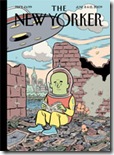
From "Show or Tell: Should Creative Writing Be Taught?" by Louis Menand, The New Yorker (June 8, 2009)
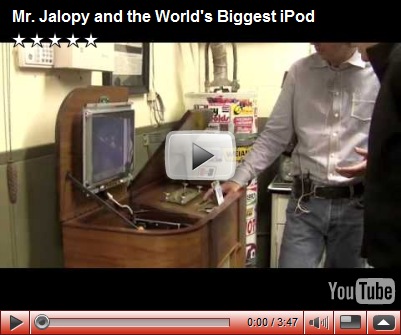
From “Mister Jalopy,” Studio 360 (April 3, 2009):
“Mr. Jalopy transforms garage sale junk into extraordinary machines. He's a hero to the Maker's Movement — a community of DIY-ers who mix science, technology, and art. Kurt spent an afternoon with Mr. Jalopy at his workshop in Los Angeles, and saw one of his inventions.”
An excerpt from The Brothers Bloom by Rian Johnson:

Stephen enjoyed it. He loved the idea that we were internationally infamous art smugglers, but I think deep down, same as me, he felt like we were putting on a persona, faking it.
PENELOPE
Telling a story.
BLOOM
He’d love to die on a job. Cornered at midnight on a run to Jakarta. That’s his dream, to tell his story so well it fulfills itself. It somehow would make it finally real for him.
PENELOPE
That’s kinda the thing we all want, right?
BLOOM
Trying to get something real by telling yourself stories is a trap. Trust me on that one.
"Poetry is the one place where people can speak their original human mind. It is the outlet for people to say in public what is known in private."
“When I first heard about meditation, I had zero interest in it. I wasn't even curious. It sounded like a waste of time.
What got me interested, though, was the phrase 'true happiness lies within.' At first I thought it sounded kind of mean, because it doesn't tell you where the 'within' is, or how to get there. But still it had a ring of truth. And I began to think that maybe meditation was a way to go within.”
~ David Lynch, from “Deep Thoughts by David Lynch,” Utne Reader (May/June 2007)
“Kevin Lee and Matt Zoller “ReWatch” Eternal Sunshine of the Spotless Mind, finding the hope and promise buried in its story of loss.”
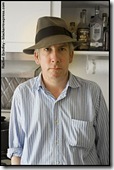
~ Jim Knipfel, describing his marathon writing style
Excerpt from Tinkers by Paul Harding:
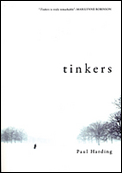
He had built the house himself—poured the foundation, raised the frame, joined the pipes, run the wires, plastered the walls, and painted the rooms. Lightning struck once when he was in the open foundation, soldering the last joint of the hot-water tank. It threw him to the opposite wall. He got up and finished the joint. Cracks in the plaster did not stay cracks; clogged pipes got routed; peeling clapboard got scraped and slathered with a new coat of paint.
Get some plaster, he said, propped up in the bed, which looked odd and institutional among the Persian rugs and Colonial furniture and dozens of antique clocks. Get some plaster. Jesus, some plaster and some wires and a couple of hooks. You’d be all set for about five bucks.
Yes, Gramp, they said.
Yes, Dad. A breeze blew through the open window behind him and cleared exhausted heads. Bocce balls clicked out on the lawn.

Daron Larson
Freelance Contemplative



