Sunday, July 05, 2009

Round-the-Clock Denial

“American popular culture is our eternal present, our illusion of deathlessness. We don’t really mourn the death of a pop-culture icon. We use his extinction to resurrect his life. In America, the death of an American star is really the occasion for a garrulous, obsessive, round-the-clock denial of death.”

~ From “How Constant Change Killed Michael Jackson," by Lee Siegel, The Daily Beast (July 5, 2009)

Saturday, July 04, 2009

On a Morning in Early Summer

Photo by Andrea Mohin/The New York TimesThe Sun
by Mary Oliver

Have you ever seen
anything
in your life
more wonderful

than the way the sun,
every evening,
relaxed and easy,
floats toward the horizon

and into the clouds or the hills,
or the rumpled sea,
and is gone -- 
and how it slides again

out of the blackness,
every morning,
on the other side of the world,
like a red flower

streaming upward on its heavenly oils,
say, on a morning in early summer,
at its perfect imperial distance --
and have you ever felt for anything
such wild love --
do you think there is anywhere, in any language,
a word billowing enough
for the pleasure

that fills you,
as the sun
reaches out,
as it warms you

as you stand there,
empty-handed --
or have you too
turned from this world --

or have you too
gone crazy
for power,
for things?

[Thanks JC and Kit!]

Thursday, July 02, 2009

An Unreal Life

Hermann Hesse "There is no reality except the one contained within us. That is why so many people live such an unreal life. They take the images outside them for reality and never allow the world within to assert itself."

~ Hermann Hesse

Humane Societies

From Ecce Homo (Behold Humanity) by Xavier Le Pichon:

Xavier Le Pichon Physical pain, like fear, are mechanisms of alarm that play a decisive role in the process of decision necessary for the survival of the individual, among animals as well as humans. They also play an important role at the community level. Beyond physical pain, there is the inner suffering. For example, the rupture, due to death or departure, of a relation of very strong dependence between two individuals, may lead to grief consumption or even death. Human societies integrate in their structure in an organic way the fragility and vulnerability manifested in this whole vast world of suffering and death. This is why they are called humane. In the French language the word “humain” is used to denote someone who is both human and humane. That is, he is sensitive to the suffering of his neighbor and tries to alleviate that suffering. In the same way, a society is humane in the degree that it takes care of the lives of those who suffer most without either rejecting or marginalizing them.

…Our humanity is not an attribute that we have received once and forever with our conception. It is a potentiality that we have to discover within us and progressively develop or destroy through our confrontation with the different experiences of suffering that will meet us throughout our life.

Tuesday, June 30, 2009

No Time


Check out Jeff Scher’s blog, The Animated Life.

From “The Parade,” June 29, 2009:

The streets of the city are a non-stop parade of humanity. It’s a kind of grand, unchoreographed ballet of human locomotion. One of the great pleasures and measures of being urban is losing yourself in the crowd, with your feet and mind wandering, alone in your head but elbow to elbow with an inexhaustible supply of strangers…

We can’t help it. We are fascinated by faces and bodies alike. Every face tells a story, and the story is a mystery. The clues abound and we read them instinctively in the blink of an eye. We categorize one another as bums, businessmen, tourists, models, etc., almost unconsciously. But what fun it is to stare, and revel in the passing faces, reading wardrobe, ethnicity, posture, age. Indeed, it’s a feast with every possible variation of the species on parade. By walking in their midst we too become a part of the constantly changing people-scape and offer our own version of the mystery.

Read the whole post and watch the related video...

[Thanks Kit!]

The Gradual, Lifelong Construction

“The purpose of art is not the release of a momentary ejection of adrenaline but rather the gradual, lifelong construction of a state of wonder and serenity.”

~ Glenn Gould

Monday, June 29, 2009

The Beginning of Language

W.S. Merwin in conversation with Bill Moyers (June 26, 2009):

One of the great themes that runs through poetry, all poetry, and I think is one of the reasons for poetry, one of the sources of poetry, one of the sources of language, is the feeling of loss. The feeling of losing things. Not being able to hold, keep things. That's what grief is -- the feeling of having lost. Of having something being out of reach. Gone. Inaccessible... But I think that language itself and poetry are born the same way.

The Shadow of SiriusI think poetry's about what can't be said and I think that language emerges out of what could not be said. Out of this desperate desire to utter something, to express something inexpressible. Probably grief. Maybe something else. You know, you see a silent photograph of an Iraqi woman who's husband or son or brother has just been killed by an explosion. And you know that if you could hear, you would be hearing one long vowel of grief. Just senseless, meaningless vowel of grief. And that's the beginning of language right there.

Inexpressible sound. And it's antisocial. It's destructive. It's utterly painful beyond expression. And the consonants are the attempts to break it, to control it, to do something with it. And I think that's how language emerged.

* * * * *

Youth
from Shadow of Sirius

Through all of youth I was looking for you
without knowing what I was looking for

or what to call you I think I did not
even know I was looking how would I

have known you when I saw you as I did
time after time when you appeared to me

as you did naked offering yourself
entirely at that moment and you let

me breathe you touch you taste you knowing
no more than I did and only when I

began to think of losing you did I
recognize you when you were already

part memory part distance remaining
mine in the ways that I learn to miss you

from what we cannot hold the stars are made

[Thanks Kit!]

Sunday, June 28, 2009

Communication Technology Triage

James Estrin/The New York Times“To Skype or not to Skype, that is the question. But answering it invokes a larger conundrum: how to perform triage on the communication technologies that seem to multiply like Tribbles — instant messaging, texting, cellphones, softphones, iChat, Facebook, MySpace, Twitter; how to distinguish among those that will truly enhance intimacy, those that result in T.M.I. and those that, though pitching greater connectedness, in fact further disconnect us from the people we love."

~ Peggy Orenstein, from “The Overextended Family,” The New York Times Sunday Magazine (June 28, 2009)

Saturday, June 27, 2009

This Small Container for a Lot of Stuff

Don't Cry "I remember when my father died...He didn't die quickly. I was with him and it lasted a few weeks. I was so astonished at the levels of feeling that I discovered in myself which I really wasn't aware of. It almost began to seem to me like people were like cans almost, that a lot substance was sort of squished into. That the form of our personalities and characters is sort of like this small container for a lot of stuff and it has to be compressed into this small thing and we can only be aware of what's on the surface at any given time. But then something like that happens, something that kind of forces the container to break a bit, a deep life-altering event, and suddenly all these feelings come to the surface that you weren't aware that you had. And because of having that experience and also other things -- it wasn't just my father's death, there've been other things that are complex to explain -- but just becoming aware of all the different layers in myself and in other people. Because once you see that in yourself, you begin to be aware of it in other people."

~ Mary Gaitskill, discussing her new collection of short stories, Don’t Cry, with Michael Silverblatt on KCRW’s Bookworm

Deadline

A short film by Bang-yao Liu

The Making Of

Wednesday, June 24, 2009

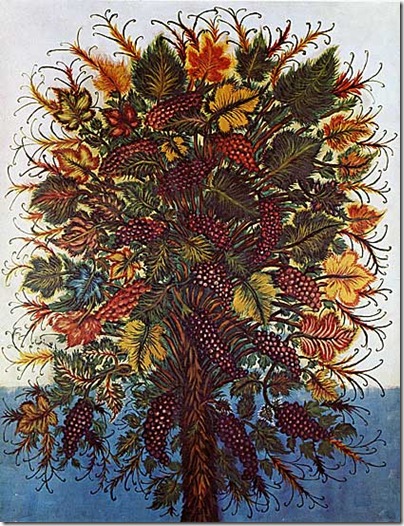
Séraphine

Seraphine

“Be ardent in your work and you will find God in your cooking pots.”

~ St. Teresa of Ávila

Tuesday, June 23, 2009

Convenient Solutions

train "To doubt everything or to believe everything are two equally
convenient solutions; both dispense with the need for thought."

Henri Poincaré (1854-1912), Science and Hypothesis

The Sun Grows In Your Smile

by Linda Rodriquez, from Heart’s Migration

When you smile, the air grows warm and soft,
the earth is watered with gentle mists,
seeds sprout and spread leaves above the dark, damp soil,
earthworms pierce the crust and frolic across the surface
to the delight of fat, happily hunting robins,
lilies of the valley unfurl beside purple, grape-scented irises,
fat pink and maroon peonies, and gay California poppies,
damask roses hurl their rich fragrance to the wind,
the crazy-with-sheer-joy song of the Northern mockingbird
echoes above other chirps and sweet winged notes,
gardeners join the worms in the warm, rich dirt,
children gallop across yards and grab handfuls of dandelions
to present to mothers who will set them in glasses of water
in kitchen windows or on dining room tables, weeds
glorious after the dark of winter with the color of the sun
that grows and warms and heals in your smile.

[Thanks Garrison!]

The Way We Orient

From TED Talks (June 2009): “Psychologist Philip Zimbardo says happiness and success are rooted in a trait most of us disregard: the way we orient toward the past, present and future. He suggests we calibrate our outlook on time as a first step to improving our lives.”

Philip Zimbardo knows what evil looks like. After serving as an expert witness during the Abu Ghraib trials, he wrote The Lucifer Effect: Understanding How Good People Turn Evil. From Nazi comic books to the tactics of used-car salesmen, he explores a wealth of sources in trying to explain the psychology of evil.

A past president of the American Psychological Association and a professor emeritus at Stanford, Zimbardo retired in 2008 from lecturing, after 50 years of teaching his legendary introductory course in psychology. In addition to his work on evil and heroism, Zimbardo recently published The Time Paradox, exploring different cultural and personal perspectives on time.

Still well-known for his controversial Stanford Prison Experiment, Zimbardo in his new research looks at the psychology of heroism. He asks, "What pushes some people to become perpetrators of evil, while others act heroically on behalf of those in need?"

Monday, June 22, 2009

How to Fly

Regina Spektor

Regina Spektor on trying to explain her song writing process:

“To try to go back and take it all apart, then try to put order on it, is almost not fair to it. Let’s say somebody actually knows how to fly, but people just can’t deal with that, they’re constantly looking, going, ‘But where is the button, the propeller, the jet?’ And eventually the person has to strap on the jet and say, ‘Here’s the button.’ I think that’s what happens with people having to explain their songs. The song was flying, and now I’m being pushed to make up shit about it. Sometimes it’s almost like people take it as an insult, like you’re being facetious or pretentious. Or, and this upsets me even more, people say, ‘Random’, ‘Puts together really cool sounds’. It’s not random, it’s very specific, and when I’m writing it, it feels like life and death. It would be so much more fun if people went, ‘Wow, that’s cool, he just flew.’”

[Thanks JC!]

Friday, June 19, 2009

Inspirational Reading

From “Some Thoughts on the Lost Art of Reading Aloud,” by Verlyn Klinkenborg, New York Times (May 16, 2009):

Reading aloud recaptures the physicality of words. To read with your lungs and diaphragm, with your tongue and lips, is very different than reading with your eyes alone. The language becomes a part of the body, which is why there is always a curious tenderness, almost an erotic quality, in those 18th- and 19th-century literary scenes where a book is being read aloud in mixed company. The words are not mere words. They are the breath and mind, perhaps even the soul, of the person who is reading.

…I read aloud to my writing students, and when students read aloud to me I notice something odd. They are smart and literate, and most of them had parents who read to them as children. But when students read aloud at first, I notice that they are trying to read the meaning of the words. If the work is their own, they are usually trying to read the intention of the writer.

It’s as though they’re reading what the words represent rather than the words themselves. What gets lost is the inner voice of the prose, the life of the language. This is reflected in their writing, too, at first.

[Thanks Kit!]

Tiny Swallowable Pieces

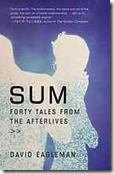
Sum
by David Eagleman

In the afterlife you relive all your experiences, but this time with the events reshuffled into a new order: all the moments that share a quality are grouped together.

You spend two months driving the street in front of your house, seven months having sex. You sleep for thirty years without opening your eyes. For five months straight you flip through magazines while sitting on a toilet.

You take all your pain at once, all twenty-seven intense hours of it. Bones break, cars crash, skin is cut, babies are born. Once you make it through, it's agony-free for the rest of your afterlife.

Sum: Forty Tales from the Afterlives But that doesn't mean it's always pleasant. You spend six days clipping your nails. Fifteen months looking for lost items. Eighteen months waiting in line. Two years of boredom: staring out a bus window, sitting in an airport terminal. One year reading books. Your eyes hurt, and you itch, because you can't take a shower until it's your time to take your marathon two-hundred-day shower. Two weeks wondering what happens when you die. One minute realizing your body is falling. Seventy-seven hours of confusion. One hour realizing you've forgotten someone's name. Three weeks realizing you are wrong. Two days lying. Six weeks waiting for a green light. Seven hours vomiting. Fourteen minutes experiencing pure joy. Three months doing laundry. Fifteen hours writing your signature. Two days tying shoelaces. Sixty-seven days of heartbreak. Five weeks driving lost. Three days calculating restaurant tips. Fifty-one days deciding what to wear. Nine days pretending you know what is being talked about. Two weeks counting money. Eighteen days staring into the refrigerator. Thirty-four days longing. Six months watching commercials. Four weeks sitting in thought, wondering if there is something better you could be doing with your time. Three years swallowing food. Five days working buttons and zippers. Four minutes wondering what your life would be like if you reshuffled the order of events. In this part of the afterlife, you imagine something analogous to your Earthly life, and the thought is blissful: a life where episodes are split into tiny swallowable pieces, where moments do not endure, where one experiences the joy of jumping from one event to the next like a child hopping from spot to spot on the burning sand.

“Eternal Whimsy,” review by Alexander McCall Smith, New York Times (June 14, 2009)

Thursday, June 18, 2009

We’re Caught in a Story

“I know the human spirit. My line is, we all love each other and there’s nothing we can do about it. And any thought that opposes that, we feel as stress. And stress is a gift. It says that we’re caught in a story that may not be true for us. Time to question your mind. Stress is like an alarm clock that says, It’s time to wake the baby, the innocent one who is caught in a dream.”

~ Byron Katie, from My Mother Is…

Night Train


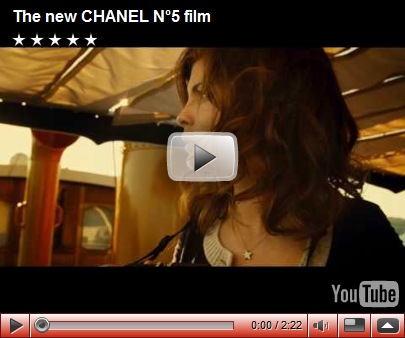
Train de Nuit 
Chanel N°5 film by Jean-Pierre Jeunet
Starring Audrey Tautou and Travis Davenport

I Lose Interest

Photography for Interview by Vinoodh Matadin, Inez Van Lamsweerde “I feel like my last album was really very much about this emotion to want justice. And maybe I go with this emotion as a way to get at how it is to feel injustice—to want justice and to demand it. It’s very strong, this image of a person with a flag, declaring independence. But I’m not interested in politics. I lose interest the microsecond it ceases to be emotional, when something becomes a political movement. What I’m interested in is emotions.”

~ Björk, from Interview Magazine (June/July 2009). Voltaic, a two-CD, two-DVD box set of live recordings from Medúlla and Volta, will be available June 23 from Nonesuch.