Saturday, May 16, 2009

Personals Ad

by Allen Ginsberg, from Cosmopolitan Greetings: Poems, 1986-1992

Cosmopolitan GreetingsPoet professor in autumn years
seeks helpmate companion protector friend
young lover w/empty compassionate soul
exuberant spirit, straightforward handsome
athletic physique & boundless mind, courageous
warrior who may also like women&girls, no problem,
to share bed meditation apartment Lower East Side,
help inspire mankind conquer world anger & guilt,
empowered by Whitman Blake Rimbaud Ma Rainey & Vivaldi,
familiar respecting Art's primordial majesty, priapic carefree
playful harmless slave or master, mortally tender passing swift time,
photographer, musician, painter, poet, yuppie or scholar
Find me here in New York alone with the Alone
going to lady psychiatrist who says Make time in your life
for someone you can call darling, honey, who holds you dear
can get excited & lay his head on your heart in peace.

Wednesday, May 13, 2009

The Beauty of Ordinary Objects

Excerpts from A Voice at the Borders of Silence by William Segal:

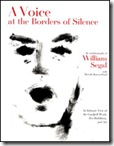
A Voice at the Borders of Silence Both the advantage and the privilege of an artist is that he is forced to look. To see. People rarely see the beauty and the greatness around them. They live their lives in half sleep.

…With sustained attention, one grasps relationships which usually are overlooked. So how to nurture an attention which penetrates into the heart of things?

…Instead of a headlong rush, which is fine for a while, one has to step back.

…Moments of stillness align one's forces. When man's energies are together in balance, more is possible than when they are random, dis-equilibrated. Heart and feeling are needed as well as the intellect. Concentration, attention is the key in any endeavor, whether building a brick wall, working with a computer program or painting a picture.

The artist is fortunate in that he can find and give meaning to the humblest encounter. No subject is too small, too insignificant, to receive his attention and care. In the sense that behind appearances there is another reality, the artist may be said to resemble God. To be true he must approach the subject with 'pure-seeing.' Always there is seduction of the mind-gravitation toward the unknown. With inside-seeing we awaken to the beauty and the potentiality of ordinary objects.

The emergence of light from an area on the canvas always intrigues. The painter cannot evoke this by technique and virtuosity alone. It does not work that way. It is the total absorption of the artist in the work that enables true luminosity to appear.

[Thanks Kit!]

Monday, May 11, 2009

My Life Wasn’t Meant To Be This Difficult

Excerpt from “To Cambodia, With Love,” by Shannon Sexton, Yoga + Joyful Living (Fall 2009):

To Cambodia With Love When millionaire movie executive Scott Neeson took a backpacking trip through Cambodia in 2003, he didn’t expect to land on a garbage dump. What he saw on the outskirts of Phnom Penh changed his life: hundreds of children—some as young as three years old—somber, sick, smeared in grime, scavenging for recyclables in the smoky wasteland of Steung Meanchey, a toxic dump site that spans eight football fields and is more than 100 feet deep.

Abandoned, orphaned, or sent here to work by their families, these children toil for 12 hours a day or longer, earning about 30¢—enough for a bowl of rice. They scorch their feet on smoldering garbage as they wade through hospital and industrial waste, shards of glass, used condoms, rancid food, and feces. Pimps lurk at the edge of the dump, hoping to lure them into brothels. Their parents—if they have any—are the youngest survivors of the blood-drenched era of the Khmer Rouge; alcoholism, drug abuse, and domestic violence are woven into the fabric of their everyday lives. The most heartbreaking statistic? Only 27 percent of these children survive.

Few of us would consider selling our house, our car, our cherished possessions, and moving here—to one of the most polluted places on the planet, shrouded in smog so thick it coats the taste buds and sears the lungs; a place where flies rise up in black clouds and children are run over by garbage trucks.

Even fewer of us would fund schools for these children with our own money or work long days and weekends with no end in sight, fortified only by the knowledge that we’re making a difference.

Scott Neeson / Cambodian Children's Fund Scott Neeson did.

…He told PBS the real turning point came when, during a visit to Cambodia, he received an "emergency" call from LA. "My phone rang, and it was my office, and the actor who was on tour was having quite a serious meltdown because the private jet didn’t have the right amenities for him. He didn’t want to get on the jet." The actor was quoted as saying, "My life wasn’t meant to be this difficult."

"And I thought, I don’t want this to be my world. This isn’t my reality anymore."

[Thanks Kit!]

Sunday, May 10, 2009

The Freedom it Gave Her

From the obituary of Martha Mason in today’s New York Times:

Breath: Life in the Rhythm of an Iron Lung Ever since the 1940s, when she was a girl in a small Southern town, Martha Mason dreamed of being a writer. But it was not till nearly half a century later, with the aid of a voice-activated computer, that she could begin setting a memoir down on paper.

…From her horizontal world — a 7-foot-long, 800-pound iron cylinder that encased all but her head — Ms. Mason lived a life that was by her own account fine and full, reading voraciously, graduating with highest honors from high school and college, entertaining and eventually writing.

She chose to remain in an iron lung, she often said, for the freedom it gave her. It let her breathe without tubes in her throat, incisions or hospital stays, as newer, smaller ventilators might require. It took no professional training to operate, letting her remain mistress of her own house, with just two aides assisting her.

“I’m happy with who I am, where I am,” Ms. Mason told The Charlotte Observer in 2003. “I wouldn’t have chosen this life, certainly. But given this life, I’ve probably had the best situation anyone could ask for.”

…After her mother’s death in 1998, Ms. Mason began work on her [memoir] in earnest. There, in her childhood home, with a microphone at her mouth and the music of the iron lung for company, she wrote her life story sentence by sentence in her soft Southern voice, with her own breath.


[Thanks Matt!]

Setting the Stage

Shinzen Young describing what he means by having a complete experience (Jan. 6, 2009):

Having a complete experience is a technical term. I don’t mean complete in the sense it was intense. I don’t mean complete in the sense that you stayed with it until the end—although that’s part of it. By complete I mean there was a certain critical mass of concentration, clarity, and equanimity present from beginning to end in that experience.

We can’t always have complete experiences, but sometimes we can and with practice we can have them more and more.

When we have a complete experience of something that’s ordinary, it becomes utterly extraordinary. It becomes paradoxical in that it becomes deeply fulfilling and no longer there at the same time…One could also say that when you bring an extraordinary degree of concentration, clarity, and equanimity to an extraordinary experience it becomes utterly ordinary. That’s the path of liberation instead of the path of powers.

We can’t always have enough concentration, clarity, and equanimity to have a complete experience of something. But maybe we can have a little bit of concentration or a little bit of clarity or a little bit of equanimity and that’s not too shabby. Maybe we can’t have any concentration, clarity, and equanimity at all under certain circumstances. But we can have equanimity with that. We can accept that that’s the case and we can continue to do formal practice despite the fact that we have essentially no concentration, no clarity, and no equanimity.

However, we’re still setting the stage for nature to do its job. We’re catalyzing a natural process. We’re giving nature what it needs. On the surface it seems like we’re wasting our time because it's like total monkey mind, total confusion, total lost in emotional chaos, sleepiness, aches and pains, etcetera. But deep down, slowly, changes are taking place, even under those circumstances.

Saturday, May 09, 2009

Resist

Messenger "Resist any temptation to use the poem to make its readers like you, or admire you, or forgive you."

~ Ellen Bryant Voigt

*     *     *     *     *

The Bat
by Ellen Bryant Voigt

Reading in bed, full of sentiment
for the mild evening and the children
asleep in adjacent rooms, hearing them
cry out now and then the brief reports
of sufficient imagination, and listening
at the same time compassionately
to the scrabble of claws, the fast treble
in the chimney—
                      then it was out,
not a trapped bird
beating at the seams of the ceiling,
but a bat lifting toward us, falling away.

Dominion over every living thing,
large brain, a choice of weapons—
Shuddering, in the lit hall
we swung repeatedly against
its rising secular face
until it fell; then
shoveled it into the yard for the cat
who shuttles easily between two worlds.

Friday, May 08, 2009

The Ear is a Great Editor

Warhorses “I think about how things are constructed. My great grandfather was a carpenter, my father was a carpenter, and I’ve been thinking, recently, if that informed my process. Because I think about how things solidify and become heft and at the same time lightness. And so language is important to me, music is important to me. Language is our very first music and the body is an amplifier, so I think in that way. I read everything aloud as I’m writing a poem and anything that’s extraneous, I try to cut away. My method is to improvise. You have everything come flowing down and then cut it back to its necessary components…

It depends on what word falls left or right of a given word to, in a way, shape the music of the word in the center…I think reading it aloud, the ear is a great editor. The ear keeps me true to the language. The poem is a made thing in that sense. It’s a made thing, in a way, approaches mystery.”

~ Yusef Komunyakaa, speaking with Michael Silverblatt of KCRW’s Bookworm (April 30, 2009)


Morgenrot


Music: Hauschka
Video: Jeff Desom

Today, Like Every Other Day

“Today, like every other day, we wake up empty
and frightened.  Don’t open the door to the study
and begin reading.  Take down a musical instrument.

Let the beauty we love be what we do.
There are hundreds of ways to kneel and kiss the ground.”

~ Rumi


Thursday, May 07, 2009

I Own These Moments

On a Perfect Day
by Jane Gentry, from A Garden in Kentucky

A Garden in Kentucky ... I eat an artichoke in front
of the Charles Street Laundromat
and watch the clouds bloom
into white flowers out of
the building across the way.
The bright air moves on my face
like the touch of someone who loves me.
Far overhead a dart-shaped plane softens
through membranes of vacancy. A ship,
riding the bright glissade of the Hudson, slips
past the end of the street. Colette's vagabond
says the sun belongs to the lizard
that warms in its light. I own these moments
when my skin like a drumhead stretches on the frame
of my bones, then swells, a bellows filled
with sacred breath seared by this flame,
                                                        this happiness.

[Thanks Garrison Keillor!]

Tuesday, May 05, 2009

To Have Without Holding

by Marge Piercy

Learning to love differently is hard,
love with the hands wide open, love
with the doors banging on their hinges,
the cupboard unlocked, the wind
roaring and whimpering in the rooms
rustling the sheets and snapping the blinds
that thwack like rubber bands
in an open palm.

It hurts to love wide open
stretching the muscles that feel
as if they are made of wet plaster,
then of blunt knives, then
of sharp knives.

It hurts to thwart the reflexes
of grab, of clutch; to love and let
go again and again. It pesters to remember
the lover who is not in the bed,
to hold back what is owed to the work
that gutters like a candle in a cave
without air, to love consciously,
conscientiously, concretely, constructively.

I can't do it, you say it's killing
me, but you thrive, you glow
on the street like a neon raspberry,
You float and sail, a helium balloon
bright bachelor's button blue and bobbing
on the cold and hot winds of our breath,
as we make and unmake in passionate
diastole and systole the rhythm
of our unbound bonding, to have
and not to hold, to love
with minimized malice, hunger
and anger moment by moment balanced.

Through Narrow Chinks

The Marriage of Heaven and Hell “If the doors of perception were cleansed, everything would appear to man as it is, infinite. For man has closed himself up, till he sees all things through narrow chinks of his cavern.”

~ William Blake, from The Marriage of Heaven and Hell

“To be shaken out of the ruts of ordinary perception, to be Doors of Perceptionshown for a few timeless hours the outer and inner world, not as they appear to an animal obsessed with survival or to a human being obsessed with words and notions, but as they are apprehended, directly and unconditionally… this is an experience of inestimable value to everyone...”

~ Aldous Huxley, from The Doors of Perception

Sunday, May 03, 2009

The Comfort of Being Strangers to Ourselves

The Night, The Porch
by Mark Strand, from New Selected Poems

To stare at nothing is to learn by heart
What all of us will be swept into, and baring oneself
To the wind is feeling the ungraspable somewhere close by.
Trees can sway or be still. Day or night can be what they wish.
What we desire, more than a season or weather, is the comfort
Of being strangers, at least to ourselves. This is the crux
Of the matter, which is why even now we seem to be waiting
For something whose appearance would be its vanishing—
The sound, say, of a few leaves falling, or just one leaf,
Or less. There is no end to what we can learn. The book out there
Tells us as much, and was never written with us in mind.

Friday, May 01, 2009

Always Beginning

To This May
by W.S. Merwin, from Present Company

Present Company They know so much more now about
the heart we are told but the world
still seems to come one a time
one day one year one season and here
it is spring once more with its birds
nesting in the holes in the walls
its morning finding the first time
its light pretending not to move
always beginning as it goes

Thursday, April 30, 2009

We are as Clouds

Mutability
by Percy Bysshe Shelley

We are as clouds that veil the midnight moon;
How restlessly they speed, and gleam, and quiver,
Streaking the darkness radiantly! — yet soon
Night closes round, and they are lost for ever:

Or like forgotten lyres, whose dissonant strings
Give various response to each varying blast,
To whose frail frame no second motion brings
One mood or modulation like the last.

We rest. — A dream has power to poison sleep;
We rise. — One wandering thought pollutes the day;
We feel, conceive or reason, laugh or weep;
Embrace fond woe, or cast our cares away:

It is the same! — For, be it joy or sorrow,
The path of its departure still is free:
Man's yesterday may ne'er be like his morrow;
Nought may endure but Mutablilty.

The Way Clouds Do by Christine Kane


[Thanks Alex!]

Cultivating Awareness of Awareness

Jon Kabat-Zinn in conversation with Krista Tippett on Speaking of Faith (April 16, 2009):

How you pay attention in your life actually can change your life and your biology and your brain. So when you don't have any cause to question Opening to Our Liveswhat's going on…and things are going in a direction that you describe for yourself as desirable — in other words, your 401(k) is increasing in value every year and so forth — it just seems like, yes, all is right with the world. And you can pay your mortgage payments and maybe buy a bigger house and on and on and…we tell ourselves that this is the way it's supposed to be. And then there are these rude awakenings that happen sometimes. It doesn't have to be the collapse of the economy or the stock market. It can be as simple as, you know, something happening to one of your family members or yourself.

…But we live in a kind of somnambulant expectation that everything will go on the way it is. Do you know what I'm saying? And that is certifiably absurd. And so that, the stress if we loop it back to stress and the whole thing about mindfulness-based stress reduction, is that the stress really has to do with wanting things to stay the same when they are inevitably going to change. The law of impermanence basically rules the universe and so things are never constant; they're continually changing. And if you want to hold them a particular way, you can do it for short periods of time at tremendous cost, but ultimately things change.

And if you don't recognize that, then you're going to create a lot of suffering for yourself and other people.

…we call ourselves Homo sapien sapiens. That's the species name we've given ourselves. And that means from the Latin sapere, which means "to taste" or "to know." The species that knows and knows that it knows. So that means really awareness and meta-awareness. And it would be nice if that were actually true, but I think it's a little premature to call ourselves that. And now maybe we need to live ourselves into owning that name by cultivating awareness and awareness of awareness itself and let that be in some sense the guide as to what we're going to invest in, how we're going to make decisions about where we live, where we're going to send our kids to school, how we're going to be at the dinner table. Whether we're going to take our bodies and our children and our parents for granted or whether we're going to live life as if it really mattered moment by moment.

And that's not some kind of prescription for more stuff that you need to do in order to be happy. This is getting out of your own way long enough to realize that you already have the potential for tremendous well-being and happiness right here, right now. Nothing else has to change.

…And all the scientific evidence is suggesting that when you choose life in the way I'm talking about, your brain changes in both form and function, your immune system changes, your body changes. I mean, we start to really take care of what's most important and there are very, very tangible results at the level of the body, the mind, and the heart, and most importantly our relationships with the world and with our loved ones and with our own bodies.

*     *     *     *     *

Books by Jon Kabat-Zinn:

Writing in a Virtual Skinner Box

Try it out at Dr. Wicked’s Writing Lab and become a potentially more prolific literary rat in your own private operant conditioning experiment.

[Thanks JC!]

Wednesday, April 29, 2009

Distilled Insinuation

We Never Know
by Yusef Komunyakaa, from Dien Cai Dau

Dien Cai Dau He danced with tall grass
for a moment, like he was swaying
with a woman. Our gun barrels
glowed white-hot.
When I got to him,
a blue halo
of flies had already claimed him.
I pulled the crumbled photograph
from his fingers.
There's no other way
to say this: I fell in love.
The morning cleared again,
except for a distant mortar
& somewhere choppers taking off.
I slid the wallet into his pocket
& turned him over, so he wouldn't be
kissing the ground.

*     *     *     *     *

"Poetry is a kind of distilled insinuation. It's a way of expanding and talking around an idea or a question. Sometimes, more actually gets said through such a technique than a full frontal assault."

~ Yusef Komunyakaa

Tuesday, April 28, 2009

Foreseeing

by Sharon Bryan, from Flying Blind

Flying Blind Middle age refers more
to landscape than to time:
it's as if you'd reached

the top of a hill
and could see all the way
to the end of your life,

so you know without a doubt
that it has an end—
not that it will have,

but that it does have,
if only in outline—
so for the first time

you can see your life whole,
beginning and end not far
from where you stand,

the horizon in the distance—
the view makes you weep,
but it also has the beauty

of symmetry, like the earth
seen from space: you can't help
but admire it from afar,

especially now, while it's simple
to re-enter whenever you choose,
lying down in your life,

waking up to it
just as you always have—
except that the details resonate

by virtue of being contained,
as your own words
coming back to you

define the landscape,
remind you that it won't go on
like this forever.

Monday, April 27, 2009

Spelunking

From a Salon.com interview with Tobias Wolff from December 2006:

Do you spend a lot of time staring at the wall or do you sit dutifully in front of a typewriter every day?

I try different things and I explore. It's like spelunking, with a light on your hat. You keep going into different chambers until you find a chamber that seems to you to be the right one; you're descending into dark and unknown territory and you can never see very far ahead.

It never gets easier, does it?

No, it gets harder in a way. It gets harder and more satisfying. Because the more you write the more you're aware of the weight of your tradition and the difficulties of the form and the more you have already done that you do not want to do again. So you're continually searching for new ways of using the story form to most perfectly contain and express the story you're telling. You're setting the bar a little higher each time to keep it interesting for yourself. There are writers who do start doing the same thing again and again and almost inevitably fall into self-parody.

[Thanks Charly!]