Monday, March 08, 2010

Leaving the Outside World Behind

Excerpt from “All-Nighters: Failing to Fall,” by Siri Hustvedt, New York Times Opinionator (March 3, 2010):

In sleep we leave behind the sensory stimulation of the outside world. A part of the brain called the thalamus, involved in the regulation of sleeping and waking, plays a crucial role in shutting out somatosensory stimuli and allowing the cortex to enter sleep. One theory offered to explain hypnogogic hallucinations is that the thalamus deactivates before the cortex in human beings, so the still active cortex manufactures images, but this is just a hypothesis. What is clear is that going to sleep involves making a psychobiological transition. Anxiety, guilt, excitement, a racing bedtime imagination, fear of dying, pain or illness can keep us from toppling into the arms of Morpheus. Depression often involves sleep disturbances, especially waking up early in the morning and not being able to get back to sleep. Weirdly enough, keeping a depressed patient awake for a couple of nights in the hospital can alleviate his symptoms temporarily. They return as soon as he begins to sleep normally again.

The Neuronal Switches for Waking and Sleeping

Keep Your Temper

Excerpt from “Algebra in Wonderland,” by Melanie Bayley, New York Times (March 7, 2010):

Alice has slid down from a world governed by the logic of universal arithmetic to one where her size can vary from nine feet to three inches. She thinks this is the root of her problem: “Being so many different sizes in a day is very confusing.” No, it isn’t, replies the Caterpillar, who comes from the mad world of symbolic algebra. He advises Alice to “Keep your temper.”

In Dodgson’s day, intellectuals still understood “temper” to mean the proportions in which qualities were mixed — as in “tempered steel” — so the Caterpillar is telling Alice not to avoid getting angry but to stay in proportion, even if she can’t “keep the same size for 10 minutes together!” Proportion, rather than absolute length, was what mattered in Alice’s above-ground world of Euclidean geometry.

Scene from Jan Švankmajer's Alice.

Friday, March 05, 2010

Seeing Stuff that Makes Real Change in the Real World


“You know, all I wanted to do was draw pictures of horses when I was little. My mother said, Well let's do a picture of something else. They've got to learn how to do something else. let's say the kid is fixated on Legos. Let's get him working on building different things. The thing about the autistic mind is it tends to be fixated. Like if a kid loves race cars, let's use race cars for math. Let's figure out how long it takes a race car to go a certain distance. In other words, use that fixation in order to motivate that kid, that's one of the things we need to do. I really get fed up when they, you know, the teachers, especially when you get away from this part of the country, they don't know what to do with these smart kids. It just drives me crazy…I get satisfaction out of seeing stuff that makes real change in the real world. We need a lot more of that, and a lot less abstract stuff.”

~ Temple Grandin, from “The World Needs All Kinds of Minds," TED Talks (February 2010)

What We Get to Keep from Our Experiences


“There is an experiencing self, who lives in the present and knows the present, is capable of re-living the past, but basically it has only the present. It's the experiencing self that the doctor approaches -- you know, when the doctor asks, Does it hurt now when I touch you here? And then there is a remembering self, and the remembering self is the one that keeps score, and maintains the story of our life, and it's the one that the doctor approaches in asking the question, How have you been feeling lately? or How was your trip to Albania? or something like that. Those are two very different entities, the experiencing self and the remembering self and getting confused between them is part of the mess of the notion of happiness.

Now, the remembering self is a storyteller. And that really starts with a basic response of our memories -- it starts immediately. We don't only tell stories when we set out to tell stories. Our memory tells us stories, that is, what we get to keep from our experiences is a story.”

~ Daniel Kahneman, from “The Riddle of Experience vs. Memory,” TED Talks (February 2010)

[Thanks Kit!]

Thursday, March 04, 2010

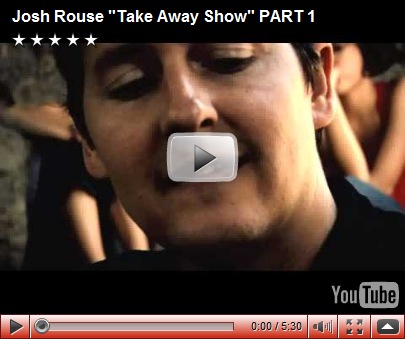
Josh Rouse Live in Barcelona

Josh Rouse
La Blogotheque Take-Away Shows

She’s the Moon


Flume
by Bon Iver

I am my mother's only one
It's enough

I wear my garment so it shows
Now you know

Only love is all maroon
Gluey feathers on a flume
Sky is womb and she's the moon

I am my mother on the wall, with us all
I move in water, shore to shore;
Nothing's more

Only love is all maroon
Lapping lakes like leary loons
Leaving rope burns --
Reddish ruse

Only love is all maroon
Gluey feathers on a flume
Sky is womb and she's the moon

[From Scratch My Back. Download "Flume" for free at http://petergabriel.com/]

On Your Way to Wonderful

Still Bill


"It's okay to head out for wonderful, but on your way to wonderful, you're going to have to pass through all right, and when you get to all right, take a good look around and get used to it, because that may be as far as you're gonna go."

~ Bill Withers, from “Still Bill: Documenting a Soul Icon,” All Things Considered (March 4, 2010)

Full Grown Before I Knew

On Coming From a Broken Home (Part 1)
by Gil Scott-Heron

[Listen]

I want to make this a special tribute
To a family that contradicts the concepts
Heard the rules but wouldn't accept
And women-folk raised me
And I was full grown before I knew
I came from a broken home

Sent to live with my grandma down south
When my uncles was leaving
And my grandfather had just left for heaven
They said and as every-ologist would certainly note
I had no strong male figure right?
But lily Scott was absolutely not your mail order
Room service type cast black grandmother
I was moved in with her; temporarily, just until things were patched,
Til this was patched and til that was patched
Until I became at 3, 4, 5, 6, 7, 8, 9 and 10
The patch that held lily Scott who held me and like them 4
I become one more and I loved her
From the absolute marrow of my bones
And we was holdin on,
I come from a broken home
She had more then the 5 senses
She knew more then books could teach
And raised everyone she touched just a little bit higher
And all around her there was a natural sense
As though she sensed what the stars say what the birds say
What the wind and the clouds say
A sensual soul and self that African sense
And she raised me like she raised 4 of her own
And I was hurt and scared and shocked
When lily Scott left suddenly one night
And they sent a limousine from heaven to take her to god,
If there is one.
So I knew she had gone; and
I came from a broken home

Twitter Wisdom

tony-hsieh“The biggest (& hardest) lesson Ive learned in life is that the external world is just a reflection of the world w/in.” ~Tony Hsieh, @zappos

The Same Enlightenment

Filmed in Nov. 2009 at Mt. Carmel Spiritual Centre in Niagara Falls.

Wednesday, March 03, 2010

Just These People

mirror
by Lucille Clifton, from Voices

one day
we will look into the mirror
and the great nation standing there
will shake its head and frown
the way babies do who
are just born
and cant remember
why they asked for just
these people     just this chance
and when we close our eyes
against regret
we will be left alone
in the wrong image     not understanding
what we are or what we
had hope to be

*     *     *

Changing Face of America
A sociological study of the changing face of America, based on demographic research from the Pew Research Center. The first grid represents an exact breakdown of the current ethnicity of young Americans. The second grid's collection of faces and ethnicities is a projection of where America will be in 2050, with far fewer Caucasians and a significant increase in Asians and Hispanics. In 2050, the minority will be the majority.

~ Ben Baker Photo, from American Youth Book

GRID 1: 13 Caucasian, 3 Hispanic, 3 African American, 1 Asian

GRID 2: 9 Caucasian, 6 Hispanic, 3 African American, 2 Asian

Tuesday, March 02, 2010

A Beguiling Call to Death

Johnny Quid’s (Toby Kebbell) cigarette monologue from RocknRolla (2008):

You see that pack of Virginia killing sticks on the end of the piano? All you need to know about life is retained within those four walls.

You will notice that one of your personalities is seduced by the illusions of grandeur. A gold packet of king size with a regal insignia. An attractive implication toward glamour and wealth. A subtle suggestion that cigarettes are indeed your royal and loyal friends. And that, Pete, is a lie.

Your other personality is trying to draw your attention to the flip side of the discussion.  Written in boring, bold, black and white, is the statement that these neat little soldiers of death, are, in fact, trying to kill you. And that, Pete, is the truth.

Oh, beauty is a beguiling call to death and I'm addicted to the sweet pitch of its siren.

That that starts sweet ends bitter. And that which starts bitter ends sweet.

Monday, March 01, 2010

An Adaptive Response to Affliction

Excerpt from “Depression’s Upside,” by Jonah Lehrer, New York Times Sunday Magazine (February 25, 2010):

The mystery of depression is not that it exists — the mind, like the flesh, is prone to malfunction. Instead, the paradox of depression has long been its prevalence. While most mental illnesses are extremely rare — schizophrenia, for example, is seen in less than 1 percent of the population — depression is everywhere, as inescapable as the common cold. Every year, approximately 7 percent of us will be afflicted to some degree by the awful mental state that William Styron described as a “gray drizzle of horror . . . a storm of murk.” Obsessed with our pain, we will retreat from everything. We will stop eating, unless we start eating too much. Sex will lose its appeal; sleep will become a frustrating pursuit. We will always be tired, even though we will do less and less. We will think a lot about death.

The persistence of this affliction — and the fact that it seemed to be heritable — posed a serious challenge to Darwin’s new evolutionary theory. If depression was a disorder, then evolution had made a tragic mistake, allowing an illness that impedes reproduction — it leads people to stop having sex and consider suicide — to spread throughout the population. For some unknown reason, the modern human mind is tilted toward sadness and, as we’ve now come to think, needs drugs to rescue itself.

The alternative, of course, is that depression has a secret purpose and our medical interventions are making a bad situation even worse. Like a fever that helps the immune system fight off infection — increased body temperature sends white blood cells into overdrive — depression might be an unpleasant yet adaptive response to affliction. Maybe Darwin was right. We suffer — we suffer terribly — but we don’t suffer in vain.


Sunday, February 28, 2010

It Won’t Be Long

Goodbye
by Robert Creeley, from Life & Death

Now I recognize
it was always me
like a camera
set to expose

itself to a picture
or a pipe
through which the water
might run

or a chicken
dead for dinner
or a plan
inside the head

of a dead man.
Nothing so wrong
when one considered
how it all began.

It was Zukofsky's
"Born very young into a world
already very old..."
The century was well along

when I came in
and now that it's ending,
I realize it won't
be long.

But couldn't it all have been
a little nicer,
as my mother'd say. Did it
have to kill everything in sight,

did right always have to be so wrong?
I know this body is impatient.
I know I constitute only a meager voice and mind.
Yet I loved, I love.

I want no sentimentality.
I want no more than home.

The Breath of Awareness

From the opening pages of Intimate Stranger by Breyten Breytenbach:

Intimate Stranger: A Writing Book Listen, this process called poetry is an exercise in imagining memory, and then having that memory snare and cherish imagination. Yet, every poem is and will be a capsule of territory in the perpetual present tense, a vessel taking on the ever-changing colors of the sea.

Poetry is the breath of awareness and the breathing thereof. I even mean this literally, for underlying the flow and the fall of verses are ‘natural units’ of consciousness sculpted by rhythm, by recall, by movement reaching for the edges of meaning and of darkness. One could illustrate by averring that the poem is a membrane, rippling, thrumming; reminding us that we are breathing organisms continually translating the space around us, continually translating ourselves into spaces of the known and thus drawing circumferences around locations of the unknown. From this one could extrapolate that the practice and process of remembering /evoking /awakening events and our selves lead quite naturally to questioning the polarities of other and I, to writing (and un-writing) the self, and toward rewriting the world. The boat changes the water.

Poetry is also the wind of time and thus the movement and singing of being…For when you hold a poem to your ear you hear the deep-sound, the movements we are part of, conveying not so much a literal meaning as an existential sense. It constitutes the spinal chord of remembering. And it reminds us that remembering is movement.

Wolves of the Forest

Vilkas miške - wolf in the forest

“However much you feed a wolf, it always looks to the forest. We are all wolves of the dense forest of Eternity.”

~ Marina Tsvetaeva

There’s No One Way to Be

Julianne-Moore

“A lot of people think that how you behave is a given or that behavior is character. When you move around a lot, you learn that behavior is mutable. I would change, depending on where I was. I would go to one school and everyone would dance one way and, then, at a new school, you’d notice that no one picked up their feet when they danced. You’re like, O.K. — I’ll shuffle my feet like them. You learn that there’s no one way to dance or be. For some reason, a lot of actors come from these peripatetic backgrounds — army kids, missionary kids, kids of salesmen. It teaches you to watch, to reinvent, that character can change.”

~ Julianne Moore, from “Julianne of the Spirits,” by Lynn Hirschberg, New York Times T Magazine (February 28, 2010)

*     *     *

frecklefacex-large Julie Anne Smith

Saturday, February 27, 2010

Willing to Think Little

Excerpt from Think Little by Wendell Berry from A Continuous Harmony: Essays Cultural & Agricultural (1972):

Wendell Berry For most of the history of this country our motto, implied or spoken, has been Think Big. I have come to believe that a better motto, and an essential one now, is Think Little. That implies the necessary change of thinking and feeling, and suggests the necessary work. Thinking Big has led us to the two biggest and cheapest political dodges of our time: plan-making and law-making. The lotus-eaters of this era are in Washington, D.C., Thinking Big. Somebody comes up with a problem, and somebody in the government comes up with a plan or a law. The result, mostly, has been the persistence of the problem, and the enlargement and enrichment of the government.

But the discipline of thought is not generalization; it is detail, and it is personal behavior. While the government is "studying" and funding and organizing its Big Thought, nothing is being done. But the citizen who is willing to Think Little, and, accepting the discipline of that, to go ahead on his own, is already solving the problem. A man who is trying to live as a neighbor to his neighbors will have a lively and practical understanding of the work of peace and brotherhood, and let there be no mistake about it — he is doing that work. A couple who make a good marriage, and raise healthy, morally competent children, are serving the world's future more directly and surely than any political leader, though they never utter a public word. A good farmer who is dealing with the problem of soil erosion on an acre of ground has a sounder grasp of that problem and cares more about it and is probably doing more to solve it than any bureaucrat who is talking about it in general. A man who is willing to undertake the discipline and the difficulty of mending his own ways is worth more to the conservation movement than a hundred who are insisting merely that the government and the industries mend their ways.

One of Many Hoops

Black Elk with wife and daughter, circa 1890-1910. “Then I was standing on the highest mountain of them all , and round about beneath me was the whole hoop of the world. And while I stood there I saw more than I can tell and I understood more than I saw; for I was seeing in a sacred manner the shapes of all things in the spirit, and the shape of all shapes as they must live together like one being. And I saw that the sacred hoop of my people was one of many hoops that made one circle, wide as daylight and as starlight, and in the center grew one mighty flowering tree to shelter all the children of one mother and one father. And I saw that it was holy.”


~ Black Elk Speaks: Being the Life Story of a Holy Man of the Oglala Sioux, as told to John Neihardt

Why Should It Be Easy?

TOLSTOY
I’ve become convinced that all the world’s religions have a
single organizing principle. Can you guess what it is? Love! Love! Simple...


TOLSTOY
I didn’t come for more recrimination. Despite good cause for alienation between us, I have never stopped loving you.

SOFYA
Of course...

TOLSTOY
God knows you don’t make it easy.

SOFYA
Why should it be easy? I’m the work of your life. You’re the work of mine. It’s what love is.

From The Last Station, based on the novel by Jan Parini, screenplay by Michael Hoffman.