To Be of Service

"The aim of the poet and the poetry is finally to be of service, to ply the effort of the individual work into the larger work of the community as a whole."



"The aim of the poet and the poetry is finally to be of service, to ply the effort of the individual work into the larger work of the community as a whole."
Excerpt from Andrew Bird's essay "Words Will Tell" posted on the New York Times music blog Measure for Measure:
Almost every breath contains some fragments of an escaping melody. If I shape my lips so as to whistle, my breath will take on a musical shape like sonic vapor. Words are much trickier. I would forgo words altogether if I didn’t love singing them so much. My choice of words and my voice betray so much and that’s what’s so terrifying and attractive about it.
I’m not the most forthcoming person — I only speak when I have  something to say. What is becoming more challenging of late is dealing with so many fully formed melodies that are unwilling to change their shape for any word. So writing lyrics becomes like running multiple code-breaking programs in your head until just the right word with just the right number of syllables, tone of vowel and finally some semblance of meaning all snap into place.
I’m kind of the opposite of the confessional singer-songwriter who fills notebooks full of poetry and intones them over a bed of chords. Meaning or “the truth that’s in my heart” usually reveals itself well after the record is released. I’m often surprised that the things I care about actually end up in my songs. Until then I’m mostly concerned with shape, tone and texture. I’m really an instrumentalist who sings words...
by William Carlos Williams
By the road to the contagious hospital
under the surge of the blue
mottled clouds driven from the
northeast a cold wind. Beyond, the
waste of broad, muddy fields
brown with dried weeds, standing and fallen
patches of standing water
the scattering of tall trees
All along the road the reddish
purplish, forked, upstanding, twiggy
stuff of bushes and small trees
with dead, brown leaves under them
leafless vines
Lifeless in appearance, sluggish
dazed spring approaches
They enter the new world naked,
cold, uncertain of all
save that they enter. All about them
the cold, familiar wind
Now the grass, tomorrow
the stiff curl of wild-carrot leaf
One by one objects are defined
It quickens: clarity, outline of a leaf
But now the stark dignity of
entrance Still, the profound change
has come upon them: rooted, they
grip down and begin to awaken
[Thanks Beth!]
This is love: to fly upward
toward the endless heavens.
To rend a hundred veils at every moment.
At the first breath, to give up life;
At the final step, to go without feet.
To see the world as a dream
and not as it appears.
I said, O heart
What a blessing it is
To join the circle of lovers,
To see beyond sight,
To know the secrets within every breast.
I said, O soul
From where comes your life
And the power of your spirit?
Tell me, speak in the language of birds,
And I will understand.
My soul said to me:
They brought me to God's workshop
Where all things take form--and I flew.
Before this form of mine
Was even shaped--I flew and I flew.
And when I could fly no longer
They dragged me into this form,
and locked me into this house
of water and clay.
~ Rumi
Amanda Baggs, a young woman with autism, describes how she experiences and communicates with her environment.
More stories on Art and Autism from Studio 360 (3.28.08).
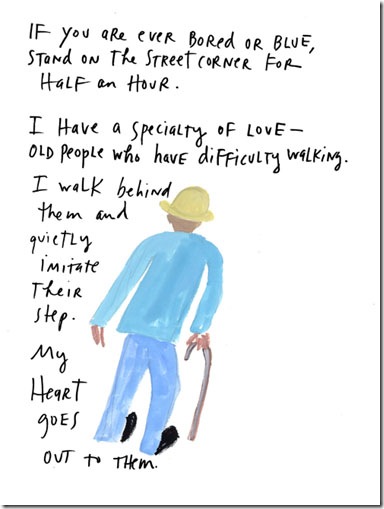
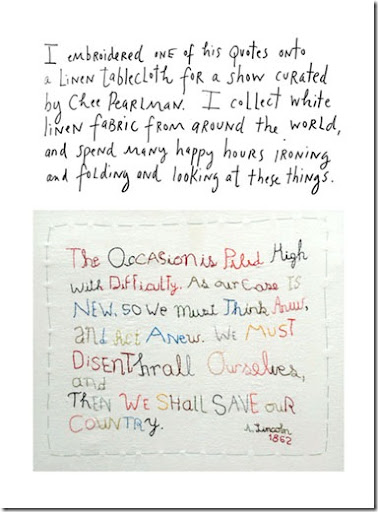
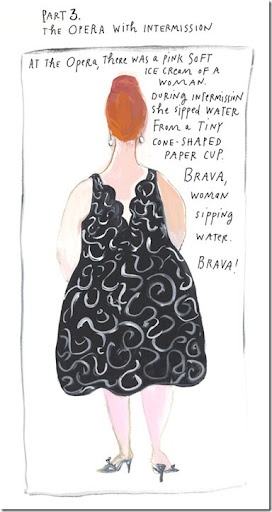
Just finished this enchanting little book by Maira Kalman which was originally her blog on the New York Times. It is so much fun. It's like effortlessly befriending someone who makes you want to look more closely at the color and drama happening right in front your eyes. How much time and energy do we waste holding ourselves back from falling in love with the mundane? Too much.
Look for her spin on Strunk & White's The Elements of Style from a few years back, too.
 "I have found it easier to identify with the characters who verge upon hysteria, who were frightened of life, who were desperate to reach out to another person. But these seemingly fragile people are the strong people really."
 A process in the weather of the heart
Turns damp to dry; the golden shot
Storms in the freezing tomb.
A weather in the quarter of the veins
Turns night to day; blood in their suns
Lights up the living worm.
A process in the eye forewarns
The bones of blindness; and the womb
Drives in a death as life leaks out.
A darkness in the weather of the eye
Is half its light; the fathomed sea
Breaks on unangled land.
The seed that makes a forest of the loin
Forks half its fruit; and half drops down,
Slow in a sleeping wind.
A weather in the flesh and bone
Is damp and dry; the quick and dead
Move like two ghosts before the eye.
A process in the weather of the world
Turns ghost to ghost; each mothered child
Sits in their double shade.
A process blows the moon into the sun,
Pulls down the shabby curtains of the skin;
And the heart gives up its dead.
~ Dylan Thomas, from The Collected Poems of Dylan Thomas 1934-1952
Shinzen Young from "Escaping Into Life," and interview with Michael Toms:
If I were required to give a "quick and dirty" definition of meditation, it would be that meditation is the practice of escaping into life. It's escape in the sense that one does not feel limited by the mind/body process or the surrounding situation. But, the direction of escape is not from what's happening, but rather into it.
This is very challenging. It's challenging to understand, and it's challenging to do. The experience of escaping into something is totally different from merely being passionately involved in it. When we ingenuously try to describe this experience, it comes out sounding like we are playing with words, fabricating paradoxes to shock or impress people. Escaping into something simply means having a radically complete experience of it. A radically complete experience is rich and fulfilling, but it is also empty and transparent. I sometimes say that we Buddhists are our own worst public relations representatives because our vocabulary seems designed to turn people off. You know, we are always talking about emptiness, no self, void.
...But the nothingness of the mystic is a very special kind of nothingness. The nihil of Meister Eckhart is not the nihil of nihilism. The nada of St. John of the Cross is not "nada." Nothingness is a terminus technicus, a well-defined technical term in the vocabulary of world mysticism.
Hinduism, Buddhism, Judaism, Christianity, Islam, and Taoism differ radically in their beliefs and customs. Yet, the mystics who represent the core of these traditions often speak of the Spiritual Source as a special kind of nothing. Historically, this can only partially be explained as the result of mutual influences. Despite what some New Age books would have you believe, these formulations arose independently in India, China, and the West before there was significant contact. So, we are faced with some fascinating questions. Why should they agree on such a counter-intuitive (if not downright offensive) description of God when they disagree in so many other areas? And furthermore, why does the mystic's description of the awesome creative power of nothingness sound so similar to contemporary theories of cosmology and quantum physics? Is it coincidence or convergence?
As a person of Jewish ancestry, I find it deeply satisfying that the description of God's creative activity as it appears in the Kabbalah is remarkably parallel to that of my present teacher Joshu Sasaki Roshi, contemporary Japanese Zen Master. The goal of Jewish meditation is to experience Briah yesh me ayn. In Hebrew: Briah (the creation) yesh (of things) me (from) ayn (nothing). Ayn is synonymous with Ha Makom, the Source, i.e., God. Moreover, in Kabbalah, creation is conceived as happening continuously. God literally loves us into existence each moment through the oscillating interplay of hesed (expansion) and gevurah (contraction).
Physicists speak of the creative power of quantum fluctuations of the void. This seems remarkably similar to the descriptions of mystics, especially Buddhist mystics. At the very least, it provides us with some wonderful metaphors. The enlightened people of the world can now stand up and say, "I know that what I'm trying to describe to you sounds weird and paradoxical, but it's not any weirder than these widely accepted theories of science, and as a matter of fact, it's rather similar to them."
...the concept of wave-particle complementarity is extremely useful in explaining certain aspects of meditative experience. The basic idea behind complementarity is that objects can be looked upon either as waves or particles. "Particle" does not necessarily imply "small." Any chunk of matter is a particle-a bowling ball, or the earth itself. Associated with every particle is its wave function.
When you think about it, it's absolutely astonishing, because particles and waves seem to be so fundamentally different. Particles are rigid and separate-two billiard balls recoil if they collide. Waves are bending and interactive-two water waves immediately merge upon contact. Particles have established boundaries and fixed centers. Waves expand and contract. A particle retains scratches and is vulnerable to shattering force. If you attempt to scratch or shatter a wave, it simply digests the energy of the attack into itself.
The practical implication of complementarity lies in the fact that some applications work better from the wave perspective, while other applications work better from the particle perspective. The issue boils down to knowing which perspective is appropriate, and the fact that the engineer always has the freedom to choose either one.
Spiritual freedom is very much like this. For some life applications, we must congeal the mind and body into a separate particular person-for example, when you need to figure stuff out or negotiate a contract. The problem is that most people are limited to the particulate perspective only. They are unable to immediately switch to the undulatory paradigm when they encounter situations that work better with the wave self. What situations are those? Well, let me give you just a few representative examples: enjoying a morsel of food, experiencing bereavement, making love, being embarrassed in public, and praying.
Once again, the issue here is freedom - freedom to adopt the most appropriate perspective. If you cannot dissolve into a wave, you are missing out on a lot of life. Naturally, death is frightening. Indeed, there are human experiences for which the wave self is not only appropriate, but absolutely essential. To attempt to pass through these experiences while maintaining a separate particulate self causes unspeakable suffering. Acute physical or emotional pain, chronic pain, and, of course, death itself, are in this category.
A news release yesterday from the University of Wisconsin-Madison reports findings from a research study on the effects of compassion meditation on brain circuitry:
Cultivating compassion and kindness through meditation affects brain regions that can make a person more empathetic to other peoples' mental states, say researchers at the University of Wisconsin-Madison.
Published March 25 in the Public Library of Science One, the study was the first to use functional magnetic resonance imaging (fMRI) to indicate that positive emotions such as loving-kindness and compassion can be learned in the same way as playing a musical instrument or being proficient in a sport. The scans revealed that brain circuits used to detect emotions and feelings were dramatically changed in subjects who had extensive experience practicing compassion meditation.
The research suggests that individuals - from children who may engage in bullying to people prone to recurring depression - and society in general could benefit from such meditative practices, says study director Richard Davidson, professor of psychiatry and psychology at UW-Madison and an expert on imaging the effects of meditation.
Various techniques are used in compassion meditation, and the training can take years of practice. The controls in this study were asked first to concentrate on loved ones, wishing them well-being and freedom from suffering. After some training, they then were asked to generate such feelings toward all beings without thinking specifically about anyone.
Each of the 32 subjects was placed in the fMRI scanner at the UW-Madison Waisman Center for Brain Imaging, which Davidson directs, and was asked to either begin compassion meditation or refrain from it. During each state, subjects were exposed to negative and positive human vocalizations designed to evoke empathic responses as well as neutral vocalizations: sounds of a distressed woman, a baby laughing and background restaurant noise.
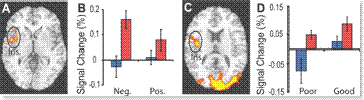
Figure 2. Meditation modulates right insula response to emotional sounds: Average response in (Insula) for experts (red) and novices (blue)
The scans revealed significant activity in the insula - a region near the frontal portion of the brain that plays a key role in bodily representations of emotion - when the long-term meditators were generating compassion and were exposed to emotional vocalizations. The strength of insula activation was also associated with the intensity of the meditation as assessed by the participants.
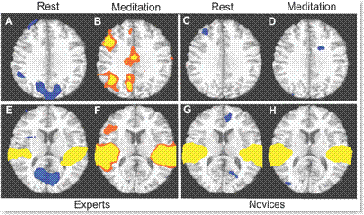
Areas showing a negative (dark blue, blue) or positive (orange, yellow) impulse response on average across 10 seconds in responses to all emotional sounds for the 15 novices and 15 experts at z=31 compared to baseline (figs. A–D) and z = 13 (figs. E–H)
"The insula is extremely important in detecting emotions in general and specifically in mapping bodily responses to emotion - such as heart rate and blood pressure - and making that information available to other parts of the brain," says Davidson, also co-director of the HealthEmotions Research Institute.
Activity also increased in the temporal parietal juncture, particularly the right hemisphere. Studies have implicated this area as important in processing empathy, especially in perceiving the mental and emotional state of others.
"Both of these areas have been linked to emotion sharing and empathy," Davidson says. "The combination of these two effects, which was much more noticeable in the expert meditators as opposed to the novices, was very powerful."
The findings support Davidson and Lutz's working assumption that through training, people can develop skills that promote happiness and compassion.
"People are not just stuck at their respective set points," he says. "We can take advantage of our brain's plasticity and train it to enhance these qualities."
Meditation instruction given to participants
As described in Dr. Matthieu Ricard's instructions for novices: “During the training session, the subject will think about someone he cares about, such as his parents, sibling or beloved, and will let his mind be invaded by a feeling of altruistic love (wishing well-being) or of compassion (wishing freedom from suffering) toward these persons. After some training the subject will generate such feeling toward all beings and without thinking specifically about someone. While in the scanner, the subject will try to generate this state of loving kindness and compassion.”
"Mouth Slightly Open"
 The body a yellow brilliance and a head
Some orange color from a Chinese painting
Dipped in sunset by the summer gods
Who are also producing that twitchy shiver
In the cottonwoods, less wind than river,
Where the bird you thought you saw
Was, whether you believe what you thought
You saw or not, and then was not, had
Absconded, leaving behind the emptiness
That hums a little in you now, and is not bad
Or sad, and only just resembles awe or fear.
The bird is elsewhere now, and you are here
Listen to the poet discussing his recent collection, Time and Materials, which won the 2007 National Book Award for poetry, on KCRW's Bookworm (2.21.08).
And here is a clip from the inaugural Poets Forum, presented by the Academy of American Poets on October 20, 2007, at Marymount College in New York City.
The Gift: imagination and the erotic life of property by Lewis Hyde
Who am I
to hold you accountable
for the risks you didn't take?
I assumed you were me.
It must have been
the lazy eye,
the persistent uncertainty,
the aching heart,
the sense of exclusion from the tribe.
We share the same sins of omission.
We could have been someone,
but you were afraid you might
die from embarrassment.
Remember when you had to ask
to be dropped from the diving board
into the paralyzing uncertainty
of the cobalt water?
Remember how you were always running to the library
to run you finger along the spines of
what had already been written about
something you just heard?
Remember the ease with which
you turned your back on Bach and Brahms
when someone you didn't know
explained her theory of
the curse of talent's impatience?
And look at us now.
Instead of being someone we might have been,
we fill this drafty house with
rough inventions and imperfect rhapsodies,
and the tables are cluttered with
books we mean to read.
Just last night, your daughter rehearsed
her French presentation
in the bathroom
with the fan running,
and our old dog sandwiched
who you are now
against the warmth
of a love so unlikely and persistent
that you never could have dreamed it.
On the kitchen island,
an amaryllis whispered a lesson on waking up
while moonlight reflected on the glass dome
covering what remains of
a double layer cake.
"Author and scholar Karen Armstrong talks about how the Abrahamic religions -- Islam, Judaism, Christianity -- have been diverted from the moral purpose they share to foster compassion. But Armstrong has seen a yearning to change this fact."
From TED
"That which is hateful to you, do not do to your neighbor. That is the Torah, the rest is commentary. Go and study it."
From Parallels Between Buddhism and Christianity, a talk given by Shinzen Young:
My teacher Sasaki Roshi used to quite regularly hold Zen retreats at a Trappist Monastery where Father Thomas Keating used to be the abbot. He would go in and put on the Trappist robes and he'd make up Christian kōans for the monks.
The first kōan he gave them was What is your experience of God when you make the sign of the cross?
He would also describe Buddhism in terms of Christianity. He would ask them questions like What was Jesus's experience of God when he was on the cross?
He would say, "Resurrection is the heart of Buddhism. Unless you understand about resurrection, you cannot understand what Buddhism is about. Dying is the easy part. The resurrection is the hard part. Any religion that doesn't teach resurrection is a false religion." He was talking about his own experience which is why he would say it with such conviction.
Do you understand what he meant when he said resurrection is the heart of Buddhism? Well, it goes back to the experience of no self and full self. Allowing the self to dissolve is half of the enlightenment experience. Allowing the self to reform without interference, that's resurrection, isn't it?
Thomas Merton wrote, "All the paradoxes about the contemplative way are reduced to this one: being without desire means being lead by a desire so great that it is incomprehensible. It's too huge to be completely felt. It's a blind desire, which seems like a desire for nothing. Only because nothing can content it. And because it is able to rest in no thing, then it rests, relatively speaking, in emptiness. But not in emptiness as such, emptiness for it's own sake, actually there's no such entity as pure emptiness. And the merely negative emptiness of the false contemplative is a thing, not a nothing."
[It's very true. In other words, the negative emptiness, empty in the sense of your bank account is empty, that's not the emptiness that the meditator is talking about. That's actually a thing.]
"True emptiness is that which transcends all things and yet is imminent in all. For what seems to be emptiness in this case is pure being. But it's not this or that. Whatever you say of it, it is other than what you say. The character of emptiness, at least for a Christian contemplative, is pure love, pure freedom. Love that is free of everything, not determined by any thing or held down by any special relationship. It's love for love's sake. It's a sharing through the Holy Spirit in the infinite charity of God. And so when Jesus told his disciples to love, he told them to love as universally as the Father who sends rain alike on the just and the unjust. This purity, freedom, and indeterminateness of love is the very essence of Christianity."
"Letting go of our suffering is the hardest work we will ever do. It is also the most fruitful. To heal means to meet ourselves in a new way -- in the newness of each moment where all is possible and nothing is limited to the old."
In the realm of passing away
This is the realm of the passing away. All that
exists does not for long.
Whatever comes into this world never stops sliding
toward the edge of eternity.
Form arises from formlessness and passes back,
arising and dissolving in a few dance steps between
creation and destruction.
We are born passing away.
Seedlings and deadfall all face forward.
Earthworms eat what remains.
We sing not for that which dies but for that which
never dies.
"Neuroanatomist Jill Bolte Taylor had an opportunity few brain scientists would wish for: One morning, she realized she was having a massive stroke. As it happened -- as she felt her brain functions slip away one by one, speech, movement, understanding -- she studied and remembered every moment. This is a powerful story about how our brains define us and connect us to the world and to one another."
From TED
"Right now I can step into the consciousness of my right hemisphere where we are -- I am -- the life force power of the universe. I'm the life force power of the fifty trillion beautiful molecular geniuses that make up my form. At one with all that is. Or I can choose to step into the consciousness of my left hemisphere where I become a single individual, a solid, separate from the flow. Separate from you. I am Dr. Jill Bolte Taylor, intellectual, neuroanatomist. These are the we inside of me. Which would you choose? Which do you choose? And when? I believe that the more time we spend choosing to run the deep inner peace circuitry of our right hemispheres, the more peace we will project into the world and the more peaceful our planet will be. And I thought that was an idea worth spreading."
My Stroke of Insight: a brain scientist's personal journey
[Thanks Kit!]
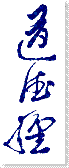 There is form arisen from chaos,
born prior to the universe;
silent and empty it stands alone without change:
this can be regarded as the mother of the world.
Though we do not yet know its name,
we can designate it as the dao;
forced to give it a name we can call it great.
"Great" means the "source,"
the "source" means "going far,"
"going far" means "returning."
Therefore:
The dao is great,
the heavens are great,
the earth is great,
and human beings are also great.
There are four things that are
great within the realm
and human beings count
as one of them.
Human beings emulate the earth,
the earth emulates the heavens,
the heavens emulate the dao,
and the dao emulates
what is naturally so.
-- Tao Te Ching
Excerpts from an interview with Ian McEwan from The Kenyon Review (Summer 2007):
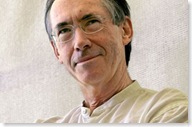 "I write to find where I'm going. But sometimes a scheme doesn't emerge very rapidly in the early part of writing, sometimes in the first five or ten thousand words. Sometimes I just blunder into a novel and start out thinking I'm doing one thing that I had asked myself to do in a note ten years before and end up doing another thing that I had asked myself in a not three years before. Sometimes I have to trick myself into doing things. But I do see writing, the actual physical matter of writing, as an act of imagination. And the best days, the best mornings are the ones in which forcing down a sentence might generate a surprise. A combination of ideas, or simply a noun meeting an adjective that suddenly gives me pleasure. Whole characters have sometimes emerged for me simply out of a sentence. Not out of the need to describe a character, but the need to make this kind of pattern on the page. And then I've gone on to build on that and found myself again pleased that something has come up, a little serendipity that's taken me in the direction."
...
"I like writers generally, and Nabokov is another who is supreme in this respect, who recognize that forty percent of the brain's processing is given over to the visual, and the visual region projects deep into other parts of the brain, of language and emotion. We are visual creatures and the novel, more than cinema, for me is ultimately a visual medium."
...
"But as for readers, readers are too diverse and the thing we all learn about contemporary literature is that there are no standards; there are no common standards of taste. You can get two perfectly intelligent, widely read people in the room who've read the same book, and one thinks it's a disgrace from one end to the other, and the other thinks it's a masterpiece. How is it that we don't have a common view of what even constitutes a good sentence? There's nothing, our feet can't touch the ground on this, and it's no good to try and sort it out by voting--these sorts of lists that you get in newspapers...Maybe the lists are our desperate plea for some certainty; given that we just don't know what a good book is or we can't agree on what a good book is...How is it we have not taught ourselves in university courses the elements of a good book?...it is impossible to constitute a reader in your head, except a strange, skeptical, critical, unimpressed one that I have who makes me take things out, generally. It's not about putting things in; it really makes me take things out."
From Catching the Big Fish: meditation, consciousness, and creativity by David Lynch:
Fifty years ago, people were saying, "Everything's speeding up." Twenty years ago, they were still saying, "Everything's speeding up." It always seems that way. And it seems even more so now. It's crazy. When you watch a lot of TV and read a lot of magazines, it can seem like the whole world is passing you by.
When I was making Eraserhead, which took five years to complete, I thought I was dead. I thought the world would be so different before it was over. I told myself, Here I am, locked in this thing. I can't finish it. The world is leaving me behind. I had stopped listening to music, and I never watched TV anyway. I didn't want to hear stories about what was going on, because hearing these things felt like dying.
At one time, I actually thought of building a small figure of the character Henry, maybe eight inches tall, and constructing a small set out of cardboard, and just stop-motioning him through and finishing it. That was the only way I could figure doing it, because I didn't have any money.
Then, one night, my younger brother and my father sat me down in a kind of dark living room. My brother is very responsible, as is my father. They had a little chat with me. It almost broke my heart, because they said I should get a job and forget Eraserhead. I had a little girl, and I should be responsible and get a job.
Well, I did get a job: I delivered the Wall Street Journal, and I made fifty dollars a week. I would save up enough to shoot a scene and I eventually finished the whole thing. And I started meditating. Jack Nance, the actor who played Henry, waited three years for me, holding this thought of Henry, keeping it alive. There's a scene in which Jack's character is on one side of a door, and it wasn't until a year and a half later that we filmed him coming through the other side of the door. I wondered, how could this happen? How could it hang together for so long? But Jack waited and held the character.
There's an expression: "Keep your eye on the doughnut, not on the hole." If you keep your eye on the doughnut and do your work, that's all you can control. You can't control any of what's out there, outside yourself. But you can get inside and do the best you can do.
The world isn't going to pass you by. There's no guarantee that meditation or delivering the Wall Street Journal is going to make you a success. But with focus and with meditation—although the events of your outer life may stay the same—the way you go through those events changes and gets so much better.

Daron Larson
Freelance Contemplative