Sunday, November 18, 2007

Song of a Man Who Has Come Through

by D.H. Lawrence

Not I, not I, but the wind that blows through me!
A fine wind is blowing the new direction of Time.
If only I let it bear me, carry me, if only it carry me!
If only I am sensitive, subtle, oh, delicate, a winged gift!
If only, most lovely of all, I yield myself and am borrowed
By the fine, fine, wind that takes its course through the chaos of the world
Like a fine, an exquisite chisel, a wedge-blade inserted;
If only I am keen and hard like the sheer tip of a wedge
Driven by invisible blows,
The rock will split, we shall come at the wonder, we shall find the Hesperides.

Oh, for the wonder that bubbles into my soul,
I would be a good fountain, a good well-head,
Would blur no whisper, spoil no expression.

What is the knocking?
What is the knocking at the door in the night?
It is somebody wants to do us harm.

No, no, it is the three strange angels.
Admit them, admit them.

Uselessness

"...art is useless, at least when compared, say, to the work of a plumber, or a doctor, or a railroad engineer. But is uselessness a bad thing? Does a lack of practical purpose mean that books and paintings and string quartets are simply a waste of our time? Many people think so. But I would argue that it is the very uselessness of art that gives it its value and that the making of art is what distinguishes us from all other creatures who inhabit this planet, that it is, essentially, what defines us as human beings.

"To do something for the pure pleasure and beauty of doing it. Think of the effort involved, the long hours of practice and discipline required to become an accomplished pianist or dancer. All the suffering and hard work, all the sacrifices in order to achieve something that is utterly and magnificently...useless."

-- Paul Auster, from his accceptance speech for the Prince of Asturias Prize for Letters (Spain's highest literary honor) last year.

The Discipline of DE

Saturday, November 17, 2007

Reading is a Debt We Owe to a Collective

Junot Díaz discussing his novel, The Brief Wondrous Life of Oscar Wao, on KCRW’s Bookworm:

A book is a gift. No matter how poorly written it is, or if we don’t like it—we think it’s simplistic or if we find it to be odious—someone did spend time working on this. Someone did take a part of their lives to make this happen. Even in the most kind of nonsense, banal books there is a note of grace in it…As a kid, I was just reading. And I never lost that sense that sometimes there are terrible books which for me produce really pleasing results in my mind and in my heart. And sometimes there are incredibly brilliant books that don’t do any of that. And I think I had to have a much more generous sense of what reading means and what it can do.
...

If you think about it, curses are narratives. They’re narratives that bind us and follow us. They’re shadows that even when we think we’ve escaped them, they’re there. History follows the same pattern. We can deny all the history we want and yet history will still reach up across time and shape our choices or behavior and our possibilities. And I think that it’s hard to be a person and not want to be independent from all those invisible forces that we can’t even begin to grasp. Through the tales that we tell ourselves, the ones that exclude those invisible forces—whether it’s history, curses, our ancestors, our parents, our earlier selves—are those stories more worthy, are they more beneficial than the stories that accept this, that embrace this, that in some ways make it deterministic—in other words, that we are cursed. Which is the better, more productive, more human story? We’re cursed or there are no such things as curses?
...

Junot DíazIn the end, why is it that it’s okay for me to have been a little person and I’ll use that to explain my world and to be like, this is why I act this way and this is why I resist and this is why I’ve struggled so hard. But what’s always extraordinary is that we’re usually not very tolerant of other small lives, even if our lives have been small. Sometimes we’ll be tolerant of a small life and the next thing we know, we’re no longer tolerant. One of the thing Oscar’s character keeps asking is, Is being human something that you do once—you make one choice and it proves that you’re human—or is it a choice you have to keep making through your whole life? And what an incredible struggle, what an incredible challenge, what a journey that is.
...

What I want is people to read and remember that reading, while we may practice alone, in solitude, it arose out of a collective learning and out of a collective exchange…Return to the notion that it’s not just you, a monk alone in a chamber. That it’s you reading out of a collective, from a collective. I love that idea because I never forgot how I learned to read…With a group of people, with teachers. I learned to read in Kindergarten when I first moved to the United States, watching other kids make mistakes, do things right, and having access to a group of teachers who were committed at that moment. And in It’s a Wonderful Life, do you remember the husband of the teacher who punches [Jimmy Stewart] goes, “My wife taught your children to read.” And it is a debt. Reading is a debt we owe to a collective, while we may practice it alone.

What Would Jesus Buy?

Thursday, November 15, 2007

Into the Mystic


We were born before the wind
Also younger than the sun
Ere the bonnie boat was won as we sailed into the mystic
Hark, now hear the sailors cry
Smell the sea and feel the sky
Let your soul and spirit fly into the mystic

And when that fog horn blows I will be coming home
And when the fog horn blows I want to hear it
I don't have to fear it

And I want to rock your gypsy soul
Just like way back in the days of old
And magnificently we will flow into the mystic

When that fog horn blows you know I will be coming home
And when that fog horn whistle blows I got to hear it
I don't have to fear it

And I want to rock your gypsy soul
Just like way back in the days of old
And together we will flow into the mystic
Come on girl...

Too late to stop now...

Stressed Out and On Edge

“My experiences are not pornography for my friends or for anyone else. I use the word pornography because I feel like it is just the ... exploitation of my personal experiences for someone else's entertainment ... I dehumanized people ... I don't even know how many raids I did while I was there. But during raids you're throwing them up against the wall, you're tying their hands behind their back, you're dragging them out of the bed. You're dehumanizing them in front of their wives and their kids and, you know, the women are crying and the children are crying and you're just like, whatever. Put a bag over their head or blindfold, drag them into the Humvee. Certain exhibitions of violence on my part that were probably unnecessary — were definitely unnecessary. But I was really stressed out and on edge at the time and I conducted myself ... like that."

Demond Mullins, a young man from Brooklyn who spent a year in Iraq with the National Guard and has found academics helpful in dealing with the effects of his experiences in the war (From Morning Edition, NPR, 11/14/07)

Not What We Say

Steve Carell, Juliette Binoche, Peter Hedges
Writer-director Peter Hedges discussing his latest movie, Dan in Real Life, with Elvis Mitchell on KCRW's The Treatment (11/07/07):

"Good writing is often what you don’t write…My stories are always about people—usually good people—trying to do the right thing, but not necessarily capable of doing it. Theater at its best teaches us how to talk to each other again and film at its best makes us feel less alone. For me [with] movies I love, I go, Oh, I know. I know what they’re feeling. I’ve felt that way. Oh, I’m afraid to feel that way. Oh, now I’m not so afraid to feel that way because I saw them feel that way.

I like stories that are not hard to understand. At their best, they may be difficult to handle, but not because they’re cryptic. They’re very clear. What’s interesting is when a character can’t speak, we find ourselves wanting to speak for them. We know what they’re saying. So I feel that those silences pull and audience in. Not from a manipulative standpoint, it’s more from this is what’s true…Ultimately it’s what we do in film, and not what we say, that matters."

Dan In Real Life director Peter Hedges and Sondre jamming in between scenes on set in Newport, Rhode Island, December 2006.

I Lived on the Moon

A musical video clip by Yannick Puig


I Lived on the Moon
official website

Tuesday, November 13, 2007

Three Big Things

"You have your three big things that you can talk about, basically, if you’re going to write something that actually means something to you as a human being, which is Love, God and Death. That’s basically the thing. Love, which occupies a lot of our time, because we don’t like being lonely. God, because everyone wants to know that there’s a reason behind what they’re doing and what the hell is going on. And death is just the reality of your finite time here...

Whatever gets your creative juice flowing. Some people write amazing protest songs because they want things to be right. That doesn’t float my boat but I say that there’s three things, there’s three guideposts, but it’s not like a math problem where you touch on one of them and it’s a decent song. I have lots of other interests, but there’s something about when you sit down to write something you want to sing over and over again, it usually comes down to one of those three things.”

--Sam Beam, from Growing a Bard (Paste, Issue #36, October 2007)

Naked As We Came

Sunday, November 11, 2007

It's the dose that makes the poison

From "Too Much Information? Ignore It" (Alex Williams, New York Times, 11-11-07):

After reading Mr. [Timothy] Ferriss’s recent best seller, The 4-Hour Workweek, Jason Hoffman, a founder of Joyent, which designs Web-based software for small businesses, urged his employees to cut out the instant-messaging and swear off multitasking. From now on, he told them, severely restrict e-mail use and conduct business the old-fashioned way, by telephone.

“All of a sudden,” Mr. Hoffman said of the results, “their evenings are free. All of a sudden Monday doesn’t feel so overwhelming.”
...
“BlackBerrys and e-mail aren’t inherently bad,” [Ferriss] said. “It’s just like medicine: it’s the dose that makes the poison.”

Our Real Work

"It may be that when we no longer know what to do, we have come to our real work, and that when we no longer know which way to go, we have begun our real journey. The mind that is not baffled is not employed. The impeded stream is the one that sings."

Wendell Berry

The Smooth Flow of the Soul

"Emptiness feels empty not because there is nothing present, but because whatever it is we're doing has no egotistic interference. The subtle arteries have no ego plaque in them, nothing to resist the smooth flow of the soul. Without our getting in the way, the life of the soul is rich and full, though unpredictable. But it isn't easy to trust strong desire and the life that keeps pouring into us. We always think we know better what should be and how it should all turn out. That is why the death principle—avoiding, worrying, being moralistic—is so popular."

--Thomas Moore, The Soul's Religion

Sailing to the Moon

"What can we gain by sailing to the moon if we are not able to cross the abyss that separates us from ourselves? This is the most important of all voyages of discovery, and without it, all the rest are not only useless, but disastrous."

-- Thomas Merton

King Jeff The Magnificent
The Old Trout Puppet Workshop

Music: Spem in alium by Thomas Tallis

Saturday, November 10, 2007

The Penalty

Beirut

More videos from The Flying Club Cup. More Take-Away Shows from Blogotheque.

Friday, November 09, 2007

Pale Blue Dot

From The Writer's Almanac today:

It's the birthday of Carl Sagan, born in Brooklyn, New York (1934), who did more to promote space exploration than almost any other single person. He was a young astronomer advising NASA on a mission to send remote-controlled spacecrafts to Venus, when he learned that the spacecrafts would carry no cameras, because the other scientists considered cameras to be excess weight. Sagan couldn't believe they would give up the chance to see an alien planet up close. He lost the argument that time, but it's largely thanks to him that cameras were used on the Viking, Voyager, and Galileo missions, giving us the first real photographs of planets like Jupiter and Saturn and their moons.

Sagan also persuaded NASA engineers to turn the Voyager I spacecraft around on Valentine's Day in 1990, so that it could take a picture of Earth from the very edge of our solar system, about 4 billion miles away. In the photograph, Earth appears as a tiny bluish speck.

Sagan later wrote of the photograph, "Look again at that dot. That's here. That's home. That's us. On it everyone you love, everyone you know, everyone you ever heard of, every human being who ever was, lived out their lives... [on] a mote of dust suspended in a sunbeam."

Pale Blue Dot
[Thanks Kit!]

Thursday, November 08, 2007

A Non-Threatening Relationship with Loneliness

From Six Kinds of Loneliness by Pema Chödrön:

As human beings, not only do we seek resolution, but we also feel that we deserve resolution. However, not only do we not deserve resolution, we suffer from resolution. We don't deserve resolution; we deserve something better than that. We deserve our birthright, which is the middle way, an open state of mind that can relax with paradox and ambiguity. To the degree that we've been avoiding uncertainty, we're naturally going to have withdrawal symptoms—withdrawal from always thinking that there's a problem and that someone, somewhere, needs to fix it.

The middle way is wide open, but it's tough going, because it goes against the grain of an ancient neurotic pattern that we all share. When we feel lonely, when we feel hopeless, what we want to do is move to the right or the left. We don't want to sit and feel what we feel. We don't want to go through the detox. Yet the middle way encourages us to do just that. It encourages us to awaken the bravery that exists in everyone without exception, including you and me.

Meditation provides a way for us to train in the middle way—in staying right on the spot. We are encouraged not to judge whatever arises in our mind. In fact, we are encouraged not to even grasp whatever arises in our mind. What we usually call good or bad we simply acknowledge as thinking, without all the usual drama that goes along with right and wrong. We are instructed to let the thoughts come and go as if touching a bubble with a feather. This straightforward discipline prepares us to stop struggling and discover a fresh, unbiased state of being.

The experience of certain feelings can seem particularly pregnantwith desire for resolution: loneliness, boredom, anxiety. Unless we can relax with these feelings, it's very hard to stay in the middle when we experience them. We want victory or defeat, praise or blame. For example, if somebody abandons us, we don't want to be with that raw discomfort. Instead, we conjure up a familiar identity of ourselves as a hapless victim. Or maybe we avoid the rawness by acting out and righteously telling the person how messed up he or she is. We automatically want to cover over the pain in one way or another, identifying with victory or victimhood.

Usually we regard loneliness as an enemy. Heartache is not something we choose to invite in. It's restless and pregnant and hot with the desire to escape and find something or someone to keep us company. When we can rest in the middle, we begin to have a non-threatening relationship with loneliness, a relaxing and cooling loneliness that completely turns our usual fearful patterns upside down.

Wednesday, November 07, 2007

Salvation

"Nothing that is worth doing can be achieved in our lifetime; therefore, we must be saved by hope. Nothing which is true or beautiful or good makes complete sense in any immediate context of history; therefore, we must be saved by faith. Nothing we do, however virtuous, could be accomplished alone; therefore, we must be saved by love. No virtuous act is quite as virtuous from the standpoint of our friend or foe as it is from our own standpoint; therefore, we must be saved by the final form of love, which is forgiveness."

-- Reinhold Niebuhr, The Irony of American History (Niebuhr wrote what has become the Serenity Prayer for a sermon in the 1930s, "God, give us grace to accept with serenity the things that cannot be changed, courage to change the things that should be changed, and the wisdom to distinguish the one from the other." The prayer was written on cards that were carried by soldiers during World War II before being adopted in a modified form by Alcoholics Anonymous.)

Yesterday is all that does count

Call it, Friend-OFrom No Country for Old Men by Cormac McCarthy:

He looked at her. After a while he said: It's not about knowin where you are. It's about thinkin you got there without takin anything with you. Your notions about startin over. Or anybody's. You dont start over. That's what it's about. Ever step you take is forever. You cant make it go away. None of it. You understand what I'm saying?

I think so.

I know you dont but let me try it one more time. You think when you wake up in the mornin yesterday dont count. But yesterday is all that does count. What else is there? Your life is made out of the days it's made out of. Nothin else. You might think you could run away and change your name and I dont know what all. Start over. And then one mornin you wake up and look at the ceilin and guess who's laying there?

...

I read in the papers here a while back some teachers come across a survey that was sent out back in the thirties to a number of schools around the country. Had this questionnaire about what was the problems with teachin in the schools. And they come across these forms, they'd been filled out and sent in from around the country answerin these questions. And the biggest problems they could name was things like talkin in class and runnin in the hallways. Chewin gum. Copyin homework. Things of that nature. So they got one of them forms that was blank and printed up a bunch of em and sent em back out to the same schools. Forty years later. Well, here come the answers back. Rape, arson, murder. Drugs. Suicide. So I think about that. Because a lot of the time ever when I say anything about how the world is goin to hell in a handbasket people will just sort of smile and tell me I'm gettin old. That it's one of the symptoms. But my feelin about that is that anybody that cant tell the difference between rapin and murderin people and chewin gum has got a lot bigger of a problem than what I've got. Forty years is not a long time neither. Maybe the next forty of it will bring some of em out from the ether. If it aint too late.

Combined to a Unique Degree

From The Body Has a Mind of Its Own: How Body Maps in Your Brain Help You Do (Almost) Everything Better, by Sandra Blakeslee and Matthew Blakeslee:

Your right frontal insula “lights up” when you feel all the quintessential human emotions—love, hate, disgust, gratitude, resentment, self-confidence, embarrassment, trust, distrust, empathy, contempt, approval, disdain, pride, humiliation, truthfulness, deceit, atonement, guilt. It also lights up when you feel strong sensations, from physical pain to a fluttery stomach to tingling loins.
...

This dual physical-emotional sensitivity is not just a coincidence. The right frontal insula is where conscious physical sensation and conscious emotional awareness co-emerge. Consider this amazing fact: the right frontal insula is active both when you experience literal physical pain and when you experience the psychic “pain” of rejection or the social exclusion of being shunned. It lights up when you feel someone is treating you unfairly.
...

In every brain-imaging study ever done of every human emotion, the right frontal insula and anterior cingulate cortex light up together, [Arthur] Craig [a neuroanatomist at the Barrow Neurological Institute in Phoenix] says. He takes this to mean that in humans, emotions, feelings, motivations, ideas and intentions are combined to a unique degree, and that this is a key element of our humanity.

Wednesday, October 31, 2007

Where do we live?

Director Shekhar Kapur discussing his most recent film, Elizabeth: The Golden Age with Elvis Mitchell on KCRW’s The Treatment (10/24/07):

"It is about, where does a body endwhere does everything endand where does the spirit start? When you’re jogging, at one point—I used to do this and test it out—I [would] run, run, run till the body gives up and then suddenly the spirit takes over. So that fascinates me. Where do we live? Do we live in the body or do we live in the spirit? When you make films about men, it’s always about the body and about conquest and the maleness of it—unless you make Buddha or Ghandi or Mandela. But with women, it becomes much more interesting and much more complex because the spirit fights back."

Boo

Halloween seems more Eros than Thanatos these days. On Saturday evening, we were drinking tea and talking about Lars and the Real Girl before its charm had a chance to evaporate (the film cleverly uses restraint to ground its unlikely premise--boy meets artificial girl--and grows a sincere tenderness out of simple and familiar social conventions), but my attention kept wandering to the Ohio State students drifting past the window on their way to costume parties.

A surgeon crossed the street with a short skirted nurse on each arm. A woman in a tight black dress wore a gilded hard hat with a light mounted on it, and yelled up to people drinking on a nearby balcony that she was a gold digger. A muscular man with glitter on his chest and shoulders clomped by alone in high heels and a low-cut ball gown. A Spartan soldier in a helmet, boots, and red cape passed by to reveal that the only other thing he’d brought along besides his spear was the pair of black briefs he was wearing. And just this morning, the sun played along as it rose slowly over the city, saturating the entire backdrop with copper and amber, the pale thighs of a French maid glowed like the moon as she stepped over the railroad tracks in fishnet stockings, long black gloves, and the lingering darkness.

Sunday, October 28, 2007

Skimming Proust

Valerio MezanottiPierre Bayard, French literature professor at the University of Paris and author of How to Talk About Books You Haven't Read, responds to questions posed by Deborah Solomon in today's New York Times Magazine.

"I think between reading and nonreading there is an indeterminate space that is quite important, a space where you have books you have skimmed, books you have heard about and books you have forgotten. You don’t have to feel guilty about it."

But what about those of us who read to feel things — to experience pleasure, an end to loneliness? Of course I read in order to feel something. And to feel an end to my loneliness, of course, just as you.

Then why are you so willing to devalue the experience of close reading in favor of skimming? You seem to believe that knowing a little bit about 100 literary classics is preferable to knowing one book intimately. I think a great reader is able to read from the first line to the last line; if you want to do that with some books, it’s necessary to skim other books. If you want to fall in love with someone, it’s necessary to meet many people. You see what I mean?

Have you read all of Proust, on whom you once wrote a scholarly book, “Off the Subject: Proust and Digression”? Proust is very difficult to read. His sentences are long and have very strange constructions, so it is not very possible to read it from the first line to the last line. You are obliged to use another way of reading.

Are you saying you skimmed Proust? Yes, of course I did! I prefer to say that I live with Proust. He’s a companion. Sometimes I go to Proust and I seek advice for my life. I open it and I skim some pages. That is to live with books. It’s important to live with books.

Monday, October 22, 2007

Multitasking

From "The Autumn of the Multitaskers" by Walter Kirn, The Atlantic Monthly, November 2007

It isn’t working, it never has worked, and though we’re still pushing and driving to make it work and puzzled as to why we haven’t stopped yet, which makes us think we may go on forever, the stoppage or slowdown is coming nonetheless, and when it does, we’ll be startled for a moment, and then we’ll acknowledge that, way down deep inside ourselves (a place that we almost forgot even existed), we always knew it couldn’t work.

Istvan Banyai

The scientists know this too, and they think they know why. Through a variety of experiments, many using functional magnetic resonance imaging to measure brain activity, they’ve torn the mask off multitasking and revealed its true face, which is blank and pale and drawn.

Multitasking messes with the brain in several ways. At the most basic level, the mental balancing acts that it requires—the constant switching and pivoting—energize regions of the brain that specialize in visual processing and physical coordination and simultaneously appear to shortchange some of the higher areas related to memory and learning. We concentrate on the act of concentration at the expense of whatever it is that we’re supposed to be concentrating on.

For more on Walter Kirn:

Better

"Better than any argument is to rise at dawn and pick dew-wet red berries in a cup."

--Wendell Berry

A Vision of Students Today

"There is a world of difference between the modern home environment of integrated electric information and the classroom. Today’s television child is attuned to the up-to-the-minute “adult” news -- inflation, rioting, war, taxes, crime, bathing beauties -- and is bewildered when he enters the nineteenth-century environment that still characterizes the educational establishment where information is scarce but ordered and structured by fragmented, classified patterns, subjects, and schedules. It is naturally an environment much like any factory set-up with its inventories and assembly lines.

"The 'child' was an invention of the seventeenth century; he did not exist in, say, Shakespeare’s day. He had, up until that time, been merged in the adult world and there was nothing that could be called childhood in our sense.

"Today’s child is growing up absurd, because he lives in two worlds, and neither of them inclines him to grow up. Growing up -- that is our new work, and it is total. Mere instruction will not suffice."

--Marshall McLuhan, The Medium is the Massage: An Inventory of Effects (1967)

[Spotted on Jonathan Carroll's blog]

Tuesday, October 16, 2007

An Act that Requires Courage

From Reading like a writer : a guide for people who love books and for those who want to write them by Francine Prose:

When we think about how many terrifying things people are called on to do every day as they fight fires, defend their rights, perform brain surgery, give birth, drive on the freeway, and wash skyscraper windows, it seems frivolous, self-indulgent, and self-important to talk about writing as an act that requires courage. What could be safer than sitting at your desk, lightly tapping a few keys, pushing your chair back, and pausing to see what marvelous tidbit of art your brain has brought forth to amuse you?

And yet most people who have tried to write have experienced not only the need for bravery but a failure of nerve as the real or imagined consequences, faults and limitations, exposures and inadequacies dance before their eyes and across the empty screen or page. The fear of writing badly, of revealing something you would rather keep hidden, of losing the good opinion of the world, of violating your own high standards, or of discovering something about yourself that you would just as soon not know—those are just a few of the phantoms scary enough to make the writer wonder if there might be a job available washing skyscraper windows.

All of which brings up yet another reason to read. Literature is an endless source of courage and confirmation. The reader and beginning writer can count on being heartened by all the brave and original works that have been written without the slightest regard for how strange or risky they were, or for what the writer’s mother might have thought when she read them.

The Temptation of Adam

by Josh Ritter
[listen]

If this was the Cold War we could keep each other warm
I said on the first occasion that I met Marie
We were crawling through the hatch that was the missile silo door
And I don't think that she really thought that much of me

I never had to learn to love her like I learned to love the Bomb
She just came along and started to ignore me
As we waited for the Big One
I started singing her my songs
And I think she started feeling something for me

We passed the time with crosswords that she thought to bring inside
What five letters spell "apocalypse" she asked me
I won her over saying "W.W.I.I.I."
We smiled and we both knew that she'd misjudged me

Oh Marie it was so easy to fall in love with you
It felt almost like a home of sorts or something
And you would keep the warhead missile silo good as new
And I watched you with my thumb above the button

Then one night you found me in my army issue cot
And you told me of your flash of inspiration
You said fusion was the broken heart that's lonely's only thought
And all night long you drove me wild with your equations

Oh Marie do you remember all the time we used to take
We'd make our love and then ransack the rations
I think about you leaving now and the avalanche cascades
And my eyes get washed away in chain reactions

Oh Marie if you would stay then we could stick pins in the map
Of all the places where you thought that love would be found
But I would only need one pin to show where my love's at
In a top secret location three hundred feet under the ground

We could hold each other close and stay up every night
Looking up into the dark like it's the night sky
And pretend this giant missile is an old oak tree instead
And carve our name in hearts into the warhead

Oh Marie there's something tells me things just won't work out above
That our love would live a half-life on the surface
So at night while you are sleeping
I hold you closer just because
As our time grows short I get a little nervous

So I think about the Big One, W.W.I.I.I.
Would we ever really care the world had ended
You could hold me here forever like you're holding me tonight
I think about that great big red button and I'm tempted

Friday, October 12, 2007

It Exists in Order to Be Discovered

Dr. George Ellis, Professor of Applied Mathematics at the University of Cape Town and the author of On the Moral Nature of the Universe: Cosmology, Theology, and Ethics in conversation with Krista Tippett on Speaking of Faith (5/10/07):

Mathematicians discover the nature of mathematics despite what they want. What I mean by that is something like the following. It was a great shock to mathematicians when they discovered that the square root of two is irrational. That's not something that they wanted. The number pi is irrational. That's also not something mathematicians wanted. What I'm pointing out here is that mathematics exists and is discovered. It's not invented by humans. It's something which is discovered. Therefore, in some sense, it exists in order to be discovered.

The view on ethics I take as an ethical realist is it's the same, the nature is sitting there in some sense waiting to be discovered. And the deep nature of ethics...is what we call kenotic ethics.

[Kenosis is] a Greek word meaning letting go or giving up, and it's used in the Bible in Philippians. It's central to my understanding of Christianity, and there's a spectrum which goes through in practical terms from forgiveness, which is a crucial part in which you are giving up the need for revenge. And it goes through to self-sacrifice on behalf of others, which is what Gandhi was about, Martin Luther King was about. And to me, that's the really, really deep transformative principle, which was also in the life of Christ, of course, when he sacrificed himself on behalf of others.

I think it's important to say that to me, kenosis is a generic principle which is much wider than just ethics. For instance, it's actually central — this emptying oneself — it's actually central to education and learning, because if you go into learning any subject with a preconceived notion, you can't learn. You have to empty your mind of your preconceived notion that you can see something new.

In ethics, though the key point about kenosis is the willingness to give up, which makes way for contact with the human part of the other person. And it's a kind of moral jujitsu in that they're expecting you to react in the way that they want you to react. They are your enemy and they want you to be their enemy. And if you refuse to be their enemy, then they don't know how to handle it.

Thursday, October 11, 2007

I Don't Have the Faintest Idea

“I’m very much of the school of sitting down with the blank page or the blank screen and going through an agonizing process of admitting that I don’t have the faintest idea of what I could write a novel about. It never begins with a concept or with a story. It tends to begin with a point of view and then I have to discover whose point of view is delivering these visual impressions. With this book, the second chapter of the published version was originally the first chapter and all I had of it were a series of really moody visual impressions of Lower Manhattan at Lafayette and Canal in winter. And I didn’t know who was the camera. And so I had to—in some way that I don’t really consciously understand—I had to interrogate that material and out of it I got my Russian-speaking, Cuban-Chinese kid, Tito. Then I had to discover his backstory.”

William Gibson, discussing his book Spook County on KCRW’s Bookworm

Whole Crowds of People within One Person

“I think so many people—I’m not talking about athletes in particular, anybody—has to know how to get off the floor. I don’t care how successful you are, how famous you are, how impenetrable you may seem to be from self-doubt or unemployment or popularity ratings…I mean who knows what it’s really like to be Jay Leno or what it’s like to be a person on television who leads nightly news…you know, the private life of [Katie Couric] and her own ups and downs, we don’t know much about that. But if you really got to know her—or anybody we’re talking about—they have many sides—many sides. They show you the perfect, public posturing. But in their off hours, when they’re not on stage, when they’re not up their in the gleaming lights of celebritydom, you have different people. They’re many different people. In any person there are many people. Whole crowds of people within one person, that sometimes show themselves and sometimes fade into the sunlight of their own series of successes and failures.”

Gay Talese, discussing his book A Writer’s Life on KCRW’s The Treatment (2/21/07)

Wednesday, October 10, 2007

I Love the Unknown

A song by Clem Snide's Eef Barzelay from the movie Rocket Science. Alex and I were charmed by the imperfect characters and the humor and the soundtrack. We seem to be unable to discuss it without, um, you know, talking like...um, like, like...um, stuttering.


The doctor asked him what he was afraid of
Just what was he running from?
And he said it’s not a fear of success nor of closeness
But of going through life feeling numb

Monday, October 08, 2007

I'm Not There

Quotes from "This is Not a Bob Dylan Movie" by Robert Sullivan, New York Times Sunday Magazine (10/07/07):

Todd Haynes’s Dylan project is a biopic starring six people as Bob Dylan, or different incarnations of Bob Dylan, including a 13-year-old African-American boy, Marcus Carl Franklin, and an Australian woman, Cate Blanchett. It’s a biopic with a title that takes it name from one of the most obscure titles in the Dylan canon, a song available only as a bootleg, called "I'm Not There."
***
“I just found this refusal to be fixed as a single self in a single voice as a key to his freedom,” Haynes [said]. “And he somehow escaped this process of being frozen into one fixed person.”
***
“If a film were to exist in which the breadth and flux of a creative life could be experienced, a film that could open up as oppose to consolidating what we think we already know walking in, it could never be within the tidy arc of a master narrative. The structure of such a film would have to be a fractured one, with numerous openings and a multitude of voices, with its prime strategy being one of refraction, not condensation. Imagine a film splintered between seven separate faces — old men, young men, women, children — each standing in for spaces in a single life.” [Todd Haynes, in a letter pitching the film idea to Bob Dylan.] (A seventh Dylan...was eventually cut.)

They're Lying Dormant in You Now

"The girl group I’ve created—Santa, Clyde, Isabel, Tori, and Pip—are my alter egos, different facets of myself. As a minister’s daughter, I was brought up with so much religion, and at a certain point I thought, ‘Wait a minute, where are the women?’ They’re either virgin mothers or prostitutes. So, I went back to Greek mythological goddesses for inspiration, to get away from those diluted stereotypes. I write separate blogs for each of the girls. They go out every week like a serial, so the girls have taken on a life of their own. When I go on stage, I’ll dress differently as if I’m each of them—it will be a big production. It’s really spurring me on—the girls are educating me. Everyone has alter egos inside them. They’re lying dormant in you now.”

--Tori Amos, AnOther Magazine, Autumn/Winter 2007

General Degrees of Perturbation

“Drama is about conflict and general degrees of perturbation, disarray. I’ve never been able to write a happy play, but I’ve been able to enjoy a happy life.”

--Harold Pinter, "Still Pinteresque," New York Times (10/07/07) Mr. Pinter wrote the screenplay for the remake of Sleuth which opens October 12.


Sunday, October 07, 2007

Giving Meaning to the Improbable

"I think we live in a time of catastrophe. I don’t think that’s something specific, necessarily to how we live today. I think we’ve always had catastrophes in history—modern history and ancient human history. I think what’s different this time is how catastrophe is projected. And by that I mean it’s taken the form of spectacle almost. It’s very much image-based. And that’s very much a reflection of technology and the fact that we spend so much time watching television and our screens, whether it’s computer screens or our TV sets at home or movie theaters…The book is also about giving meaning to the improbable and being prepared for the improbable, whether that improbable is a catastrophic thing like the collapse of the World Trade Center, which was a horrific event, or falling in love."

--Viken Berberian, discussing his novel, Das Kapital, with Michael Silverblatt on KCRW’s Bookworm

A Sense that Someone is Listening

"I’m quite fascinated with our narrative sense of ourselves. We tell our story to ourselves often, in fact we tell it all the time. We tell fragments of it. At certain times, we stop and try to tell the whole story of our existence and our lives to ourselves. And when we do that, we have a sense that someone is listening. We’re telling this narrative not just to ourselves, but there’s something about our mind that creates a listener even though we know that no one’s there. And it fascinates me how much we do in our life implies a listener who will be listening to the story of what we’ve done."

--C.K. Williams, speaking with Michael Silverblatt on KCRW's Bookworm

Saturday, October 06, 2007

Let Me Tell You

how to do it from the beginning.
First notice everything:
the stain on the wallpaper
of the vacant house,
the mothball smell of a
Greyhound toilet.
Miss nothing. Memorize it.
You cannot twist the fact you do not know.

Remember
The blond girl you saw in the bar.
Put a scar on her breast.
Say she left home to get away from her father.
Invent whatever will support your line.
Leave out the rest.

Use metaphors: The mayor is a pig
is a metaphor
which is not to suggest
it is not a fact.
Which is irrelevant.
Nothing is less important
than a fact.

Be suspicious of any word you learned
and were proud of learning.
It will go bad.
It will fall off the page.

When your father lies
in the last light
and your mother cries for him,
listen to the sound of her crying.
When your father dies
take notes
somewhere inside.

If there is a heaven
he will forgive you
if the line you found was a good one.

It does not have to be worth the dying.

by Miller Williams

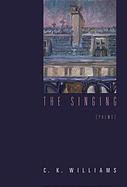
The Singing

by C.K. Williams

I was walking home down a hill near our house
on a balmy afternoon
under the blossoms
Of the pear trees that go flamboyantly mad here
every spring with
their burgeoning forth

When a young man turned in from a corner singing
no it was more of
a cadenced shouting
Most of which I couldn't catch I thought because
the young man was
black speaking black

It didn't matter I could tell he was making his
song up which pleased
me he was nice-looking
Husky dressed in some style of big pants obviously
full of himself
hence his lyrical flowing over

We went along in the same direction then he noticed
me there almost
beside him and "Big"
He shouted-sang "Big" and I thought how droll
to have my height
incorporated in his song

So I smiled but the face of the young man showed nothing
he looked
in fact pointedly away
And his song changed "I'm not a nice person"
he chanted "I'm not
I'm not a nice person"

No menace was meant I gathered no particular threat
but he did want
to be certain I knew
That if my smile implied I conceived of anything like concord
between us I should forget it

That's all nothing else happened his song became
indecipherable to
me again he arrived
Where he was going a house where a girl in braids
waited for him on
the porch that was all

No one saw no one heard all the unasked and
unanswered questions
were left where they were
It occurred to me to sing back "I'm not a nice
person either" but I
couldn't come up with a tune

Besides I wouldn't have meant it nor he have believed
it both of us
knew just where we were
In the duet we composed the equation we made
the conventions to
which we were condemned

Sometimes it feels even when no one is there that
someone something
is watching and listening
Someone to rectify redo remake this time again though
no one saw nor
heard no one was there

* * *

“The most interesting thing about a poem is that it doesn't exist until it has its music. Every poem has a music. And until it has that, it's not a poem. It's just information or data that's floating around in your head or on your desk.” – C.K. Williams

Tuesday, October 02, 2007

He Wasn't Free at All

Joyce Johnson spoke with Terry Gross back in June 2001 when her book, Door Wide Open: A Beat Love Affair in Letters came out in paperback. She was in a relationship with Jack Kerouac during the time that On the Road was published. Her insights into him and how the success of the book changed him really rang true, and I think about her comments whenever his writing is brought up as it has been recently with the 50th anniversary of its publication (such as today's New York Times editorial by David Brooks). Joyce, whose memoir is titled Minor Characters, was airbrushed out of the photo that Gap used several years ago for an ad featuring Kerouac.

TG: You say in your book that you had to protect your memories from being swamped by Jack Kerouac’s legend. What are some parts of the legend that don’t fit with your memories?

JJ: Well, the idea that Jack was such a free spirit, mainly, a big example of freedom or that he was this great Buddhist. Those things. Because although he certainly did go on the road, deep inside him he wasn’t free at all. He was so knotted up and so miserable and so attached to his mother. Buddhism was something that was very important to Jack. It was one of those things he looked to, to find some solution to what troubled him. But he really misused it. Even though he had a profound intellectual understanding of it, he used Buddhism to sort of rationalize all his problems—what was the point of dealing with them since we’re all going to die anyway?

Sunday, September 30, 2007

Writing for Whatever Audience is Left


From Stephen King's essay in The New York Times Book Review (9/30), "What Ails the Short Story?":

We could argue all day about the reasons for fiction’s out-migration from the eye-level shelves — people have. We could marvel over the fact that Britney Spears is available at every checkout, while an American talent like William Gay or Randy DeVita or Eileen Pollack or Aryn Kyle (all of whom were among my final picks) labors in relative obscurity. We could, but let’s not. It’s almost beside the point, and besides — it hurts.

Instead, let us consider what the bottom shelf does to writers who still care, sometimes passionately, about the short story. What happens when he or she realizes that his or her audience is shrinking almost daily? Well, if the writer is worth his or her salt, he or she continues on nevertheless, because it’s what God or genetics (possibly they are the same) has decreed, or out of sheer stubbornness, or maybe because it’s such a kick to spin tales. Possibly a combination. And all that’s good.

What’s not so good is that writers write for whatever audience is left. In too many cases, that audience happens to consist of other writers and would-be writers who are reading the various literary magazines (and The New Yorker, of course, the holy grail of the young fiction writer) not to be entertained but to get an idea of what sells there. And this kind of reading isn’t real reading, the kind where you just can’t wait to find out what happens next (think “Youth,” by Joseph Conrad, or “Big Blonde,” by Dorothy Parker). It’s more like copping-a-feel reading. There’s something yucky about it.

The Border

"It is so easy to conjure permanence....when the alarm goes off in the morning, one is already forced to jump into the dream that is reality, the dream of affection and accountability, the dream that leads to the ultimate Other...To begin to know this is to begin a journey toward awareness, the border of personal power."


- Bruce Wagner, "The Art of Reality," Tricycle: The Buddhist Review, Fall 2007

Friday, September 28, 2007

118 Project

Here is a rap video produced by the Swiss fire department to counter confusion over updated directory assistance phone numbers which are similar to the department's emergency number.

Thursday, September 27, 2007

Fuerzabruta

"We want to break intellectual submission of the language. To use all the resources that prepare themselves to operate efficiently over the sensibility of the spectator. Bringing them to other territories where other, more powerful laws exist. A space where the pressure of the senses affect the mind. Where the speed of the stimuli that the spectator receives, supersedes the intellectual reaction. The the emotion arrives before, always before."

"That hits the body, beneath the clothes. Behind the eyes. Within. A space where the spectator gives itself to, knowing that he forms part of an artistic event, that is inside a parallel reality, etherea, beautiful, delirious and absolutely more truthful than the day to day. Where the spectator knows he is being driven to smash against his own sensibility. A sensibility collective and universal."

Running Man

Under Water

Tuesday, September 25, 2007

Book Autopsies

"Brian Dettmer carves into books revealing the artwork inside, creating complex layered three-dimensional sculptures."


We Do Not See

"When one door closes, another opens; but we often look so long and so regretfully upon the closed door that we do not see the one which has opened for us."

- Alexander Graham Bell

[Thanks Vicky!]

Saturday, September 22, 2007

A Single, Readable Page

In the documentary No End in Sight, Robert Hutchings, the Chairman of the National Intelligence Council from 2003 to 2005 recalls that President Bush dismissed his agency's Report on the State of the Insurgency in Iraq as mere guesswork. "The President hadn't read it, not even the one-page summary over which we worked so hard to reduce these findings to a single, readable page."

Friday, September 21, 2007

Hastings-on-Hudson

When clouds of spring scud by on windy tide
Like old Dutch sloops beneath the Palisades;
When robin sings from memory, and beside
The house lost fragrance stirs in leafy shades;
Then on a ramble memory goes
To Ravensdale and Uniontown,
To high Mt. Hope, steep Pinecrest,
To Edgars Lane, Villard Estates,
Three Island Pond and Indian Rock;
The VFW, Warburton Bridge,
Reynolds Field and the Aqueduct,
To old Southside and Tower Ridge,
To Billie Burke’s and Draper Park.

Say the word and you are there; each scene
Clear in recall, more clear by nature’s art
When Spring, the mountain-leaper, hangs her green
In all the winding bygones of my heart,
And lilac breathes to mind, how faint so ever,
A little village by the Hudson River.

-by Henry J. Scully

[Thanks to my friend Carolyn who sent me this sweet,
nostalgic poem written by her 84-year-old brother-in-law.]

Let Your Characters Do The Suffering

From Catching the Big Fish: meditation, consciousness, and creativity by David Lynch:

It’s good for the artist to understand conflict and stress. Those things can give you ideas. But I guarantee you, if you have enough stress, you won’t be able to create. And if you have enough conflict, it will just get in the way of your creativity. You can understand conflict, but you don’t have to live with it.

In stories, in the worlds that we can go into, there’s suffering, confusion, darkness, tension, and anger. There are murders; there’s all kinds of stuff. But the filmmaker doesn’t have to be suffering to show suffering. You can show it, show the human condition, show conflicts and contrasts, but you don’t have to go through that yourself. You are the orchestrator of it, but you’re not in it. Let your characters do the suffering.

Wednesday, September 19, 2007

When Someone Deeply Listens To You

by John Fox, from Poetic Medicine: The Healing Art of Poem Making

When someone deeply listens to you
it is like holding out a dented cup
you've had since childhood
and watching it fill up with
cold, fresh water.
When it balances on top of the brim,
you are understood.
When it overflows and touches your skin,
you are loved.

When someone deeply listens to you
the room where you stay
starts a new life
and the place where you wrote
your first poem
begins to glow in your mind's eye.
It is as if gold has been discovered!

When someone deeply listens to you
your bare feet are on the earth
and a beloved land that seemed distant
is now at home within you.

Tuesday, September 18, 2007

This Is What Practicing Is All About

"After you lose some great passion in your life, or a dream that you've had collapses, it often takes a really long time before you can come to terms with what that loss meant to you... This is what practicing is all about. You're striving for some unattainable goal. And consequently every day you are going to end up not achieving what you dream of and, yet, the next day somehow you start again. And try again. And the fact that you don't achieve what you dream of each time you sit down is what leads you forward and makes you continue.

And I think it's true for anything. It doesn't matter if it's music or dance or acting or an art form or baking a cake or parenting even. I think this idea of practice means that you come back to it--almost no matter what happens."

--Glenn Kurtz, classical guitar player and author of Practicing: A Musician's Return to Music

Check out his playlist on Paper Cuts.

[Quote found on Jonathan Carroll's blog]

Gossip

"Every Sunday afternoon throughout my childhood, our considerably extended family -- my grandfather was one of nineteen children -- met at my grandparents' apartment for a dinner of pot roast, brown potatoes, and string beans...And when the meal was over and the dishes cleared, and Memere's sons-in-law had drifted to the parlor to watch the Red Sox blow a five-run lead to the Yankees, and the children went outside to play in the driveway, then someone perked a pot of coffee, set the sugar bowl and the can of condensed milk on the table, dealt the ashtrays to the aunts, and then we all sat around the kitchen and talked about the family and the neighbors...Gossip, I loved it. And that turns out to be the writer's job: to attend to the gossip and spread it as far as you can. At the heart of all good fiction and at the heart of all good gossip is the same thing: trouble. If you think about it, fiction is nothing more than gossip about the people you've made up."

Words

"All I know is what I have words for."

-- Ludwig Wittgenstein

Monday, September 17, 2007

To See Takes Time

“In a way, nobody sees a flower, really, it is so small, we haven’t the time – and to see takes time, like to have a friend takes time.”

Georgia O’Keefe

The Dhamma Brothers

"In 2002, Donaldson Correctional Facility [near Birmingham, Alabama] became the first maximum-security prison in North America to hold an extended Vipassana retreat, an emotionally and physically demanding course of silent meditation lasting ten days. The Dhamma Brothers tells a dramatic tale of human potential and transformation as it closely follows and documents the stories of 36 prison inmates who enter this arduous and intensive program. It challenges assumptions about the nature of prisons as places of punishment rather than rehabilitation and raises the question: is it possible for these men, some of who have committed horrendous crimes, to change?"

Wednesday, September 12, 2007

Librophiliac Love Letter

"Everyone has some kind of place that makes them feel transported to a magical realm. For some people it's castles with their noble history and crumbling towers. For others it's abandoned factories, ivy choked, a sense of foreboding around every corner. For us here at Curious Expeditions, there has always been something about libraries. Row after row, shelf after shelf, there is nothing more magical than a beautiful old library."

Abbey Library St. Gallen, Switzerland

A Compendium of Beautiful Libraries


Sing

The Dresden Dolls
Brechtian Punk Cabaret

Monday, September 10, 2007

Rocket Science

"Life is not easy for teenager Hal Hefner. His parents have split, his older brother is an obsessive-compulsive and he has an unpredictable stutter. Given that his active mind and quick wit tend to be obscured by his problematic voice, Hal is not an obvious candidate for his school's high-powered debate team. So when the star of debate team, Ginny Ryerson, asks him to be her partner, Hal rises to the occasion, and in doing so he scores a victory that has nothing to do with winning a debate, but everything to do with finding his voice."

A Keeper

The Book of Hours
by Joyce Sutphen

There was that one hour sometime
in the middle of the last century.
It was autumn, and I was in my father's
woods building a house out of branches
and the leaves that were falling like
thousands of letters from the sky.

And there was that hour in Central Park
in the middle of the seventies.
We were sitting on a blanket, listening
to Pete Seeger singing "This land is
your land, this land is my land," and
the Vietnam War was finally over.

I would definitely include an hour
spent in one of the galleries of the
Tate Britain, looking up at thepainting of King Cophetua and
the Beggar Maid, and, afterwards
the walk along the Thames, and

I would also include one of those
hours when I woke in the night and
couldn't get back to sleep thinking
about how nothing I thought was going
to happen happened the way I expected,
and things I never expected to happen did—

just like that hour today, when we saw
the dog running along the busy road,
and we stopped and held on to her
until her owner came along and brought
her home—that was an hour well
spent. Yes, that was a keeper.


[Thanks Kit!]

Sunday, September 09, 2007

What an Artist Does is Fail

"Let me point out, if it has escaped your notice, that what an artist does is fail. Any reading of the literature (I mean the theory of artistic creation), however summary, will persuade you instantly that the paradigmatic artistic experience is that of failure. The actualization fails to meet, equal, the intuition. There is something 'out there' which cannot be brought 'here.' This is standard. I don't mean bad artists, I mean good artists. There is no such thing as a 'successful artist' (except, of course, in worldly terms)."

--From "The Sandman" by Donald Barthelme


[Thanks Tammy!]

To Be the Best in the World at Something

Seth Gordon discussing his debut documentary, The King of Kong: A Fistful of Quarters, on KCRW's The Treatment.

"Twin Galaxies, which became sort of the governing body of classic arcade records, make it their business to verify whether or not a score is legit or not. And they spend the next twenty some years determining whether scores when they are submitted are any good. And the one score that never gets challenged in all these years is Donkey Kong, the one that sort of started it all. Until a substitute middle school science teacher who has just been laid off from Boeing was bored and got himself a Donkey Kong for his garage and, without realizing it, was setting record scores all by himself."


Check out Seth Gordon's short film, Fears of a Clown, which explores a clown's childhood fears.

Thursday, September 06, 2007

A Mind That Becomes Rigid

From Practicing Peace in Times of War by Pema Chödrön:

I remember reading once about a peace march. When one group was coming back from the march, some pro-war people started cutting them off and blocking them; everyone started screaming and hitting each other. I thought, "Wait a minute, is there something wrong with this picture? Clobbering people with your peace sign?"

The next time you get angry, check out your righteous indignation, check out your fundamentalism that supports your hatred of this person, because this one really is bad--this politician, that leader, those heads of big companies. Or maybe it's rage at an individual who has harmed you personally or harmed your loved ones. A fundamentalist mind is a mind that becomes rigid. First the heart closes, then the mind becomes hardened into a view, then you can justify your hatred of another human being because of what they represent and what they say and do.

Wednesday, September 05, 2007

Not Intent On Arriving

Here are a couple of fun travel web pages:

  • Matador is "a place to share travel stories & photos, meet people in the places you're going, get info and advice from experts, become a paid travel writer, collaborate with local organizations, and get inspired everyday with articles about sustainability and world culture."
  • CouchSurfing is "a worldwide network for making connections between travelers and the local communities they visit."

"A good traveler has no fixed plans, and is not intent on arriving."
-- Lao Tzu