
Common Sense, Dancing
"Common sense and a sense of humor are the same thing, moving at different speeds. A sense of humor is just common sense, dancing."
- William James



"Common sense and a sense of humor are the same thing, moving at different speeds. A sense of humor is just common sense, dancing."
- William James
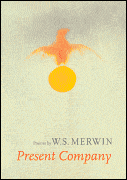 To Waiting
You spend so much of your time
expecting to become
someone else
always someone
different to whom a moment
whatever moment it may be
at last has come
and who has been
met and transformed
into no longer being you
and so has forgotten you
meanwhile in your life
you hardly notice
the world around you
lights changing
sirens dying along the buildings
your eyes intent
on a sight you do not see yet
not yet there
as long as you
are only yourself
with whom as you
recall you were
never happy
to be left alone for long
- by W.S. Mervwin from Present Company (KCRW Bookworm)
From the Brazen Careerist
Richard Florida, professor at George Mason University in Virginia and author of "The Rise of the Creative Class," summarized conclusions from a recent summit of the mavens of the economic development and the psychology of happiness: "Place is as important as having a job that challenges you, but not as important as relationships with family and friends."
- Penelope Trunk
A man strolled around the North Market balancing a cardboard box on his head. His wife walked beside him and their baby was strapped to his front like a tiny tandem skydiver. Shoppers were doing double takes, their faces lighting up as they tracked the moving stage he was creating with each relaxed and alert step. There were bumper stickers on the box: I ♥ YOGA and We had our baby at home. His wife caught me staring and winked at me for smiling at her husband’s little hobby.
 French novelist Jules Renard published his journal in 1925. In an introduction to his own journal, A Writer's Notebook, Somerset Maugham says of Renard's, "The journal is wonderfully good reading. It is extremely amusing. It is witty and subtle and often wise... Jules Renard jotted down neat retorts and clever phrases, epigrams, things seen, the sayings of people and the look of them, descriptions of scenery, effects of sunshine and shadow, everything, in short, that could be of use to him when he sat down to write for publication."
 It's the birthday of the poet Vachel Lindsey, born in Springfield, Illinois (1879). His parents wanted him to become a doctor, but he dropped out of medical school after three years and tried to make a living drawing pictures and writing poetry. After struggling for several years and working for a time in the toy department of Marshall Fields, he decided to walk across the United States, trading his poems and pictures for food and shelter along the way.
Then in 1913, Poetry magazine published Lindsay's poem "General William Booth Enters into Heaven," and it was a big hit. He became one of the leaders of the movement to revive poetry as an oral rather than a written art form, and he spent much of the rest of his life traveling around the country, reciting his work for audiences.
The Writer's Almanac
From The Psychology of Taste, and Choice by Alain De Botton
It’s hard not to be mystified by the taste of others. No wonder the Romans coined the expression de gustibus non est disputandum - tastes are not to be disputed.
But I think you can make some generalizations about how taste works. I think we’re drawn to call something beautiful whenever we detect that it contains, in a concentrated form, those qualities in which we personally, or our society’s more generally, are deficient.
You’ll call a nearly blank canvas beautiful when your own life is slightly messy and your city chaotic. We call good taste, a style which can move us away from what we fear and towards what we crave. A style which carries a correct dosage of our missing virtues.
Viewed in this light, a given stylistic choice will tell us as much about what someone lacks inside as what he or she likes.
Unforeseen
by Reid Bush
Before we buried him, no one thought
to trace around his hand.
It would have been an easy thing to do
if you could stand his fingers cold, stiff:
just a piece of paper underneathand pen or pencil.
I don't think there's anybody
could half imagine in a million years
how much since he died we've argued
over just how big his hands were.
It's hard to know when you need to
what it is you're going to want.
[from Jonathan Carroll's blog]
"What would it be like if you didn't measure the success of your life just by what you get and don't get, but gave equal or greater priority to how aligned you are with your deepest values?"
- Phillip Moffitt
"Instead of writing around a problem, always write into the problem.”
- Paul Haggis
 "You can ask me anything you want about acting and I will try and answer. But if what you want to know about is fame and celebrity, then I can't help you. Because the whole celebrity thing has no content to it. It's not valuable, it's not meaningful, it's not anything. It's not real."
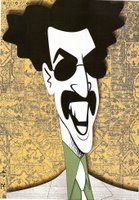 Were you wondering how Sacha Baron Cohen get all of those people to embarrass themselves in his movie? Like rodeo director, Bobby Rowe, who recommends that Borat shave his mustache so that he wouldn't look quite so Muslim and make people nervous about whether he's got explosives strapped to his body. Rowe also responds to Borat's claim that back in his country they put gays in prison and hang them saying, "That's what we're trying to do over here."
After Borat praises Bush's "war of terror" and works the crowd up with images of the president of the United States drinking "the blood of every single man, woman, and child in Iraq," he butchers the national anthem so badly that they finally turn on him.
Rowe told Newsweek, "I go out there, and I say, 'Get the hell outta this dadgum building! Half the sumbucks in here are probably packin' heat, and they'll put you in front of the firin' squad.' Boy, they got in their trucks and hauled boogie."
With a budget of $18 million, Borat made $26.5 million in its opening weekend earning the highest wide release opening gross for a film showing on under 1,100 screens.
Metacritic reviews of Borat
 "Blind to the mind's true nature, we hold fast to our thoughts, which are nothing but manifestations of that nature. This freezes awareness into solid concepts, such as I and other, desirable and detestable, and plenty of others...Once you have recognized the true nature of reality, which is empty and at the same time appears as the phenomenal world, your mind will cease to be under the power of delusion. If you know how to leave your thoughts free to dissolve by themselves as they arise, they will cross your mind as a bird crosses the sky -- without leaving any trace."
Dilgo Khyentse Rinpoche (1910-1991)
 What I like about the era I am writing about, meaning 1958 to 1972, is that the anti-Communism mandate justified virtually any kind of clandestine activity. I like exploring the mind-set of extreme expediency.
What about more contemporary forms of expediency, like the anti-terrorism measures practiced by the Bush administration?
I do not follow contemporary politics. I live in a vacuum. I don’t read books. I don’t read newspapers. I do not own a TV set or a cellphone or a computer. I spend my evenings alone, usually lying in the dark talking to women who aren’t in the room with me.
You mean they’re on the phone?
No. They’re metaphysical. I brood. I brood about former women in my life. Potential future women in my life. I ignore the culture. I don’t want it to impede, impair, interdict, suppress or subsume my imagination with extraneous influences.
Is this an act? Are you trying to pass yourself off as the sort of isolated sociopath who is a stock character in crime fiction?
No. I am not acting. There are times when I think it isn’t quite kosher to be lying in the dark talking to women who aren’t in the room with me. And it turns into a certain kind of hauntedness and loneliness. But by and large, I dig it.
You’re oddly cheerful for a self-described hermit.
I am happy by and large. I work hard. And I love life. I am having a blast.
- Deborah Solomon, New York Times Magazine, November 5, 2006
From THE WEEK MAGAZINE, November 10, 2006
Dilbert cartoonist Scott Adams has made a miraculous recovery from a strange disease called Spasmodic Dysphonia that made it impossible for him to talk normally for more than a year. SD, which affects some 30,000 Americans, affects the portion of the brain that controls speech. Sufferers typically cannot speak at all unless reciting poetry, laughing, or using an exaggerated falsetto or baritone. Most patients never recover, but Adams' voice returned to him suddenly while he was chanting "Jack Be Nimble" as an exercise. "I don't even know if my voice is going to last," he said. "Maybe this is an illusion. It came back, but in a few days it could go away again forever."
From a December 2005 entry posted on the Dilbert blog
It’s bad enough to find out that I’ll probably never speak normally to another person for the rest of my life. But to make things worse, my notorious cleverness makes people think I’m joking when I explain it. The following scene has been played out about 100 times in the past week.
Me (hoarse whisper): “Hi. How…are…you?”
Other Person: “Ooh, sounds like you have laryngitis”
Me (hoarse whisper): “No…it’s a… speaking disorder. It’s.. permanent.”
Other Person: “Ha Ha Ha Ha! You’re funny.”
Droplets
by C.K. Williams, from Love About Love
Even when the rain falls relatively hard,
only one leaf at a time of the little tree
you planted on the balcony last year,
then another leaf at its time, and one more,
is set trembling by the constant droplets,
but the rain, the clouds flocked over the city,
you at the piano inside, your hesitant music
mingling with the din of the downpour,
the gush of rivulets loosed from the eaves,
the iron railings and flowing gutters,
all of it fuses in me with such intensity
that I can't help wondering why my longing
to live forever has so abated that it hardly
comes to me anymore, and never as it did,
as regret for what I might not live to live,
but rather as a layering of instants like this,
transient as the mist drawn from the rooftops,
yet emphatic as any note of the nocturne
you practice, and, the storm faltering, fading
into its own radiant passing, you practice again.
 Check out Toni Collette's new CD, Beautiful Awkward Pictures. You can hear the songs at her web page and watch a video of the title song at YouTube. I read that is was only being released in Australia, but I downloaded it from iTunes.
I found some information about her singing background. She has been singing since she was 14: school musicals, the lead in a big musical production celebrating the bicentennial, advertising jingles, musicals in Sydney and on Broadway. She's been writing songs for about ten years.
Her husband, Dave Galafassi, is the drummer in her band.

I've been streaming the new Damien Rice CD, 9, and checking out the video clips while I wait to download it when it's available on iTunes.
I'm especially enjoying 9 crimes, rootless tree, dogs, grey room, and accidental babies. That's one of the things I admire about him. He seems to approach a project as a whole instead of putting out a couple of strong songs with a bunch that have been phoned in. It is sweet with intense sections. The trip from spare and simple to complex and powerful within one song seems to be his trademark.
If the woman he is singing to in accidental babies is a real person, I feel for her. I feel even worse for the guy Damien argues that she has settled for. He's not one to quickly extinguish a flame just because the relationship is over.
I love this from dogs:
She lives with an orange tree and a girl that does yoga. She picks her dead ones from the ground when we come over. And she gives - I get without giving anything - to me like a morning sun.

Daron Larson
Freelance Contemplative



