Monday, April 12, 2010

Both the Problem and the Solution

Listen to this short, remarkable story about a clever strategy which a nursing home in Düsseldorf, Germany came up with to address the problem of disoriented residents wandering away.

“It’s like another thought comes up and you forget what you wanted. It’s like fishes coming up to the surface of the water and then going down again. Thoughts come up and they disappear and you don’t know that they have ever been there. You forget.”

~ Richard Neureither (translated by Regine Hauch) for “The Bus Stop,” by Lulu Miller, Radiolab, March 23, 2010

Pressure
by Company of Thieves

I'm angry all the time
No one's fault but mine
Tell me how you fashion kind
When you're out of style

And I try hard to answer
All the questions that you've posed
Tell me now how should I care
When I feel so alone
And so unloved

The pressure is rising
I mean it, it's binding
I've been compromising for you

When you come home really late at night
Ripe to pick a fight
I know just the kind you'd like
So come on and bite

And I try hard to answer
All the punches that you throw
Tell me now how should I fair
When I feel so unloved and so alone

The pressure is rising
I mean it, it's binding
I've been compromising for you

The pressure is rising
I've been compromising for you
I'm waiting at the bus stop in the morning
And it's pouring

Oh, I am waiting at the bust stop for you
Staring at walls with closed doors
The key that won't work
Sure helps the time pass by
Saying I'm wrong when I'm wrong
Knowing it's the right thing
Sure helps the thoughts in my mind

The pressure is rising
I mean it, it's binding
I've been compromising for you
You, you

I am waiting at the bus stop
In the morning
And it's boring

Pressure
by Company of Thieves

I'm angry all the time
No one's fault but mine
Tell me how you fashion kind
When you're out of style

And I try hard to answer
All the questions that you've posed
Tell me now how should I care
When I feel so alone
And so unloved

The pressure is rising
I mean it, it's binding
I've been compromising for you

When you come home really late at night
Ripe to pick a fight
I know just the kind you'd like
So come on and bite

And I try hard to answer
All the punches that you throw
Tell me now how should I fair
When I feel so unloved and so alone

The pressure is rising
I mean it, it's binding
I've been compromising for you

The pressure is rising
I've been compromising for you
I'm waiting at the bus stop in the morning
And it's pouring

Oh, I am waiting at the bust stop for you
Staring at walls with closed doors
The key that won't work
Sure helps the time pass by
Saying I'm wrong when I'm wrong
Knowing it's the right thing
Sure helps the thoughts in my mind

The pressure is rising
I mean it, it's binding
I've been compromising for you
You, you

I am waiting at the bus stop
In the morning
And it's boring

Stillness at Birdcall

Grailville Retreat Center in Loveland, Ohio

Ornithology in a World of Flux
by Robert Penn Warren, from The Collected Poems of Robert Penn Warren

It was only a bird call at evening,
unidentified,
As I came from the spring with water,
Across the rocky back-pasture;
But I stood so still sky above was
not stiller than sky in pale-water.
Years past, all places and faces
fade, some people have died,
And I stand in a far land, the evening
still, and am at last sure
That I miss more that stillness at
birdcall than some things that
were to fail later.

[Thanks Rebecca Bradshaw!]

Sunday, April 11, 2010

Counting Loved Ones

Conception Abbey in Conception, Missouri Photo by Donna Forgey used with permission.

A Remedy for Insomnia
by Vera Pavlova, number 66 in the hundred poems that make up her collection If There Is Something To Desire

Not sheep coming down the hills,
not cracks on the ceiling—
count the ones you loved,
the former tenants of dreams
who would keep you awake,
once meant the world to you,
rocked you in their arms,
those who loved you . . .
You will fall asleep, by dawn, in tears.


“The only thing I hope for is that, regardless of what the outward world is for different people, different nations, I hope their internal world is similar. And if I, hopefully, have managed to somehow describe my inner world in this book, all I count on is that it will have some resonance among the American readers, or, at the very least, the American readers will treat this book as a kind of a guidebook for my inner world, strange as it may appear.”

~ Vera Pavlova

Friday, April 09, 2010

Going Down the Road

“"Oh, there's many a time you're just going down the road at O-dark-thirty in the morning and you just start thinking about a particular pattern."

~ Long-haul trucker Dave White, on his newfound passion for quilting, “Idle Pastime: In Off Hours, Truckers Pick Up Stitching,” Wall Street Journal, March 29, 2010


[Thanks Kit!]

Thursday, April 08, 2010

Tip Me Over, Pour Me Out

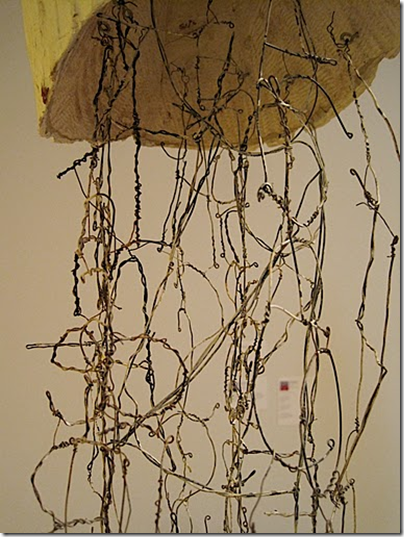
My friend Dōshin Owen spotted this compelling piece by Lesley Dill at the Kemper Museum of Modern Art recently.

Poem Spill, 1995
paint, plaster, collage, wire and wood

Photo by Dōshin Owen

Here’s a description from Voices in My Head, a 1995 exhibit of works by Lesley Dill: “The exhibition [consisted] of large—12 feet long—hanging cloths of muslin or gauze, each silkscreened with an image of a figure or part of a figure. The surface is stained with tea, paint and varnish, and in most cases collaged with pieces of cloth, stitched with thread, or even burned. Fragments of Emily Dickinson's poems are painted directly on the figure, or are stamped on or below the images, even cut out of the cloth. The inspiration for this series are the Buddhist prayer flags that captivated Dill during her stays in India and Nepal. These flags, pieces of cloth on which prayers have been printed, are hung, sometimes in great numbers, outside of temples or in sacred places to blow in the wind. Used to convey prayers, they are imbued with a powerful sense of spirituality.”

Photo by Dōshin Owen

One need not be a Chamber — to be Haunted —
One need not be a House —
The Brain has Corridors — surpassing
Material Place —

Far safer, of a Midnight Meeting
External Ghost
Than its interior Confronting —
That Cooler Host.

Far safer, through an Abbey gallop,
The Stones a'chase —
Than Unarmed, one's a'self encounter —
In lonesome Place —

Ourself behind ourself, concealed —
Should startle most —
Assassin hid in our Apartment
Be Horror's least.

The Body — borrows a Revolver —
He bolts the Door —
O'erlooking a superior spectre —
Or More —

Making Time

Excerpts from “Time Lost and Found,” by Anne Lamott, Sunset:

Anne Lamott, photographed for Sunset by James Hall I sometimes teach classes on writing, during which I tell my students every single thing I know about the craft and habit. This takes approximately 45 minutes. I begin with my core belief—and the foundation of almost all wisdom traditions—that there is nothing you can buy, achieve, own, or rent that can fill up that hunger inside for a sense of fulfillment and wonder. But the good news is that creative expression, whether that means writing, dancing, bird-watching, or cooking, can give a person almost everything that he or she has been searching for: enlivenment, peace, meaning, and the incalculable wealth of time spent quietly in beauty.

Then I bring up the bad news: You have to make time to do this.

…I know how addictive busyness and mania are. But I ask them whether, if their children grow up to become adults who spend this one precious life in a spin of multitasking, stress, and achievement, and then work out four times a week, will they be pleased that their kids also pursued this kind of whirlwind life?

If not, if they want much more for their kids, lives well spent in hard work and savoring all that is lovely, why are they living this manic way?

…Time is not free—that’s why it’s so precious and worth fighting for.

Will they give me one hour of housecleaning in exchange for the poetry reading? Or wash the car just one time a month, for the turtles? No? I understand. But at 80, will they be proud that they spent their lives keeping their houses cleaner than anyone else in the family did, except for mad Aunt Beth, who had the vapors? Or that they kept their car polished to a high sheen that made the neighbors quiver with jealousy? Or worked their fingers to the bone providing a high quality of life, but maybe accidentally forgot to be deeply and truly present for their kids, and now their grandchildren?

I think it’s going to hurt. What fills us is real, sweet, dopey, funny life.

I’ve heard it said that every day you need half an hour of quiet time for yourself, or your Self, unless you’re incredibly busy and stressed, in which case you need an hour. I promise you, it is there. Fight tooth and nail to find time, to make it. It is our true wealth, this moment, this hour, this day.

Read the entire article…

[Thanks Kit!]

Wednesday, April 07, 2010

Wider and Deeper

“In Zen literature the word intimacy is often used as a synonym for enlightenment. In the classical Zen enlightenment stories, a monk or a nun is reduced simultaneously to tears and laughter as he or she suddenly recognizes that nothing in this world is separate, that each and every thing, including one’s own self, is nothing but the whole, and that the whole is nothing but the self. What are such stories telling us if not that love is much wider and deeper than an emotion? Love is the fruition of, the true shape of, one’s self and all that is.”

~ Norman Fischer, from Taking Our Places

Life in Itself is Nothing

April 2010

Spring
by Edna St. Vincent Millay, from Millay: Poems (Everyman's Library Pocket Poets)

To what purpose, April, do you return again?
Beauty is not enough.
You can no longer quiet me with the redness
Of little leaves opening stickily
I know what I know.
The sun is hot on my neck as I observe
The spikes of the crocus.
The smell of the earth is good.
It is apparent that there is no death
But what does that signify?
Not only under the ground are the brains of men
Eaten by maggots.
Life in itself
Is nothing,
An empty cup, a flight of uncarpeted stairs.
It is not enough that yearly, down this hill,
April
Comes like an idiot, babbling and strewing flowers.

Monday, April 05, 2010

Seeing Each Other

Abramovic, left, with Karen Dorothee Peters. Photo by Joshua Bright for The New York Times. The Artist is Present

“Time was passing, but I couldn’t tell…The overwhelming feeling I had was that you think you can understand a person just by looking at them, but when you look at them over a long period of time, you understand how impossible that is. I felt connected, but I don’t know how far the connection goes…We insulate ourselves in New York City. Everyone goes around with headphones. It’s one of the fantastic things about New York: you can be near all these people, and still be in your own head.”

~ Dan Visel, on sitting across a table from artist Marina Abramovic, from “Confronting a Stranger, for Art,” by Jim Dwyer, New York Times, April 2, 2010

[Thanks Matt!]

Sunday, April 04, 2010

From the Beginning

Ab Ovo
by Joseph Brodsky, from So Forth

Ultimately, there should be a language
in which the word "egg" is reduced to O
entirely. The Italian comes the closest,
naturally, with its uova. That's why Alighieri thought
it the healthiest food, sharing the predilection
with sopranos and tenors whose pear-like torsos
in the final analysis embody "opera."
eggsThe same pertains to the truly Romantic, that is,
German poets, with practically every line
starting the way they'd begin a breakfast,
or to the equally cocky mathematicians
brooding over their regularly laid infinity,
whose immaculate zeros won't ever hatch.

Saturday, April 03, 2010

Poetry Blows the Roof Off at CIFF


From “Louder Than a Film Festival,” by Clint O’Connor, The Plain Dealer (March 29, 2010):

Poetry, let alone high school poetry, is not supposed to outshine flashy films from around the globe. But "Louder Than a Bomb," a documentary about the inspiring teens of a huge poetry slam in Chicago, thrilled the audiences and judges at the 34th Cleveland International Film Festival.

The movie, which had its world premiere here, won both the Roxanne T. Mueller Audience Choice Award for best film, and the Greg Gund Memorial Standing Up Film Competition, which honors movies about social justice and activism, and includes a $5,000 prize for co-directors Jon Siskel and Greg Jacobs.

More…

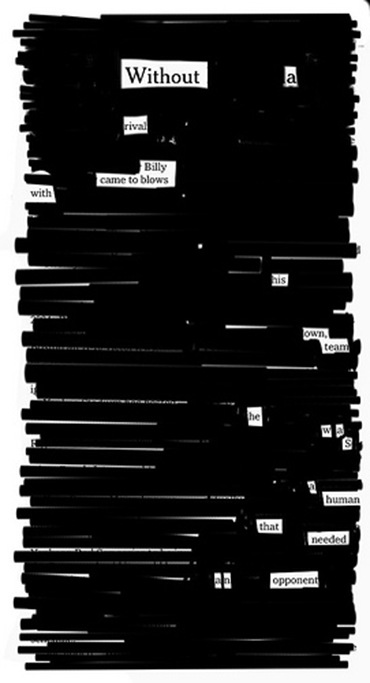
First Real Blackout Poem on the iPad

by Austin Kleon

@largeheartedboy

From Next to Next

Satellites
by Dan Chiasson, from Where's the Moon, There's the Moon

5. Next

If you can orbit the planet, why can't you see
what makes the human heart happy?
Is it art or is it sex?
Or is it, as I suspect, just keeping going

from next thing to next thing
to next thing to next thing
to next to next to next to next
pulsating stupidly to outlast time?

Friday, April 02, 2010

Ism After Ism

Poems should be more like essays and essays should be more like poems.

~ Charles Olson

Two of every sort shall thou bring into the Ark.

~ Genesis

*     *     *

Religion
by Stephen Dunn, from Riffs and Reciprocities: Prose Pairs

Riffs & Reciprocities: Prose Pairs First, it was more about mystery than about trying to get us to behave. Whichever, we’re still in some lonely cave, not far from that moment a lightning storm or a sunset drove us to invent the upper reaches of the sky. Religion is proof that a good story, we'll-told, is a powerful thing. Proof, too, that terror makes fabulists of us all. We’re pitiful, finally, and so oddly valiant. The dead god rising into ism after ism—that longing for coherence that keeps us, if not naive, historically challenged. To love Christ you must love the Buddha, to love Mohammed or Moses you must love Confucius and, say Schopenhauer and Nietzsche as well. They were all wise and unsponsored and insufficient, some of the best of us. I’m saying this to myself: the sacred cannot be found unless you give up some old version of it. And when you do, mon semblable, mon frère, I swear there’ll be an emptiness it’ll take a lifetime to fill. Indulge, become capacious, give up nothing, Jack my corner grocer said. He was pushing the portobellos, but I was listening with that other, my neediest ear.

Thursday, April 01, 2010

The Uncovering of Language to Its Sacred Condition

“I do feel that images are gifts. I don’t know if they create the soul, but they certainly reveal it. The image is a revelation of sorts, therefore apocalyptic as opposed to ecliptic. While eclipses cover, an apocalypse is an uncovering. The writing of a poem is the uncovering of language to its sacred condition. Many people who don’t write poetry think that poetry is prettified language. But poetry undresses language down to its manifold meaning. I keep imagining the body of God naked, radiating meaning and significance and voice; somehow we cover it, and dress it up so it becomes prose. And I feel like images come from the body; it’s kind of a body wisdom. ”

~ Li-Young Lee, from “Poems from God,” by Amy Pence, Poets & Writers, November/December 2001 (subscription required)

* * *

To Life
by Li-Young Lee, from Behind My Eyes: Poems

Behind My Eyes: Poems Who hasn’t thought, “Take me with you,”
hearing the wind go by?
And finding himself left behind, resumed
his own true version of time
on earth, a seed fallen here to die
and be born a thing promised
in the one dream
every cell of him has dreamed headlong
since infancy, every common minute has served.
Born twice, he has two mothers, one who dies, and one
the mortar in which he’s tried. His double
nature cleaves his eye, splits his voice.
So if you hear him say, while he sits at the bed
of one mother, “Take me home,”
listen closer. To Life,
he says, “Keep me at heart.”


Tearing the Page
by Li-Young Lee

Every wise child is sad.

Every prince, is a member of the grass.

Each bud opening opens on the unforeseen.

Every wind-strewn flower is God tearing God.

And the stars are leaves
blown across my grandmother’s lap.
Or the dew multiplying.

And of time’s many hands, who can tell
the bloody from the perfumed,

the ones that stitch
from the ones that rip.

Every laughing child is forgetful.
Every solitary child rules the universe.

And the child who can’t sleep
learns to count, a patient child.

And the child who counts negotiates
between limit and longing,
infinity and subtraction.

Every child who listens
all night to the wind eventually

knows his breathing turns a wheel
pouring time and dream to leave no trace.

Though he can’t tell what a minute weighs,
or is an hour too little or too long.

As old as night itself,
he’s not old enough in the morning
to heat his milk on the stove.

But he knows about good-byes.
Some of them, anyway. The good-bye
at the door each morning, a kiss for a kiss.
The good-bye at bedtime,
stories and songs until it’s safe to close his eyes.

And maybe he’s even heard about the waiting room
at Union Station, where dust and echoes climb
to the great skylights

accompanied by farewells
of the now-going, to join the distant
farewells of the long gone,

while a voice announces the departure
of the Twentieth Century for all points West.

Yes, every wise child is heart-broken.
A sorrowing pip,

he knows the play
he’s called away from each evening
is the beginning and end of order
in a human household.

He’s sure his humming to himself
and his rising and falling ball are appointed
by ancient laws his own heart-tides obey.

But he can’t tell anybody what he knows.

Old enough to knot his shoelaces,
he’s not old enough to unknot them.

Old enough to pray, he doesn’t always
know who to pray to.

Old enough to know to close the window
when it storms, old enough to know the rain,
given the chance, would fall on him,

and darken him, and darken him, the way
he himself colors the figures
he draws, pressing so hard he tears the page.

Wednesday, March 31, 2010

Something More than Mere Survival

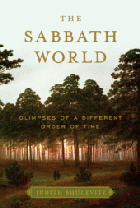
Judith Shulevitz, from “Making Room For The Sabbath,” a conversation with Terry Gross about her book, The Sabbath World: Glimpses of a Different Order of Time:

The Sabbath World I was fascinated by rules. I sensed that one of the things about my life that I didn't like is that I was a kind of knee-jerk libertarian. Nobody could tell me what to do. But that's not how life works in a society. Societies have rules and we keep them. We don't object to the ones we all keep because we all keep them together. We object to the new ones that don't seem familiar to us. And I wanted to get familiar with these rules because it seemed to me that rules are how society passes on from one generation to the next moral behavior and moral activity and its idea of how life should be shaped and life should be led. And I wanted to get to know what these rules had to say to me...

The basic principle uniting all these rules is that you as a human being should not be exerting mastery over the world. For one day a week, let the world be as it is and you be in it and you're not trying to dominate it. That's the basic principle. Now the form that the rules took when they were first thought up was agricultural because they were conceived of in an agricultural society. And there's something to me very beautiful about this because not only were they conceived in an agricultural society, they were conceived of in a mainly subsistence farming society. So people were being asked not to bring in the crops. They were being asked not to do basic labors which would have helped them survive and they had to transfer that work of surviving to six days a week. And it had to have been very, very hard because we know how hard it is to survive when you're living off the land. And that to me gives me a sense of the seriousness with which it was taken and the beauty of the idea. Imagine telling people who are struggling to barely survive that one day a week they must give themselves over to something more than mere survival -- and they have the right to even if circumstances dictate otherwise. Those two things are very beautiful to me...

The thing that was most intriguing to me when I was working on the book and remains most intriguing to me, is as a fundamental political idea. And it's an idea that we've really lost in America today, though I think we've had it in the history and, indeed, I try to make the case that we were really one of the most Sabbatarian nations when we were founded by the Puritans. (Sabbatarian meaning keeping the Sabbath.) But this is an idea that we have really moved radically away from. And the idea is this: that as a society we have the right to collectively regulate our time and that everyone has the right not to work at least one day a week. You have to imagine a world in which this idea was conceived of and codified. This had never been said before.

[Thanks Tammy!]

Tuesday, March 30, 2010

Preparing for Things that Matter Most

“Most people vastly overestimate the extent to which more money would improve our lives. Most schools and colleges spend too much time preparing students for careers and not enough preparing them to make social decisions. Most governments release a ton of data on economic trends but not enough on trust and other social conditions. In short, modern societies have developed vast institutions oriented around the things that are easy to count, not around the things that matter most. They have an affinity for material concerns and a primordial fear of moral and social ones…Governments keep initiating policies they think will produce prosperity, only to get sacked, time and again, from their spiritual blind side.”

~ David Brooks, from “The Sandra Bullock Trade,” New York Times (March 29, 2010)

To Practice Hope

Chosen Blindness
by Mary Karr, from Viper Rum

1.

Viper RumI was blind to flowers for one thing.
Picture a meadow stitched with dandelion,
those seed stalks whose tall white heads

poke up like ancestral ghosts
(pale auroras of wisdom), but profligate,
the fluff shot through with brown seeds

that others might follow. I never saw it,
just fixed on my own death, sat on the sofa
ingesting poison, looked out

at the rectangular field as if it were a postcard
from some foreign land, useless, already cancelled.
I sucked streams of gray smoke down my lungs

to blacken me deeper. The embroidery sampler I did in x’s
read BAD NEWS. The butterless popcorn I ate
was a bowl full of spiders. Skinny?

My skeleton forced itself forward. No word
of praise passed my lips though a million breaths
moved through me. That’s what human bodies do, keep

breathing, no matter the venom their brains manufacture.

2.

Now I go to church. Who’d think it?
We stand in rows, like graves, I’d once have thought,
like herd beasts lined up for slaughter. Now I notice

our bodies bend in the same places. We form the same angles.
To sing together, we have to breathe in unison,
draw the same air into the dark meat of our bodies

as if it actually were spiritu sancti and ourselves
that spirit incarnate. Every now and then,
a toddler bolts up the main aisle, pursued

by a lumbering adult. Babies list
in sloping arms and toothless grin.
The old lean on canes

and chrome walkers set down slow. People
pause to let them pass. Always a list of dead is read,
always the sick are mentioned so your own aches

seem aggressively minor. My forebears
forebore this way, in company. Bread fed them,
and they had to practice hope to keep

plowing up the Dust Bowl’s
starved earth in rows, year
after fruitless year, till the cotton came back.

3.

At the end of my drinking,
I coiled a garden hose in the back of my station wagon
and set off driving to a town

called Marblehead to breathe in the cool
exhaust and thus stop thoughts from streaming
through my mind like bad current.

I’d left my infant son a note, glowing green
on my computer screen, how he’d be
better off. Now a column of sun

through high windows shines
on his blond head. His hand
holds half our hymnal, index finger

underlining each word as we struggle
to match up our voices, hold the beat,
find the pattern emerging, feel the light

that glows in our chests, keep it going.

for Dev Milburn

Making Every Second Count


The Big C

See also: Laura Linney interviewed by Alec Baldwin, Studio 360

Monday, March 29, 2010

Scopophilia

Cleveland International Film Festival, March 27, 2010

We spent the weekend shoulder-to-shoulder with like-minded cinephiles, our collective gaze fixed on the lights flickering on the cave walls.

We watched a butcher in Jerusalem let trouble stir life into his cold bones, confining a nibble of vitality to be preserved forever in a meat locker and the icy waters of a nearby spring.

We watched Joseph Brodsky gazing back at the St. Petersburg of his youth: potatoes, paintings of nudes, shelves of books, his parents dancing after the war, an orchestra of musical instruments floating in the sky like clouds.

We watched a Croatian sniper try to dodge the trajectory of his own bullets while hunting down the traumatized Little Red Riding Hood he had fallen in love with through the scope of his rifle and nearly destroyed.

We watched a Mongolian folk singer search for the lyrics to a song hidden in the unrepeatable archives of fading human memory.

We watched Renaud Capuçon perform Gluck’s Orfeo Melody on a 1737 Guarnerius violin in the Paris subway from 7:57 a.m. to 7:57 p.m to mostly indifferent commuters a couple of days before playing the same piece to a sold-out auditorium in the Théâtre des Champs-Elysées. Our hearts were collectively broken until a blind woman renewed our hope by venturing as close as possible to warm herself in the glow.

We watched, Juan Pujol Garcia, a double agent from Spain and his contrived network of spies convince the Nazis to prepare for an attack on Pas de Calais as the Allied Forces stormed the beaches of Normandy.

We watched art collectors, dealers, galleries, and auction houses enthusiastically inflate the value of contemporary art to staggering and unsustainable heights through secrecy, speculation, tax strategies, and cornering markets.


Cleveland International Film Festival

Friday, March 26, 2010

We’ve Seen it All Before

Excerpt from the introduction of Taking Our Places: The Buddhist Path to Truly Growing Up by Norman Fischer:

Taking Our Places Another characteristic of maturity — one that any of us would mention — is experience. A grown-up is someone who is experienced and, through having lived long enough to have seen many things, has a point of view and a measure of savvy about how life works. There is certainly no substitute for the experience that accumulates as the years go by, but it is also possible to be alive for a long time and not really experience our living, not really see our life. The human capacity for self-deception and blindness runs deep. We may be alive, but we have not necessarily lived. If we accumulate experiences without really engaging with them, then our experience tends to make us stodgy and boring. As we catalog and define our experiences, possessing them without ever really being possessed by them, we begin to expect that new situations will just be repetitions of old ones. Soon we feel as if we’ve seen it all before. We know what to expect. Our point of view gradually becomes a set of blinders rather than a searching flashlight.

But if we pay close and open attention to our experiences, life’s larger patterns begin to come into view. We see that all things are transitory and unique. Nothing repeats. We understand that, though always instructive, the past can never tell us what the future will be. Within the larger pattern that experience reveals, there are endless variations. Insofar as we see this, our experience increases our wonder at and appreciation of all that happens. With little life experience, we might be naively excited by the novelty of a person we meet or an event that occurs. But when we truly appreciate our experience, we respond to that newness with a deeper understanding of its meaning and wonder as we relate it to what we have seen before. Far from dampening our sense of wonder, real experience refreshes and mellows it.

Wednesday, March 24, 2010

The Language of Individual Freedom

Excerpt from “The Broken Society,” by David Brooks, New York Times (March 18, 2010):

Phillip Blond argues that over the past generation we have witnessed two revolutions, both of which liberated the individual and decimated local associations. First, there was a revolution from the left: a cultural revolution that displaced traditional manners and mores; a legal revolution that emphasized individual rights instead of responsibilities; a welfare revolution in which social workers displaced mutual aid societies and self-organized associations.

Then there was the market revolution from the right. In the age of deregulation, giant chains like Wal-Mart decimated local shop owners. Global financial markets took over small banks, so that the local knowledge of a town banker was replaced by a manic herd of traders thousands of miles away. Unions withered.

The two revolutions talked the language of individual freedom, but they perversely ended up creating greater centralization. They created an atomized, segmented society and then the state had to come in and attempt to repair the damage.

The free-market revolution didn’t create the pluralistic decentralized economy. It created a centralized financial monoculture, which requires a gigantic government to audit its activities. The effort to liberate individuals from repressive social constraints didn’t produce a flowering of freedom; it weakened families, increased out-of-wedlock births and turned neighbors into strangers. In Britain, you get a country with rising crime, and, as a result, four million security cameras.

More…

[Thanks Suzanne!]

Tuesday, March 23, 2010

Why It Takes All Day

Silk Parachute “On a sentence-by-sentence level, it’s more spontaneous. In other words, I know what I want to have said when I’m finished with this writing, but I really don’t know, when I’m down to the nub of it to address it, what’s going to happen. I mean I know where it should go, but it certainly isn’t — the phraseology — is not prefabricated and that’s why it takes me all day to get one sentence written.”

~ John McPhee, discussing his writing process and his new collection of essays, Silk Parachute, with Michael Silverblatt on KCRW’s Bookworm (March 18, 2010).

Rambling Man


Rambling Man by Laura Marling from her new album, I Speak Because I Can. She will perform at the Wexner Center on May 5, 2010.

Enchanted by the Trick and the Story

How the Puppets from Fantastic Mr. Fox Were Made [Slide Show] by Julian Sancton, Vanity Fair, 11.23.2009

Wes Anderson discussing the appeal of stop-motion animation with Michael Specter from The Making of Fantastic Mr. Fox: A Film by Wes Anderson Based on the Book by Roald Dahl:

The thing I’ve always loved with stop-motion, more than anything else, is puppets that have fur, and actually not only that. I also like the fighting skeletons in, maybe it’s Jason and the Argonauts, or maybe it’s one of the Sinbad movies where they have the fighting skeletons. But I have always like — I love the way King Kong, the old King Kong, looked, with his fur – the animators call it “boiling.” And for some reason, the whole magical aspect of stop-motion was one of those things where you can see the trick — I mean, you know the Cocteau movies? The visual effects in Beauty and the Beast, for instance, are things where you can really see that a person is behind this wall sticking their arm through it, holding a torch, and the film is running backwards, and so that is how this light is coming on, or the mirror is actually water. You know, those kinds of effects, where you can see what it is, have always been the most fascinating and mesmerizing and moving to me. And with stop-motion, the whole film is that sort of thing in a way, to my mind. So I guess, to the degree that that makes any sense, that’s more or less where it comes from for me. That magical effect where you can see how it is accomplished — where at one and the same time you are enchanted by the trick to the effect and by the story itself. I have no idea why this concept means so much to me.

Monday, March 22, 2010

The Evil of Not Doing Anything

Hokai Sobol in conversation with Terry Patten from “Can Dharma Help us Turn the Corner?”, Buddhist Geeks Podcast #163 (March 15, 2010):

Originally, Dharma, meaning all traditional spirituality, in this case…All the great spiritual traditions have appeared in a world where human culture, because of technological reasons, first of all, and because of limited number of humans at the time, did not have the power to threaten the world. To threaten the natural world, to threaten the limits of the resources in the world, to threaten each other. Many cultures existed in spatial isolation, or distanced enough from each other to feel safe, which is now an impossibility. We can’t even plan to achieve that in the future because we’re going in the opposite direction. We’re not just closing on each other, we’re mixing up to an incredible degree all over the world.

So, basically, Dharma appeared in a situation where warnings and instructions on the importance of digging into the fundamentals of human culture and working to transform the culture, not the individual mind, was extremely important. So, that type of instruction couldn’t even appear at that time. Because if you simply practice non-violence, meaning if you did nothing wrong to anyone, there was nothing that could go much wrong on its own accord. But, at this moment, in human history, if you just passively don’t do anything wrong, this may be the greatest evil. Because if you’re capable of not doing anything wrong, then you are one of rare humans who are extremely equipped of doing a lot of good. And if you don’t contribute that good, a certain destructive or a certain skeptical or a certain small-hearted attitude may prevail in the world. Thus, allowing the culture, equipped with an incredible technology now, to actually wreck havoc all around us. We can see traces of this havoc already taking place, right?

More…

A Global Water Cooler

Excerpt from “Texts Without Context,” by Michiko Kakutani, New York Times (March 17, 2010):

Today's technology has bestowed miracles of access and convenience upon millions of people, and it’s also proven to be a vital new means of communication. Twitter has been used by Iranian dissidents; text messaging and social networking Web sites have been used to help coordinate humanitarian aid in Haiti; YouTube has been used by professors to teach math and chemistry. But technology is also turning us into a global water-cooler culture, with millions of people sending each other (via e-mail, text messages, tweets, YouTube links) gossip, rumors and the sort of amusing-entertaining-weird anecdotes and photographs they might once have shared with pals over a coffee break. And in an effort to collect valuable eyeballs and clicks, media outlets are increasingly pandering to that impulse — often at the expense of hard news. “I have the theory that news is now driven not by editors who know anything,” the comedian and commentator Bill Maher recently observed. “I think it’s driven by people who are” slacking off at work and “surfing the Internet.” He added, “It’s like a country run by ‘America’s Funniest Home Videos.’ ”

Sunday, March 21, 2010

Nature Guards Its Secrets

Spring Equinox 2010

Look Again
by Sarah Lindsay, from Twigs and Knucklebones 

I know how little I know
from observation:
that the dog sleeping on the rug
with pure concentration
will be sleeping, each time I look up,
in a different direction,

that five wart-lidded mushrooms
can form on the lawn
in the time rain takes
to shift from falling to fallen,

that my eyes are too slow
to track shooting stars, too quick
to spy continental drift,
and Earth conceals its spin
by spinning me with it,

that a tree won’t let me
see its growth, only its height,
that hairs on my head go singly gray
only by night. 

Opening to Sounds

“Everything supports wakefulness if you are willing to let yourself be awakened by tenderly yet consistently connecting though your senses. Everything. But it requires a brave heart, and a mind that sees the folly in clinging…to anything.

As an experiment, see if you can be here in the pure awareness of hearing, surrendering over and over, again and again, to a hearing that is always happening without your having to do anything or exert yourself at all…opening to sounds and the spaces between them, and to the silence lying inside, underneath, and in between all sound.”

~ Jon Kabat-Zinn, from Arriving at Your Own Door: 108 Lessons in Mindfulness

That Spark Will Never Be a Commodity

Excerpt from “America’s Real Dream Team,” by Thomas L. Friedman, New York Times (March 21, 2010):

Photo by Felipe T. Marques In today’s wired world, the most important economic competition is no longer between countries or companies. The most important economic competition is actually between you and your own imagination. Because what your kids imagine, they can now act on farther, faster, cheaper than ever before — as individuals. Today, just about everything is becoming a commodity, except imagination, except the ability to spark new ideas.

If I just have the spark of an idea now, I can get a designer in Taiwan to design it. I can get a factory in China to produce a prototype. I can get a factory in Vietnam to mass manufacture it. I can use Amazon.com to handle fulfillment. I can use freelancer.com to find someone to do my logo and manage by backroom. And I can do all this at incredibly low prices. The one thing that is not a commodity and never will be is that spark of an idea.

[See also: Outliers: The Story of Success by Malcolm Gladwell and The Genius in All of Us: Why Everything You've Been Told About Genetics, Talent, and IQ Is Wrong by David Shenk]

The Shrine Down the Hall

“Seven years after the beginning of the Iraq war — and with U.S.troop deaths in Iraq and Afghanistan exceeding 5,000 — a look at some of the bedrooms America’s young war dead left behind.”

Ashley Gilbertson/VII Network, for The New York Times

FIRST LT. BRIAN N. BRADSHAW, ARMY Killed June 25, 2009, Kheyl, Afghanistan; roadside bomb. AGE: 24 HOMETOWN: Steilacoom, Wash.

From the New York Time Sunday Magazine.

Saturday, March 20, 2010

A Clock in the Zendo

time ticks
     mind tocks

life gestates
     heart narrates

soul flows
     self knows

ruts in the road
     slowly erode

Speak Up

truth

@JSCarroll

Friday, March 19, 2010

Listen and Watch

Untitled #15,  2006
 Pigment Print
 
© Mikhail Baryshnikov
Courtesy Edwynn Houk Gallery, New York“It’s said that to understand a people you don’t need to speak their language, you just listen to their music and watch them move.”

~ Mikhail Baryshnikov, “Notes on Design,” from the Spring 2010 issue of Zoetrope: All-Story

[See also: Merce My Way]

Thursday, March 18, 2010

You Can Read Me Anything


The Book of Love
by Stephin Merritt (The Magnetic Fields), covered by Nataly Dawn (Pomplamoose)

The book of love is long and boring
No one can lift the damn thing
It's full of charts and facts and figures and instructions for dancing
But I
I love it when you read to me
And you
You can read me anything
The book of love has music in it
In fact that's where music comes from
Some of it is just transcendental
Some of it is just really dumb
But I
I love it when you sing to me
And you
You can sing me anything
The book of love is long and boring
And written very long ago
It's full of flowers and heart-shaped boxes
And things we're all too young to know
But I
I love it when you give me things
And you
You ought to give me wedding rings
And I
I love it when you give me things
And you
You ought to give me wedding rings
And I
I love it when you give me things
And you
You ought to give me wedding rings

Less Small Talk

Excerpt from “Talk Deeply, Be Happy?” by Roni Caryn Rabin, New York Times (March 17, 2010):

…people who spend more of their day having deep discussions and less time engaging in small talk seem to be happier, said Matthias Mehl, a psychologist at the University of Arizona who published a study on the subject.

“We found this so interesting, because it could have gone the other way — it could have been, ‘Don’t worry, be happy’ — as long as you surf on the shallow level of life you’re happy, and if you go into the existential depths you’ll be unhappy,” Dr. Mehl said.

But, he proposed, substantive conversation seemed to hold the key to happiness for two main reasons: both because human beings are driven to find and create meaning in their lives, and because we are social animals who want and need to connect with other people.

More…

Wednesday, March 17, 2010

Become What You Are

Excerpt from the introduction of Taking Our Places: The Buddhist Path to Truly Growing Up by Norman Fischer:

Time is strange. We live within it, depend on it, take it for granted, yet it relentlessly passes, and our lives slip through our fingers moment by moment. Where does time come from, and where does it go? How is it that every moment we are different, we grow, we develop, we are born, we die? What are we supposed to be doing with this life?

After many years of grappling with these questions during the course of my long spiritual journey, I have come to have a feeling for their answers. We don’t really know what appears, what time is, where it goes. But we are here to try to understand. And we all have our own way of understanding, and of expressing that understanding through the living of our lives.

Each of us has a place in this world. Taking that place, I have come to feel, is our real job as human beings. We are not generic people, we are individuals, and when we appreciate that fact completely and allow ourselves to embrace it and grow into it fully, we see that taking our unique place in this world is the one thing that gives us a sense of ultimate fulfillment.

Bantu tribesmen, it is said, sneak into the rooms of their children as they sleep and whisper in their ears, “Become what you are.”

To take our place is to mature, to grow into what we are. Mostly we take maturity for granted, as if it were something that comes quite naturally and completely as our bodies grow and our minds and hearts fill up with life experience. In fact, however, few of us are truly mature individuals; few of us really occupy our places. We are merely living out a dream of maturity, a set of received notions and images that passes for adulthood. What does it really mean to grow up? How do we do the work that will nurture a truly mature heart from which can flow healing words and deeds? Each of our lives depends on our undertaking the exploration that these questions urge us toward. And the mystery is that the whole world depends on each of us to take this human journey.

With Liberty and Justice for Many

“I accept this award on behalf of those who have been struck down, beaten up, and — instead of attention and praise — have gotten only intolerance, violence, or — even worse — indifference.”

~ Will Phillips, accepting the award for Outstanding TV Journalism Segment at the 21st Annual GLAAD Media Awards in New York on March 13, 2010.


Phillips appeared in the award winning segment "Why Will Won't Pledge Allegiance" from CNN's American Morning on November 16, 2009.

Both Respect and Imagination

Excerpt from the preface of From Disgust to Humanity: Sexual Orientation and Constitutional Law (Inalienable Rights) by Martha Nussbaum:

Today, large segments of the Christian Right openly practice a politics based upon disgust. Depicting the sexual practices of lesbians and, especially, of gay men as vile and revolting, they suggest that such practices contaminate and defile society, producing decay and degeneration…Although the influence of such appeals peaked, perhaps, in the 1980s and 1990s, and has since been declining, the politics of disgust continues to exercise influence, often in more subtle and unstated ways. We need, then, to understand why it is not a good approach to politics and law in a democratic society.

The politics of disgust is profoundly at odds with the abstract idea of a society based on the equality of all citizens, in which all have a right to the equal protection of the laws. It says that the mere fact that you happen to make me want to vomit is reason enough for me to treat you as a social pariah, denying you some of your most basic entitlements as a citizen.

…the politics of disgust is alive and well in America today, as many groups aggressively depict same-sex practices in such a way as to arouse disgust and then draw on that reaction when campaigning against the legalization of same-sex marriage, or nondiscrimination laws. Such appeals are often seen as not politically correct today, so other arguments are increasingly put forward. Disgust, however, has not gone away. We still need to understand its force, and why arguments based upon it are bad political arguments. A closer study of the emotion of disgust and the ways in which it has been used politically through history will suggest some powerful arguments against disgust’s apostles in theory and in practice, by showing how that emotion expresses a universal human discomfort with bodily reality, but then uses that discomfort to target and subordinate vulnerable minorities.

…Disgust relies on moral obtuseness. It is possible to view another human being as a slimy slug or a piece of revolting trash only if one has never made a serious good-faith attempt to see the world through that person’s eyes or to experience that person’s feelings. Disgust imputes to the other a subhuman nature. How, by contrast, do we ever become able to see one another as human? Only through the exercise of imagination. Humanity does not automatically reveal itself to strangers. No placard hung on the front of a fellow citizen announces that this one is a full-fledged human being. Seeing the shape of a human being before us, we always have choices to make: will we impute full equal humanity to that shape, or something less? Only by imagining how the world looks through that person’s eyes does one get to the point of seeing the other person as a someone and not a something. (Sadly, racial minorities have long been seen as somethings rather than someones, and women are all too frequently so seen today, given the ever-present phenomenon of sexual “object-ification,” in which a person is treated as a mere thing.) That crucial imaginative engagement has been sadly and sorely lacking in majority dealings with lesbians and gay lives…

The politics of humanity, as I shall use the term, includes respect. But respect, as usually conceived, is not sufficient for it: something else, something closer to love, must also be involved. First of all, we are unlikely to achieve full respect for one another unless we can do something else first – see the other as a center of perception, emotion, and reason, rather than an inert object. Put that way, it might appear that this imaginative and emotional attitude is a mere instrument to a respect that might be arrived at by some other route. However, respect without this attitude is certainly no a complete basis for political action in a diverse society: for only imagination animates the cold and abstract categories of morality and law, turning them into the ways we can live together. So, respect is politically incomplete without imagination.

One may, however, make a stronger claim, and I shall defend this claim: the capacity for imaginative and emotional participation in the lives of others is an essential ingredient of any respect worthy of the name. Only this capacity makes real an ability that is a key part of respect, the ability to see the other as an end, not as a mere means. The politics of humanity includes, then, both respect and imagination, and imagination understood as an ingredient essential to respect itself.

Monday, March 15, 2010

A Real Fortune-Teller Knows

Excerpt from Noah’s Compass by Anne Tyler:

“I mean, your left hand is your whole entire past! I wonder if one of my books deals with this.”

“If it’s my past, why do we care?” Liam asked. “We just want to know about my future?

“Oh, you can’t read one without the other,” Esther Jo told him. “They’re intermingled. They bounce off of each other. That’s what the amateurs fail to understand.”

She released his hands with a dismissive little pat that gave Liam a sense of rejection, absurdly enough.

“Let’s see if I can explain this,” she said. “You know how farmers can predict what kind of winter they’ll have by looking at the acorns and berries? Those acorns and berries are the way they are because of what has gone before — how much rainfall there’s been and et cetera, et cetera. A whole lot depends on the weather that’s already happened. And the farmers know that.”

She gave him a quick, self-confirming nod.

“We, just the same way, a real fortune-teller — and I’m not one to brag, but I am a real fortune-teller; I’ve just always had the gift, somehow — a real fortune-teller knows that your future depends on your past. It keeps shifting about; it’s not carved in stone. It keeps bouncing off whatever happened earlier. So, no, I can’t do a thing without seeing what’s in your left palm.”

Sunday, March 14, 2010

Not as Good as the Needle

“Sugar pills, injections of nothing -- studies show that, more often than you'd expect, placebos really work. At TEDMED, magician Eric Mead does a trick to prove that, even when you know something's not real, you can still react as powerfully as if it is.”