Paradise

“Paradise may be the time when we finally turn to our past and see that its beauty was there despite our being there. In fact, its beauty can finally be seen because we aren't there.”




“Paradise may be the time when we finally turn to our past and see that its beauty was there despite our being there. In fact, its beauty can finally be seen because we aren't there.”
Excerpt from “Alive Enough?” on Being, April 7, 2011:

Sherry Turkle (author of Alone Together): Well, I think in my case the question didn't come from a spiritual quest. It came from a deeply personal psychological quest. My father — my biological father disappeared from my life when I was around two. My mother, my grandparents, my mother's sister, my aunt, didn't want me to know anything about him. And so, of course, I only wanted to know things about him and would search…
There were these places. There was a closet that had old books and trinkets and there was a junk drawer. There were just these places where the memories were kept. I would scour them for traces of him and finally I found one. I found a photograph of him in which 
As I became a sociologist, [I discovered] there's a fancy word for studying this; it's called bricolage. It's the science of studying meanings and the interplay of objects, and I realized that that's kind of what I'd been doing all the time. A little bit like Molière's, Monsieur Jourdain who'd been speaking prose all his life without knowing it, I'd been a bricoleur all my life without knowing it.
* * * * *
To make our life livable, we have to have spaces where we are fully present to each other or to ourselves, where we're not competing with the roar of the Internet and, quite frankly, where the people around us are not competing with the latest news off the Facebook status update. They may not have anything new. They may just be there being in a way that needs attention. I mean, people like to put things on Facebook--and certainly Twitter--that are happy. I've interviewed people who say things to me as simple as, you know, I don't even like to put that my dog died...because it doesn't seem the place. It doesn't seem the place for a lot of people to share negative things.
Anyway, I guess I'm saying that sacred space [are] the places in your daily life where you want to keep them for yourself and the people who you need to give your full attention to. I have very simple rules — so far as I have rules — for how to know you're close to one or in one or should be having one: it's dinner, it's sharing meals with your family, it's that moment at school pickup when your kid looks up and is trying to meet your eye. You know, you're looking down at your smartphone and your child is trying to meet your eye.

* * * * *
See also: “Brainpower,” To the Best of Our Knowledge, 4/10/11
"You are seeing everything for the last time, and everything you see is gilded with goodbyes — the child's hand like a starfish on the pillow, your hand on the doorknob, the dachshund's lurching off the forbidden couch when you come through the door. . .
You are seeing everything for the last time — the room where for years Christmases have happened, snow falling so thick by the windows that sometimes it starts to snow in the room, Christmas brightness falling on tables, books, chairs. . .
You are seeing everything for the last time — the gaudy tree in the corner, the family sitting there snowbound, snow-blind to the crazy passing of what they think will never pass. . .
And now, today, everything will pass, because it is the last day. For the last time you are seeing the rain fall and, in your mind, that snow, the child asleep, the dog making sheepishly for his pillow by the radiator. . .
For the last time you are hearing the house come alive, because you who are part of this life have come alive to it. . .
All the unkept promises, if they are ever to be kept, have to be kept today.
All the unspoken words, if you do not speak them today, will never be spoken.
The people, the ones you love and the ones who bore you to death, all the life you have in you to live with them, if you do not live it with them today, will never be lived.
It is the first day, because it has never been before, and it is the last day, because it will never be again. Be alive, if you can, through today, this day of your life. Follow your feet. Put on the coffee. Start the orange juice, the bacon, the toast. Then go wake your children and think about the work of your hands. . ."
~ Frederick Buechner, from Listening to Your Life
See also: A PBS Profile of Frederick Buechner

Illustration by Peter Arkle for Newsweek
Excerpt from “Can You Build a Better Brain?” by Sharon Begley, Newsweek, Jan. 10 & 17, 2011:
The rule that “neurons that fire together, wire together” suggests that cognitive training should boost mental prowess. Studies are finding just that, but with a crucial caveat. Training your memory, reasoning, or speed of processing improves that skill, found a large government-sponsored study called ACTIVE. Unfortunately, there is no transfer: improving processing speed does not improve memory, and improving memory does not improve reasoning. Similarly, doing crossword puzzles will improve your ability to?.?.?.?do crosswords. “The research so far suggests that cognitive training benefits only the task used in training and does not generalize to other tasks,” says Columbia’s Yaakov Stern.
The holy grail of brain training is something that does transfer, and here there are three good candidates. The first is physical exercise. Simple aerobic exercise, such as walking 45 minutes a day three times a week, improves episodic memory and executive-control functions by about 20 percent, finds Art Kramer of the University of Illinois at Urbana-Champaign. His studies have mostly been done in older adults, so it’s possible the results apply only to people whose brain physiology has begun to deteriorate—except that that happens starting in our 20s. Exercise gooses the creation of new neurons in the region of the hippocampus that files away experiences and new knowledge. It also stimulates the production of neuron fertilizers such as BDNF, as well as of the neurotransmitters that carry brain signals, and of gray matter in the prefrontal cortex. Exercise stimulates the production of new synapses, the connections that constitute functional circuits and whose capacity and efficiency underlie superior intelligence. Kramer finds that a year of exercise can give a 70-year-old the connectivity of a 30-year-old, improving memory, planning, dealing with ambiguity, and multitasking. “You can think of fitness training as changing the molecular and cellular building blocks that underlie many cognitive skills,” he says. “It thus provides more generalizable benefits than specifically training memory or decision making.”
The second form of overall mental training is meditation, which can increase the thickness of regions that control attention and process sensory signals from the outside world. In a program that neuroscientist Amishi Jha of the University of Miami calls mindfulness-based mind-fitness training, participants build concentration by focusing on one object, such as a particular body sensation. The training, she says, has shown success in enhancing mental agility and attention “by changing brain structure and function so that brain processes are more efficient,” the quality associated with higher intelligence.
Finally, some videogames might improve general mental agility. Stern has trained older adults to play a complex computer-based action game called Space Fortress, which requires players to shoot missiles and destroy the fortress while protecting their spaceship against missiles and mines. “It requires motor control, visual search, working memory, long-term memory, and decision making,” he says. It also requires that elixir of neuroplasticity: attention, specifically the ability to control and switch attention among different tasks. “People get better on tests of memory, motor speed, visual-spatial skills, and tasks requiring cognitive flexibility,” says Stern. Kramer, too, finds that the strategy-heavy videogame Rise of Nations improves executive-control functions such as task switching, working memory, visual short-term memory, and reasoning in older adults.
Σώμα, θυμήσου όχι μόνο το πόσο αγαπήθηκες,
όχι μονάχα τα κρεββάτια όπου πλάγιασες,
αλλά κ’ εκείνες τες επιθυμίες που για σένα
γυάλιζαν μες στα μάτια φανερά,
κ’ ετρέμανε μες στην φωνή — και κάποιο
τυχαίον εμπόδιο τες ματαίωσε.
Τώρα που είναι όλα πια μέσα στο παρελθόν,
μοιάζει σχεδόν και στες επιθυμίες
εκείνες σαν να δόθηκες — πώς γυάλιζαν,
θυμήσου, μες στα μάτια που σε κύτταζαν·
πώς έτρεμαν μες στην φωνή, για σε, θυμήσου, σώμα.

Body, remember not just how much you were loved,
not simply those beds on which you have lain,
but also the desire for you that shone
plainly in the eyes that gazed at you,
and quavered in the voice for you, though
by some chance obstacle was finally forestalled.
Now that everything is finally in the past,
it seems as though you did yield to those desires —
how they shone, remember, in the eyes that gazed at you,
how they quavered in the voice for you — body, remember.
C. P. Cavafy, from Collected Poems: Bilingual Edition. Translated by Edmund Keeley and Philip Sherrard.
[Thanks, Jonathan Carroll!]
We die to each other daily.
What we know of other people
Is only our memory of the moments
During which we knew them. And they have changed since then.
To pretend that they and we are the same
Is a useful and convenient social convention
Which must sometimes broken. We must also remember
That at every meeting we are meeting a stranger.
~ T. S. Eliot, The Cocktail Party (1949)
“The song written by an Englishman about an American city whose promise of togetherness really yields loneliness sung by a white Parisian woman everyone thought was black.”
~ From “Pop Music: Songs that Cross Borders,” Radiolab, April 21, 2008
When you're alone and life is making you lonely
You can always go - downtown
When you've got worries, all the noise and the hurry
Seems to help, I know - downtown
Just listen to the music of the traffic in the city
Linger on the sidewalk where the neon signs are pretty
How can you lose?
The lights are much brighter there
You can forget all your troubles, forget all your cares
So go downtown, things'll be great when you're
Downtown - no finer place, for sure
Downtown - everything's waiting for you
Don't hang around and let your problems surround you
There are movie shows - downtown
Maybe you know some little places to go to
Where they never close - downtown
Just listen to the rhythm of a gentle bossa nova
You'll be dancing with him too before the night is over
Happy again
The lights are much brighter there
You can forget all your troubles, forget all your cares
So go downtown, where all the lights are bright
Downtown - waiting for you tonight
Downtown - you're gonna be all right now
[Instrumental break]
And you may find somebody kind to help and understand you
Someone who is just like you and needs a gentle hand to
Guide them along
So maybe I'll see you there
We can forget all our troubles, forget all our cares
So go downtown, things'll be great when you're
Downtown - don't wait a minute for
Downtown - everything's waiting for you
Downtown, downtown, downtown, downtown ...
* * * * *
Listen to the whole fascinating Radiolab episode:
Guilty of Dust
by Frank Bidart, from In the Western Night
up or down from the infinite C E N T E R
B R I M M I N G at the winking rim of time
the voice in my head said
LOVE IS THE DISTANCE
BETWEEN YOU AND WHAT YOU LOVE
WHAT YOU LOVE IS YOUR FATE
•
then I saw the parade of my loves
those PERFORMERS comics actors singers
forgetful of my very self so often I
desired to die to myself to live in them
then my PARENTS my FRIENDS the drained
SPECTRES once filled with my baffled infatuations
love and guilt and fury and
sweetness for whom
nail spirit yearning to the earth
•
then the voice in my head said
WHETHER YOU LOVE WHAT YOU LOVE
OR LIVE IN DIVIDED CEASELESS
REVOLT AGAINST IT
WHAT YOU LOVE IS YOUR FATE

Gap
by Gary Jackson
Every year, my mother reminds me
to place flowers on my sister’s grave.
On a Thursday, I buy red
and yellow carnations
and baby’s breath. I drive alone.
The oak that grows nearby
has branches low enough to bear
the graves’ shadows.
I do this
for all of us. My sister buried in Topeka.
My mother who left for Dallas. The boy
I used to be who still clings to the years between.
I swore long ago I would never come back.
My mother does not swear,
but bears the same memories that lie beneath
Kansan green, waiting to break open
like rain on concrete. So I become
her emissary. I shoulder her burden.
I drudge down familiar streets, careful
to avoid high school crushes,
teachers, bullies, cousins who never made it out
of the state they were born in.
By the time I’ve pulled onto 21st,
the black iron gates behind,
I think of how there is no real distance
between anything, how Kansas
is always a breath
away. It’s not the grave,
but the memory that pulls.
Robert Patterson, who has Alzheimer's disease, speaks with his wife, Karen, from StoryCorps:

Karen: You know how we talk sometimes about who we really are. What is our essence? Memories are not who you are.
Robert: Well, I think one thing I experience with Alzheimer's is I live in the moment ‘cause I can’t remember what happened yesterday—I can’t remember what happened ten minutes ago, but I’m much more present, I think.
Karen: Do you think about the future?
Robert: I know that there’s probably a bad time that comes in the future. This disease gets more wicked, but I don’t obsess on it. I do a nice job of ignoring it.
Karen: With this disease, you moved from somebody that lived in their head a lot to somebody who lived in their heart.
Robert: The head is an overstated organ; the heart is where all the action is. I remember things that occur in my heart much better than things in my head: having fun with the kids, laughing, our new grandchild.”
Karen: Speaking of this new grandchild, is there something you’d like him to know?
Robert: I would like him to know that I fell in love with him the first time I saw him in the hospital. And every time I see that sweet little face, it just makes me feel good. I’m looking forward to hanging with him and teaching him things that I think are really important. That’s my job for the rest of my life.
Karen: I don’t know if you even remember this, but once we were listening to a book on tape. It talked about the greatest thing you could do if you loved somebody, that you would be the one that was left. And that you would be the one that could care for your lover.
You are not alone. And I’m honored that I’m the one that can care for you. I always will.
Robert: You always have. Thank you.
“Making Sense of Life,” from September 11: Portraits of Grief:

"He was so proud of his big boy," recalled Mrs. Gallagher. Later that evening, at dinner with his brother and friends, he told them about the jaunt. "Isn't that what dads are supposed to do with their families on a beautiful September day?" he asked.
Mr. Gallagher, 31, stood 6 feet 3 inches tall and weighed around 270 pounds, but he had an extraordinary grace about him, his wife said. He never took anything for granted, perhaps because he lost his mother when he was 1 and his father six years later. He was born in the Bronx but he and his wife loved to travel. In 1999, Mr. Gallagher asked his future wife to marry him on a trip to Ireland. "He made my life make sense," Mrs. Gallagher said. "It's hard to make sense of things now that he's gone."

Airport
by W.S. Merwin, from The Rain in the Trees
None of the computers can say
how long it took to evolve a facility
devoted to absence in life
you walk out of the chute
and a person smiles at your ticket
and points you to your seat
is this the only way home
nobody asks
because nobody knows
the building is not inhabited it is not
home except to roaches
it is not loved it is serviced
it is not a place
but a container with signs
directing a process
there is neither youth in the air
nor earth under foot
there is a machine to announce
yet the corridors beat with anguish longing relief
news trash insurance dispensers
and many are glad to be here
thinking of being somewhere else
hurrying at great expense
across glass after glass
we travel far and fast
and as we pass through we forget
where we have been
"Danny Perasa and his wife, Annie, came to StoryCorps to recount their twenty-seven-year romance. As they remember their life together from their first date to Danny's final days with terminal cancer, these remarkable Brooklynites personify the eloquence, grace, and poetry that can be found in the voices of everyday people when we take the time to listen."
StoryCorps episodes, which have been animated by brothers Mike and Tim Rauch, will be shown on the PBS documentary series POV and can also be seen on the StoryCorps YouTube channel.
Simon Kilmurry, the executive director of American Documentary, which produces POV, told The New York Times, “The audio pieces are so wonderful, you pause and listen and let your imagination go. The challenge with the animation is to retain that intimacy and not let the animation get in the way of the story.”

“Attention is the holy grail. Everything that you’re conscious of, everything you let in, everything you remember and you forget, depends on it.”
~ University of Utah psychology professor David Strayer, from “Outdoors and Out of Reach, Studying the Brain,” by Matt Richtel, New York Times (August 15, 2010)
PS Dozens of people responded to New York Time’s challenge to try giving up technology and report back about the experience. Check out their stories at The Unplugged Challenge.
[Thanks, Kit!]
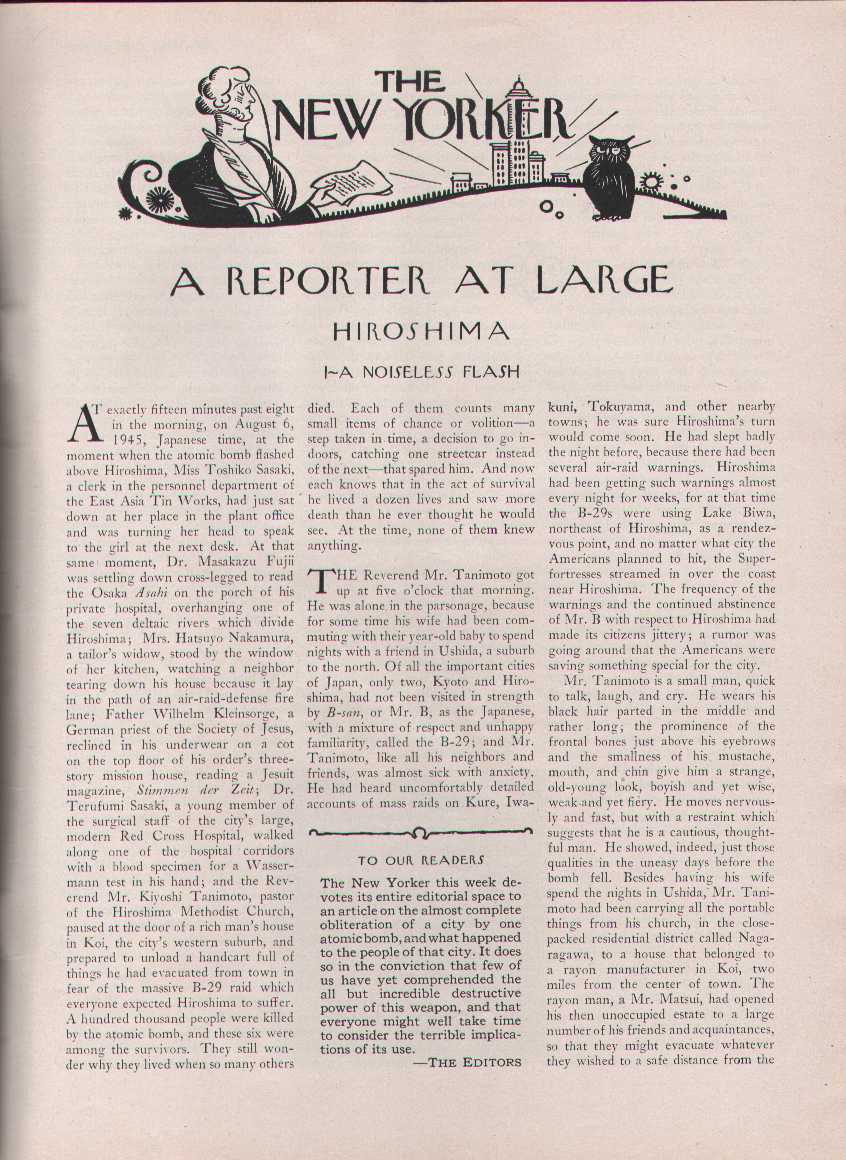
Excerpt from “The Publication of ‘Hiroshima’ in The New Yorker,” by Steve Rothman:

"Hiroshima" traced the experiences of six residents who survived the blast of August 6, 1945 at 8: 15 am. There was a personnel clerk, Miss Toshiko Sasaki; a physician, Dr. Masakazu Fujii; a tailor's widow with three small children, Mrs. Hatsuyo Nakamura; a German missionary priest, Father Wilhelm Kleinsorge; a young surgeon, Dr. Terufumi Sasaki; and a Methodist pastor, the Reverend Mr. Kiyoshi Tanimoto. The article told the story of their experiences, starting from when the six woke up that morning, to what they were doing the moment of the blast and the next few hours, continuing through the next several days and then ending with the situations of the six survivors several months later.
The article, written by John Hersey, created a blast of its own in the publishing world. The New Yorker sold out immediately, and requests for reprints poured in from all over the world. Following publication, "Hiroshima" was read on the radio in the United States and abroad. Other magazines reviewed the article and referred their readers to it. The Book-of-the-Month Club sent a copy of the article in book form to its entire membership as a free selection. Later that fall, "Hiroshima" was published as a book by Alfred A. Knopf and has remained in print ever since.
"Hiroshima" was not the first exposure that readers had to the events that took place on August 6. Many articles in the popular press described the destruction of the city, such as a Collier's story published in the spring of 1946 crammed full of details about the power of the atom bombs dropped on Hiroshima and Nagasaki ("at a distance of 4,200 feet—about eight tenths of a mile—the pressure was 2,160 pounds a square foot") and anecdotes about the horrific effects of nuclear weapons on human beings ("Men in black-striped shirts were burned in strips. Heat stenciled dress figures onto the bodies of women."). Collier's also included an artist's rendition of the effect of a nuclear blast on downtown Manhattan. But most of these stories steered clear of details that would help readers identify with the dead or the survivors. Usually, "the statistics of devastation and death were simply recited as prefatory to a plea for international control, civil defense, or some other cause. On a canvas whose broadbrush background scenes were already familiar, Hersey etched several vividly realized foreground figures.”
The direct effect of "Hiroshima" on the American public is difficult to gauge. No mass movement formed as a result of the article, no laws were passed, and reaction to the piece probably didn't have any specific impact on U.S. military strategy or foreign policy. But certainly the vivid depictions in the book must have been a strong contributor to a pervasive sense of dread (and guilt) about nuclear weaponry felt by many Americans ever since August 1945.

Fireflies
by Marilyn Kallet, from American Life in Poetry: Column 280
In the dry summer field at nightfall,
fireflies rise like sparks.
Imagine the presence of ghosts
flickering, the ghosts of young friends,
your father nearest in the distance.
This time they carry no sorrow,
no remorse, their presence is so light.
Childhood comes to you,
memories of your street in lamplight,
holding those last moments before bed,
capturing lightning-bugs,
with a blossom of the hand
letting them go. Lightness returns,
an airy motion over the ground
you remember from Ring Around the Rosie.
If you stay, the fireflies become fireflies
again, not part of your stories,
as unaware of you as sleep, being
beautiful and quiet all around you.
Rain
by Peter Everwine, from American Life in Poetry: Column278

and the pear tree at my window darkened,
I put down my book and stood at the open door,
the first raindrops gusting in the eaves,
a smell of wet clay in the wind.
Sixty years ago, lying beside my father,
half asleep, on a bed of pine boughs as rain
drummed against our tent, I heard
for the first time a loon’s sudden wail
drifting across that remote lake—
a loneliness like no other,
though what I heard as inconsolable
may have been only the sound of something
untamed and nameless
singing itself to the wilderness around it
and to us until we slept. And thinking of my father
and of good companions gone
into oblivion, I heard the steady sound of rain
and the soft lapping of water, and did not know
whether it was grief or joy or something other
that surged against my heart
and held me listening there so long and late.

Daron Larson
Freelance Contemplative