




Showing posts with label PBS. Show all posts
Showing posts with label PBS. Show all posts
Thursday, October 28, 2010

Tuesday, August 17, 2010
Animating without Getting in the Way
StoryCorps episodes, which have been animated by brothers Mike and Tim Rauch, will be shown on the PBS documentary series POV and can also be seen on the StoryCorps YouTube channel.
Simon Kilmurry, the executive director of American Documentary, which produces POV, told The New York Times, “The audio pieces are so wonderful, you pause and listen and let your imagination go. The challenge with the animation is to retain that intimacy and not let the animation get in the way of the story.”

- “The Stories Speak for Themselves, but Pictures Help,” by Elizabeth Jensen, New York Times, Aug. 13, 2010
- Listening Is an Act of Love: A Celebration of American Life from the StoryCorps Project
Wednesday, May 19, 2010
Hovering

“Biologist Doug Altshuler has turned his lab into a kind of hummingbird training center, where he can test the limits of their aerial agility. The key, he says, is hovering.”
From the Hummingbirds: Magic in the Air episode of PBS Nature
[Thanks Dōshin!]
Wednesday, February 03, 2010
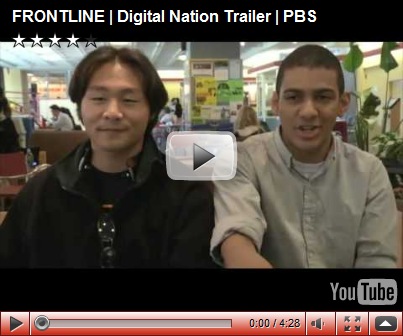
Short Attention Span Culture
tte
Visit the digital_nation site to learn more and about this program, watch it online, and join the conversation.
Tuesday, November 03, 2009
The Survival of the More Versatile
Dr. Rick Potts, from “The Adaptable Human,” NOVA, October 26, 2009:
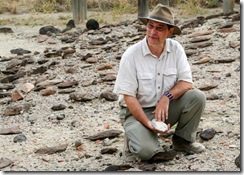
But when I began the work here at Olorgesailie, we kept seeing layer after layer of environmental change, from soils to volcanic ashes to a lake to a drought when the lake completely evaporated. We saw this through 700,000 years, and I began to think, well, maybe it's not the particular environment of a savanna that was important, but the tendency of the environment to change, to vary in very dramatic ways. And we saw that the large grazing animals of the savanna—elephants, baboons, pigs, zebras, all of whom ate grass—disappeared in the time period when worldwide climate began to vary the most.
So it dawned on me: Rick, you're an anthropologist. Maybe this has something to do with human evolution, and it's not the survival of the fittest in any one environment but the survival of the more versatile, the more general and flexible creatures that would really persist over time. This gave me a new insight into human evolution. The origin of stone tools, the expansion of the brain, and the complexity of social life that we see with the emergence of our own species may actually be a response not to just the dry savanna or the cold Ice Age but to the wide and dramatic variability of climate over time.
- Becoming Human Part 1 (PBS)
Subscribe to:
Posts (Atom)


