Showing posts with label animation. Show all posts

Monday, April 18, 2011

Animated Prose

Using around 3,000 still images, Andersen M Studio has animated an extract from Maurice Gee's novel, Going West, for the New Zealand Book Council...

Colenso BBDO commissioned Andersen M Studio to create this stop-frame animation, which took around eight months to complete. The film was designed and animated by the studio's Line Andersen and photographed by her brother, Martin, who set up Andersen M Studio in 2000.

"The entire film is handmade, using only 10A scalpel blades and paper," explains Martin Andersen.

~ Creative Review (11.30.09)

See also: Altered books (Wikipedia)

Tuesday, December 14, 2010

Bottle

Bottle from Kirsten Lepore on Vimeo.

Tuesday, November 16, 2010

We Find Beauty in Something Done Well

“The next time you pass by a jewelry shop window displaying a beautifully cut, teardrop-shaped stone, don’t be so sure it’s just your culture telling you that that sparkling jewel is beautiful. Your distant ancestors loved that shape and found beauty in the skill needed to make it—even before they could put their love into words.”

~ Denis Dutton, author of The Art Instinct: Beauty, Pleasure, and Human Evolution

Saturday, September 11, 2010

To Empathize is to Civilize

“In this talk from RSA Animate, bestselling author Jeremy Rifkin investigates the evolution of empathy and the profound ways it has shaped human development and society.”

~ TED Talks | Best of the Web

Tuesday, August 17, 2010

Animating without Getting in the Way

StoryCorps episodes, which have been animated by brothers Mike and Tim Rauch, will be shown on the PBS documentary series POV and can also be seen on the StoryCorps YouTube channel.

Simon Kilmurry, the executive director of American Documentary, which produces POV, told The New York Times, “The audio pieces are so wonderful, you pause and listen and let your imagination go. The challenge with the animation is to retain that intimacy and not let the animation get in the way of the story.”

Tuesday, March 23, 2010

Enchanted by the Trick and the Story

How the Puppets from Fantastic Mr. Fox Were Made [Slide Show] by Julian Sancton, Vanity Fair, 11.23.2009

Wes Anderson discussing the appeal of stop-motion animation with Michael Specter from The Making of Fantastic Mr. Fox: A Film by Wes Anderson Based on the Book by Roald Dahl:

The thing I’ve always loved with stop-motion, more than anything else, is puppets that have fur, and actually not only that. I also like the fighting skeletons in, maybe it’s Jason and the Argonauts, or maybe it’s one of the Sinbad movies where they have the fighting skeletons. But I have always like — I love the way King Kong, the old King Kong, looked, with his fur – the animators call it “boiling.” And for some reason, the whole magical aspect of stop-motion was one of those things where you can see the trick — I mean, you know the Cocteau movies? The visual effects in Beauty and the Beast, for instance, are things where you can really see that a person is behind this wall sticking their arm through it, holding a torch, and the film is running backwards, and so that is how this light is coming on, or the mirror is actually water. You know, those kinds of effects, where you can see what it is, have always been the most fascinating and mesmerizing and moving to me. And with stop-motion, the whole film is that sort of thing in a way, to my mind. So I guess, to the degree that that makes any sense, that’s more or less where it comes from for me. That magical effect where you can see how it is accomplished — where at one and the same time you are enchanted by the trick to the effect and by the story itself. I have no idea why this concept means so much to me.

Sunday, February 21, 2010

Sweet Dreams


Granny O’Grimm’s Sleeping Beauty was directed by Nicky Phelan, produced by Brown Bag Films, and written/voiced by Kathleen O'Rourke. Nominated for Best Animated Short Film 2010.

Sunday, November 29, 2009

The House of Small Cubes

La Maison En Petites Cubes from Anton Cherednichenko on Vimeo.

Thursday, October 15, 2009

COMBO

@rydercarroll

Tuesday, October 06, 2009

A Shadow’s Dream

Creatures of a day
What is someone?
What is no one?
Man is merely a shadow's dream
But when god-given glory comes upon him in victory
A bright light shines on us and life is sweet
When the end comes the loss of flame brings darkness
But his glory is bright forever.

~ Pindar of Thebes (522-443 BC)

The Shadow's Dream by Jeff Scher

The Shadow’s Dream’ from Jeff Scher’s The Animated Life

Wednesday, September 09, 2009

Extending Our Reach

Excerpts from Ray Kurzweil’s “Introduction to 9”:

Our emotional intelligence is not just a sideshow to human intelligence, it’s the cutting edge. The ability to be funny, to get the joke, to express a loving sentiment represent the most complex things we do. But these are not mystical attributes. They are forms of intelligence that take also place in our brains. And the complexity of the design of our brains – including our emotional and moral intelligence – is a level of technology that we can master. There are only about 25 million bytes of compressed design information underlying the human brain (that’s the amount of data in the human genome for the brain’s design). That’s what accounts for our ability to create music, art and science, and to have relationships.

Mastering these capabilities is the future of AI. We will want our future AI’s to master emotional intelligence and the movie 9 shows us why. We want our future machines to be like the stitchpunk creations, not like the rampaging machines.
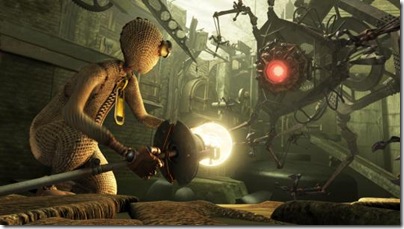
My view of the future is that we will work hand-in-hand with friendly machines, just as we do today. Indeed we will merge with them, and that process has already started, with machines like neural implants for Parkinson’s patients and cochlear implants for the deaf. But my vision of the future is not utopian. While I don’t foresee the end of conflict, future conflict will not simply be man-versus-machine. It will be among different groups of humans amplified in their abilities by their machines, just as we see today.

The stitchpunk creations succeed not despite their emotionalism and bickering with each other, but because of it. We will want our future machines to be emotionally, socially, and morally intelligent because we will become the machines. That is, we will become the rag dolls. We will extend our reach physically, mentally, and emotionally through our technology. This is the only way we can avoid the apocalyptic world that 9 wakes up to.

Tuesday, July 21, 2009

Ce Soir


Ce Soir is Montreal-based band Monogrenade's first music video. Directed by Christophe Collette, the video is entirely made in stop-motion.

See also Vidéomusique

[Thanks again JC!]

Tuesday, June 30, 2009

No Time


Check out Jeff Scher’s blog, The Animated Life.

From “The Parade,” June 29, 2009:

The streets of the city are a non-stop parade of humanity. It’s a kind of grand, unchoreographed ballet of human locomotion. One of the great pleasures and measures of being urban is losing yourself in the crowd, with your feet and mind wandering, alone in your head but elbow to elbow with an inexhaustible supply of strangers…

We can’t help it. We are fascinated by faces and bodies alike. Every face tells a story, and the story is a mystery. The clues abound and we read them instinctively in the blink of an eye. We categorize one another as bums, businessmen, tourists, models, etc., almost unconsciously. But what fun it is to stare, and revel in the passing faces, reading wardrobe, ethnicity, posture, age. Indeed, it’s a feast with every possible variation of the species on parade. By walking in their midst we too become a part of the constantly changing people-scape and offer our own version of the mystery.

Read the whole post and watch the related video...

[Thanks Kit!]

Saturday, June 27, 2009

Deadline

A short film by Bang-yao Liu

The Making Of

Wednesday, April 15, 2009

She Really Does Emote

Coraline: A Visual Companion Animator Travis Knight talking about the many facial expressions which had to be created for the characters in Coraline. The main character herself required over 200,000 different expressions (from Coraline: A Visual Companion by Stephen Jones):

“For facial animation, in particular, we’ve been able to find ways to use a computer to help out the stop-motion. Replacement animation has been around forever, but there’s only a certain amount of refinement you can get with it—it’s hand-done and it’s a little crude, but it does have a real beauty to it. With the computer you can make it pixel-perfect, get real subtlety.”

“We have these machines that can transfer what we’ve done with the computer, make physical objects out of them. That’s how we did a lot of the facial replacement animation. We were modeling and sculpting in the computer, printing them out on these wacky 3-D printers, painting them all by hand, and then fitting them and putting them on the puppets. That was how we got this really incredible, subtle, beautiful, and expressive facial animation.”

A painter in the puppet department cleans Coraline replacement faces on location in Portland. "Coraline," August 6, 2008

“It hurts my stomach to think about all those poor people who had to paint all that stuff and build all that. But I think it shows. When you see the film, she really does emote, and she feels like a real, living, breathing girl. Of course, all that comes from the animators.”

Vice President of Animation Travis Knight works on the "Coraline" set in Portland, Oregon. August 7, 2008

Tuesday, January 13, 2009

9


The Oscar nominated short made by Shane Acker.

9
Directed by Shane Acker
9-9-09

Tuesday, November 18, 2008

Happy 80th Birthday, Mickey!

Steamboat Willie first appeared on November 18, 1928 at New York’s Colony Theater.

“The cartoon featured a soundtrack synchronized to follow the visual animation of the story, which was new at the time….Within a decade, Mickey had appeared in more than 100 cartoons, and during these 10 years, he underwent some changes. White oval eyes with little black pupils replaced solid black ones, and his face became less angular and more rounded, to make him look friendlier. His personality became less cunning and more winsome. He was a commercial hit right away, and even during the Great Depression, Mickey merchandise sold well…Mickey Mouse has also become a standard write-in name on U.S. election ballots as a protest vote. Mickey has been a contender in nearly all the American presidential elections since his birth.”

~ From The Writer’s Almanac (11.18.08)

Friday, November 14, 2008

Poetry in Motion

Animated interpretations of poems written and read by Billy Collins:

The Country


The Best Cigarette


Budapest


More…

Wednesday, July 09, 2008

The Danish Poet


A fIlm by Torrill Kove
Narrated by Liv Ullman

[Spotted on JC's blog]

Friday, May 16, 2008

MUTO

BLU