Showing posts with label seeing. Show all posts

Tuesday, May 10, 2011

Frequent Intermittent Rewards

Excerpt from "Fixated by Screens, but Seemingly Nothing Else," by Perri Klass, M.D., The New York Times, May 9, 2011:

Is a child’s fascination with the screen a cause or an effect of attention problems — or both? It’s a complicated question that researchers are still struggling to tease out.

The kind of concentration that children bring to video games and television is not the kind they need to thrive in school or elsewhere in real life, according to Dr. Christopher Lucas, associate professor of child psychiatry at New York University School of Medicine. “It’s not sustained attention in the absence of rewards,” he said. “It’s sustained attention with frequent intermittent rewards.”

The child may be playing for points accumulated, or levels achieved, but the brain’s reward may be the release of the neurotransmitter dopamine. Children with A.D.H.D. may find video games even more gratifying than other children do because their dopamine reward circuitry may be otherwise deficient.

Indeed, at least one study has found that when children with A.D.H.D. were treated with methylphenidate (Ritalin), which increases dopamine activity in the brain, they played video games less. The authors suggested that video games might serve as a kind of self-medication for these children.

So increased screen time may be a consequence of A.D.H.D., but some researchers fear it may be a cause, as well. Some studies have found that children who spend more time in front of the screen are more likely to develop attention problems later on.

In a 2010 study in the journal Pediatrics, viewing more television and playing more video games were associated with subsequent attention problems in both schoolchildren and college undergraduates.

The stimulation that video games provide “is really about the pacing, how fast the scene changes per minute,” said Dr. Dimitri Christakis , a pediatrician at the University of Washington School of Medicine who studies children and media. If a child’s brain gets habituated to that pace and to the extreme alertness needed to keep responding and winning, he said, the child ultimately may “find the realities of the world underwhelming, understimulating.”

Saturday, May 07, 2011

We Create the World

"When you have an awareness of anything internally, you perceive that externally. We really do, I believe, create the world that we live in. The word ‘eye’, in its Sanskrit and Hebrew root, means fountain. In other words, this is not an organ that's receiving vibrations from what's out there going through the brain and being interpreted. It's a projector."

~ Hubert Selby, Jr., from Memories, Dreams & Addictions. Interview with Ellen Burstyn. Special feature on Requiem for a Dream, Director's Cut DVD release. (2001)

See also: A List of Indignities

Wednesday, April 13, 2011

You Will See

Evelyn Corley Buzbee

“Go into your own familiar yard. It may be a beautiful garden. It may be only a weedy lawn with a few half-dead shrubs. No matter — if you throw back your shoulders and look up into the sky, you will see what else is yours.”

~ Evelyn Corley Buzbee, lifelong gardener

See also: Cabin Tiger Studio

[Thanks, Pat!]

Monday, April 04, 2011

Seeing a Song, Dripping with Color

“What happens during a Cloud Cult show is that I start with a blank canvas and the idea is that it is a visual instrument and that people get to see a song being visually rendered on stage each night.”

~ Scott West, Visual Artist & Live Painter for Cloud Cult

Tuesday, March 29, 2011

Just Looking

(Thanks, But I’m) Just Looking
Peggy Levison Nolan
Dina Mitrani Gallery, March 10 — April 23, 2011

Untitled (bud) 2010

“Continuing her search for beauty and poetry in life’s ordinariness, Nolan exhibits various photographic formats illustrating her almost obsessive act of observing what is around her on a daily basis. She explores the concept of narrative in her series of photographs of the amaryllis flowers that grow in her backyard. This series, approximately thirty 8 x 8 inch prints, depicts her investigative way of looking, studying the everyday phenomenon of nature’s life cycles.”

Untitled (bud2), 2010

Untitled (bud3), 2010

Untitled (dying bud) 2010

“The real voyage of discovery consists not in seeking new landscapes but in having new eyes.” ~ Marcel Proust

Sunday, March 13, 2011

Seeing with Sound

Excerpts from “Blindness No Obstacle To Those With Sharp Ears,” All Things Considered, March 13, 2011:

Meet Daniel Kish. He's a man of many talents. He likes to hike, make music and write. He enjoys children and loves nature. He's an avid biker.

He's also completely blind.

How can Kish bike if he can't see? The method is called echolocation — Kish calls it "flash sonar." As he speeds along on his bike, he makes clicking sounds. As the clicks bounce back to him, he creates a mental image of the space around him. He's kind of like a human bat.

"It is literally a process of seeing with sound," he says.

"It is literally a process of seeing with sound." ~ Daniel Kish
Daniel Kish leads All Things Considered weekend host Guy Raz on a bike ride in Culver City, Los Angeles, Ca.

“I think that children are incredibly adaptable and intuitive. We know this. I work a lot with children, especially very young children. What I often tell parents when children lose their sight is — warn and support parents — to try and get themselves out of the way of the adaptation process, become more an asset to it than a liability. Because children will adapt if given support to do so and given space to do so.

…It’s the overall process of being willing to reach out into the environment and discover what is around them. If that discovery process is broken by introducing a situation that is not natural, such as keeping the blind child in a playpen or a crib or in the corner, or such as always guiding their hands around their environment or guiding their bodies around their environment — [you really just have to let them figure it out. Getting hurt] is part of it for any child…It is tough, but there’s still a kind of a priori difference. When a sighted child gets hurt we consider it to be unfortunate; when a blind child gets hurt we consider it to be tragic…We really need to divest ourselves of that double standard.

[At World Access for the Blind] our main focus is supporting individuals to access their environment better…It is about a philosophy that we call No Limits Philosophy which challenges us to challenge what we think we know. To challenge every boundary, every box, every limitation that we’ve either put up ourselves or allowed ourselves to be conditioned to accept.

… Conventional wisdom doesn’t favor blindness. Conventional wisdom basically favors the perpetuation of convention. Blindness is not conventional — it’s anything and everything but conventional. So we tend to challenge conventional wisdom to expand itself and accept that there are situations, circumstances which are not conventional yet which still warrant accommodation, consideration, acceptance, awareness.   

Saturday, March 12, 2011

Saturday, March 05, 2011

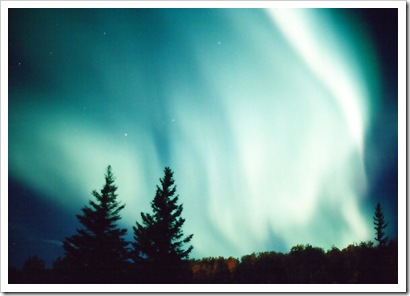
Steadied by the Darkness

Northern Lights over Fairbanks, Alaska (Stormscape Photography / Michael Phelps)

In the Sleep of Reason
by John Haines (1924 – 2011), from The Owl in the Mask of the Dreamer: Collected Poems

And so I closed that book,
laid down the pen
and closed my eyes.

What had I thought to find,
reading by the light of cyphers,
abstract and piercing
in their constellations?

Nothing that night and the wind
could not have told me,
had I raised my head,
dimmed my lamp, and listened—

I, a thoughtful man, prone
to the dust of bindings,
coughing in the dry sequence
of verse and chapter
(for I had reasons).

And while I was sleeping,
came a small beak at my heart,
like a thorn, insistently
probing . . .

And I in terror awoke,
to know in that room
a tread ceaseless and pacing.

As if from within my being
came this upwelling,
of brute and shouldering forms:

heavy and beastlike, buoyant
and birdlike, but nothing
I could name, they moved
at ease, about and within me . . .

creatures of the starlight,
but also of the mind,
harbor to wolf and warlock.

So much do I remember now:
the pulse of obedient hearts,
hot tongues licking
the night; and I heard,

like a dry wind over leaves,
the scaly rustling of reptiles
coiling and resting . . .
All turned in the lamplight

eyes that never turned from mine
in their bright interrogation
(for I could see them,
and yet they were not there).

And I would speak, my hand
upheld to shield me,
when the shutter clapped
and my lamp blew out—

(was it a natural wind,
or a spirit-breath
lifting the leaves
of heavy trees in the night?)

And all subsided in the hush
that followed, in the calm
of great wings folding
and shadowy forms lying down.

I rose and left that room,
the house of my grief
and my bondage, my book
never again to be opened.

To see as once I saw,
steadied by the darkness
in which I walked
and would make my way.

See also: “John Haines, a Poet of the Wild, Dies at 86,” by Douglas Marin, New York Times, Mar. 5, 2011

Friday, March 04, 2011

Nothing Cannot Be Thought

Bust of the great Greek philosopher, Plato. SOCRATES: He then who sees some one thing, sees something which is?

THEAETETUS: Clearly.

SOCRATES: And he who hears anything, hears some one thing, and hears that which is?

THEAETETUS: Yes.

SOCRATES: And he who touches anything, touches something which is one and therefore is?

THEAETETUS: That again is true.

SOCRATES: And does not he who thinks, think some one thing?

THEAETETUS: Certainly.

SOCRATES: And does not he who thinks some one thing, think something which is?

THEAETETUS: I agree.

SOCRATES: Then he who thinks of that which is not, thinks of nothing?

THEAETETUS: Clearly.

SOCRATES: And he who thinks of nothing, does not think at all?

THEAETETUS: Obviously.

SOCRATES: Then no one can think that which is not, either as a self-existent substance or as a predicate of something else?


~ Plato, from Theaetetus

Saturday, February 12, 2011

Learning How to See Again Using Sound

| Artists Wanted | In Focus : Pete Eckert from Artists Wanted on Vimeo.

Even though he can’t see, Pete Eckhert demonstrates that he is a visual person through photography. He was the Grand Prize recipient of Artists Wanted: Exposure 2008, an international photography competition, and was awarded $2,008 with a formal reception at Leo Kesting Gallery in New York City on Thursday August 7, 2008.

Check out Artists Wanted and visit the program on Facebook.

Thursday, January 06, 2011

Infinity is Open to Your Sight

Entrance
by Rainer Maria Rilke, translated by Dana Gioia

Whoever you are: step out of doors tonight,
Out of the room that lets you feel secure.
Infinity is open to your sight.
Whoever you are.
With eyes that have forgotten how to see
From viewing things already too well-known,
Lift up into the dark a huge, black tree
And put it in the heavens: tall, alone.
And you have made the world and all you see.
It ripens like the words still in your mouth.
And when at last you comprehend its truth,
Then close your eyes and gently set it free.

Wednesday, November 17, 2010

For One Minute

…or just look at this pole and try to relax the impulse to define it or interpret it or decide whether or not it is beautiful. Try to notice what it feels like to see, as if you had no words for any of the forms or colors in front of you, as if the words on the paper were written in a language you never learned to read.

…or let your gaze spread gently across your entire field of vision, taking in the area immediately in front of you, the farthest distance you can observe without straining, the right and left edges of your peripheral vision, and everything in between. Take it all in at once—the whole three-dimensional volume of visual space. This is what the present looks like. This is what it feels like to see without spinning a story. This is what it feels like to see as a young child sees, simply fascinated with the seeing itself. Sixty seconds can feel like a long time. Try stringing together several intervals of four or five seconds instead. 

…or listen to what this moment sounds like without needing to know the source of the sounds or to evaluate any of them as pleasant or unpleasant. Steep in the wonder of vibrations striking tiny bones inside your ears and massaging that space where all of the internal chatter plays out, wave after wave of internal sound. There’s no need to tamp down the internal sounds that well up as you’re listening. Allow them to play out as they will, trying to be aware of the silence between the waves. Use the activity of internal sound to remind you to spread your listening out in all directions and become absorbed by it. 

Tuesday, October 26, 2010

If We Could See Them As They Are

West Second Avenue. October 19, 2010

If You Knew
by Ellen Bass, from The Human Line

What if you knew you'd be the last
to touch someone?
If you were taking tickets, for example,
at the theater, tearing them,
giving back the ragged stubs,
you might take care to touch that palm,
brush your fingertips
along the life line's crease.

When a man pulls his wheeled suitcase
too slowly through the airport, when
the car in front of me doesn't signal,
when the clerk at the pharmacy
won't say Thank you, I don't remember
they're going to die.

A friend told me she'd been with her aunt.
They'd just had lunch and the waiter,
a young gay man with plum black eyes,
joked as he served the coffee, kissed
her aunt's powdered cheek when they left.
Then they walked half a block and her aunt
dropped dead on the sidewalk.

How close does the dragon's spume
have to come? How wide does the crack
in heaven have to split?
What would people look like
if we could see them as they are,
soaked in honey, stung and swollen,
reckless, pinned against time?

Sketchy Subway Artist

Excerpt from “An iPhone Artist Haunts the Subways,” by Emily B. Hager, New York Times, October 22, 2010:

R train. 10/21/10 (Eric Molinsky) Click here to watch video. Eric Molinsky does not like to get caught. One recent afternoon on a Manhattan-bound R train, Mr. Molinsky, a freelance radio producer and inveterate people-watcher, slid into position. He scanned the not-yet-packed car. At one end, two aging New York dames laughed. Mr. Molinsky, 39, set his sights on the blonde.

He is not a stalker. He is an artist who secretly draws fellow subway riders on his iPhone, and has collected scores of New York characters on his blog. “Usually if my cover is blown,” Mr. Molinsky explained, “it’s kind of a slippery slope to the drawing just not really happening in the end.” Using his index finger and the application Sketchbook, he quickly drew a crude black-and-white outline of the woman’s face and then began to add layers of color. A base of skin tone, yellow for her dyed hair, green spectacles.

The woman looked up. “It doesn’t really affect my drawing if they know I’m drawing them,” Mr. Molinsky said. “But it does make me a little bit more self-conscious about it and makes me wonder if they’re going to come over and take a look and maybe say, ‘Hey I don’t look anything like that.’ ”

Read the entire City Room post…

See also: The Subway Issue, “the first-ever themed issue of The Times’s Sunday Metropolitan section.”

Thursday, October 07, 2010

To Want to See, but Not Being Able To

“There is always a paradox inherent in vision, an impossible desire to see yourself seeing. A lot of my work probes this tension; to want to see, but not being able to."

~ Spencer Finch

spencer-finch

“Sunlight in an Empty Room (Passing Cloud for Emily Dickinson, Amherst, MA, August 28, 2004).” Photo: Art Evans/Mass MoCA

Excerpt from by Blake Gopnik’s exhibit review of “My Business with the Cloud,” at the Corcoran, Washington Post, September 9, 2010: 

"Passing Cloud," the single, giant piece that he's installed in the Corcoran's grand rotunda, gives a picture of the cloud in its title and of the light that passes through it. It does that by giving us the light itself along with the cloud. High under the room's dome Finch has suspended a huge "cloud" assembled from 110 crumpled theatrical gels in an assortment of pale blues and grays. Light piercing the rotunda's skylight passes through the tangle of filters on its way to us below, so that it winds up matching the blueness and brightness of the light we'd see on a bright day under a passing cloud.

Finch could have given us that cloud by painting or photographing it, like his great cloud-art predecessors John Constable and Alfred Stieglitz. But he prefers to make cloud art that actually works on us the way a cloud-filled reality would. Cross from one side of the rotunda to the other, while keeping your eyes focused on your hands or clothes, and you see the light on them pass from blue to a sunny yellow-white.

One way to understand Finch's piece, then, is to keep your eyes turned away from it. There aren't many other art works you can say that about. Is a cloud mostly about what it happens to look like or what it does? For Finch, it's the doing that matters.

NOW: Spencer Finch at the Corcoran from Corcoran Gallery of Art on Vimeo.

*     *     *     *     *

Excerpt from “Trying to Capture a Trick of Light, a Tug of Memory,” by Bridget L. Goodbody, New York Times, June 19, 2007:

In “What Time Is It on the Sun?” Spencer Finch takes viewers on a journey — equal parts psycho-autobiography, travel log and science experiment — to demonstrate that even with light and eyes, vision doesn’t give you unmediated access to the world.

Because he often uses light and color as his primary tools, it’s easy to place Mr. Finch among artists like James Turrell and Olafur Eliasson. But while Mr. Turrell’s goal is to illuminate light’s transcendent qualities, and Mr. Eliasson’s is to emphasize humanity’s place in nature’s construction, Mr. Finch wants to replicate, through scientific means, his experience of light and color in a specific place and at a specific time…

Mr. Finch is at his best when both the art and the science in his work embrace the poetic, as they do, literally, in “Peripheral Error (After Moritake).” These watercolors, exquisite small spots of jewel-like colors on otherwise large, blank sheets of paper, portray a butterfly — not head on, but out of the corner of the artist’s eye. The series pays homage to a haiku by the Japanese poet Moritake:

The falling flower

I saw drift back to the branch

was a butterfly

Cymothoe Coccinata
2004
22” x 30”, Watercolor on Paper.

Wednesday, September 29, 2010

There is a Boundary to Looking

Full moon rise over Woody Mountain.

photo by Pez Owen

Turning-Point
by Rainer Maria Rilke, translated by Stephen Mitchell

The road from intensity to greatness
passes through sacrifice.         —Kassner

For a long time he attained it in looking.
Stars would fall to their knees
beneath his compelling vision.
Or as he looked on, kneeling,
his urgency's fragrance
tired out a god until
it smiled at him in its sleep.

Towers he would gaze at so
that they were terrified:
building them up again, suddenly, in an instant!
But how often the landscape,
overburdened by day,
came to rest in his silent awareness, at nightfall.

Animals trusted him, stepped
into his open look, grazing,
and the imprisoned lions
stared in as if into an incomprehensible freedom;
birds, as it felt them, flew headlong
through it; and flowers, as enormous
as they are to children, gazed back
into it, on and on.

And the rumor that there was someone
who knew how to look,
stirred those less
visible creatures:
stirred the women.

Looking how long?
For how long now, deeply deprived,
beseeching in the depths of his glance?

When he, whose vocation was Waiting, sat far from home—
the hotel's distracted unnoticing bedroom
moody around him, and in the avoided mirror
once more the room, and later
from the tormenting bed
once more:
then in the air the voices
discussed, beyond comprehension,
his heart, which could still be felt;
debated what through the painfully buried body
could somehow be felt—his heart;
debated and passed their judgment:
that it did not have love.

(And denied him further communions.)

For there is a boundary to looking.
And the world that is looked at so deeply
wants to flourish in love.

Work of the eyes is done, now
go and do heart-work
on all the images imprisoned within you; for you
overpowered them: but even now you don't know them.
Learn, inner man, to look at your inner woman,
the one attained from a thousand
natures, the merely attained but
not yet beloved form.

[Thanks, Ryan!]

Friday, September 10, 2010

Look More Closely

Water drop, Felice Frankel

“We glance, and turn away without noticing. We don’t ever really see, and then we forget what we have seen. Water drips from faucets; candles burn; yeast makes bread rise; a tiny, living mouse — pursuing its tiny murine intentions — runs across a floor that was once a living tree; the sun consumes itself.

We don’t notice.

Look more closely, and everyday events bloom into a reality so transfixingly marvelous that you can’t look away. Life becomes something we don’t understand that happens in ordinary matter. Ordinary matter happens somehow when atoms get together. Atoms build themselves from electrons and nuclei, following rules that flummox intuition. Electrons and nuclei are strange avatars of yet stranger fish swimming in a darker sea.
But whatever it all is — this amazing assembly we so flippantly nickname ‘reality’ — is all there is, and all we are.”

~ Georges Whitesides, from No Small Matter: Science on the Nanoscale 


"I'm sort of a visual ambassador in the sense that I'm using a language, that is the pictorial language, to get people to be less intimidated about what is going on in the laboratories. Photographing science is definitely about showing evidence, but the photography itself, the process is sort of a metaphor for the discovery in science. Most of this stuff, you come to the assignment and you think you have a way you're going to do it, and then you don't do it that way. You discover another way to do it. And in the process you see things. Isn't that fun?"

~ Felice Frankel, on her method for capturing the images that appear in the book, No Small Matter: Science on the Nanoscale, which she co-wrote with Harvard chemist George Whitesides. (Studio 360, 09/10/2010).

See also: Slideshows from 2020 Science and Science Friday

Saturday, September 04, 2010

Blinded by Familiarity

Excerpt from “Really Looking,” by Verlyn Klinkenborg, New York Times Editorial: The Rural Life, September 2, 2010:

I look out across the pasture as dusk begins and see a shining galaxy of airborne bugs. How would it be, I wonder, to have an awareness of the actual number of insects on this farm?

One Queen at a Time I ask myself a version of that question every day: “Have you ever really looked at ...?” You can fill in the blank yourself. But every day I feel blinded by familiarity. I open the hive, which is filled with honey, and the particularity of the honeybees, even their community, somehow escapes me, if only because I’ve been living with honeybees a good part of my life. I remember the phrase, “keep your eyes peeled,” and maybe that’s what I need, a good peeling.

Again and again, I find myself trying to really look at what I’m seeing. It happened the other afternoon, high on a nearby mountain. A dragonfly had settled on the denuded tip of a pine bough. It clung, still as only a dragonfly can be. Then it flicked upward and caught a midge and settled on the bough again, adjusting precisely into the wind. I see the dragonflies quivering through the insect clouds above my pasture, too. I always notice that there’s no such thing as really looking.

What I want to be seeing is invisible anyway: the prehistoric depth of time embodied in the form of those dragonflies, the pressure of life itself, the web of relations that bind us all together. I find myself trying to witness the moment when the accident of life becomes a continued purpose. But this is a small farm, and, being human, I keep coming up against the limits of what a human can see.

Read the entire essay…

[Thanks, Kit!]

Tuesday, August 24, 2010

The Way We Perceive

Ludwig Wittgenstein "That it doesn't strike us at all when we look around us, move about in space, feel our own bodies, shows how natural these things are to us. We do not notice that we see space perspectively or that our visual field is in some sense blurred towards the edges. It doesn't strike us and never can strike us because it is the way we perceive. We never give it a thought and it's impossible we should, since there is nothing that contrasts with the form of our world. What I wanted to say is it's strange that those who ascribe reality only to things and not to our ideas move about so unquestioningly in the world as idea and never long to escape from it."

~ Ludwig Wittgenstein

See also: Hidden in Plain Sight All Around Us

Saturday, August 07, 2010

At the Heart of Change

The first few sentences of “Forgetting” by W.S. Merwin, from The Book of Fables:

First you must know that the whole of the physical world floats in each of the senses at the same time. Each of them reveals to us a different aspect of the kingdom of change. But none of them reveals the unnamable stillness that unites them. At the heart of change it lies unseeing, unhearing, unfeeling, unchanging, holding within itself the beginning and the end. It is ours. It is our only possession. Yet we cannot take it in to our hands, which change, nor see it with our eyes, which change, nor hear it or taste it or smell it. None of the senses can come to it. Except backwards.

Any more than they can come to each other.

Yet they point the way. And most authoritatively as they disappear.