
Showing posts with label sleep. Show all posts

Saturday, March 05, 2011

Steadied by the Darkness
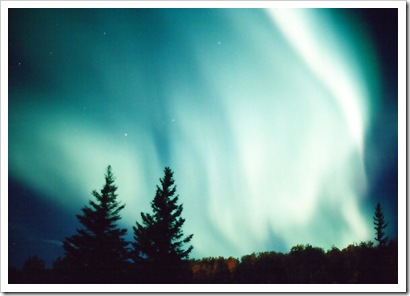
Northern Lights over Fairbanks, Alaska (Stormscape Photography / Michael Phelps)

In the Sleep of Reason
by John Haines (1924 – 2011), from The Owl in the Mask of the Dreamer: Collected Poems

And so I closed that book,
laid down the pen
and closed my eyes.

What had I thought to find,
reading by the light of cyphers,
abstract and piercing
in their constellations?

Nothing that night and the wind
could not have told me,
had I raised my head,
dimmed my lamp, and listened—

I, a thoughtful man, prone
to the dust of bindings,
coughing in the dry sequence
of verse and chapter
(for I had reasons).

And while I was sleeping,
came a small beak at my heart,
like a thorn, insistently
probing . . .

And I in terror awoke,
to know in that room
a tread ceaseless and pacing.

As if from within my being
came this upwelling,
of brute and shouldering forms:

heavy and beastlike, buoyant
and birdlike, but nothing
I could name, they moved
at ease, about and within me . . .

creatures of the starlight,
but also of the mind,
harbor to wolf and warlock.

So much do I remember now:
the pulse of obedient hearts,
hot tongues licking
the night; and I heard,

like a dry wind over leaves,
the scaly rustling of reptiles
coiling and resting . . .
All turned in the lamplight

eyes that never turned from mine
in their bright interrogation
(for I could see them,
and yet they were not there).

And I would speak, my hand
upheld to shield me,
when the shutter clapped
and my lamp blew out—

(was it a natural wind,
or a spirit-breath
lifting the leaves
of heavy trees in the night?)

And all subsided in the hush
that followed, in the calm
of great wings folding
and shadowy forms lying down.

I rose and left that room,
the house of my grief
and my bondage, my book
never again to be opened.

To see as once I saw,
steadied by the darkness
in which I walked
and would make my way.

See also: “John Haines, a Poet of the Wild, Dies at 86,” by Douglas Marin, New York Times, Mar. 5, 2011

Friday, February 18, 2011

What You Can Plan is Too Small

Brandywine Falls p schmitt 

What to Remember When Waking
by David Whyte, from The House of Belonging

In that first
hardly noticed
moment
in which you wake,
coming back
to this life
from the other
more secret,
moveable
and frighteningly
honest world
there is a small opening
into the new day
which closes
the moment
you begin
your plans.

What you can plan
is too small
for you to live.

What you can live
wholeheartedly
will make plans
enough
for the vitality
hidden in your sleep.

To be human
is to become visible
while carrying
what is hidden
as a gift to others.

To remember
the other world
in this world
is to live in your
true inheritance.

You are not
a troubled guest
on this earth,
you are not
an accident
amidst other accidents
you were invited
from another and greater
night
than the one
from which
you have just emerged.

Now, looking through
the slanting light
of the morning
window toward
the mountain
presence
of everything
that can be,
what urgency
calls you to your
one love? What shape
waits in the seed
of you to grow
and spread
its branches
against a future sky?

Is it waiting
in the fertile sea?
In the trees
beyond the house?
In the life
you can imagine
for yourself?
In the open
and lovely
white page
on the waiting desk?

Monday, August 02, 2010

The Natural Dramatic Urge

Excerpts from Three Uses of the Knife: On the Nature and Purpose of Drama by David Mamet:

It is our nature to dramatize. At least once a day wee reinterpret the weather—an essentially impersonal phenomenon—into an expression of our current view of the universe: “Great. It’s raining. Just when I’m blue. Isn’t that just like life?”

Or we say: “I can’t remember when it was this cold,” in order to forge a bond with our contemporaries. Or we say: “When I was a lad the winters were longer,” in order to avail ourselves of one of the delights of aging.

The weather is impersonal, and we both understand it and exploit it as dramatic, i.e., having a plot, in order to understand its meaning for the hero, which is to say for ourselves.

We dramatize the weather, the traffic, and other impersonal phenomena by employing exaggeration, ironic juxtaposition, inversion, projection, all the tools the dramatist uses to create, and the psychoanalyst uses to interpret, emotionally significant phenomena.

We dramatize an incident by taking events and reordering them, elongating them, compressing them, so that we understand their personal meaning to us—to us as the protagonist of the individual drama we understand our life to be.

If you said, “I waited at the bus today,” that probably wouldn’t be dramatic. If you said, “I waited at the bus stop for a long time today,” that might be a little more dramatic. If you said, “The bus came quickly today,” that wouldn’t be dramatic (and there would be no reason to say it). But you might say, “Do you know how quickly that bus came today?”—and all of a sudden, we’re taking the events of life and using dramatic tools.

“I waited half an hour for a bus today” is a dramatic statement. It means: “I waited that amount of time sufficient for me to be sure you will understand it was ‘too long.’”

(And this is a fine distinction, for the utterer cannot pick a time too short to be certain that understanding is communicated, or too long for the hearer to accept it as appropriate—at which point it becomes not drama but farce. So the ur-dramatist picks unconsciously, and perfectly, as it is our nature to do, the amount of time that allows the hearer to suspend his or her disbelief—to accept that the half-hour wait is not outside the real of probability, yet is within the parameters of the unusual. The hearer then accepts the assertion for the enjoyment it affords, and a small perfectly recognizable play has been staged and appreciated.")

*     *     *     *     *

We can see the natural dramatic urge in newspaper quotes of a film’s grosses. The dramatic urge—our impulse to structure cause and effect in order to increase our store of practical knowledge about the universe—is absent in the film itself, but emerges spontaneously in our proclamation of a natural ocurring drama between films.

*     *     *     *     *

jumping-on-a-bedChildren jump around at the end of the day, to expend the last of that day’s energy. The adult equivalent, when the sun goes down, is to create or witness drama—which is to say, to order the universe into a comprehensible form. Our sundown play/film/gossip is the day’s last exercise of that survival mechanism. In it we attempt to discharge any residual perceptive energies in order to sleep. We will have drama in that spot, and it it’s not forthcoming we will cobble it together out of nothing.

Thursday, May 06, 2010

Wide Awake

"For me, the main thing that I found after my three-year quest was meditation. Meditation was a real major revelation for me, not only for my life but for my sleep. It really helped calm me down. So I think if you can do any type of relaxation exercises, if you can practice breathing, I think that if you can do it, it's far more beneficial than going the pharmaceutical route.”

~ Patricia Morrisroe, author of Wide Awake: A Memoir of Insomnia, from Talk of the Nation (May 4, 2010)

[Thanks Suzanne!]

Saturday, April 24, 2010

Constantly Keeping Track

Excerpts from "Sleep," Radiolab, May 25, 2007:

sticky-notes Robert Krulwich: Robert Stickgold has the theory that as you go through your day, your brain is constantly keeping track of emotional content. Your brain is going to flag that stuff, It says, Oh, I need to remember so I can work on it later. I’m going to put a sticky on this one.

Robert Stickgold: So if it puts a sticky on everything that’s hard during the day, then all the brain has to do when it’s creating a dream is go and grab stickies.

Jad Abumrad: Stickgold thinks he’s seeing the outline if the dream-making process here. It starts really simply at the very beginning of sleep, right after you fall asleep, with the replay. This, he suspects, is just the brain emptying out its stickies.

Robert Krulwich: Are you at all puzzled by the super-duper, Technicolor, extraordinarily cinematic qualities of some of these [dreams]? Because if it were just an everyday brain function to sort of make sense of the world and allow you to make new connections, you wouldn’t really need quit the movie quality.

Robert Stickgold: When we talk about dreams, what seems to come into dreams are memories, concepts, relationships, associations that have a strong emotional flavor and — I’m guessing from the data — need a full-blown orchestration to be properly processed.

“Sleep is the annihilation of consciousness, so it’s a terrible time in which everything disappears — the universe and yourself with it. I think if people didn’t sleep and didn’t have the unconsciousness of sleep, they possibly wouldn’t even realize that consciousness is an enormous gift.”

~ Dr. Giulio Tunoni

Monday, March 08, 2010

Leaving the Outside World Behind

Excerpt from “All-Nighters: Failing to Fall,” by Siri Hustvedt, New York Times Opinionator (March 3, 2010):

In sleep we leave behind the sensory stimulation of the outside world. A part of the brain called the thalamus, involved in the regulation of sleeping and waking, plays a crucial role in shutting out somatosensory stimuli and allowing the cortex to enter sleep. One theory offered to explain hypnogogic hallucinations is that the thalamus deactivates before the cortex in human beings, so the still active cortex manufactures images, but this is just a hypothesis. What is clear is that going to sleep involves making a psychobiological transition. Anxiety, guilt, excitement, a racing bedtime imagination, fear of dying, pain or illness can keep us from toppling into the arms of Morpheus. Depression often involves sleep disturbances, especially waking up early in the morning and not being able to get back to sleep. Weirdly enough, keeping a depressed patient awake for a couple of nights in the hospital can alleviate his symptoms temporarily. They return as soon as he begins to sleep normally again.

The Neuronal Switches for Waking and Sleeping