Showing posts with label creativity. Show all posts

Saturday, May 07, 2011

We Create the World

"When you have an awareness of anything internally, you perceive that externally. We really do, I believe, create the world that we live in. The word ‘eye’, in its Sanskrit and Hebrew root, means fountain. In other words, this is not an organ that's receiving vibrations from what's out there going through the brain and being interpreted. It's a projector."

~ Hubert Selby, Jr., from Memories, Dreams & Addictions. Interview with Ellen Burstyn. Special feature on Requiem for a Dream, Director's Cut DVD release. (2001)

See also: A List of Indignities

Sunday, May 01, 2011

No Idea

“To know how good you are at something requires the same skills as it does to be good at that thing. Which means, if you’re absolutely hopeless at something, you lack exactly the skills that you need to know that you’re absolutely hopeless at it. And this is a profound discovery, that most people who have absolutely no idea what they’re doing have absolutely no idea that they have no idea what they’re doing. It explains a great deal of life.”

~ John Cleese

British writer, actor and tall person John Cleese discusses the importance of creating boundaries to foster creativity (Creativity World Forum).

Saturday, April 02, 2011

Avoiding Interesting Jobs

Inn at Honey Run, March 30, 2011 (Pat Schmitt) p schmidtt

"I consider myself kind of a reporter — one who uses words that are more like music and that have a choreography. I never think of myself as a poet; I just get up and write. For most of my life, I haven't had the structure of an actual job. When I was very young and decided I wanted to try to write as well as I could, I made a great list of all the things I would never have, because I thought poets never made any money. A house, a good car, I couldn't go out and buy fancy clothes or go to good restaurants. I had the necessities. Not that I didn't take some teaching jobs over the years — I just never took any interesting ones, because I didn't want to get interested. That's when I began to get up so early in the morning — you know I'm a 5 A.M. riser — so I could write for a couple of hours and then give my employer my very best second-rate energy...

You have to be in the world to understand what the spiritual is about, and you have to be spiritual in order to truly be able to accept what the world is about...I think about the spiritual a great deal. I like to think of myself as a praise poet....If I have any lasting worth, it will be because I have tried to make people remember what the Earth is meant to look like."

~ Mary Oliver, from "Maria Shriver Interviews the Famously Private Poet Mary Oliver," O Magazine, March 9, 2011

Tuesday, March 22, 2011

Experimenting with Forms

Japanese Garden, Dawes Arboretum (March 19, 2011)

“We are the miracle of force and matter making itself over into imagination and will. Incredible. The Life Force experimenting with forms. You for one. Me for another. The Universe has shouted itself alive. We are one of the shouts.”

~ Ray Bradbury

Wednesday, February 09, 2011

A Blank Canvas for Flavor

“I think of flavor the way a painter thinks of color. Ice cream is a blank canvas for flavor, filling your nose and mouth as it melts. Food is an art form to be experienced.”

~ Jeni Britton Bauer, artisan ice cream empress 

Airy meringue stars on their way into a batch of Violets & Meringue Ice Cream

The BombeBastick

Torching marshmallows for Sweet Potato with Torched Marshmallows Ice Cream

Sweet Corn with Black Raspberries from the stunning gallery by photographer George Lange

Pre-order Jeni’s debut cookbook, Jeni’s Splendid Ice Creams, which is being published by Artisan this spring. In it, she reveals secrets for recreating many of her signature flavors using a modestly priced automatic ice cream maker

Thursday, January 27, 2011

Encouraging Urges

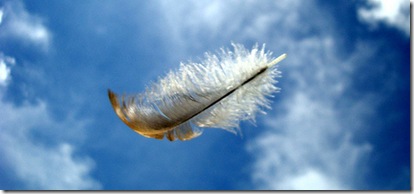
feather by cschubert18

The Trouble with Poetry
by Billy Collins, from The Trouble with Poetry

The trouble with poetry, I realized
as I walked along a beach one night —   
cold Florida sand under my bare feet,
a show of stars in the sky —  

the trouble with poetry is
that it encourages the writing of more poetry,
more guppies crowding the fish tank,
more baby rabbits
hopping out of their mothers into the dewy grass.

And how will it ever end?
unless the day finally arrives
when we have compared everything in the world
to everything else in the world,

and there is nothing left to do
but quietly close our notebooks
and sit with our hands folded on our desks.

Poetry fills me with joy
and I rise like a feather in the wind.
Poetry fills me with sorrow
and I sink like a chain flung from a bridge.

But mostly poetry fills me
with the urge to write poetry,
to sit in the dark and wait for a little flame
to appear at the tip of my pencil.

And along with that, the longing to steal,
to break into the poems of others
with a flashlight and a ski mask.

And what an unmerry band of thieves we are,
cut-purses, common shoplifters,
I thought to myself
as a cold wave swirled around my feet
and the lighthouse moved its megaphone over the sea,
which is an image I stole directly
from Lawrence Ferlinghetti —  
to be perfectly honest for a moment — 

the bicycling poet of San Francisco
whose little amusement park of a book
I carried in a side pocket of my uniform
up and down the treacherous halls of high school.

Sunday, December 05, 2010

Everything is Invented

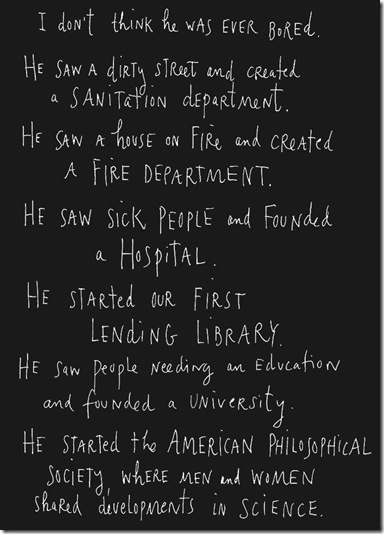
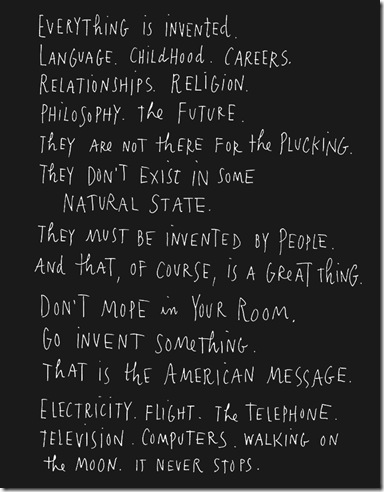
From And the Pursuit of Happiness by Maira Kalman:

MKJULY_02b

Tuesday, October 19, 2010

We All Have the Capacity

“Kids will take a chance and if they don’t know they’ll have a go. Am I right? They’re not frightened of being wrong. Now I don’t mean to say that being wrong is the same thing as being creative. What we do know is if you’re not prepared to be wrong, you will never come up with anything original. By the time they get to be adults, most kids have lost that capacity. They have become frightened of being wrong. And we run our companies this way. We stigmatize mistakes. And we’re now running national education systems where mistakes are the worst thing you can make. And the result is that we are educating people out of their creative capacities. Picasso once said that ‘All children are born artists. The problem is to remain an artist as we grow up.’ I believe this passionately. We don’t grow into creativity, we grow out of it. Or rather, we get educated out of it.”

~ Ken Robinson

“This animate was adapted from a talk given at the RSA by Sir Ken Robinson, world-renowned education and creativity expert and recipient of the RSA's Benjamin Franklin award.”

Monday, August 16, 2010

Inconvenience

Circus Manager with a Circus Girl, George Rouault, 1941. Oil on canvas, Jacques and Natasha Gelman Collection (1998), Metropolitan Museum of Art, European Modern Paintings.

Matisse was as reluctant as most painters to try to express what any given work signified in words; but he made an exception that autumn when Rouault, who had finally obtained a permit to return to Paris, sent his daughter over to Cimiez with the only picture he had managed to produce in the Midi, a tragic canvas painted with infinite delicacy in a gamut of bruised blues. ‘The subject is The Circus Girl and the Manager, seated opposite one another like a lamb confronting a tiger…It is powerfully and poignantly expressive, it is—the entire picture is—a portrait of Rouault,’ Matisse wrote to [his son] Pierre (he added that the painting disturbed him so much he had to keep it shut up in a cupboard). Rouault’s daughter spent two hours at Cimiez pouring over her family’s complaints and grievances to Matisse, who recognized the situation only too well, and tried to get her to see that inner fires consumed her father, whose glaring faults were inseparable from his great strengths. Afterwards, he told Pierre there was no real difference between his case and Rouault’s:

A man who makes pictures like the one we are looking at is an unhappy creature, tormented day and night. He relieves himself of his passion in his pictures, but also in spite of himself on the people around him. That is what normal people never understand. They want to enjoy the artists’ products— as one might enjoy cows’ milk— but they can’t put up with the inconvenience, the mud and the flies.

~ From Matisse the Master: A Life of Henri Matisse: The Conquest of Colour, 1909-1954 , by Hilary Spurling

[Thanks, Mark!]

Tuesday, August 03, 2010

You Have to Find Out

The Poet's View from The Academy of American Poets (www.poets.org/dvd)


Excerpt from “Gardening Notes: America's New Poet Laureate,” by Ed Lake, The National (July 25, 2010):

For [Merwin, poetry] involves more than just the…musical effects…A kind of conceptual harmony is required, a gradual perception of the poem’s ideal shape emerging through draft after draft. “I can’t say what it is, but when it’s right, when it sounds right, then it is right,” he says. “Sometimes getting it right means a whole new aspect of what you’re talking about. And I tell students that writing comes from listening, that poetry comes from listening, and they inevitably say: ‘Listening to what?’ And I say: ‘That’s what you have to find out.’”

Tuesday, July 20, 2010

An Inability to Conceive of Alternatives

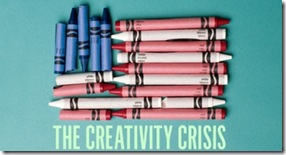
Excerpt from “The Creativity Crisis,” by Po Bronson and Ashley Merryman, Newsweek (July 10, 2010):

For the first time, research shows that American creativity is declining. What went wrong—and how we can fix it. In early childhood, distinct types of free play are associated with high creativity. Preschoolers who spend more time in role-play (acting out characters) have higher measures of creativity: voicing someone else’s point of view helps develop their ability to analyze situations from different perspectives. When playing alone, highly creative first graders may act out strong negative emotions: they’ll be angry, hostile, anguished. The hypothesis is that play is a safe harbor to work through forbidden thoughts and emotions.

In middle childhood, kids sometimes create paracosms—fantasies of entire alternative worlds. Kids revisit their paracosms repeatedly, sometimes for months, and even create languages spoken there. This type of play peaks at age 9 or 10, and it’s a very strong sign of future creativity. A Michigan State University study of MacArthur “genius award” winners found a remarkably high rate of paracosm creation in their childhoods.

From fourth grade on, creativity no longer occurs in a vacuum; researching and studying become an integral part of coming up with useful solutions. But this transition isn’t easy. As school stuffs more complex information into their heads, kids get overloaded, and creativity suffers. When creative children have a supportive teacher—someone tolerant of unconventional answers, occasional disruptions, or detours of curiosity—they tend to excel. When they don’t, they tend to underperform and drop out of high school or don’t finish college at high rates.

They’re quitting because they’re discouraged and bored, not because they’re dark, depressed, anxious, or neurotic. It’s a myth that creative people have these traits. (Those traits actually shut down creativity; they make people less open to experience and less interested in novelty.) Rather, creative people, for the most part, exhibit active moods and positive affect. They’re not particularly happy—contentment is a kind of complacency creative people rarely have. But they’re engaged, motivated, and open to the world.

The new view is that creativity is part of normal brain function. Some scholars go further, arguing that lack of creativity—not having loads of it—is the real risk factor. In his research, Runco asks college students, “Think of all the things that could interfere with graduating from college.” Then he instructs them to pick one of those items and to come up with as many solutions for that problem as possible. This is a classic divergent-convergent creativity challenge. A subset of respondents, like the proverbial Murphy, quickly list every imaginable way things can go wrong. But they demonstrate a complete lack of flexibility in finding creative solutions. It’s this inability to conceive of alternative approaches that leads to despair. Runco’s two questions predict suicide ideation—even when controlling for preexisting levels of depression and anxiety.

In Runco’s subsequent research, those who do better in both problem-finding and problem-solving have better relationships. They are more able to handle stress and overcome the bumps life throws in their way. A similar study of 1,500 middle schoolers found that those high in creative self-efficacy had more confidence about their future and ability to succeed. They were sure that their ability to come up with alternatives would aid them, no matter what problems would arise.

  • See also: Forget Brainstorming What you think you know about fostering creativity is wrong. A look at what really works.

Wednesday, June 09, 2010

The Same Source

Moleskin“Every day we slaughter our finest impulses. That is why we get a heartache when we read those lines written by the hand of a master and recognize them as our own, as the tender shoots which we stifled because we lacked the faith to believe in our own powers, our own criterion of truth and beauty. Every man, when he gets quiet, when he becomes desperately honest with himself, is capable of uttering profound truths. We all derive from the same source. There is no mystery about the origin of things. We are all part of creation, all kings, all poets, all musicians; we have only to open up, only to discover what is already there.”

~ Henry Miller, from Sexus

Friday, May 21, 2010

All Living Things Have Shoulders

Chapter from Nick Flynn’s extraordinarily authentic and poetic memoir, The Ticking Is the Bomb:
For those few years when I worked in New York City public schools as an itinerant poet—Crown Heights, Harlem, the South Bronx—I’d lug a satchel heavy with books on the train every morning. Much of what I taught was directed toward finding out what the students saw every day. It was a way to honor their lives, which isn’t generally taught in public schools.

The beginning exercises were very simple: Tell me one thing you saw on the way into school this morning. Tell me one thing you saw last night when you got home. Describe something you see every day, describe something you saw only once and wondered about from then on. Tell me a dream, tell me a story someone told you, tell me something you’ve never told anyone else before. No one, in school at least, had ever asked them what their lives were like, no one had asked them to tell about their days. In this sense it felt like a radical act. I tried to imagine what might happen if each of them knew how important their lives were.

In the schools I’d visit, I’d sometimes pick up a discarded sheet of paper from the hallway floor, something a student had written in his notebook and then torn out. Sometimes, I could tell that he’d been given an assignment, and that he’d tried to fulfill it, and by tearing it out it was clear that he felt he had somehow failed.

Out of all the ephemera I’ve bent down to collect from black and green elementary school linoleum floors over the years, one has stayed with me. Likely it was part of a research paper, likely for biology. It started with a general statement, which was, I imagine, meant to be followed by supporting facts. The sentence, neatly printed on the first line, was this: All shoulder-gray327living things have shoulders—after this there was nothing, not even a period, as if even as he was writing it he realized something was wrong, that he would never be able to support what he was only beginning to say, that no facts would ever justify it.
All living things have shoulders—the first word is pure energy, the sweeping “All,” followed by the heartbeat of “living”—who wouldn’t be filled with hope having found this beginning? Then the drift begins, into uncertainty—”things”—a small misstep, not so grave that it couldn’t be righted, but it won’t be easy. Now something has to be said, some conclusion, I can almost hear the teacher, I can almost see what she has written on the blackboard—”Go from the general to the specific”—and what could be more general than “All living things,” and what could be more specific than “shoulders”? He reads it over once and knows it can never be reconciled, and so it is banished from his notebook.

All living things have shoulders—this one line, I have carried it with me since, I have tried to write a poem from it over and over, and failed, over and over. I have now come to believe that it already is a poem.

All living things have shoulders. Period. The end. A poem.

Wednesday, May 12, 2010

Stone Soup

lost-books-of-the-odyssey “It never struck me that writing was something anyone could teach you—or if anyone could, it was the great masters, which meant going to the library and reading with great care the authors I most loved and admired. It struck me that an MFA program could be not just helpful but actually harmful.

There’s an orthodoxy of style at MFA programs, and it’s a style that turns me off. It’s the stone soup parable. Lots of people who don’t really know what they’re doing tear your work to shreds. No matter how robust you are, it has to be a painful experience and change your work, and probably not in a good way. I’m all in favor of grad school for surgeons and car mechanics, but less so as we get towards art, where I don’t think it does much good.”

~ Zachary Mason, computer scientist and author of The Lost Books of the Odyssey, from “Trojan Horse in Silicon Valley,” by Hara Estroff Marano, Psychology Today, May/June 2010

Sunday, May 09, 2010

Bitroverted

alone-in-a-crowd

“Creative people tend to be both extroverted and introverted. We're usually one or the other, either preferring to be in the thick of crowds or sitting on the sidelines and observing the passing show. In fact, in psychological research, extroversion and introversion are considered the most stable personality traits that differentiate people from each other and that can be reliably measured. Creative individuals, on the other hand, seem to exhibit both traits simultaneously.”

~ Mihaly Csikszentmihalyi, from “The Creative Personality,” Psychology Today, July 1, 1996

Thursday, April 08, 2010

Making Time

Excerpts from “Time Lost and Found,” by Anne Lamott, Sunset:

Anne Lamott, photographed for Sunset by James Hall I sometimes teach classes on writing, during which I tell my students every single thing I know about the craft and habit. This takes approximately 45 minutes. I begin with my core belief—and the foundation of almost all wisdom traditions—that there is nothing you can buy, achieve, own, or rent that can fill up that hunger inside for a sense of fulfillment and wonder. But the good news is that creative expression, whether that means writing, dancing, bird-watching, or cooking, can give a person almost everything that he or she has been searching for: enlivenment, peace, meaning, and the incalculable wealth of time spent quietly in beauty.

Then I bring up the bad news: You have to make time to do this.

…I know how addictive busyness and mania are. But I ask them whether, if their children grow up to become adults who spend this one precious life in a spin of multitasking, stress, and achievement, and then work out four times a week, will they be pleased that their kids also pursued this kind of whirlwind life?

If not, if they want much more for their kids, lives well spent in hard work and savoring all that is lovely, why are they living this manic way?

…Time is not free—that’s why it’s so precious and worth fighting for.

Will they give me one hour of housecleaning in exchange for the poetry reading? Or wash the car just one time a month, for the turtles? No? I understand. But at 80, will they be proud that they spent their lives keeping their houses cleaner than anyone else in the family did, except for mad Aunt Beth, who had the vapors? Or that they kept their car polished to a high sheen that made the neighbors quiver with jealousy? Or worked their fingers to the bone providing a high quality of life, but maybe accidentally forgot to be deeply and truly present for their kids, and now their grandchildren?

I think it’s going to hurt. What fills us is real, sweet, dopey, funny life.

I’ve heard it said that every day you need half an hour of quiet time for yourself, or your Self, unless you’re incredibly busy and stressed, in which case you need an hour. I promise you, it is there. Fight tooth and nail to find time, to make it. It is our true wealth, this moment, this hour, this day.

Read the entire article…

[Thanks Kit!]

Sunday, March 21, 2010

That Spark Will Never Be a Commodity

Excerpt from “America’s Real Dream Team,” by Thomas L. Friedman, New York Times (March 21, 2010):

Photo by Felipe T. Marques In today’s wired world, the most important economic competition is no longer between countries or companies. The most important economic competition is actually between you and your own imagination. Because what your kids imagine, they can now act on farther, faster, cheaper than ever before — as individuals. Today, just about everything is becoming a commodity, except imagination, except the ability to spark new ideas.

If I just have the spark of an idea now, I can get a designer in Taiwan to design it. I can get a factory in China to produce a prototype. I can get a factory in Vietnam to mass manufacture it. I can use Amazon.com to handle fulfillment. I can use freelancer.com to find someone to do my logo and manage by backroom. And I can do all this at incredibly low prices. The one thing that is not a commodity and never will be is that spark of an idea.

[See also: Outliers: The Story of Success by Malcolm Gladwell and The Genius in All of Us: Why Everything You've Been Told About Genetics, Talent, and IQ Is Wrong by David Shenk]

Friday, March 05, 2010

Seeing Stuff that Makes Real Change in the Real World


“You know, all I wanted to do was draw pictures of horses when I was little. My mother said, Well let's do a picture of something else. They've got to learn how to do something else. let's say the kid is fixated on Legos. Let's get him working on building different things. The thing about the autistic mind is it tends to be fixated. Like if a kid loves race cars, let's use race cars for math. Let's figure out how long it takes a race car to go a certain distance. In other words, use that fixation in order to motivate that kid, that's one of the things we need to do. I really get fed up when they, you know, the teachers, especially when you get away from this part of the country, they don't know what to do with these smart kids. It just drives me crazy…I get satisfaction out of seeing stuff that makes real change in the real world. We need a lot more of that, and a lot less abstract stuff.”

~ Temple Grandin, from “The World Needs All Kinds of Minds," TED Talks (February 2010)

Thursday, February 25, 2010

Never Be Ashamed of Kindergarten

Instructions to the Artist
by Billy Collins, from Questions About Angels

I wish my head to appear perfectly round
and since the canvas should be of epic dimensions,
please trace the circle with a dinner plate
rather than a button or a dime

My face should be painted with
an ant-like sense of detail;
pretend you are executing a street map
of Rome and that all citizens
can lift thirty times their own weight

The result should be a strained
but self-satisfied expression,
as if I am lifting a Volkswagen with one foot.

The body is no great matter;
just draw some straight lines
with a pencil and ruler.
I will not be around to hear the voice
of posterity calling me Stickman.

The background I leave up to you
but if there is to be a house,
lines of smoke rising from the chimney
should be mandatory.
Never be ashamed of kindergarten--
it is the alphabet's only temple.

Also, have several kangaroos grazing
and hopping around in the distance,
an allusion to my world travels.

Some final recommendations:
I should like to appear hatless.
Kindly limit your palette to a single
primary color, any one but red or blue.
Sign the painting on my upper lip
so your name will always be my mustache.

Tuesday, February 23, 2010

Hunger for Reality

“Every single one of these [successful games] has succeeded off a clever psychological angle. But there’s more than that. There’s something else these things have in common, not just these psychological tricks. What these all have in common is they are all busting through to reality. We’re used to, in the old days of gaming, it being all about fantasy. It’s all about fantasy and Ben Gordon used to say, ‘We don’t care about realism in games because people come to our games to escape from reality.’ And so we have this strong belief that fantasy is the thing. But every single one of these is breaking through into reality in some interesting way. And we don’t feel good about reality as game designers. We’re a little uncomfortable about reality…

…But it’s not just us that were kind of snuck up on by this reality thing. And it’s not just just happening to us. Go look at TV. The people in TV, their heads are spinning. Everything’s turned into reality TV. Go to the grocery store. It’s not just groceries anymore. It’s organic groceries. The more genuine, the more real groceries. You go to McDonald’s and to get a Big Mac and – you could get a Big Mac or you could get the real burger, the angus burger made with real this and that or whatever. Everything is suddenly about reality.

Now what’s going on? Is this just how it’s always been? Well, I found this really interesting book. It’s called Authenticity. It’s by the guys who wrote The Experience EconomyGilbert and Pine put forth this most interesting concept: the most valuable thing in products is are the real, are they authentic. Which is a bold hypothesis. And then they go further and they say, Why is it? Why now? It didn’t always used to be this way. Certainly that’s not what sold stuff in the eighties…They’re arguing that all this virtual stuff that’s been creeping up on us over the last twenty years has really cut us off from nature. We’re cut off from self-sufficiency. We couldn’t be self-sufficient if we wanted to. We don’t know how to do it. We live in a bubble of fake bullshit and we have this hunger for to get to anything that’s real. Even if the best we can do is a Starbucks mocha with real Swiss chocolate — we’ll take it. Oh, look how real that seems to me relative to what I’m used to. And so there’s this idea that maybe there’s this hunger for reality. ”

~ Jesse Schell, from his talk at DICE Summit 2010