Showing posts with label inspiration. Show all posts

Friday, February 04, 2011

Living Life Without False Illusions

whosafraidPhoto: Amy Morton, Carrie Coon, Madison Dirks and Tracy Letts
Credit: Michael Brosilow

“There was a saloon—it's changed its name now—on Tenth Street, between Greenwich Avenue and Waverly Place, that was called something at one time, now called something else, and they had a big mirror on the downstairs bar in this  saloon where people used to scrawl graffiti. At one point back in about 1953 . . . 1954, I think it was—long before  any of us started doing much of anything—I was in there having a beer one night, and I saw ‘Who's Afraid of Virginia  Woolf?’ scrawled in soap, I suppose, on this mirror. When I started to write the play it cropped up in my mind  again. And of course, who's afraid of Virginia Woolf means who's afraid of the big bad wolf . . . who's afraid of living life without false illusions. And it did strike me as being a rather typical university, intellectual joke.”

~ Edward Albee, from "Edward Albee, The Art of Theater No. 4," by William Flanagan, The Paris Review, Fall 1966


Thursday, January 27, 2011

Encouraging Urges

feather by cschubert18

The Trouble with Poetry
by Billy Collins, from The Trouble with Poetry

The trouble with poetry, I realized
as I walked along a beach one night —   
cold Florida sand under my bare feet,
a show of stars in the sky —  

the trouble with poetry is
that it encourages the writing of more poetry,
more guppies crowding the fish tank,
more baby rabbits
hopping out of their mothers into the dewy grass.

And how will it ever end?
unless the day finally arrives
when we have compared everything in the world
to everything else in the world,

and there is nothing left to do
but quietly close our notebooks
and sit with our hands folded on our desks.

Poetry fills me with joy
and I rise like a feather in the wind.
Poetry fills me with sorrow
and I sink like a chain flung from a bridge.

But mostly poetry fills me
with the urge to write poetry,
to sit in the dark and wait for a little flame
to appear at the tip of my pencil.

And along with that, the longing to steal,
to break into the poems of others
with a flashlight and a ski mask.

And what an unmerry band of thieves we are,
cut-purses, common shoplifters,
I thought to myself
as a cold wave swirled around my feet
and the lighthouse moved its megaphone over the sea,
which is an image I stole directly
from Lawrence Ferlinghetti —  
to be perfectly honest for a moment — 

the bicycling poet of San Francisco
whose little amusement park of a book
I carried in a side pocket of my uniform
up and down the treacherous halls of high school.

Thursday, September 30, 2010

Listen to the Music of the Traffic in the City

“The song written by an Englishman about an American city whose promise of togetherness really yields loneliness sung by a white Parisian woman everyone thought was black.”

~ From “Pop Music: Songs that Cross Borders,” Radiolab, April 21, 2008

When you're alone and life is making you lonely
You can always go - downtown
When you've got worries, all the noise and the hurry
Seems to help, I know - downtown
Just listen to the music of the traffic in the city
Linger on the sidewalk where the neon signs are pretty
How can you lose?

The lights are much brighter there
You can forget all your troubles, forget all your cares
So go downtown, things'll be great when you're
Downtown - no finer place, for sure
Downtown - everything's waiting for you

Don't hang around and let your problems surround you
There are movie shows - downtown
Maybe you know some little places to go to
Where they never close - downtown
Just listen to the rhythm of a gentle bossa nova
You'll be dancing with him too before the night is over
Happy again

The lights are much brighter there
You can forget all your troubles, forget all your cares
So go downtown, where all the lights are bright
Downtown - waiting for you tonight
Downtown - you're gonna be all right now

[Instrumental break]

And you may find somebody kind to help and understand you
Someone who is just like you and needs a gentle hand to
Guide them along

So maybe I'll see you there
We can forget all our troubles, forget all our cares
So go downtown, things'll be great when you're
Downtown - don't wait a minute for
Downtown - everything's waiting for you

Downtown, downtown, downtown, downtown ...

*     *     *     *     *

Listen to the whole fascinating Radiolab episode:

Friday, June 25, 2010

Undervaluing What We Can’t Measure

“Just in the way that I'm inspired by books and magazines of all kinds, conversations I have, movies, so I also think, when I put visual work out there into he mass media, work that is interesting, unusual, intriguing, work that maybe opens up that sense of inquiry in the mind, that I'm seeding the imagination of the populace. And you just never know who is going to take something from that and turn it into something else. Because inspiration is cross-pollinating. So a piece of mine may inspire a playwright or a novelist or a scientist, and that in turn may be the seed that inspires a doctor or a philanthropist or a babysitter. And this isn't something that you can quantify or track or measure. And we tend to undervalue things in society that we can't measure.”

~ Marian Bantjes, from “Intricate Beauty by Design,” TED Talks (February 2010)

Tuesday, June 08, 2010

Deepest Blue


“World champion freediver Guillaume Nery’s special dive at Dean's Blue Hole, the deepest blue hole in the world filmed entirely on breath hold by the French champion Julie Gautier.”

Wednesday, May 19, 2010

To Be Able to Sing

An excerpt from a Radiolab conversation between Jad Abumrad and musician Juana Molina (May 4, 2009):

Juana: I usually feel that the sounds tell me what to do with them. Every sound has its own behavior. I’m just feeling like a driver of those sounds. Little by little, my ridiculously small universe becomes huge. Anything that has a note or a rhythm, you can make music with.

Jad: Are you inspired more by a thought, like I want to say something?

Juana: No. Never! There’s absolutely nothing that I really want to say.

Jad: Really?

Juana: Really.

Jad: Well, you have lyrics sometimes.

Juana: Most of the times.

Jad: So when the song pops into your head and you develop it, you’re not thinking of  a story per se.

Juana: No. Never.

Jad: But you put the story on afterwards, why?

Juana: In order to be able to sing.

Un Día

Un día voy a cantar las canciones sin letra y cada uno podrá imaginar si hablo de amor, de desilusión, banalidades o sobre platón.

One day I will sing the songs with no lyrics and everyone can imagine for themselves if it's about love, disappointment, banalities or about Plato.

Monday, February 22, 2010

To Map Out the World

Art Spiegelman and Francoise Mouly discussing The Toon Treasury of Classic Children’s Comics with Michael Silverblatt on KCRW’s Bookworm (February 4, 2010).

Francoise Mouly: Kids aren’t necessarily — the way we imagine they might be — looking for escape and fantasy. Actually, the seven year old, the eight year old, is eager for a way to map out information — to map out the world. And that’s part of the reason why comics appeal to them. Because they are a very instinctive way to structure information…As Art has often referred to it, it’s a story made manifest spatially. You have a very instinctive way to understand narratives and to understand character’s emotion…It gives you cues. It is in and of itself a medium that kids can use to understand all other kinds of visual information – much more than watching television or playing video games…They can go back to the same story and read it over and over again. And also because it’s done by one person — it’s drawn by hand — it inspires them to want to make comics.

Art Spiegelman: What makes this a real treasury rather than just a bunch of product put together in four hundred pages of offering [is that] so much of this is written and drawn by the same person…And here when we’re looking at Walt Kelly and Sheldon Mayer and, to a degree, John Stanley and certainly Carl Barks, they were really able to enter and make a whole world themselves. Really act it out, draw it, and write it. So you’re really throbbing inside one person’s brain. And to have that many brains presenting fully realized worlds, you feel it when you’re looking through these stories. They have a kind of urgency in their own way…These characters are a lot more complex than Spider Man. Little Lulu is so much more richer than Peter Parker.

Tuesday, October 06, 2009

The Purpose of Human Life

Jane Campion in conversation with Elvis Mitchell on The Treatment (September 16, 2009):

“What I was struck by when I read the story was how emotionally powerful it was for me. It wasn’t just the sadness, it seemed to tell the whole story of the yearning heart. But also this other thing elevated by Keats who — only twenty-five —dying, yet he had already realized something that seems to be, I think, contingent on us all to discover which is the purpose of human life — somehow to realize your consciousness and to value it. And I think in the way he explored it philosophically in his letters to his friends and in his poetry he was aware, he did listen, and I felt I learned such a lot from the story in that way.”

“If you read Louise Bourgeois, she talks about women and waiting. Her family mended tapestries and she was a great sewer and I like sewing, too. I collect women’s embroidery of tablecloths and things like that. I’ve got quite a big collection. I often give them as gifts because I find there’s enormous pathos for me in that a woman can spend all this time embroidering this thing that you’re never going to get the money back on, it’s got no immediate return, but it’s satisfying to them. I find it’s like the woman’s place in this world. It’s moving to me the way that they’re happy to make these beautiful things for other people to enjoy with no commercial return. None.”

Wednesday, June 24, 2009

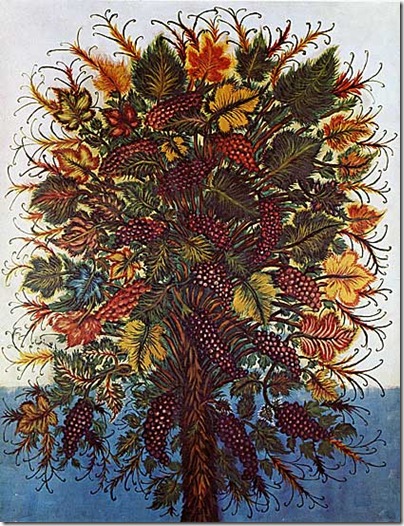
Séraphine

Seraphine

“Be ardent in your work and you will find God in your cooking pots.”

~ St. Teresa of Ávila

Saturday, May 23, 2009

The Seeking Blind

The Winter Sun “People who are destabilized by historical forces are more intelligent than the secure ones who have got the formulas in place. The safety of received tastes and opinions, confirmed in furniture and inherited artworks, stops the true brain, the brain of the seeking blind. When people are uprooted and insecure, their tables are alive with conversation of prophets—philosophy, music, literature, god. But when the people are safe, the repetition of a formula goes around and around.”

~ Fanny Howe, from The Winter Sun: Notes on a Vocation

Wednesday, May 20, 2009

A Story That Has Lasted

Wally Lamb, from Novel Ideas:

Novel Ideas When I began work on my MFA at Vermont College, my teacher, Gladys Swan, asked, “What would you like to accomplish?” I said, “Well, I work with high-school students. I know that some novels really work with them and some don’t. I would love to write a book that would speak to young people the way that To Kill a Mockingbird has spoken to so many of my students and also to me.” We also talked about The Catcher in the Rye in that conversation. I don’t think it’s any accident that both of those novels have a prevalent first-person narrator with a strong sense of voice.

Gladys said to me, “The first thing that you have to do is not think about who your audience is.” She said, “Write it for you. Make it true for yourself, and let the audience find it.” In that same conversation, we talked about a short story I’d just begun about a crazy woman named Mary Anne, who later became Dolores. Gladys said, “You have too many pots on the stove here. There’s too much going on here for a short story.” That’s what I had written up to that point, so I said, “What should I cut out?” She said, “Don’t cut out anything. Keep going. Maybe you’re trying to write a novel.” I said, “Not me. I couldn’t handle that. That’s beyond what I can do.” And she said, “Well, if you want to learn how to write a novel, read the oldest stories. Those stories have lasted because they say things that people have needed to be told over and over and over again.” She said, “The world is an old place and all the stories that people need are already out there. You’re never going to tell an original story because everybody who’s come before you has beaten you to it. Put your own original spin on a story that has lasted.”

She came up with a reading list for me, and when I started reading and studying the myths, seeing the cross sections from culture to culture, that’s when I saw what she was getting at. And, really, that’s been the wellspring that I go back to over and over and over again when I’m starting something new.

Saturday, April 18, 2009

A Free and Active Space

From an interview with Ann Lauterbach, “From the Periphery,” by Celia Band, Poets & Writers (May/June 2009):

The night sky : writings on the poetics of experience In The Night Sky I write about being able to see best from the periphery as a kind of poetics. It’s easy to become romantic and idealize these kinds of abstractions, but I do think it’s pretty clear that when you’re in the center, you can’t see very far, and when you’re outside the bubble—whatever bubble it is—you see more clearly. The margin can be a free and active space. And in American poetry, there are hundreds of centers—everywhere you look there’s another center.

Or to Begin Again …I reject the idea of the muse because I’m not as interested in inspiration as I am in the riddle of making something. A poem is for me much more of an invitation to find form. Once the words are on the page, I have a conversation with them: “How can I help you become a poem?” A poet has to become the most generous and the most critical reader—it’s like being a really good parent. I might say to some of the poems in Or to Begin Again, “You can’t go there!” But they responded, “Yes, I can.”
Friday, November 14, 2008

Flowers

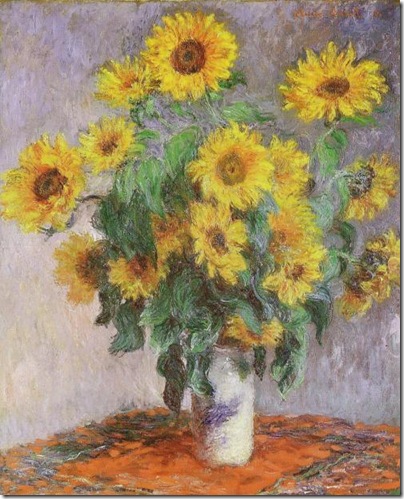
Bouquet de Soleils

"Gardening was something I learned in my youth when I was unhappy. I perhaps owe having become a painter to flowers."

~ Claude Monet

Wednesday, February 27, 2008

You Know How This Works

herbie_hancock"I like the idea of having something that comes from someone else  or some other medium and finding myself in it. I like that process. To me it's intriguing. It's like a puzzle. You have pieces of a puzzle to put together. When it's from yourself, you've got nothing. You gotta make the pieces.

"On the rare occasions when I do write something, once the juices start to flow, I always say to myself, Okay, Herbie, you know how this works. If you stop doing this, the juices will stop flowing and the next time you're gonna have to start up from scratch again. Keep writing. Keep writing. And I always fall down and stop. I always -- but I know the secret is to keep doing it.

"There is something I do now, and I have been doing actually for the past thirty-five years, that I can use to stimulate the production of the pieces. Buddhism. We chant Nam Myōhō Renge Kyō, that's the phrase we use, but it's a sound and what happens is that it opens up your core and is the source for elevating your life condition and getting you in sync with the universe. Where do the songs come from? They come from life. And when life is illuminated, and you feel more illumination from life, then the inspiration is there. It's been sitting out there all along. You just couldn't see it. So I feel more inspired when I chant."  

-- Herbie Hancock talking with Kurt Andersen on Studio 360 (1/18/08).

Listen to an excerpt from "Edith and the Kingpin" with Tina Turner, from Herbie Hancock's River: The Joni Letters which recently won Grammy awards for Album of the Year and Best Contemporary Jazz Album.

Friday, December 14, 2007

Real Red Blood

"In high school, you know, there really wasn't that much around in terms of music. I mean , grunge was kind of happening, but me and none of my friends were old enough to go...We had kind of a top 40 station. But Nashville Skyline -- my parents owned it. I knew Dylan's name, but I dusted that record off and put I it on because of Johnnie Cash. It took a long time for the rest of that josh_ritter2record to sink in, but 'Girl from the North Country' hit me hard. I really think it was like somebody discovering punk for the first time.

"That was my moment when I realized that music was something that anybody could do. You know, here it is -- it's imperfections and it's excitement and the fact that it's real red blood making this record. And really singing. It sounded like they'd been up all night. You could almost tell that they needed to shave.

"Without that song, I might not have ever discovered it. I mean, it was just such a huge moment. I really think it was like seeing the person you want to marry. Either that day or the day after, I went down to Kmart and I got a guitar."

-- Josh Ritter discussing the influence of Bob Dylan on his musical career (Studio 360, 11.23.07)

Monday, May 14, 2007

Like the Fire Through the Mountain

"The truly contemporary force is something that is built of the past, but with a difference. Most of what calls itself contemporary is built, whether it knows it or not, out of a desire to be liked. It is created in imitation of what already exists and is already admired. There is, in other words, nothing new about it. To be contemporary is to rise through the stack of the past, like the fire through the mountain. Only a heat so deeply and intelligently born can carry a new idea into the air."

--Mary Oliver, A Poetry Handbook