
Showing posts with label reality. Show all posts

Friday, April 15, 2011

Real Life

Phil Stutz describing the 96 Hour Academy Awards Principle to Kim Masters on KCRW’s The Business (April 4, 2011):

My rules of life are there’s uncertainty, there’s pain and it requires constant effort. You can’t abrogate those rules. I don’t care how many Academy Awards you’ve won. I find the high lasts roughly 96 hours. After that, the person’s a little bit stunned because life is going on just as it was, they just can’t believe it. And once in a while, they’ll really crash badly. The principle isn’t a treatment for it. I just try to warn them in advance. If they get nominated, I put them in the army to prepare.

*     *     *     *     *

Barry Michael describes the Realm of Illusion (New Yorker):

Our culture denies reality. It suggests that you can live in a world that is free of hardship. The media portray the beautiful people who inhabit this world. Their lives seem like glossy magazine photographs—airbrushed, like a “perfect moment” frozen in time. Phil Stutz was the first person I heard give this mythical world a name: the Realm of Illusion. We’re trained to feel like failures if our lives don’t resemble this ideal world.

But there’s a way to accept the imperfections of real life and still feel good about yourself: First, you must face the truth about reality.

Phil encapsulated this truth in the drawing above. The Realm of Illusion is depicted above the line. The stick figure is you on a quest for the perfect life (symbolized by the square with the dotted line). This realm is just an image. It has no more depth or movement than a still photograph.

Real life is below the line. Each circle represents an event (one project, one confrontation, even one day). The black dots inside each circle are turds. That means that no event is perfect; pain, uncertainty, loss are always with us. But, whether you consider an event a success or a failure, life will keep moving and produce another event. It’s this constant movement that gives life its creative power.

Look at the picture every morning. It reminds you that the Realm of Illusion doesn’t exist. No one’s life is without turds, no matter how successful people appear to be. Practice projecting yourself into the illusion at the top and then forcing yourself downward into the flawed (but alive) reality at the bottom. You’ll develop the following strengths:

  1. You’ll become more accepting of yourself and stop judging yourself against an impossible standard.
  2. You’ll deal with difficulties calmly and rationally as a natural part of life.
  3. You’ll begin to feel a sacred kind of wisdom in events, even the bad ones. This builds faith.

See also: “Hollywood Shadows: A Cure for Blocked Screenwriters,” by Dana Goodyear, New Yorker, March 21, 2011

Friday, November 19, 2010

Getting Right with Tao

A Contemporary Spin on the Tao Te Ching
by Ron Hogan

#28

getting-right-with-tao If you are strong,
but remain sensitive,
power will flow through you.
With that power,
you'll always be right with Tao:
It's like a whole new life.

If you are idealistic,
but stay rooted in reality,
you are an example to others.
Set that example,
and you'll always be right with Tao:
There is no limit to what you can do.

If you are honorable,
but remain humble,
you will see things as they are.
If you see things as they are,
you'll always be right with Tao:
Your life will become simple,
yet full of potential.

Let Tao show you
how to get right with Tao,
so your slightest gesture
can change the world.

*     *     *     *     *

#16

Keep your head clear.
Stay calm.
Watch as everything happens around you.

Everything reverts to its original state,
which was nothing.
And when something becomes nothing,
it gets right with Tao.

If you don't understand that,
you're going to screw up somewhere down the line.
If you figure it out, you'll always know what to do.

If you get right with Tao,
you won't be afraid to die,
because you know you will.

Wednesday, July 21, 2010

Where We Live

"It's no wonder we don't defend the land where we live. We don't live here. We live in television programs and movies and books and with celebrities and in heaven and by rules and laws and abstractions created by people far away and we live anywhere and everywhere except in our particular bodies on this particular land at this particular moment in these particular circumstances."

~ Derrick Jensen, from Endgame, Volume 2: Resistance

Sunday, June 27, 2010

Experiences that We Know are Not Real

Excerpt from How Pleasure Works: The New Science of Why We Like What We Like by Paul Bloom:

How Pleasure WorksHow do Americans spend their leisure time? The answer might surprise you. The most common voluntary activity is not eating, drinking alcohol, or taking drugs. It is not socializing with friends, participating in sports, or relaxing with the family. While people sometimes describe sex as their most pleasurable act, time-management studies find that the average American adult devotes just four minutes per day to sex.

Our main leisure activity is, by a long shot, participating in experiences that we know are not real. When we are free to do whatever we want, we retreat to the imagination—to worlds created by others, as with books, movies, video games, and television (over four hours a day for the average American), or to worlds we ourselves create, as when daydreaming and fantasizing. While citizens of other countries might watch less television, studies in England and the rest of Europe find a similar obsession with the unreal.

This is a strange way for an animal to spend its days. Surely we would be better off pursuing more adaptive activities—eating and drinking and fornicating, establishing relationships, building shelter, and teaching our children. Instead, 2-year-olds pretend to be lions, graduate students stay up all night playing video games, young parents hide from their offspring to read novels, and many men spend more time viewing Internet pornography than interacting with real women. One psychologist gets the puzzle exactly right when she states on her Web site: "I am interested in when and why individuals might choose to watch the television show Friends rather than spending time with actual friends."

One solution to this puzzle is that the pleasures of the imagination exist because they hijack mental systems that have evolved for real-world pleasure. We enjoy imaginative experiences because at some level we don't distinguish them from real ones. This is a powerful idea, one that I think is basically—though not entirely—right...

...Just as artificial sweeteners can be sweeter than sugar, unreal events can be more moving than real ones. There are three reasons for this.

First, fictional people tend to be wittier and more clever than friends and family, and their adventures are usually much more interesting. I have contact with the lives of people around me, but this is a small slice of humanity, and perhaps not the most interesting slice. My real world doesn't include an emotionally wounded cop tracking down a serial killer, a hooker with a heart of gold, or a wisecracking vampire. As best I know, none of my friends has killed his father and married his mother. But I can meet all of those people in imaginary worlds.

Second, life just creeps along, with long spans where nothing much happens. The O.J. Simpson trial lasted months, and much of it was deadly dull. Stories solve this problem—as the critic Clive James once put it, "Fiction is life with the dull bits left out." This is one reason why Friends is more interesting than your friends.

Finally, the technologies of the imagination provide stimulation of a sort that is impossible to get in the real world. A novel can span birth to death and can show you how the person behaves in situations that you could never otherwise observe. In reality you can never truly know what a person is thinking; in a story, the writer can tell you.

Sunday, March 14, 2010

Not as Good as the Needle

“Sugar pills, injections of nothing -- studies show that, more often than you'd expect, placebos really work. At TEDMED, magician Eric Mead does a trick to prove that, even when you know something's not real, you can still react as powerfully as if it is.”

Tuesday, February 23, 2010

Hunger for Reality

“Every single one of these [successful games] has succeeded off a clever psychological angle. But there’s more than that. There’s something else these things have in common, not just these psychological tricks. What these all have in common is they are all busting through to reality. We’re used to, in the old days of gaming, it being all about fantasy. It’s all about fantasy and Ben Gordon used to say, ‘We don’t care about realism in games because people come to our games to escape from reality.’ And so we have this strong belief that fantasy is the thing. But every single one of these is breaking through into reality in some interesting way. And we don’t feel good about reality as game designers. We’re a little uncomfortable about reality…

…But it’s not just us that were kind of snuck up on by this reality thing. And it’s not just just happening to us. Go look at TV. The people in TV, their heads are spinning. Everything’s turned into reality TV. Go to the grocery store. It’s not just groceries anymore. It’s organic groceries. The more genuine, the more real groceries. You go to McDonald’s and to get a Big Mac and – you could get a Big Mac or you could get the real burger, the angus burger made with real this and that or whatever. Everything is suddenly about reality.

Now what’s going on? Is this just how it’s always been? Well, I found this really interesting book. It’s called Authenticity. It’s by the guys who wrote The Experience EconomyGilbert and Pine put forth this most interesting concept: the most valuable thing in products is are the real, are they authentic. Which is a bold hypothesis. And then they go further and they say, Why is it? Why now? It didn’t always used to be this way. Certainly that’s not what sold stuff in the eighties…They’re arguing that all this virtual stuff that’s been creeping up on us over the last twenty years has really cut us off from nature. We’re cut off from self-sufficiency. We couldn’t be self-sufficient if we wanted to. We don’t know how to do it. We live in a bubble of fake bullshit and we have this hunger for to get to anything that’s real. Even if the best we can do is a Starbucks mocha with real Swiss chocolate — we’ll take it. Oh, look how real that seems to me relative to what I’m used to. And so there’s this idea that maybe there’s this hunger for reality. ”

~ Jesse Schell, from his talk at DICE Summit 2010

Monday, February 22, 2010

To Map Out the World

Art Spiegelman and Francoise Mouly discussing The Toon Treasury of Classic Children’s Comics with Michael Silverblatt on KCRW’s Bookworm (February 4, 2010).

Francoise Mouly: Kids aren’t necessarily — the way we imagine they might be — looking for escape and fantasy. Actually, the seven year old, the eight year old, is eager for a way to map out information — to map out the world. And that’s part of the reason why comics appeal to them. Because they are a very instinctive way to structure information…As Art has often referred to it, it’s a story made manifest spatially. You have a very instinctive way to understand narratives and to understand character’s emotion…It gives you cues. It is in and of itself a medium that kids can use to understand all other kinds of visual information – much more than watching television or playing video games…They can go back to the same story and read it over and over again. And also because it’s done by one person — it’s drawn by hand — it inspires them to want to make comics.

Art Spiegelman: What makes this a real treasury rather than just a bunch of product put together in four hundred pages of offering [is that] so much of this is written and drawn by the same person…And here when we’re looking at Walt Kelly and Sheldon Mayer and, to a degree, John Stanley and certainly Carl Barks, they were really able to enter and make a whole world themselves. Really act it out, draw it, and write it. So you’re really throbbing inside one person’s brain. And to have that many brains presenting fully realized worlds, you feel it when you’re looking through these stories. They have a kind of urgency in their own way…These characters are a lot more complex than Spider Man. Little Lulu is so much more richer than Peter Parker.

Tuesday, July 28, 2009

Fundamental Reality

From “Buddhism and Quantum Physics,” by Christian Thomas  Kohl, The Buddhist Channel (July 22, 2009):

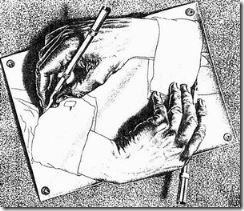
Drawing Hands, a 1948 lithograph by M. C. Escher

If you don’t believe in a creator, nor in the laws of nature, nor in a permanent object, nor in an absolute subject, nor in both, nor in any of it, in what do you believe then? What remains that you can consider a fundamental reality? The answer is simple; it is so simple that we barely consider it being a philosophical statement: things depend upon other things. For instance, a thing is dependent upon its cause. There is no effect without a cause and no cause without an effect. There is no fire without fuel, no action without an actor and vice versa. Things are dependent upon other things; they are not identical with each other, nor do they break up into objective and subjective parts.

This Buddhist concept of reality is often met with disapproval and considered incomprehensible. But there are modern modes of thought with points of contact. For instance, there is a discussion in quantum physics about fundamental reality. What is fundamental in quantum physics: particles, waves, field of force, law of nature, mindsets or information? Quantum physics came to a result that is expressed by the key words of complementarity, interaction and entanglement.

According to these concepts there are no independent quantum objects, just complementary ones; they are at the same time waves and particles. Quantum objects interact with others, and they are entangled even when they are separated at a far distance. Without being observed philosophically, quantum physics has created a physical concept of reality. According to that concept, the fundamental reality is an interaction of systems that interact with other systems and with their own components.

Gary Larson, March 23, 1984

"Ohhhhhhh...Look at that, Schuster...Dogs are so cute when they try to comprehend quantum mechanics."

Thursday, July 02, 2009

An Unreal Life

Hermann Hesse "There is no reality except the one contained within us. That is why so many people live such an unreal life. They take the images outside them for reality and never allow the world within to assert itself."

~ Hermann Hesse

Wednesday, June 03, 2009

Trying to Get Something Real

An excerpt from The Brothers Bloom by Rian Johnson:

Rachel Weisz as Penelope in The Brothers BloomBLOOM
Stephen enjoyed it. He loved the idea that we were internationally infamous art smugglers, but I think deep down, same as me, he felt like we were putting on a persona, faking it.

PENELOPE
Telling a story.

BLOOM
He’d love to die on a job. Cornered at midnight on a run to Jakarta. That’s his dream, to tell his story so well it fulfills itself. It somehow would make it finally real for him.

PENELOPE
That’s kinda the thing we all want, right?

BLOOM
Trying to get something real by telling yourself stories is a trap. Trust me on that one.

Thursday, April 23, 2009

Like Yesterday

“You must not count overmuch on your reality as you feel it today, since, like that of yesterday, it may prove an illusion for you tomorrow.”

~ Luigi Pirandello

[Thanks Alex!]