
Showing posts with label flow. Show all posts

Saturday, May 07, 2011

Direct Contact

May 7, 2011

From “Purpose and Method of Vipassana Meditation,” by Shinzen Young:

The essence of this practice can be stated as a simple formula: ordinary experience plus mindfulness plus equanimity yields insight and purification. In this formula, each term is defined very precisely. Ordinary experience is defined as hearing, seeing, smelling, tasting, the feeling body and the thinking mind. Mindfulness is defined as specificity in awareness, clarity in awareness, continuity in awareness, richness in awareness, precision in awareness. Equanimity is defined as not interfering with the flow of the senses at any level, including the level of preconscious processing.

When sufficient mindfulness and equanimity are brought to bear on ordinary experience, we arrive at purification and insight. And, as a result of the purification and insight, our intrinsic happiness, our true birthright and spiritual reality, gets uncovered and we discover that what we thought was the world of phenomena—the world of time, space, and matter—turns out to really be a world of spiritual energy, and that we are in direct contact with it moment by moment. Because, when the senses become purified, when the inner conflicts—at all levels—have been broken up, the flow of these ordinary senses turns into a prayer, a mantra, a sacred song, and we find that, just by living our life, we are in moment-by-moment contact with the Source. In the Christian contemplative tradition this is called the "practice of the presence of God." In the Jewish mystical tradition it is called briah yesh me ayn—the experience of things (yesh) being continuously created (briah) from no-thing (ayn), that is, from God.

For most people the senses are opaque. A window is opaque if it is covered by soot; light can't come through. The soot is craving, aversion, and ignorance. When that's cleared away, the ordinary senses become literally transparent. It is very hard to describe what this is like. Hearing returns to being part of the effortless flow of nature, seeing returns to being part of the effortless flow of nature, and likewise with smelling, tasting, the body sensations whether they are pleasant, unpleasant, or neutral, they all go back to being part of "God's breath" so to speak.

Even the thinking process returns to being part of this effortless flow. At the beginning stages of meditation one is very concerned with overcoming the wandering thoughts in order to develop enough calm and concentration to be able to practice mindfulness. But when you get further along in the process there will be no necessity whatsoever to have a still mind because the ordinary flow of thought will be experienced as not different from the activity of the Source.

Read more…

Saturday, April 23, 2011

To Cultivate Attention

Excerpts from "Buddha Nature: Living in Attention," by Ken McLeod:

"It seems to me that the intention of all these practices is to cultivate attention, either by practicing attention directly or by removing what prevents attention from developing. Once attention is present, appropriate action, skillful means, bodhicitta, everything else flows quite naturally. There is no need for minute dissections of Buddhist ethics or philosophy. The phrase ‘Be there or be square’ acquired a new meaning for me. Very simply, attention reveals buddha nature and enables it to manifest in our lives...

Once I shifted my effort to paying attention to what was arising, doors started to open. I began to see a little more clearly what was going on. I'd had to let go of old ways of looking at things, some that I had learned in the course of my training, others going back much further to family patterns. The patterns became apparent. The function and purpose of the patterns also became apparent...

Bring the attention to what is arising and we know, directly, what needs to be done. This changed not only my own practice but how I tried to teach others. The source of that knowing is buddha nature. And the practice is very simple in principle: strip away whatever prevents it from manifesting.

Read the entire essay...

[Thanks, Kit !]

Monday, January 31, 2011

My Only Drink

Hierve de Aqua, San Isidro, Oaxaca (Fall 2010)

The First Words
by Seamus Heaney, from The Spirit Level

The first words got polluted
Like river water in the morning
Flowing with the dirt
Of blurbs and the front pages.
My only drink is meaning from the deep brain,
What the birds and the grass and the stones drink.
Let everything flow
Up to the four elements,
Up to water and earth and fire and air.

Thursday, January 20, 2011

A Creature in the River of Knowledge

Monologue from a fictional neuroscientist speaking at an imagined Aspen Ideas Festival/TED Talk event, from “Social Animal,” by David Brooks, New Yorker, Jan. 17. 2011:

“I guess I used to think of myself as a lone agent, who made certain choices and established certain alliances with colleagues and friends…Now, though, I see things differently. I believe we inherit a great river of knowledge, a flow of patterns coming from many sources. The information that comes from deep in the evolutionary past we call genetics. The information passed along from hundreds of years ago we call culture. The information passed along from decades ago we call family, and the information offered months ago we call education. But it is all information that flows through us. The brain is adapted to the river of knowledge and exists only as a creature in that river. Our thoughts are profoundly molded by this long historic flow, and none of us exists, self-made, in isolation from it.

Columbia River plume “And though history has made us self-conscious in order to enhance our survival prospects, we still have deep impulses to erase the skull lines in our head and become immersed directly in the river. I’ve come to think that flourishing consists of putting yourself in situations in which you lose self-consciousness and become fused with other people, experiences, or tasks. It happens sometimes when you are lost in a hard challenge, or when an artist or a craftsman becomes one with the brush or the tool. It happens sometimes while you’re playing sports, or listening to music or lost in a story, or to some people when they feel enveloped by God’s love. And it happens most when we connect with other people. I’ve come to think that happiness isn’t really produced by conscious accomplishments. Happiness is a measure of how thickly the unconscious parts of our minds are intertwined with other people and with activities. Happiness is determined by how much information and affection flows through us covertly every day and year.”

Read the entire piece here…

Friday, November 19, 2010

Getting Right with Tao

A Contemporary Spin on the Tao Te Ching
by Ron Hogan

#28

getting-right-with-tao If you are strong,
but remain sensitive,
power will flow through you.
With that power,
you'll always be right with Tao:
It's like a whole new life.

If you are idealistic,
but stay rooted in reality,
you are an example to others.
Set that example,
and you'll always be right with Tao:
There is no limit to what you can do.

If you are honorable,
but remain humble,
you will see things as they are.
If you see things as they are,
you'll always be right with Tao:
Your life will become simple,
yet full of potential.

Let Tao show you
how to get right with Tao,
so your slightest gesture
can change the world.

*     *     *     *     *

#16

Keep your head clear.
Stay calm.
Watch as everything happens around you.

Everything reverts to its original state,
which was nothing.
And when something becomes nothing,
it gets right with Tao.

If you don't understand that,
you're going to screw up somewhere down the line.
If you figure it out, you'll always know what to do.

If you get right with Tao,
you won't be afraid to die,
because you know you will.

Monday, November 02, 2009

The Full Flowering of Humanity

Coming Home “Enlightenment is the awakening to our primal harmony or, in another mystical language, to our rootedness in the Divine. From Enlightenment radiate the insight, compassion, and power needed to resolve individual and collective human problems as they continue to rise endlessly. Enlightenment is not a magical transcendence of the human condition but the full flowering of humanity, disclosing unity and equilibrium at the heart of the love and suffering we call life.
All existence is revealed to the Enlightened human being as a seamless whole, as Divine Life. Some taste of this Enlightenment which consciously touches the Ultimate is possible for each of us. It need not be deferred to any future existence in heaven or on earth.

Enlightenment is the secret essence of our consciousness, and the gradual revelation of this essence is the process of spiritual growth in which everyone is involved.”

~ Lex Hixon, from Coming Home: The Experience of Enlightenment in Sacred Traditions

Monday, October 12, 2009

Extemporizing

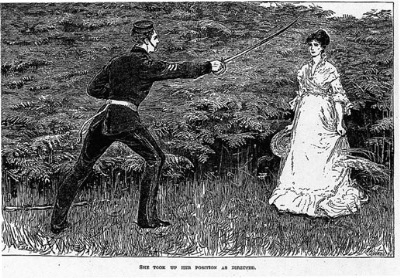
"She took up her position as directed." Troy courts Bathsheba; Cornhill illustration by Helen Paterson Allingham.

"It is safer to accept any chance that offers itself, and extemporize a procedure to fit it, than to get a good plan matured, and wait for a chance of using it."

~ Thomas Hardy, from Far from the Madding Crowd

[Thanks Linda!]

Wednesday, May 20, 2009

Everything Wiggles


A 1971 television recording with Alan Watts walking in the mountains and talking about the limitations of technology and the problem of trying to keep track of an infinite universe with a single tracked mind. Video posted by Alan's son and courtesy of www.alanwatts.com.

[Thanks Ron!]

Wednesday, April 22, 2009

Leaving the Doors and Windows Open

Jonathan Carroll on writer’s block. Read the rest of his essay at Timothy Hallinan’s The Blog Cabin:

jonathan_carroll I like to write.  I have always considered writing my friend. We sit down together in the morning and do our job.   But (and this is a big but) if my friend Writing (notice the capital W) says not today because I’d rather go for a walk, or coffee, or nothing at all, I say fine — no work today.  If that extends to a week, then so be it.  Like the wild animals living so oddly but comfortably in the gamekeeper’s house on the Serengeti Plain, Writing stays friendly to me so long as I let him come and go as he pleases. If he doesn’t want to stay in the house he walks out and I do something else like read a book or go to the movies.  I never, ever grab Writing by the neck and say you sit back down here and go to work.   I would never treat a friend like that, nor would I treat a tiger like that.  So why treat the thing I love as much as my creative drive like that?

I believe people get writer’s block a lot of the time because they panic when the flow stops.  Then they run around the house shutting the doors and windows, trying to keep their creativity inside and at work.  Bad idea.  I do think that if they were just to get up and walk away from their work for however long, a lot of their problems would solve themselves.  Some of you might say yeah but I’ve been blocked for six months — what about that?  I’d posit that it’s likely some of the block, maybe not all, is because you are scared and trying to close all your windows.  Which in turn has scared your Writing and made IT panicky.

Tuesday, November 18, 2008

Then Something Moves Me

"We write so much of our songs in, how do you say, improvising sort of thing. Well, if you call it improvising. I think its more just when you get into a flow with somebody. We always go into a studio…And he starts playing. We hit record straight away. And then I just sort of sit around doing nothing and then something happens that moves me. And I kind of react to that and it's something very beautiful that happens. Because sometimes, you know, one wants to go up and the other one wants to go down and so it's a clash and you have to stop and go back, and you know, write the song. And sometimes both are just completely there and it's like, when that happens, it's like some kind of tunnel vision happens. And you almost feel like you don't have a body at all. There's this panoramic view of things happening and it's kind of explaining that -- what you're seeing. It's a beautiful feeling. You get really addicted to it."

~ Emiliana Torrini, discussing her writing the songs on her latest album, Me and Armini, with David Dye on the World Café (11.18.08)

Sunday, March 16, 2008

Paradise

"The real difference between God and human beings, he thought, was that God cannot stand continuance. No sooner has He created a season of a year, or a time of the day, than He wishes for something quite different, and sweeps it all away. No sooner was one a young man, and happy at that, than the nature of things would rush one into marriage, martyrdom, or old age. And human beings cleave to the existing state of things. All their lives they are striving to hold the moment fast, and are up against a force majeure. Their art itself is nothing but an attempt to catch by all means the one particular moment, one mood, one light, the momentary beauty of one woman or one flower, and make it everlasting. It is all wrong to imagine paradise as a never-changing state of bliss. It will probably, on the contrary, turn out to be, in the true spirit of God, an incessant up and down, a whirlpool of change. Only you may yourself, by that time, have become one with God, and have taken a liking to it."
Isak Dinesen, "The Monkey," Seven Gothic Tales

[Thanks JC!]