Showing posts with label interdependence. Show all posts

Saturday, April 23, 2011

Silence No One Hears

Poem with No Speaker
by Franz Wright, from Earlier Poems

Are you looking
for me? Ask that crow

rowing
across the green wheat.

See those minute air bubbles
rising to the surface

at the still creek's edge—
talk to the crawdad.

Inquire
of the skinny mosquito

on your wall
stinging its shadow,

this lock
of moon

lifting
the hair on your neck.

When the hearts in the cocoon
start to beat,

and the spider begins
its hidden task,

and the seed sends its initial
pale hairlike root to drink,

you'll have to get down on all fours

to learn my new address:
you'll have to place your skull

besides this silence
no one hears.

Thursday, January 20, 2011

A Creature in the River of Knowledge

Monologue from a fictional neuroscientist speaking at an imagined Aspen Ideas Festival/TED Talk event, from “Social Animal,” by David Brooks, New Yorker, Jan. 17. 2011:

“I guess I used to think of myself as a lone agent, who made certain choices and established certain alliances with colleagues and friends…Now, though, I see things differently. I believe we inherit a great river of knowledge, a flow of patterns coming from many sources. The information that comes from deep in the evolutionary past we call genetics. The information passed along from hundreds of years ago we call culture. The information passed along from decades ago we call family, and the information offered months ago we call education. But it is all information that flows through us. The brain is adapted to the river of knowledge and exists only as a creature in that river. Our thoughts are profoundly molded by this long historic flow, and none of us exists, self-made, in isolation from it.

Columbia River plume “And though history has made us self-conscious in order to enhance our survival prospects, we still have deep impulses to erase the skull lines in our head and become immersed directly in the river. I’ve come to think that flourishing consists of putting yourself in situations in which you lose self-consciousness and become fused with other people, experiences, or tasks. It happens sometimes when you are lost in a hard challenge, or when an artist or a craftsman becomes one with the brush or the tool. It happens sometimes while you’re playing sports, or listening to music or lost in a story, or to some people when they feel enveloped by God’s love. And it happens most when we connect with other people. I’ve come to think that happiness isn’t really produced by conscious accomplishments. Happiness is a measure of how thickly the unconscious parts of our minds are intertwined with other people and with activities. Happiness is determined by how much information and affection flows through us covertly every day and year.”

Read the entire piece here…

Monday, January 17, 2011

The Interrelated Structure of Reality

"It really boils down to this: that all life is interrelated. We are all caught in an inescapable network of mutuality, tied together into a single garment of destiny. Whatever affects one directly, affects all indirectly…Before you finish eating breakfast in the morning, you've depended on more than half the world. This is the way our universe is structured, this is its interrelated quality. We aren't going to have peace on Earth until we recognize the basic fact of the interrelated structure of all reality. "

~ Dr. Martin Luther King, Jr., A Christmas Sermon on Peace (1967)

Thursday, June 24, 2010

No Other Meaning

The House Was Quiet And The World Was Calm
by Wallace Stevens, from Harmonium

The house was quiet and the world was calm.
The reader became the book; and summer night

Was like the conscious being of the book.
The house was quiet and the world was calm.

The words were spoken as if there was no book,
Except that the reader leaned above the page,

Wanted to lean, wanted much to be
The scholar to whom his book is true, to whom

The summer night is like a perfection of thought.
The house was quiet because it had to be.

The quiet was part of the meaning, part of the mind:
The access of perfection to the page.

And the world was calm. The truth in a calm world,
In which there is no other meaning, itself

Is calm, itself is summer and night, itself
Is the reader leaning late and reading there.

[Thanks Mark!]

We Can Be with Both

“Psychology has refined such a nuanced observation, understanding and insight about the particulars of our human psyches. And certain existential truths that are universal, of course. And there is a realm that we call absolute or universal. It’s not separate. We can call it emptiness, there are so many names. But it’s completely interwoven. It’s one with, it’s connected to, the words don’t express the fact that it’s not  separate from the particular. And the trick for us as practitioners, whether we are practitioners of psychology or meditation, is to really see and unite these experiences so that we can be present with the ordinary moments of our life, and more and more hold an understanding of those moments as Weeds and Purple Flowersbeing deeply significant, expressions of the truth of that moment. Not truth with a capital T that some reified, always true…but the truth of that moment because it’s life. It’s life in the form of you, me, this moment of experience. And then, when we really can truly know that, so many things are possible for us. We don’t have to be afraid of experience or afraid of our own minds. Of course, we like flowers, we hate weeds. We wish for happy experiences and we kind of dread scary sad ones. But as practitioners we can really be with both.”

~ Trudy Goodman, from “Zen, Vipassana, and Psychotherapy,” Buddhist Geeks Podcast: Episode 173 (May 24, 2010)

Tuesday, July 28, 2009

Fundamental Reality

From “Buddhism and Quantum Physics,” by Christian Thomas  Kohl, The Buddhist Channel (July 22, 2009):
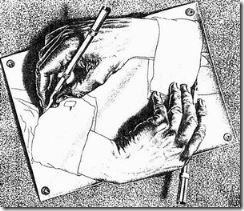
Drawing Hands, a 1948 lithograph by M. C. Escher

If you don’t believe in a creator, nor in the laws of nature, nor in a permanent object, nor in an absolute subject, nor in both, nor in any of it, in what do you believe then? What remains that you can consider a fundamental reality? The answer is simple; it is so simple that we barely consider it being a philosophical statement: things depend upon other things. For instance, a thing is dependent upon its cause. There is no effect without a cause and no cause without an effect. There is no fire without fuel, no action without an actor and vice versa. Things are dependent upon other things; they are not identical with each other, nor do they break up into objective and subjective parts.

This Buddhist concept of reality is often met with disapproval and considered incomprehensible. But there are modern modes of thought with points of contact. For instance, there is a discussion in quantum physics about fundamental reality. What is fundamental in quantum physics: particles, waves, field of force, law of nature, mindsets or information? Quantum physics came to a result that is expressed by the key words of complementarity, interaction and entanglement.

According to these concepts there are no independent quantum objects, just complementary ones; they are at the same time waves and particles. Quantum objects interact with others, and they are entangled even when they are separated at a far distance. Without being observed philosophically, quantum physics has created a physical concept of reality. According to that concept, the fundamental reality is an interaction of systems that interact with other systems and with their own components.

Gary Larson, March 23, 1984

"Ohhhhhhh...Look at that, Schuster...Dogs are so cute when they try to comprehend quantum mechanics."

Tuesday, June 23, 2009

The Sun Grows In Your Smile

by Linda Rodriquez, from Heart’s Migration

When you smile, the air grows warm and soft,
the earth is watered with gentle mists,
seeds sprout and spread leaves above the dark, damp soil,
earthworms pierce the crust and frolic across the surface
to the delight of fat, happily hunting robins,
lilies of the valley unfurl beside purple, grape-scented irises,
fat pink and maroon peonies, and gay California poppies,
damask roses hurl their rich fragrance to the wind,
the crazy-with-sheer-joy song of the Northern mockingbird
echoes above other chirps and sweet winged notes,
gardeners join the worms in the warm, rich dirt,
children gallop across yards and grab handfuls of dandelions
to present to mothers who will set them in glasses of water
in kitchen windows or on dining room tables, weeds
glorious after the dark of winter with the color of the sun
that grows and warms and heals in your smile.

[Thanks Garrison!]

Wednesday, May 20, 2009

Everything Wiggles


A 1971 television recording with Alan Watts walking in the mountains and talking about the limitations of technology and the problem of trying to keep track of an infinite universe with a single tracked mind. Video posted by Alan's son and courtesy of www.alanwatts.com.

[Thanks Ron!]