
Showing posts with label present. Show all posts

Monday, April 11, 2011

Looking for Meaning in Objects

Excerpt from “Alive Enough?on Being, April 7, 2011:

Krista Tippett (host): I'm utterly intrigued just by the way you describe your passion, your interest and concern, that you study this objective side of our encounters with technologies, that I'm concerned with— the human meaning of the objects of our lives. And just as we start, I wanted to ask you a kind of question I ask everyone, which is, was there a spiritual background to your childhood?

Sherry Turkle (author of Alone Together): Well, I think in my case the question didn't come from a spiritual quest. It came from a deeply personal psychological quest. My father — my biological father disappeared from my life when I was around two. My mother, my grandparents, my mother's sister, my aunt, didn't want me to know anything about him. And so, of course, I only wanted to know things about him and would search…

There were these places. There was a closet that had old books and trinkets and there was a junk drawer. There were just these places where the memories were kept. I would scour them for traces of him and finally I found one. I found a photograph of him in which someone in anger had rubbed out his face, but I found all kinds of information from that photograph, you know, that he wore tweed pants, where he was standing, what his lace-up shoes looked like, and I just think that some place in that quest of a child, the notion of looking for objects to fill in human meaning became very close to my heart in a very personal way.

As I became a sociologist, [I discovered] there's a fancy word for studying this; it's called bricolage. It's the science of studying meanings and the interplay of objects, and I realized that that's kind of what I'd been doing all the time. A little bit like Molière's, Monsieur Jourdain who'd been speaking prose all his life without knowing it, I'd been a bricoleur all my life without knowing it.

*     *     *     *     *

To make our life livable, we have to have spaces where we are fully present to each other or to ourselves, where we're not competing with the roar of the Internet and, quite frankly, where the people around us are not competing with the latest news off the Facebook status update. They may not have anything new. They may just be there being in a way that needs attention. I mean, people like to put things on Facebook--and certainly Twitter--that are happy. I've interviewed people who say things to me as simple as, you know, I don't even like to put that my dog died...because it doesn't seem the place. It doesn't seem the place for a lot of people to share negative things.

Anyway, I guess I'm saying that sacred space [are] the places in your daily life where you want to keep them for yourself and the people who you need to give your full attention to. I have very simple rules — so far as I have rules — for how to know you're close to one or in one or should be having one: it's dinner, it's sharing meals with your family, it's that moment at school pickup when your kid looks up and is trying to meet your eye. You know, you're looking down at your smartphone and your child is trying to meet your eye.

swing I have enough data from children who're going through this experience to know that it's a terrible moment for them. It's on the playground. Very bad when your child's on the jungle gym and is desperately trying to have you look at them, for them to be taking hands off the jungle gym to try to get your attention — accident time. I mean, be in the park. Be in the park with them. Spend less time there, but make it a space. Make it a moment. These are important moments.

*     *     *     *     *

See also: “Brainpower,” To the Best of Our Knowledge, 4/10/11

Wednesday, April 06, 2011

Maybe We Try Too Hard

April 6, 2011

"Maybe we try too hard to be remembered, waking to the glowing yellow disc in ignorance, swearing that today will be the day, today we will make something of our lives. What if we are so busy searching for worth that we miss the sapphire sky and cackling blackbird. What else is missing? Maybe our steps are too straight and our paths too narrow and not overlapping. Maybe when they overlap someone in another country lights a candle, a couple resolves their argument, a young man puts down his silver gun and walks away."

~ Naomi Shihab Nye, from Time You Let Me: 25 Poets Under 25

@WhiskeyRiver

Saturday, April 02, 2011

Just Another Phenomenon of Consciousness

Excerpt from “Just One Breath: The Practice of Poetry and Meditation,” by Gary Snyder, Tricycle Magazine, Fall 1991:

snyder Traditions of deliberate attention to consciousness, and of making poems, are as old as humankind. Meditation looks inward, poetry holds forth. One is private, the other is out in the world. One enters the moment, the other shares it. But in practice it is never entirely clear which is doing which.

In any case, we do know that in spite of the contemporary public perception of meditation and poetry as special, exotic, and difficult, they are both as old and as common as grass. The one goes back to essential moments of stillness and deep inwardness, and the other to the fundamental impulse of expression and presentation.

People often confuse meditation with prayer, devotion, or vision. They are not the same. Meditation as a practice does not address itself to a deity or present itself as an opportunity for revelation. This is not to say that people who are meditating do not occasionally think they have received a revelation or experienced visions. They do. But to those for whom meditation is their central practice, a vision or a revelation is seen as just another phenomenon of consciousness and as such is not to be taken as exceptional.

The meditator would simply experience the ground of consciousness, and in doing so avoid excluding or excessively elevating any thought or feeling. To do this one must release all sense of the "I" as experiencer, even the "I" that might think it is privileged to communicate with the divine. It is in sensitive areas such as these that a teacher can be a great help.

Read the entire essay…

Wednesday, March 23, 2011

What’s Always Here

Excerpt from Natural Awareness: Guided Meditations and Teachings for Welcoming All Experience by Pema Chödrön:

There are various ways to say what we’re doing here. One of them is uncovering our natural wakefulness or open awareness. Not attaining it or achieving it, but relaxing enough to experience it—to tune into it. What’s always said is like tuning into what’s always here.

When you listen to sounds…

For just a moment, just listen.

Can you hear your heartbeat?

Or feel your heartbeat?

Can you hear your breath?

The idea is that your heart is hopefully always beating. You’re always breathing. But there’s no consciousness of it. In the same way, you’re not conscious of the sounds. We all know what it’s like to walk a city block or country street — or anywhere — and be so lost in thought that you don’t see anything that’s on that street — just enough to keep you from bumping into people or falling down. But you miss a lot.

So the practice is returning or tuning into this natural ability to be present and see and hear — to be conscious, really. You could call it a practice of being fully conscious as opposed to being unconscious. Which is a pretty typical state. Lost in thought. Wandering away.

The point I’m trying to make is it’s not about acquiring something, but uncovering or tuning into a natural wakefulness, a natural awareness, an open awareness that’s always been here.

Tuesday, March 15, 2011

A Philosophy of the Present

From “In Search of the Present,” by Octavio Paz (translated by Anthony Stanton), Nobel Lecture, October 8, 1990:

Reflecting on the now does not imply relinquishing the future or forgetting the past: the present is the meeting place for the three directions of time. Neither can it be confused with facile hedonism. The tree of pleasure does not grow in the past or in  the future but at this very moment. Yet death is also a fruit of The death mask of Sir Isaac Newton.the present. It cannot be rejected, for it is part of life. Living well implies dying well. We have to learn how to look death in the face. The present is alternatively luminous and somber, like a sphere that unites the two halves of action and contemplation. Thus, just as we have had philosophies of the past and of the future, of eternity and of the void, tomorrow we shall have a philosophy of the present. The poetic experience could be one of its foundations. What do we know about the present? Nothing or almost nothing. Yet the poets do know one thing: the present is the source of presences.

In this pilgrimage in search of modernity I lost my way at many points only to find myself again. I returned to the source and discovered that modernity is not outside but within us. It is today and the most ancient antiquity; it is tomorrow and the beginning of the world; it is a thousand years old and yet newborn. It speaks in Nahuatl, draws Chinese ideograms from the 9th century, and appears on the television screen. This intact present, recently unearthed, shakes off the dust of centuries, smiles and suddenly starts to fly, disappearing Venus of Willendorf through the window. A simultaneous plurality of time and presence: modernity breaks with the immediate past only to recover an age-old past and transform a tiny fertility figure from the Neolithic into our contemporary. We pursue modernity in her incessant metamorphoses yet we never manage to trap her. She always escapes: each encounter ends in flight. We embrace her and she disappears immediately: it was just a little air. It is the instant, that bird that is everywhere and nowhere. We want to trap it alive but it flaps its wings and vanishes in the form of a handful of syllables. We are left empty-handed. Then the doors of perception open slightly and the other time appears, the real one we were searching for without knowing it: the present, the presence.

[Thanks, Whiskey River!]

Wednesday, March 02, 2011

Sing and Dance While the Music Plays

A short animated clip made by Trey Parker & Matt Stone featuring Alan Watts, from Do You Do It, or Does It Do You?


[Thanks, Alex!]

Saturday, January 15, 2011

Where Work and Play Merge

From Free Play: Improvisation in Life and Art by Stephen Nachmanovitch:

We have all observed the intense absorption of children in play, that wide-eyed concentration in which both the child and the world vanish, and there is only the play. Grown-ups involved in work they love also can experience such moments. It is possible to become what you are doing; these times come when pouf!—out you go, and there is only the work. The intensity of your focused concentration and involvement maintains and augments itself, your physical needs decrease, your gaze narrows, your sense of time stops. You feel alert and alive; effort becomes effortless. You lose yourself in your own voice, in the handling of your tools, in your feelings for the rules. Absorbed in the pure fascination of the game of that particular medium, you forget time and place and who you are. The noun of self becomes a verb. This flashpoint of creation in the present moment is where work and play merge.
Buddhists call this state of absorbed, selfless, absolute concentration samadhi. Samadhi is best known to be attainable through the practice of meditation, thought there is also walking samadhi , cooking samadhi, sandcastle-building samadhi, writing samadhi, fighting samadhi, lovemaking samadhi, flute-playing samadhi. When the self-clinging personality somehow drops away, we are both entranced and alert at the same time.

Babies of our own and other species seem to be often, if not usually, in a state of samadhi, and also have the unique property of putting everyone around them into a state of samadhi as well. Happy, relaxed, unmindful of self, concentrated, the baby envelops us in her own state of divine delight and expansiveness. Even when a baby is squalling and miserable, and making everyone else miserable too, she is whole and thorough about it, and is generating her own special atmosphere of squalling samadhi and misery-making samadhi

…One of the great ways of emptying the self, along with meditation, dance, love, and play, is tuning a musical instrument. In tuning an instrument we are forced to obliterate outside noises and distractions: As the sound gets closer and closer to the pure vibration we are trying for, as the pitch moves up and down over a smaller and smaller range, we find body and mind progressively dropping away. We enter more and more deeply into the sound. We enter into a kind of trance state. This intensified listening is deep play—total immersion in the game. And once we pick up that instrument to play, our friends the audience will enter into a similar state of mind more readily in proportion to the care we have given to that process of tuning. What we discover, mysteriously, is that in tuning the instrument we tune the spirit.

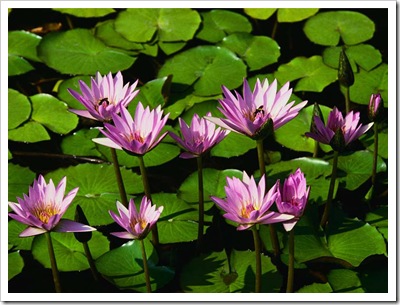
An even simpler samadhi exercise is this: Look at whatever is in front of you and say, “Yes! Yes! Yes!” to it, like Molly Bloom’s life-affirming, love-affirming mantra at the end of Ulysses. The universe of possibilities becomes visibly, tangibly larger, over a period of mere moments. When you say, “No, No, No,” the world gets smaller and heavier. Try it both ways and verify the truth of this very simple method. Look at water lilies or other highly vascular flowering plants. When the sun comes out, the flowers unfold before your eyes; when the sun goes away, they close. What the sun’s radiation and the lilies say to each other, translated through the biophysical language of chlorophyll, sugar, protein, and water, is “Yes! Yes! Yes!”

Wednesday, January 05, 2011

Moment by Moment

The Meaning of Existence
by Les Murray, from Poems the Size of Photographs

Everything except language
knows the meaning of existence.
Trees, planets, rivers, time
know nothing else. They express it
moment by moment as the universe.

Even this fool of a body
lives it in part, and would
have full dignity within it
but for the ignorant freedom
of my talking mind.

Sunday, December 05, 2010

Reborn Every Moment

"We need not think of rebirth only in a future life. We are in actual fact reborn every moment with new thoughts and feelings, and we bring with us the karma that we made in past moments. If we were angry a moment ago, we are not going to feel good immediately. If we were loving a minute ago, we would be feeling fine now. Thus we live from moment to moment with the results of our karma.

Every morning, particularly, can be seen as a rebirth. The day is young, we are full of energy, and have a whole day ahead of us. Every moment we get older and are tired enough in the evening to fall asleep and die a small death. All we can do then is toss and turn in bed, and our mind is dreamy and foggy. Every day can be regarded as a whole lifespan, since we can only live one day at a time; the past is gone and the future may or may not come; only this rebirth, this day, this moment, is important."

~ Ayya Khema

Tuesday, November 30, 2010

Attention Training

Excerpt from “Living in Buddha Standard Time,” a Buddhist Geeks conversation with Lama Surya Das (October 4, 2010):

Most people have had an experience of time slowing down, maybe like in a traffic accident or while they’re falling from a height, or tumbling over beneath the waves and drowning or something. Or, if you’re in pain, a minute seems like an hour. What’s the saying? The watched pot never seems to boil. You know, while you’re waiting for the pot to boil, if you go away it boils right away. You like have to hurry back it seems. But if you sit there, watching it, it seems never to boil.

Time is so elastic, and it’s not just that it’s speeded up in this era; it could also be slowed down if we’re more aware. Maybe you’ve experienced that on some drug or something. Maybe you’ve experienced it in a dream or a vision. Time can also be very slow motion. The outer slowing down of time with slow motion film and all is just an image of how this feels internally, when you’re more aware. By sharpening you’re awareness, processing the frames of awareness like a movie frame. Every step seems to be slower, you can be very aware of lifting and moving your foot forward and shifting the weight in your abdomen and putting down the other foot and stepping on it—without walking slower, by shifting the mind, by more sharp and quick awareness. Not thinking faster, but with quicker awareness.

This is attention training. This is awareness training. This is part of samadhi or focused awareness. We can train ourselves in this way to be aware of more mind moments within one second or one minute. To be aware of the space between thoughts, not just the thoughts that we’re caught in, and so on. And to slow down a little and to be more present so we can choose how and if to respond to stimuli, not just blindly reacting. The secret of mindful anger management is creating some space between the outer stimulus and your reaction, so you can choose how and when to respond.

I think that time is very elastic, and…what did Einstein say? Time slows down so much when you’re waiting to see if you can take that first kiss from a girl. That’s Albert Einstein by the way, I’m not making it up. So he doesn’t just talk about e=mc2 and how at the speed of light all mass is fused and so on, time and space continuum and different dimensions. He was actually saying that when you are keenly present and aware and involved wholly in something, when you’re on the edge of your mental seat, time seems to slow down, like waiting to see if you can kiss that girl, when you’re young.

Wednesday, November 17, 2010

For One Minute

…or just look at this pole and try to relax the impulse to define it or interpret it or decide whether or not it is beautiful. Try to notice what it feels like to see, as if you had no words for any of the forms or colors in front of you, as if the words on the paper were written in a language you never learned to read.

…or let your gaze spread gently across your entire field of vision, taking in the area immediately in front of you, the farthest distance you can observe without straining, the right and left edges of your peripheral vision, and everything in between. Take it all in at once—the whole three-dimensional volume of visual space. This is what the present looks like. This is what it feels like to see without spinning a story. This is what it feels like to see as a young child sees, simply fascinated with the seeing itself. Sixty seconds can feel like a long time. Try stringing together several intervals of four or five seconds instead. 

…or listen to what this moment sounds like without needing to know the source of the sounds or to evaluate any of them as pleasant or unpleasant. Steep in the wonder of vibrations striking tiny bones inside your ears and massaging that space where all of the internal chatter plays out, wave after wave of internal sound. There’s no need to tamp down the internal sounds that well up as you’re listening. Allow them to play out as they will, trying to be aware of the silence between the waves. Use the activity of internal sound to remind you to spread your listening out in all directions and become absorbed by it. 

Tuesday, November 16, 2010

The Heart Goes Where the Head Takes It

"If you ask people to imagine winning the lottery, they typically talk about the things they would do — ‘I’d go to Italy, I’d buy a boat, I’d lay on the beach’ — and they rarely mention the things they would think. But our data suggest that the location of the body is much less important than the location of the mind, and that the former has surprisingly little influence on the latter. The heart goes where the head takes it, and neither cares much about the whereabouts of the feet.”

~ Dan Gilbert, from "When the Mind Wanders, Happiness Also Strays," by John Tierney, New York Times, November 15, 2010

Read the whole article...

Participate in this research by using your iPhone to track your happiness.

Saturday, November 13, 2010

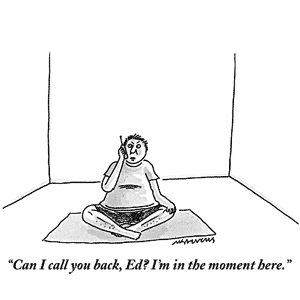
In the Moment

Mick Stevens

Thursday, November 11, 2010

Like a Flame

La vista desde nuestra palapa. (San Augustinillo, Oaxaca, noviembre de 2010)

The Dream of Now
by William Stafford

When you wake to the dream of now
from night and its other dream,
you carry day out of the dark
like a flame.

When spring comes north, and flowers
unfold from earth and its even sleep,
you lift summer on with your breath
lest it be lost ever so deep.

Your life you live by the light you find
and follow it on as well as you can,
carrying through darkness wherever you go
your one little fire that will start again.

Tuesday, October 19, 2010

We All Have the Capacity

“Kids will take a chance and if they don’t know they’ll have a go. Am I right? They’re not frightened of being wrong. Now I don’t mean to say that being wrong is the same thing as being creative. What we do know is if you’re not prepared to be wrong, you will never come up with anything original. By the time they get to be adults, most kids have lost that capacity. They have become frightened of being wrong. And we run our companies this way. We stigmatize mistakes. And we’re now running national education systems where mistakes are the worst thing you can make. And the result is that we are educating people out of their creative capacities. Picasso once said that ‘All children are born artists. The problem is to remain an artist as we grow up.’ I believe this passionately. We don’t grow into creativity, we grow out of it. Or rather, we get educated out of it.”

~ Ken Robinson

“This animate was adapted from a talk given at the RSA by Sir Ken Robinson, world-renowned education and creativity expert and recipient of the RSA's Benjamin Franklin award.”

Monday, October 18, 2010

Walking the Razor’s Edge

Excerpt from “This Very Moment,” by Charlotte Joko Beck, from Ordinary Magic: Everyday Life as Spiritual Path:

Phillipe Petite (Man on Wire) Always we have an illusion of being separate, which we have created. When we’re threatened or when life doesn’t please us, we start worrying, we start thinking about a possible solution. And without exception there is no person who doesn’t do this. We dislike being with life as it is because that can include suffering, and that is not acceptable to us. Whether it’s a serious illness or a minor criticism or being lonely or disappointed—that is not acceptable to us. We have no intention of putting up with that or just being that if we can possibly avoid it. We want to fix the problem, solve it, get rid of it. That is when we need to understand the practice of walking the razor’s edge. Spiritual practice is about understanding the razor’s edge and how to work with it.

The point at which we need to practice walking the razor’s edge is whenever we begin to be upset (angry, irritated, resentful, jealous). First, we need to know we’re upset. Many people don’t even know that upset is taking place. When we meditate and begin to know our minds and our reactions, we begin to be aware that yes, we are upset.

The Man Who Walked Between The Towers by Mordicai GersteinThat’s the first step, but it’s not the razor’s edge. We’re still separate, but now we know it. How do we bring our separated life together? To walk the razor’s edge is to do that; we have once again to be what we basically are, which is seeing, touching, hearing, smelling; we have to experience whatever our life is, right this second. If we’re upset we have to experience being upset. If we’re frightened, we have to experience being frightened. If we’re jealous we have to experience being jealous. And such experiencing is physical; it has nothing to do with the thoughts going on about the upset.

When we are experiencing nonverbally we are walking the razor’s edge—we are in the present moment. When we walk the edge the agonizing states of separateness are pulled together, and we experience perhaps not happiness but joy. Understanding the razor’s edge (and not just understanding it, but doing it) is what meditation practice is. The reason it’s difficult is that we don’t want to do it. We know we don’t want to do it. We want to escape from it.

If I feel that I’ve been hurt by you, I want to stay with my thoughts about the hurt. I want to increase my separation; it feels good to be consumed by those fiery, self-righteous thoughts. By thinking, I try to avoid feeling the pain. The more sophisticated my practice becomes, the more quickly I see this trap and return to experiencing the pain, the razor’s edge. And where I might once have stayed upset for two years, the upset shrinks to two months, two weeks, two minutes. Eventually I can experience an upset as it happens and stay right on the razor’s edge.

In fact the enlightened life is simply being able to walk that edge all the time. And while I don’t know anyone who can always do this, certainly after years of practice we can do it much of the time. It is joy to walk that edge.

Still, it is necessary to acknowledge that most of the time we want nothing to do with that edge; we want to stay separate. We want the sterile satisfaction of wallowing in “I am right.” That’s a poor satisfaction, of course, but still we will usually settle for a diminished life rather than experience life as it is when that seems painful and distasteful.

All troublesome relationships at home and work are born of the desire to stay separate. By this strategy we hope to be a separate person who really exists, who is important. When we walk the razor’s edge we’re not important; we’re no-self, embedded in life. This we fear—even though life as no-self is pure joy. Our fear drives us to stay over here in our lonely self-righteousness. The paradox: only in walking the razor’s edge, in experiencing the fear directly, can we know what it is to have no fear.

phillipe petite-2Now I realize we can’t see this all at once or do it all at once. Sometimes we jump onto the razor’s edge and then hop off, like water dropped on a sizzling frying pan. That may be all we can do at first, and that’s fine. But the more we practice, the more comfortable we become there. We find it’s the only place where we are at peace. So many people say, “I want to be at peace.” Yet there may be little understanding of how peace is to be found. Walking the razor’s edge is it. No one wants to hear that. We want somebody who will take our fear away or promise us happiness. No one wants to hear the truth, and we won’t hear it until we are ready to hear it.

Saturday, July 24, 2010

No Other Life

"You must live in the present, launch yourself on every wave, find your eternity in each moment. Fools stand on their island opportunities and look toward another land. There is no other land, there is no other life but this."

~ Henry David Thoreau

Wednesday, July 21, 2010

Where We Live

"It's no wonder we don't defend the land where we live. We don't live here. We live in television programs and movies and books and with celebrities and in heaven and by rules and laws and abstractions created by people far away and we live anywhere and everywhere except in our particular bodies on this particular land at this particular moment in these particular circumstances."

~ Derrick Jensen, from Endgame, Volume 2: Resistance

Thursday, June 24, 2010

We Can Be with Both

“Psychology has refined such a nuanced observation, understanding and insight about the particulars of our human psyches. And certain existential truths that are universal, of course. And there is a realm that we call absolute or universal. It’s not separate. We can call it emptiness, there are so many names. But it’s completely interwoven. It’s one with, it’s connected to, the words don’t express the fact that it’s not  separate from the particular. And the trick for us as practitioners, whether we are practitioners of psychology or meditation, is to really see and unite these experiences so that we can be present with the ordinary moments of our life, and more and more hold an understanding of those moments as Weeds and Purple Flowersbeing deeply significant, expressions of the truth of that moment. Not truth with a capital T that some reified, always true…but the truth of that moment because it’s life. It’s life in the form of you, me, this moment of experience. And then, when we really can truly know that, so many things are possible for us. We don’t have to be afraid of experience or afraid of our own minds. Of course, we like flowers, we hate weeds. We wish for happy experiences and we kind of dread scary sad ones. But as practitioners we can really be with both.”

~ Trudy Goodman, from “Zen, Vipassana, and Psychotherapy,” Buddhist Geeks Podcast: Episode 173 (May 24, 2010)

Thursday, June 03, 2010

Full

From the Teeth of Angels

“The best you can hope for is to live in a present so full and all-encompassing that you lose any sense of future or past.”

~ From the Teeth of Angels, by Jonathan Carroll