Wherever They Are
“Wildflowers don't move to find the sun's rays. God makes them fecund wherever they are.”
~ Frère Christian de Chergé, from Of Gods and Men



“Wildflowers don't move to find the sun's rays. God makes them fecund wherever they are.”
~ Frère Christian de Chergé, from Of Gods and Men
“Lessons from General Grant,” by Francis Wilkinson, The Week, November 26, 2010:

Yet the pace suits me — and the material. The war was a long, hard slog. And Grant's reflections have such resonance that I keep putting the book down to listen to the echoes. The fight against Mexico in 1846, Grant laments, was a "political" war waged on a false premise. Has a contemporary ring, doesn't it? The general who presided over the greatest destruction of American life in history — more than 600,000 soldiers on both sides died — also surprises with compassion. Contemptuous of slavery and committed to crushing the rebellion, Grant nonetheless has an ample soft spot for the enemy, taking risks to protect his foes' dignity. When Grant is ordered to handle rebels "without gloves" — including evicting Southern civilians from their homes and arresting them — he simply ignores the command. In fact, he fails to make a single arrest, having "deemed it better that a few guilty men should escape than that a great many innocent ones should suffer." It’s hard to resist projecting this thoughtful, anguished titan — a civil libertarian up to his epaulets in carnage — into the era of Guantánamo and Abu Ghraib. Grant didn't shrink from violence, but he didn't surrender principle, either. He did his duty, and he won. I peeked at the ending.
Cast of Thousands
by Sandra Beasley, from I Was the Jukebox
When they make a movie of this war
I am minute ninety-seven, soot tears
applied with a Q-tip, the one whose roof
collapses on her head before
her pie is done. Look how I look at you—
the apple and the apple’s knife still rolled
into my skirt, eyes wide as gin. The blast,
then ash. The director cried Cut!
More ash, he said, and they bombed me again.
My death is the clip they send to the Academy;
later they will kill me in Spanish, then French.
I will die on mute, on airplanes, row after row
of my tiny, touchscreened dying. My love,
I have joined the cast of thousands: me
and the plucky urchin, the scared infantryman,
me and the woman whose laminated beauty
sells gyros on every Greek storefront—
a useful anyone who advances the story,
then drops away. In your dream
six months from now I’ll make a cameo
as the customer with an unfocused smile,
offering a twenty as the register
begins to shake and smolder under your hands.
The coins will rise and spit silver into the air.
The coins will rise and spit silver into the air.
They buried my village a house at a time,
unable to sort a body holding from a body held,
and in minute ninety-six you can see me raise
my arms as if to keep the sky from falling.

Excerpt from “What Oman Can Teach Us,” by Nicholas D. Kristof, New York Times, October 13, 2010:

Many researchers have found links between rising education and reduced conflict. One study published in 2006, for example, suggested that a doubling of primary school enrollment in a poor country was associated with halving the risk of civil war. Another found that raising the average educational attainment in a country by a single grade could significantly reduce the risk of conflict.
Sorry if this emphasis on education sounds like a cliché. It’s widely acknowledged in theory, and President Obama pledged as a candidate that he would start a $2 billion global education fund. But nothing has come of it. Instead, he’s spending 50 times as much this year alone on American troops in Afghanistan — even though military solutions don’t have as good a record in trouble spots as education does.
The pattern seems widespread: Everybody gives lip service to education, but nobody funds it.

Excerpts from Mayor Bloomberg’s remarks at the Annual Ramadan Iftar Dinner at Gracie Mansion, August 24, 2010:
“If we say that a mosque or a community center should not be built near the perimeter of the World Trade Center site, we would compromise our commitment to fighting terror with freedom. We would undercut the values and principles that so many heroes died protecting. We would feed the false impressions that some Americans have about Muslims. We would send a signal around the world that Muslim Americans may be equal in the eyes of the law, but separate in the eyes of their countrymen. And we would hand a valuable propaganda tool to terrorist recruiters, who spread the fallacy that America is at war with Islam."
“The members of our military are men and women at arms, battling for hearts and minds. And their greatest weapon in that fight is the strength of our American values which have already inspired people around the world. But if we don’t practice those values here at home, if we don’t practice what we preach abroad, if we don’t lead by example, we undermine our soldiers. We undermine our foreign policy objectives. And we undermine our national security.”
“While some of [Feisal Abdul Rauf]’s a lot of attention, I want to read to you something that he said that you may not have heard.
At an interfaith memorial service for the martyred journalist Daniel Pearl, Imam Rauf said, ‘If to be a Jew means to say with all one’s heart, mind, and sou, Shema Yisrael Adonai Eloheinu Adonai Echad - Hear, O Israel: the Lord is our God, the Lord is One, not only today I am a Jew, but I have always been one.’ He then continued to say, ‘If to be a Christian is to love the Lord our God with all my heart, mind, and soul, and to love for my fellow human beings what I love for myself, then I am not only a Christian, but I have always been one.’”
“In that spirit, let me declare that we in New York are Jews, and Christians, and Muslims, and we always have been. And above all of that, we are Americans. Each with an equal right to worship and pray where we choose. There is nowhere in the five boroughs of New York City that is off-limit to any religion. And by affirming that basic idea, we will honor America’s values and we will keep New York the most open, diverse, tolerant, and free city in the world.”
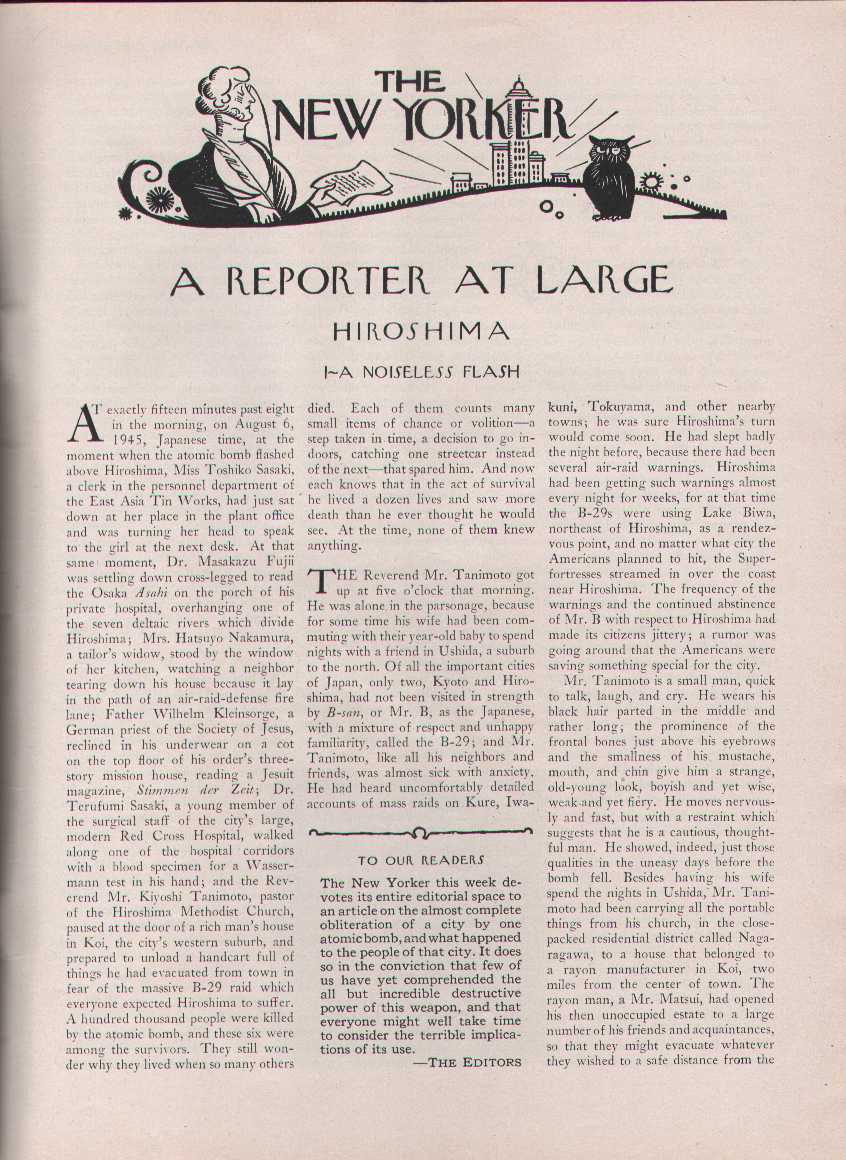
Excerpt from “The Publication of ‘Hiroshima’ in The New Yorker,” by Steve Rothman:
"Hiroshima" traced the experiences of six residents who survived the blast of August 6, 1945 at 8: 15 am. There was a personnel clerk, Miss Toshiko Sasaki; a physician, Dr. Masakazu Fujii; a tailor's widow with three small children, Mrs. Hatsuyo Nakamura; a German missionary priest, Father Wilhelm Kleinsorge; a young surgeon, Dr. Terufumi Sasaki; and a Methodist pastor, the Reverend Mr. Kiyoshi Tanimoto. The article told the story of their experiences, starting from when the six woke up that morning, to what they were doing the moment of the blast and the next few hours, continuing through the next several days and then ending with the situations of the six survivors several months later.
The article, written by John Hersey, created a blast of its own in the publishing world. The New Yorker sold out immediately, and requests for reprints poured in from all over the world. Following publication, "Hiroshima" was read on the radio in the United States and abroad. Other magazines reviewed the article and referred their readers to it. The Book-of-the-Month Club sent a copy of the article in book form to its entire membership as a free selection. Later that fall, "Hiroshima" was published as a book by Alfred A. Knopf and has remained in print ever since.
"Hiroshima" was not the first exposure that readers had to the events that took place on August 6. Many articles in the popular press described the destruction of the city, such as a Collier's story published in the spring of 1946 crammed full of details about the power of the atom bombs dropped on Hiroshima and Nagasaki ("at a distance of 4,200 feet—about eight tenths of a mile—the pressure was 2,160 pounds a square foot") and anecdotes about the horrific effects of nuclear weapons on human beings ("Men in black-striped shirts were burned in strips. Heat stenciled dress figures onto the bodies of women."). Collier's also included an artist's rendition of the effect of a nuclear blast on downtown Manhattan. But most of these stories steered clear of details that would help readers identify with the dead or the survivors. Usually, "the statistics of devastation and death were simply recited as prefatory to a plea for international control, civil defense, or some other cause. On a canvas whose broadbrush background scenes were already familiar, Hersey etched several vividly realized foreground figures.”
The direct effect of "Hiroshima" on the American public is difficult to gauge. No mass movement formed as a result of the article, no laws were passed, and reaction to the piece probably didn't have any specific impact on U.S. military strategy or foreign policy. But certainly the vivid depictions in the book must have been a strong contributor to a pervasive sense of dread (and guilt) about nuclear weaponry felt by many Americans ever since August 1945.
Atomic Dawn
by Gary Snyder, from Danger on Peaks
The day I first climbed Mt. St. Helens was August 13, 1945.
Spirit Lake was far from the cities of the valley and news came slow.
Though the first atomic bomb was dropped on Hiroshima August 6
and the second dropped on Nagasaki August 9, photographs didn't
appear in the Portland Oregonian until August 12. Those papers must
have been driven in to Spirit Lake on the 13th. Early the morning of
the 14th I walked over to the lodge to check the bulletin board. There
were whole pages of the paper pinned up: photos of a blasted city
from the air, the estimate of 150,000 dead in Hiroshima alone, the
American scientist quoted as saying "nothing will grow there again
for seventy years." The morning sun on my shoulders, the fir forest
smell and the big tree shadows; feet in thin moccasins feeling the
ground, and my heart still one with the snowpeak mountain at my
back. Horrified, blaming scientists and politicians and the govern-
ments of the world, I swore a vow to myself, something like, "By
the purity and beauty and permanence of Mt. St. Helens, I will fight
against this cruel destructive power and those who would seek to
use it, for all my life."
“I am saying there is a different drama which is enacting itself in our country right now and it has to do with a failure to acknowledge the necessary moral and imaginative predicate that has become an entirely virtual existence, which is, you know, people spend more than half their waking hours watching television. Just think about that for a second. That has to shape the neural pathways. It creates an impatience, for example, with irresolution. And I'm doing what I can to tell stories which engage those issues in ways which can engage the imagination so that people don't feel threatened by it.”
~ David Milch, from “Television’s Greatest Writer,” an interview with David Simon, MIT (April 20, 2006)
“[PowerPoint] is dangerous because it can create the illusion of understanding and the illusion of control. Some problems in the world are not bullet-izable.”
~ Brig. Gen. H. R. McMaster, from “We Have Met the Enemy and He is PowerPoint,” by Elisabeth Bumiller, New York Times, April 26, 2010
The Signal
by Sharon Olds, from One Secret Thing
When they brought his body back, they told
his wife how he'd died:
the general thought they had taken the beach,
and sent in his last reserves. In the smokescreen,
the boats moved toward shore. Her husband
was the first man in the first boat
to move through the smoke and see the sand
dark with bodies, the tanks burning,
the guns thrown down, the landing craft
wrecked and floored with blood. In the path of the
bullets and shells from the shore, her husband had
put on a pair of white gloves
and turned his back on the enemy,
motioning to the boats behind him
to turn back. After everyone else
on his boat was dead
he continued to signal, then he, too,
was killed, but the other boats had seen him
and turned back. They gave his wife the medal,
and she buried him, and at night floated through
a wall of smoke, and saw him at a distance
standing in a boat, facing her,
the gloves blazing on his hands as he motioned her back.
“Seven years after the beginning of the Iraq war — and with U.S.troop deaths in Iraq and Afghanistan exceeding 5,000 — a look at some of the bedrooms America’s young war dead left behind.”

FIRST LT. BRIAN N. BRADSHAW, ARMY Killed June 25, 2009, Kheyl, Afghanistan; roadside bomb. AGE: 24 HOMETOWN: Steilacoom, Wash.
From the New York Time Sunday Magazine.

"I did it for the fun. I was a young girl and everybody had left and it was wartime. You didn't want to get stuck in a hole in Iowa; you wanted to see what was going on."
~ Margaret Phelan Taylor, on her experience as a Women Airforce Service Pilot, “Female WWII Pilots: The Original Fly Girls,” Morning Edition (3/9/10)
From The Writer’s Almanac today:

About 100,000 men from France, Germany, and Italy answered the call, formed into several large groups, and marched across Asia Minor to the Middle East. Nearly half of them died from exhaustion and sickness before they ever reached their destination. They began sacking cities along the way, and they fought among each other for the spoils of each battle. When they reached the trading city of Antioch, they killed almost everyone, including the Christians who lived there. By the time they got to Jerusalem, it had recently fallen into the hands of Egyptians, who were friendly with the Vatican. But the crusaders attacked anyway, killing every Muslim they could find. The Jews in the city gathered in the temple, and the crusaders set it on fire.
Pope Urban II died two weeks later, never hearing the news.
Letter Composed During a Lull in the Fighting
by Kevin C. Powers, from Poetry Magazine, February 2009
or ten minutes of sleep
beneath the low rooftop wall
on which my rifle rests.
I tell her in a letter that will stink,
when she opens it,
of bolt oil and burned powder
and the things it says.
I tell her how Pvt. Bartle says, offhand,
that war is just us
making little pieces of metal
pass through each other.
“I try to say something through those images, though I don’t know what it is. It’s hard to describe. My head is full of that stuff. It comes pouring out.”
~ Ben Steele, from “The Memorial of the Mind,” with Michael Norman, The New York Times (May 25, 2009)
Two poems by Yusef Komunyakaa. The first one appears at the end of “Love in the Time of War” from Warhorses (2008). “Facing It” is from Dien Cai Dau (1988).
His name is called. A son’s lost voice
hovers near a fishing hole in August.
His name is called. A lover’s hand
disturbs a breath of summer cloth.
His name is called a third time,
but his propped-up boots & helmet
refuse to answer. The photo remains silent,
& his name hangs in the high rafters.
She tenderly hugs the pillow,
whispering his name. The dog
rises beside the bedroom door
& wanders to the front door,
& stands with its head cocked,
listening for a name in a dead language.
* * * * *
Facing It
My black face fades,
hiding inside the black granite.
I said I wouldn't,
dammit: No tears.
I'm stone. I'm flesh.
My clouded reflection eyes me
like a bird of prey, the profile of night
slanted against morning. I turn
this way--the stone lets me go.
I turn that way--I'm inside
the Vietnam Veterans Memorial
again, depending on the light
to make a difference.
I go down the 58,022 names,
half-expecting to find
my own in letters like smoke.
I touch the name Andrew Johnson;
I see the booby trap's white flash.
Names shimmer on a woman's blouse
but when she walks away
the names stay on the wall.
Brushstrokes flash, a red bird's
wings cutting across my stare.
The sky. A plane in the sky.
A white vet's image floats
closer to me, then his pale eyes
look through mine. I'm a window.
He's lost his right arm
inside the stone. In the black mirror
a woman's trying to erase names:
No, she's brushing a boy's hair.
We Never Know
by Yusef Komunyakaa, from Dien Cai Dau

for a moment, like he was swaying
with a woman. Our gun barrels
glowed white-hot.
When I got to him,
a blue halo
of flies had already claimed him.
I pulled the crumbled photograph
from his fingers.
There's no other way
to say this: I fell in love.
The morning cleared again,
except for a distant mortar
& somewhere choppers taking off.
I slid the wallet into his pocket
& turned him over, so he wouldn't be
kissing the ground.
* * * * *
"Poetry is a kind of distilled insinuation. It's a way of expanding and talking around an idea or a question. Sometimes, more actually gets said through such a technique than a full frontal assault."
“It’s all about going from reality to dreams and subconscious. It’s about memory—lost memory. And animation is perfect for that because you can really stream the events easily, go from one dimension to another with no interference at all. It looks like one story line. And I do believe that life in general is this story line that goes between reality and fantasy all the time.”
~ Ari Folman, discussing his animated documentary, Waltz with Bashir, with Studio 360’s Kurt Anderson (12.26.08).


Daron Larson
Freelance Contemplative