Showing posts with label belief. Show all posts

Sunday, April 24, 2011

The Psychology of Belief and Compassion

“I think that these three habits of mind, animisms, creationism, dualism, are present in all of us. They're not biological adaptations, they're accidents. But I think they're what make religious belief attractive and plausible and universal.”

~ Paul Bloom, from “Hardwired for God?” Big Think, Dec. 22, 2009

“When people are less focused on self and the problems of the self, there is a kind of alleviation of stress.  There’s nothing like reaching out and contributing to the lives of others to give a person, first of all a sense of significance and purpose.”

~ Stephen Post, from “The Science of Compassion,” Big Think, April 24, 2011

Friday, March 18, 2011

Who Needs Them?

Religious Consolation
by John Updike, from Americana and Other Poems

Americana: and Other Poems by John UpdikeOne size fits all. The shape or coloration
of the god or high heaven matters less
than that there is one, somehow, somewhere, hearing
the hasty prayer and chalking up the mite
the widow brings to the temple. A child
alone with horrid verities cries out
for there to be a limit, a warm wall
whose stones give back an answer, however faint.

Strange, the extravagance of it—who needs
those eighteen-armed black Kalis, those musty saints
whose bones and bleeding wounds appall good taste,
those joss sticks, houris, gilded Buddhas, books
Moroni etched in tedious detail?
We do; we need more worlds. This one will fail.

* * * * *
See also: Updike's 'This I Believe' Essay
[Thanks, Suzanne!]

Saturday, February 19, 2011

Our Minds Create the Medicine

Professor Funk’s YouTube Channel

Wednesday, August 11, 2010

I Have to Call Myself Back

“I’m very bad when it comes to worship. This is just me. This is probably a terrible thing to say [in a church], but I don’t need it very much. I try to live in this kind of presence and a kind of awareness and I have to call myself back time and time again to remembrance of who I am. Partly, I think, all that’s because as a kid, as a Presbyterian, I had to go to church four times on Sunday. That wears out your patience and your ass. I’ve sort of done my stint. But that’s just me. It’s not other people.”

~ Sam Keen, author of In the Absence of God: Dwelling in the Presence of the Sacred

Friday, April 02, 2010

Ism After Ism

Poems should be more like essays and essays should be more like poems.

~ Charles Olson

Two of every sort shall thou bring into the Ark.

~ Genesis

*     *     *

Religion
by Stephen Dunn, from Riffs and Reciprocities: Prose Pairs

Riffs & Reciprocities: Prose Pairs First, it was more about mystery than about trying to get us to behave. Whichever, we’re still in some lonely cave, not far from that moment a lightning storm or a sunset drove us to invent the upper reaches of the sky. Religion is proof that a good story, we'll-told, is a powerful thing. Proof, too, that terror makes fabulists of us all. We’re pitiful, finally, and so oddly valiant. The dead god rising into ism after ism—that longing for coherence that keeps us, if not naive, historically challenged. To love Christ you must love the Buddha, to love Mohammed or Moses you must love Confucius and, say Schopenhauer and Nietzsche as well. They were all wise and unsponsored and insufficient, some of the best of us. I’m saying this to myself: the sacred cannot be found unless you give up some old version of it. And when you do, mon semblable, mon frère, I swear there’ll be an emptiness it’ll take a lifetime to fill. Indulge, become capacious, give up nothing, Jack my corner grocer said. He was pushing the portobellos, but I was listening with that other, my neediest ear.

Sunday, July 26, 2009

Reverse Engineering of Religion

"...religions are an important natural phenomenon. We should study them with the same intensity that we study all the other important natural phenomena...Today's religions are brilliantly designed. They're immensely powerful social institutions and many of their features can be traced back to earlier features that we can really make sense of by reverse engineering. And, as with the cow, there's a mixture of evolutionary design, designed by natural selection itself, and intelligent design -- more or less intelligent design -- redesigned by human beings who are trying to redesign their religions."

~ Dan Dennett, from TED Talks (February 2006)

Mr. Dennet't’s book Breaking the Spell: Religion as a Natural Phenomenon was reviewed by Leon Wieseltier in “The God Genome,” New York Times (February 19, 2006).

Tuesday, June 23, 2009

Convenient Solutions

train "To doubt everything or to believe everything are two equally
convenient solutions; both dispense with the need for thought."

Henri Poincaré (1854-1912), Science and Hypothesis

Sunday, December 21, 2008

Uncertainty

“I wouldn’t ever say whether the priest is innocent or guilty because I saw ‘Doubt’ as being about something larger…What’s so essential about this movie is our desire to be certain about something and say, This is what I believe is right, wrong, black, white. That’s it. To feel confident that you can wake up and live your day and be proud instead of living in what’s really true, which is the whole mess that the world is. The world is hard, and John is saying that being a human on this earth is a complicated, messy thing…And I, personally, am uncomfortable with that messiness, just as I acknowledge its absolute necessity. I find the need to play a part like Father Flynn inescapable, and I only want to do things I’m that passionate about. I know there are actors out there that present themselves as cool cats, but you better take your cool-cat suit off if you want to act. You can’t otherwise.”

~ Philip Seymour Hoffman, from “A Higher Calling,” by Lynn Hirschberg, New York Times Sunday Magazine (12.21.08)

“…I've always been really, deeply interested, because I think I can understand the solace that's available in the whole construct of religion. But I really don't believe in the power of prayer, or things would have been avoided that have happened, that are awful. So it's a horrible position as an intelligent, emotional, yearning human being to sit outside of the available comfort there. But I just can't go there…I have a belief, I guess, in the power of the aggregate human attempt – the best of ourselves. In love and hope and optimism – you know, the magic things that seem inexplicable. Why we are the way we are. I do have a sense of trying to make things better. Where does that come from? And why do some people just seem to want to make other people miserable?”

~ Meryl Streep, from “Meryl Streep: Mother Superior,” by Mick Brown, Daily Telegraph (12.2008)

Tuesday, December 02, 2008

The Problem

Excerpts from an interview with Truthdig columnist and author Chris Hedges in The Sun Magazine (Dec. 2008), “Moral Combat: Chris Hedges on War, Faith, and Fundamentalism."

I Don't Believe in Athiests Fundamentalism can be found within either a secular or a religious framework. It’s a binary worldview that divides the world into us and them, good and evil, right and wrong. It’s a belief that you and those who subscribe to your ideology have found the absolute truth, which must be accepted by everyone, and those who won’t accept it must be silenced or eradicated. Fundamentalism is an abdication of our moral responsibility to make difficult decisions, because within a fundamentalist movement people are told what to do. They don’t believe in a plurality of truths or ways of being. Fundamentalism is anti-intellectual, because it discourages investigation of other cultures, histories, and belief systems.

...Fundamentalism is a form of tribalism. There’s a great comfort in it, because it discourages self-criticism and self-reflection. Retreating into tribal groups is a way to revert to a childlike state of security, rather than live as an adult and struggle with ambiguity.

...I think that those who remain open to other realities must always cope with anxiety. That is the pain of being fully human. The only other choice is to live in an authoritarian system — either religious or secular — where moral choice is made for you, because you are told what is moral and what is immoral.

...Communism, fascism, religious fanaticism, neocon utopianism in Iraq — there are all sorts of ideologies that can motivate people to kill. Religion is just one. Like political ideologies, theological systems are a human creation. God is a human concept, a flawed attempt by human beings to acknowledge, cope with, and explain the infinite, which is the only reality.

...Like art, [religion] is an attempt at wisdom, which doesn’t come from knowledge. You can memorize as many sutras, verses, and prayers as you want, but it will never make you wise. Religion and art are both ways of grappling with those non-rational forces of love, beauty, truth, grief, and meaning that make one a whole individual. The problem is not religion. The problem is the human heart. And the new atheists don’t get that. People will always find reasons to act inhumanely, whether it’s religion, or nationalism, or “Liberté, égalité, fraternité,” or the workers’ paradise.

Thursday, June 12, 2008

A Mystery to Solve

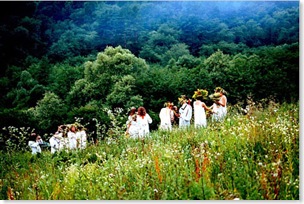
"I think there is a kind of slippery slope where once you've stopped believing that the mainstream discourse, whether that be that of science or whatever else, you've stopped going along with that discourse, then you become open to everything else. And if you're not careful and if you're not judicious, then you'll just kind of start believing that all those other things must therefore be true. So there's that tendency, which you find with social movements that are on the fringes. Young women from Poland celebrate the night of Kupala (Photo: Marek Kosior) And I've been fascinated by all of it because I think that even the extraterrestrial thing, how many millions of people claim to have been abducted by aliens in American society?...What do you do with that fact? Do you just say that they're all deluded or do you start getting interested in why it is that, you know, there's some kind of gap that people are filling with using that imagery of aliens. Why aliens? Well, because there aren't any fairies left so they got to come from off planet. Why are there no fairies left? Because we know...what happens in the natural world...So it becomes a kind of mystery to solve. And rather than rejecting the things that people say, I think, as an ethnographer of religion, one of the first principles is that you don't treat people as idiots for what they believe and that, in fact, by treating them seriously, you might get some insights that you wouldn't get to otherwise. And I think, for me, it's led to insights about myself as well."

~ Adrian Ivakhiv, "Pagans Ancient and Modern," Speaking of Faith, (6.12.08)

Wednesday, May 07, 2008

Standing Up to Reason

The Joy of Living and Dying in Peace (1997)"If this [scientific finding] contradicts some aspect of Buddhist doctrine as contained in the scriptures, we have no other choice but to accept that that teaching is in need of interpretation. Thus, we cannot accept it literally simply because it has been taught by the Buddha; we have to examine whether it is contradicted by reason or not. If it does not stand up to reason, we cannot accept it literally. We have to analyze such teachings to discover the intention and purpose behind them and regard them as subject to interpretation. Therefore, in Buddhism great emphasis is laid on the importance of investigation."

~ The Dalai Lama, from The Joy of Living and Dying in Peace

Wednesday, November 21, 2007

A History of Doubt

Jennifer Michael Hecht"...right now the truth is I don't think that there is much pride in doubt or much recognition that it has a rich history. And I think that that's really crucial right now, especially because of the way that belief is coming up again as part of policy. That kind of idea, it's got to be met with the voices of people who are looking at things from the other side. And right now, you know, well, I think I'd like to contextualize this a little bit and say that America in the beginning of the 20th century was a wonderful time to be a doubter. You know, Thomas Edison tells The New York Times he doesn't believe in an afterlife. You know, that's something that most people believe in an afterlife wouldn't tell The New York Times today. It was thought of as — the whole idea of nonconformism, of questioning, of bucking the dominant idea was celebrated as part of what democracy desperately needed, really, from John Stuart Mill and Harriet Mill onward, that idea of liberty as being something you have to keep enacting, otherwise you'll lose it.

"And that was celebrated in the beginning of the 20th century. And we really see that close down with the Cold War because the United States felt that it had, well, it had a violent, tense enemy in the communist world, and that communism was equated with making legalist gestures of atheism. Well, that made it seem that atheism was treasonous. And that's when 'Under God' went into the pledge and 'In God We Trust' went on all the money. And when you look at the congressional record, it's very specifically against communist atheism that those things were done.

"Well, we live in a very different world now. In the early 21st century, the murderous tension that we have in the world is with fundamentalist religion that's willing to commit terror. And so it's time to change our stance a little bit."

-- Jennifer Michael Hecht, poet and writer of Doubt: A History and The Happiness Myth in conversation with Krista Tippeett on Speaking of Faith (5/3/07)