Tuesday, February 23, 2010

Hunger for Reality

“Every single one of these [successful games] has succeeded off a clever psychological angle. But there’s more than that. There’s something else these things have in common, not just these psychological tricks. What these all have in common is they are all busting through to reality. We’re used to, in the old days of gaming, it being all about fantasy. It’s all about fantasy and Ben Gordon used to say, ‘We don’t care about realism in games because people come to our games to escape from reality.’ And so we have this strong belief that fantasy is the thing. But every single one of these is breaking through into reality in some interesting way. And we don’t feel good about reality as game designers. We’re a little uncomfortable about reality…

…But it’s not just us that were kind of snuck up on by this reality thing. And it’s not just just happening to us. Go look at TV. The people in TV, their heads are spinning. Everything’s turned into reality TV. Go to the grocery store. It’s not just groceries anymore. It’s organic groceries. The more genuine, the more real groceries. You go to McDonald’s and to get a Big Mac and – you could get a Big Mac or you could get the real burger, the angus burger made with real this and that or whatever. Everything is suddenly about reality.

Now what’s going on? Is this just how it’s always been? Well, I found this really interesting book. It’s called Authenticity. It’s by the guys who wrote The Experience EconomyGilbert and Pine put forth this most interesting concept: the most valuable thing in products is are the real, are they authentic. Which is a bold hypothesis. And then they go further and they say, Why is it? Why now? It didn’t always used to be this way. Certainly that’s not what sold stuff in the eighties…They’re arguing that all this virtual stuff that’s been creeping up on us over the last twenty years has really cut us off from nature. We’re cut off from self-sufficiency. We couldn’t be self-sufficient if we wanted to. We don’t know how to do it. We live in a bubble of fake bullshit and we have this hunger for to get to anything that’s real. Even if the best we can do is a Starbucks mocha with real Swiss chocolate — we’ll take it. Oh, look how real that seems to me relative to what I’m used to. And so there’s this idea that maybe there’s this hunger for reality. ”

~ Jesse Schell, from his talk at DICE Summit 2010

Monday, February 22, 2010

Slow-Motion Coalescence

co·a·lesce
To come together so as to form one whole; unite.

[Latin coalēscere: co-, co- + alēscere, to grow, inchoative of alere, to nourish.]

A water drop filmed in ultra-slow-motion at 2000 frames per second.

To Map Out the World

Art Spiegelman and Francoise Mouly discussing The Toon Treasury of Classic Children’s Comics with Michael Silverblatt on KCRW’s Bookworm (February 4, 2010).

Francoise Mouly: Kids aren’t necessarily — the way we imagine they might be — looking for escape and fantasy. Actually, the seven year old, the eight year old, is eager for a way to map out information — to map out the world. And that’s part of the reason why comics appeal to them. Because they are a very instinctive way to structure information…As Art has often referred to it, it’s a story made manifest spatially. You have a very instinctive way to understand narratives and to understand character’s emotion…It gives you cues. It is in and of itself a medium that kids can use to understand all other kinds of visual information – much more than watching television or playing video games…They can go back to the same story and read it over and over again. And also because it’s done by one person — it’s drawn by hand — it inspires them to want to make comics.

Art Spiegelman: What makes this a real treasury rather than just a bunch of product put together in four hundred pages of offering [is that] so much of this is written and drawn by the same person…And here when we’re looking at Walt Kelly and Sheldon Mayer and, to a degree, John Stanley and certainly Carl Barks, they were really able to enter and make a whole world themselves. Really act it out, draw it, and write it. So you’re really throbbing inside one person’s brain. And to have that many brains presenting fully realized worlds, you feel it when you’re looking through these stories. They have a kind of urgency in their own way…These characters are a lot more complex than Spider Man. Little Lulu is so much more richer than Peter Parker.

Sunday, February 21, 2010

Sweet Dreams


Granny O’Grimm’s Sleeping Beauty was directed by Nicky Phelan, produced by Brown Bag Films, and written/voiced by Kathleen O'Rourke. Nominated for Best Animated Short Film 2010.

Saturday, February 20, 2010

Making Sense with Our Bodies

Excerpt from “Abstract Thoughts? The Body Takes Them Literally,” by Natalie Angier, New York Times (February 1, 2010):

Researchers at the University of Aberdeen found that when people were asked to engage in a bit of mental time travel, and to recall past events or imagine future ones, participants’ bodies subliminally acted out the metaphors embedded in how we commonly conceptualized the flow of time.

As they thought about years gone by, participants leaned slightly backward, while in fantasizing about the future, they listed to the fore. The deviations were not exactly Tower of Pisa leanings, amounting to some two or three millimeters’ shift one way or the other. Nevertheless, the directionality was clear and consistent.

“When we talk about time, we often use spatial metaphors like ‘I’m looking forward to seeing you’ or ‘I’m reflecting back on the past,’ ” said Lynden K. Miles, who conducted the study with his colleagues Louise K. Nind and C. Neil Macrae. “It was pleasing to us that we could take an abstract concept such as time and show that it was manifested in body movements.”

Anterior-posterior position of participants in the past-imagery and future-imagery conditions as a function of time. Also shown are regression lines. Error bars represent ±1 SEM.

The new study, published in January in the journal Psychological Science, is part of the immensely popular field called embodied cognition, the idea that the brain is not the only part of us with a mind of its own.

“How we process information is related not just to our brains but to our entire body,” said Nils B. Jostmann of the University of Amsterdam. “We use every system available to us to come to a conclusion and make sense of what’s going on.”

Research in embodied cognition has revealed that the body takes language to heart and can be awfully literal-minded.

You say you’re looking forward to the future? Here, Ma, watch me pitch forward!

You say a person is warm and likable, as opposed to cold and standoffish? In one recent study at Yale, researchers divided 41 college students into two groups and casually asked the members of Group A to hold a cup of hot coffee, those in Group B to hold iced coffee. The students were then ushered into a testing room and asked to evaluate the personality of an imaginary individual based on a packet of information.

Students who had recently been cradling the warm beverage were far likelier to judge the fictitious character as warm and friendly than were those who had held the iced coffee.

Read more…

[Thanks Dōshin!]

Interconnected in Surprising Ways

Excerpt from “Botox Treatment Slows Perception of Negative Emotions” by Jonathan Rottenberg, Ph.D., Psychology Today (January 31, 2010):

Our default assumption is that our eyes and our brains are the organs dedicated to processing emotional information. New work led by David Havas of the University of Wisconsin, to be published in the journal Psychological Science, provides a fascinating demonstration that our facial muscles share in this job.

botox The new study reported on 40 people who were treated with Botox. Tiny applications of the nerve poison were used to deactivate muscles in the forehead that cause frowning (the corrugator muscles).
Before and after the Botox treatment, patients were asked to read written statements that carried an emotional tenor, including statements that were angry ("The pushy telemarketer won't let you return to your dinner"); sad ("You open your email in-box on your birthday to find no new emails"); or happy ("The water park is refreshing on the hot summer day.")

The authors used reading time as a proxy for processing speed.

The results showed no change in the time needed to understand the happy sentences. But in a fascinating result, after Botox treatment, the subjects needed more time to read the angry and sad sentences…

Perhaps the most interesting implication of the study is scientific. It shows yet again that our systems for communicating and perceiving emotion are interconnected, often in surprising ways.

A Refuge

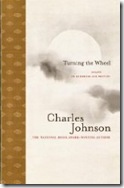
Excerpt from Turning the Wheel: Essays on Buddhism and Writing by Charles R. Johnson:

Turning the Wheel These cultural questions, so eloquently expressed by Du Bois and King (and many others), which pose the ancient, pre-Socratic problem of how shall we live, consumed my imagination and intellectual interests from adolescence into adulthood. They kept me up late at night. They colored my perceptions of all I saw and heard in the 1960s and 1970s. They were behind my first practicing meditation when I was fourteen, falling in love with philosophy when I was eighteen, and equally behind my turn to writing novels at twenty-two. This historic devotion to freedom by black America’s finest leaders also prepared me in my depths for embracing the Buddhist Dharma as the most revolutionary and civilized of possible human choices, as the logical extension of King’s dream of the “beloved community,” and Du Bois’s “vision of what the world could be if it was really a beautiful world.”

Were it not for the Buddhadharma, I’m convinced that, as a black American and an artist, I would not have been able to successfully negotiate my last half century of life in this country. Or at least not with a high level of creative productivity, working in a spirit of metta toward all sentient beings, and selfless service to others as a creator, teacher, husband, father, son, colleague, student, lecturer, editor, neighbor, friend, and citizen, which, in my teens, were ideals I decided I valued more than anything else. The obstacles, traps, and racial minefields faced by black men in a society that has long demonized them as violent, criminal, stupid, bestial, lazy, and irresponsible are well-documented…

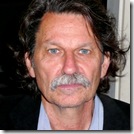
Charles R. Johnson For me, Buddhism has always been a refuge, as it was intended to be: a place to continually refresh my spirit, stay centered and at peace, which enabled me to work joyfully and without attachment even in the midst of turmoil swirling round me on all sides, through “good” times and “bad.” So I am thankful for the perennial wisdom in its two-millennia-old sutras; the phenomenological insights of Shakyamuni himself into the nature of suffering, craving, and dualism; the astonishing beauty of Sanskrit, which I’ve been privileged to study now for five years; and the methods of different forms of meditational practice, the benefits of which fill whole libraries.

Thursday, February 18, 2010

The Standard for All Kinds of Things

Mr. Lee's 5th & 6th grade class, Sunnyside Elementary, Wichita, Kansas, 1976/77.

“Children—and humans, everybody—all need both windows and mirrors in their lives: mirrors through which you can see yourself and windows through which you can see the world. And minority children have not had mirrors.

That has placed them at a disadvantage. If you want to call white children majority children—[they] have had only mirrors. That has placed them at a disadvantage also…Because they live on a planet that is more window than mirror. And they have tended to believe that the planet is a planet like them or people who wish to be like them. And it’s not necessarily so.

It’s a mistake to believe oneself one’s only valid participator in life, that that is the standard, the standard for human is white. I tell children the standard for flowers is many-colored; the standard for all kinds of things is many-colored. That is also the standard for humans, though they have not been taught that.”

~ Lucille Clifton, from “She Could Tell You Stories,” interview by Hilary Holladay, Poetry Foundation (April 11, 1998)

Wednesday, February 17, 2010

How Endless is this Whiteness

Buddha Weeping in Winter
by E. Ethelbert Miller, from Buddha Weeping in Winter

snow falling on prayers
covering the path
made by your footprints

I wait for spring
and the return of love

how endless
is this whiteness
like letters
without envelopes

LIsten to E. Ethelbert Miller reading from more of his work at “Black & Universal,” Speaking of Faith, February 11, 2010

In the Light of this New Idea

Excerpt from The Story of My Life by Helen Keller:

Helen Keller with Anne Sullivan vacationing at Cape Cod in July 1888. I remember the morning that I first asked the meaning of the word, "love." This was before I knew many words. I had found a few early violets in the garden and brought them to my teacher. She tried to kiss me; but at that time I did not like to have any one kiss me except my mother. Miss Sullivan put her arm gently round me and spelled into my hand, "I love Helen."

"What is love?" I asked.

She drew me closer to her and said, "It is here," pointing to my heart, whose beats I was conscious of for the first time. Her words puzzled me very much because I did not then understand anything unless I touched it.

I smelt the violets in her hand and asked, half in words, half in signs, a question which meant, "Is love the sweetness of flowers?"

"No," said my teacher.

Again I thought. The warm sun was shining onus.

"Is this not love?" I asked, pointing in the direction—from which the heat came, "Is this not love?"

It seemed to me that there could be nothing more beautiful than the sun, whose warmth makes all things grow. But Miss Sullivan shook her head, and I was greatly puzzled and disappointed. I thought it strange that my teacher could not show me love.

A day or two afterward I was stringing beads of different sizes in symmetrical groups—two large beads, three small ones, and so on. I had made many mistakes, and Miss Sullivan had pointed them out again and again with gentle patience. Finally I noticed a very obvious error in the sequence and for an instant I concentrated my attention on the lesson and tried to think how I should have arranged the beads. Miss Sullivan touched my forehead and spelled with decided emphasis, "Think."

In a flash I knew that the word was the name of the process that was going on in my head. This was my first conscious perception of an abstract idea.

For a long time I was still—I was not thinking of the beads in my lap, but trying to find a meaning for "love" in the light of this new idea. The sun had been under a cloud all day, and there had been brief showers; but suddenly the sun broke forth in all its southern splendour.

Again I asked my teacher, "Is this not love ?"

"Love is something like the clouds that were in the sky before the sun came out," she replied. Then in simpler words than these, which at that time I could not have understood, she explained: "You cannot touch the clouds, you know; but you feel the rain and know how glad the flowers and the thirsty earth are to have it after a hot day. You cannot touch love either; but you feel the sweetness that it pours into everything. Without love you would not be happy or want to play."

The beautiful truth burst upon my mind—I felt that there were invisible lines stretched between my spirit and the spirits of others.

Facsimile of the braille manuscript of The Story of My Life

Evidence of Things Unseen

Ruach dances in the backyard.
It blows without swaying
the trees, still
the snow-sifted air reveals
contours of swirling forms,
unique as fingerprints,
transparent arabesques brought to light.
The insubstantial proof, certain as
the scattered footprints
on an ash-dusted temple floor,
of earthly visitation.

Tuesday, February 16, 2010

Developing Our Human Qualities

Excerpt from “Matthieu Ricard: Meditate Yourself Better,” by Curtis Abraham, New Scientist (Feb. 3, 2010)

Matthieu Ricard (Photo: Angeles Nassar) “Experiments have indicated that the region of the brain associated with emotions such as compassion shows considerably higher activity in those with long-term meditative experience. These discoveries suggest that basic human qualities can be deliberately cultivated through mental training. The study of the influence of mental states on health, which was once considered fanciful, is now an increasing part of the scientific research agenda.

Twenty minutes of daily practice can contribute significantly to a reduction of anxiety and stress, the tendency to become angry and the risk of relapse in cases of severe depression. Thirty minutes a day over the course of eight weeks results in a considerable strengthening of the immune system and of one's capacity for concentration. It also speeds up the healing of psoriasis and decreases arterial tension in people suffering from hypertension.

Why should we bother to meditate? The answer is that we all have the potential for positive change, which largely remains untapped. That's a great pity, because we know the virtue of training and learning. We spend years going to school and training in things like sports, but for some strange reason we don't think that the same need applies to developing and optimizing our human qualities.”

[Thanks Alex!]

To Find Another Way

From “Kindle Armageddon: How the Publishing Industry Is Slitting Its Own Throat,” by Dan Agin, Huffington Post (Feb. 14, 2009):

“Once upon a time, the only books that existed were books copied by hand by monks and scribes and sold to the very rich for the equivalent of $5000 or $6000 a book. Then along came the printing press, and all the monks and scribes had to find another way to earn their bread.

Once upon a time the only books that existed were books on paper made by printing presses and sold to the rich and not so rich and not rich at all for enough money to make publishing houses worth hundreds of millions of dollars, enough money to pay high salaries to publishing executives. Then along came the digital book, and many thousands of people in and around publishing had to find another way to earn their bread.

The subtext of the story is the impact of technology on culture and commerce, and the unfailing collapse of any industry that allows itself to be blinded by sloth, short term greed, and general mediocrity of attitudes.”

More…

[Thanks Kit!]

Undermining the Institution of Marriage

Monday, February 15, 2010

What I Have Shaped into a Kind of Life


won't you celebrate with me

by Lucille Clifton, from The Book of Light

won't you celebrate with me
what i have shaped into
a kind of life? i had no model.
born in babylon
both nonwhite and woman
what did i see to be except myself?
i made it up
here on this bridge between
starshine and clay
my one hand holding tight
my other hand; come celebrate
with me that everyday
something has tried to kill me
and has failed.


From Baltimore Sun’s blog, Read Street today: Former state poet laureate and National Book Award winner Lucille Clifton died Saturday at age 73, after a long battle with cancer and other illnesses. Her obituary in the Baltimore Sun noted that the long-time Columbia resident was known for a mix of profundity, earthiness and humor in her 11 books of poetry…At Poets.org you can read some of her poems, including "blessing the boats," and hear her provocative voice reading "homage to my hips."

My Whole Life a Bell

"Then one day I was walking along Tinker Creek thinking of nothing at all and I saw the tree with the lights in it. I saw a backyard cedar where the mourning doves roost charged and transfigured, each cell buzzing with flame. I stood on the grass with the lights in it, grass that was wholly fire, utterly focused and utterly dreamed. It was less like seeing than like being for the first time seen, knocked breathless by a powerful glance. The flood of fire abated, but I'm still spending the power. Gradually the lights went out in the cedar, the colors died, the cells unflamed and disappeared. I was still ringing. I had been my whole life a bell, and never knew it until at that moment I was lifted and struck."

~ Annie Dillard, from Pilgrim at Tinker Creek

[Thanks Steph!]

A Textbook Example

Excerpt from ''How Christian Were the Founders?” by Russell Shorto, New York Times (February 11, 2009):

brown-bear“Brown Bear, Brown Bear, What Do You See?” It’s not an especially subversive-sounding title, but the author of this 1967 children’s picture book, Bill Martin Jr., lost his place in the Texas social-studies guidelines at last month’s board meeting due to what was thought to be un-American activity — to be precise, “very strong critiques of capitalism and the American system.” Martin, the creator of 300 children’s books, was removed from the list of cultural figures approved for study by third graders in the blizzard of amendments offered by board members…

…The [Texas school] board has the power to accept, reject or rewrite the [Texas Essential Knowledge and Skills], and over the past few years, in language arts, science and now social studies, the members have done all of the above. Yet few of these elected overseers are trained in the fields they are reviewing. “In general, the board members don’t know anything at all about content,” Tom Barber, the textbook executive, says. Kathy Miller, the watchdog, who has been monitoring the board for 15 years, says, referring to Don McLeroy and another board member: “It is the most crazy-making thing to sit there and watch a dentist and an insurance salesman rewrite curriculum standards in science and history. Last year, Don McLeroy believed he was smarter than the National Academy of Sciences, and he now believes he’s smarter than professors of American history.”

In this case, one board member sent an e-mail message with a reference to “Ethical Marxism,” by Bill Martin, to another board member, who suggested that anyone who wrote a book with such a title did not belong in the TEKS. As it turned out, Bill Martin and Bill Martin Jr. are two different people. But by that time, the author of “Brown Bear, Brown Bear” was out. “That’s a perfect example of these people’s lack of knowledge,” Miller says. “They’re coming forward with hundreds of amendments at the last minute. Don McLeroy had a four-inch stack of amendments, and they all just voted on them, whether or not they actually knew the content. What we witnessed in January was a textbook example of how not to develop textbook standards.”

Sunday, February 14, 2010

Your Crooked Heart

From Flagstaff Snow Days by Dōshin Owen.

As I Walked Out One Evening
by W.H. Auden

As I walked out one evening,
Walking down Bristol Street,
The crowds upon the pavement
Were fields of harvest wheat.

And down by the brimming river
I heard a lover sing
Under an arch of the railway:
'Love has no ending.

'I'll love you, dear, I'll love you
Till China and Africa meet,
And the river jumps over the mountain
And the salmon sing in the street,

'I'll love you till the ocean
Is folded and hung up to dry
And the seven stars go squawking
Like geese about the sky.

'The years shall run like rabbits,
For in my arms I hold
The Flower of the Ages,
And the first love of the world.'

But all the clocks in the city
Began to whirr and chime:
'O let not Time deceive you,
You cannot conquer Time.

'In the burrows of the Nightmare
Where Justice naked is,
Time watches from the shadow
And coughs when you would kiss.

'In headaches and in worry
Vaguely life leaks away,
And Time will have his fancy
To-morrow or to-day.

'Into many a green valley
Drifts the appalling snow;
Time breaks the threaded dances
And the diver's brilliant bow.

'O plunge your hands in water,
Plunge them in up to the wrist;
Stare, stare in the basin
And wonder what you've missed.

'The glacier knocks in the cupboard,
The desert sighs in the bed,
And the crack in the tea-cup opens
A lane to the land of the dead.

'Where the beggars raffle the banknotes
And the Giant is enchanting to Jack,
And the Lily-white Boy is a Roarer,
And Jill goes down on her back.

'O look, look in the mirror?
O look in your distress:
Life remains a blessing
Although you cannot bless.

'O stand, stand at the window
As the tears scald and start;
You shall love your crooked neighbour
With your crooked heart.'

It was late, late in the evening,
The lovers they were gone;
The clocks had ceased their chiming,
And the deep river ran on.

Mighty in Contradiction

"We cannot avoid using power,
Cannot escape the compulsion
To afflict the world.
So let us, cautious in diction
And mighty in contradiction,
Love powerfully."

~ Martin Buber

The Highest Form of Intimacy

Excerpts from “A Monotheistic Model of Love,” by Gilla Nissan, Parabola (Spring 2010):

parabola-35-1 In B’re-sheet, Genesis, during the process of the creation of the world, it is said that God separated the water into two: sha-ma-yim, the water of above, and ma-yim, the water below. The Zohar: The Book of Splendor, a collection of works ascribed to Simon Bar Yochai of the second century CE, goes on to say that the lower waters missed and longed for the higher waters and so cried out to unite back with them. The Hebrew words reflect this deep relationship: mayim, meaning water, and shamayim, meaning sky.

God tried several times to create the world. He used equal measures of compassion, che-sed, and judgment, din. More than once the world collapsed until He incorporated an extra measure of ra-cha-mim, another word for compassion. Without love the world cannot exist, yet we humans were given freedom to love or not to love. God so wants to be known and be loved out of free will; forced love is no love at all.

*     *     *

The Hebrew language has gender; we refer to God in the  masculine; although, in His true nature He is William Gesenius's Hebrew punctuation (i.e., Yahweh)without gender. In the Tetragrammaton, Yud Hey Vav Heh, the unutterable name of God, the letters vav and heh represent the male and female forces of providence. The male force is that which acts upon the world, while the female force is that which allows the world to be receptive to God’s power. We refer to God as Him because we want Him to act upon the world through the male force of providence. The Hebrew word for Divine Presence, on the other hand, is She-chi-nah, a feminine noun.

*     *     *

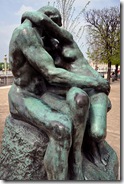
Rodin's Le Baiser (The Kiss) in the Tuileries Garden in Paris According to the Zohar, love begins with a physical attraction, then communication and speech. A kiss is the merging of one breath with another. As closeness occurs, the lovers stop speaking and are merely aware of each other’s breath. Finally, they come even closer, to the point of physical contact, and their communication becomes a kiss. Here they are aware of each other’s life force. Kissing, explains the modern mystic Rabbi Aryeh Kaplan, is a natural consequence of increased intimacy in speech. Two mouths come closer and closer, and progress from speech to breath to the kiss. The kiss, then, is the highest form of intimacy.

The Zohar describes four levels in the intimacy of love: physical attraction, speech, breath, and the kiss. These same four levels exist in the relationship of a person with the Divine. These levels are to this day reflected in the structure of the daily services in the synagogue and private prayer, moving the worshipper from one level of intimacy to another. The impact is deeply profound when one’s ka-va-nah, intention, is aligned with the words.

Missing Something Personal

Excerpt from “Post-Minimal to the Max,” by Roberta Smith, New York Times (Feb. 14, 2010):

David Bates's "Lower End Boat Dock II"  (Photo: DC Moore Gallery, New York)

After 40 years in which we’ve come to understand that dominant styles like Abstract Expressionism, Minimalism and Pop are at best gross simplifications of their periods, it often feels as though an agreed-upon master narrative is back in place.

What’s missing is art that seems made by one person out of intense personal necessity, often by hand. A lot but not all of this kind of work is painting, which seems to be becoming the art medium that dare not speak its name where museums are concerned….

…Museum curators need to think less about an artist’s career, its breakthroughs and its place in the big picture and more in terms of an artist’s life’s work pursued over time with increasing concentration and singularity.

They have a responsibility to their public and to history to be more ecumenical, to do things that seem to come from left field. They owe it to the public to present a balanced menu that involves painting as well as video and photography and sculpture. They need to think outside the hive-mind, both distancing themselves from their personal feelings to consider what’s being wrongly omitted and tapping into their own subjectivity to show us what they really love.

These things should be understood by now: The present is diverse beyond knowing, history is never completely on anyone’s side, and what we ignore today will be excavated later and held against us the way we hold previous oversights against past generations.

Everybody’s Gotta Learn Sometimes


JOEL: Wait.

CLEMENTINE: (impatiently) What, Joel? What do you want?

JOEL: (at a loss) I don’t know. (pause) Just wait. I want you to wait for a while.

They lock eyes for a long moment: Clementine stone-faced, Joel with a worried, knit brow. Clementine cracks up.

CLEMENTINE: Okay.

JOEL: Really?

CLEMENTINE: I’m not a concept, Joel. I’m just a fucked-up girl who is looking for my own peace of mind. I’m not perfect.

JOEL: I can’t think of anything I don’t like about you right now.

CLEMENTINE: But you will. You will think of things. And I’ll get bored with you and feel trapped because that’s what happens with me.

JOEL: Okay.

CLEMENTINE: Okay.

THE END

Thursday, February 11, 2010

Wild Joy

Gregory Orr “One consequence of traumatic violence is that it isolates its victims. It can cut us off from other people, cutting us off from their own emotional lives until we go numb and move through the world as if only half alive. As a young person, I found something to set against my growing sense of isolation and numbness: the making of poems.

When I write a poem, I process experience. I take what's inside me — the raw, chaotic material of feeling or memory — and translate it into words and then shape those words into the rhythmical language we call a poem. This process brings me a kind of wild joy. Before I was powerless and passive in the face of my confusion, but now I am active: the powerful shaper of my experience. I am transforming it into a lucid meaning.”

~ Gregory Orr, from “The Making of Poems,” This I Believe, February 20, 2006

Three poems from How Beautiful the Beloved by Gregory Orr:

Reading the world
As if it were a book
Written before words —

That sparrow perched
On the withered stalk
In the garden — isn’t
The bird itself
A song to the beloved

Even before it sings?

*     *     *

Praising all creation, praising the world:
That’s our job — to keep
The sweet machine of it
Running as smoothly as it can.

With words repairing, where is wears out,
Where it breaks down.

With songs and poems keeping it going.
With whispered endearments greasing its gears.

*     *     *

Human heart —
That tender engine.

Love revs it;
Loss stalls it.

What can make it
poem = word / temple (Copper Canyon Press logo)Go again?

The poem, the poem.

Wednesday, February 10, 2010

Open Your Heart


From The Music Mix Blog (Feb. 2, 2010):

“About 10 months ago, Michel Gondry met West Coast singer-songwriter Mia Doi Todd at a party. “I really fell in love with her music,” he says. “It’s incredibly fragile, personal, and very elevated.” They became friends, and soon Todd penned a new tune, Open Your Heart, that Gondry thought would work perfectly with the color-coordinated choreography he’d been wanting to use.

After signing on to direct the video for Open Your Heart, Gondry went with Todd to scout locations in east Los Angeles. ‘Basically, L.A. is not made for humans. It’s a lot of concrete and cars passing by. It’s very blank, which is a great background to put all these people with colors.’ Next, they cast their stars. ‘I needed a group of people who could move together, but it would have been too affected if they were professional dancers. We found this marching band from Riverside Community College.’ Over three sunny days, Todd and 100 or so marching band members-turned-dancers brought Gondry’s vision to life.”

Tuesday, February 09, 2010

Sutro Baths

Sutro Baths opened March 14, 1896 with a $1 million price tag — an extravagant public bathhouse envisioned and developed by the eccentric one-time mayor of San Francisco, Adolph Sutro. After working its way through its many lives, it burned down while being demolished on June 26, 1966.”

~ sutrobaths.com

Sutro Baths Ruins • San Francisco from barton bishoff on Vimeo.

Barton Bishoff

Monday, February 08, 2010

Waiting Motionless

The Room I Work In
by Adam Zagajewski, from Mysticism for Beginners

     — To Derek Walcott

The room I work in is as foursquare
as half a pair of dice.
It holds a wooden table
with a stubborn peasant’s profile,
a sluggish armchair, and a teapot’s
pouting Hapsburg lip.
From the window I see a few skinny trees,
wispy clouds, and toddlers,
always happy and loud.
Sometimes a windshield glints in the distance
or, higher up, an airplane’s silver husk.
Clearly others aren’t wasting time
while I work, seeking adventures
on earth or in the air.
The room I work in is a camera obscura.
And what is my work—
waiting motionless,
flipping pages, patient meditation,
passivities not pleasing
to that judge with the greedy gaze.
I write as slowly as if I’ll live two hundred years.
I seek images that don’t exist,
and if they do they’re crumpled and concealed
like summer clothes in winter,
when frost stings the mouth.
I dream of perfect concentration; if I found it
I’d surely stop breathing.
Maybe after all, I hear the first snow hissing,
the frail melody of daylight,
and the city’s gloomy rumble.
I drink from a small spring,
my thirst exceeds the ocean.

A Very Organic Process

"There are all kinds of stories and myths that have arisen about this. Most of them are nonsense.  And it became ever more apparent to me, as I worked my way up through this system, that I was not becoming a superman and I wasn’t becoming a saint and my morality was not becoming perfected.  And what was happening here was a very organic process that I’ve more recently come to think of as what I call a physio-energetic process.  There is some energy that arises in the body and can be developed in stages.  And that’s what’s happening.  All of the stuff, all of the stories that we layer on to that, that if you reach this stage, you’re going to act a certain way or you’re going to be incapable of committing various immoral acts, that’s just fantasy island...I’ve completely given up on the notion that you’re going to develop to the point of being incapable of lying, for example, or of being incapable of anger or lust."

~ Kenneth Folk, in conversation with Vince Horn, "Ordinary People Can Get Enlightened," Buddhist Geeks Podcast (Episode 156)

Sunday, February 07, 2010

The Big Game: Art, Sports, and Masculinity

ART AT STAKE
I'll See Your Lorrain and Raise You a Turner (Studio 360)

“The directors of the New Orleans and the Indianapolis art museums have a lot more riding on this weekend's Super Bowl than a couple of bucks in the office pool. After arts blogger [Tyler Green] posed a challenge, they've each put up a treasured painting from their collections. The director of the losing city's museum will have to lend his masterpiece to the winner.”

5th-plague-Egypt

J.M.W. Turner, The Fifth Plague of Egypt
Courtesy of the Indianapolis Museum of Art

ideal-view-Tivoli

Claude Lorrain, Ideal View of Tivoli
Courtesy of the New Orleans Museum of Art

HARD TARGETS
Sports and Masculinity Explored in Art

“The multimedia exhibition Hard Targets, on view January 30–April 11, 2010 at the Wexner Center, surveys provocative artworks produced over the last 25 years that take masculinity and sports as their central themes. Ranging broadly in interest and focus from biology to commodity and locker room to stadium, Hard Targets endeavors to complicate and revise the time-honored archetype of the male athlete as an aggressive, heterosexual, hyper-competitive, emotionally remote subject. Instead, the artists in the show offer opposing views of masculinity and sport, and of the entire theater of athletic play, including the rituals and accoutrements that surround this intimate, and often still male-dominated, world. The more than 70 works—in a wide variety of media, including video, photography, mixed-media sculpture, painting, and installation—range from funny and irreverent to self-effacing and incisive.”

Still from St. Henry Composition

Joe Sola, still from St. Henry Composition
The Wexner Center for the Arts

“The 21 artists in the show are Doug Aitken, Matthew Barney, Mark Bradford, Harun Farocki, Andreas Gursky, Douglas Gordon, David Hammons, Brian Jungen, Byron Kim, Jeff Koons, Cary Leibowitz, Glenn Ligon, Kori Newkirk, Catherine Opie (including a new suite of photographs of high school football players produced in Columbus), Philippe Parreno, Paul Pfeiffer (whose 11 exhibited pieces offer a mini-survey of this artist’s work), Collier Schorr, Sam Taylor-Wood, Hank Willis Thomas, and Jonas Wood. In addition, a video work by Joe Sola video will be presented in The Box video space during the first month of the show.”

brian_jungen-prototype

Brian Jungen, Prototype for New Understanding #23

“Each artist examines the way masculinity is characterized and ‘performed’ in a sporting context, and each suggests that the ways we view and consume sports stars and athletic events are structured by more complex systems of desire and identification than most spectators realize. The works in the exhibition open up alternative, and possibly more democratic, interpretations and inflections of sports and sports fandom than the authorized, often frankly commercial, images that most frequently and forcefully convey the cultural identity of male athletes and athleticism.”

opie_josh Catherine Opie, Josh, 2007

Saturday, February 06, 2010

The Two are One

“If we’re not careful, this is how we approach mindfulness: as an idea, one we rather like, to elevate our lives with special contemplative consideration, a method for making smarter choices and thereby assuring better outcomes. The problem is that the life before us is the only life we have. The search for meaning robs our life of meaning, sending us back into our discursive minds while right in front of us the laundry piles up…

…With only a change in perspective, the most ordinary things take on inexpressible beauty. When we don’t know, we don’t judge. And when we don’t judge, we see things in a different light. That is the light of our awareness, unfiltered by intellectual understanding, rumination, or evaluation. When we cultivate nondistracted awareness as a formal practice, we call it mindfulness meditation. When we cultivate it in our home life, we call it the laundry, the kitchen, or the yard—all the places and the ways to live mindfully by attending without distraction to whatever appears before us. But it’s hard for us to believe that attention is all there is to it, and so we complicate things with our judgment—debasing the ordinary as insignificant and idealizing the spiritual as unattainable—never seeing that the two are one.”

~ by Karen Maezen Miller, from “Do Dishes, Rake Leaves (And Don’t Forget the Endless Loads of Laundry),” Shambhala Sun, March 2010

All This Music

To be alive
by Gregory Orr

To be alive: not just the carcass
But the spark.
That's crudely put, but…

If we're not supposed to dance,
Why all this music?

Friday, February 05, 2010

A Promise with a Catch

Nothing Made Modern Science Possible

sifr“Our word cipher, meaning zero or nothing, comes from the Arabic word Sifr, meaning zero. We call our numbers Arabic numerals, but they actually came from India. It was the Arabs, however, who brought the Indian numerals to Europe. It took centuries to convince Europeans to use them, even  though they made calculations easier than using clumsy Roman numerals. Medieval Arab scholars also took the Indian idea of representing zero (the Arabs use a dot, ٠). This enables us to write all numbers with only ten symbols (0 to 9). Without the use of the zero, modern science would be impossible!”

~ Barbara Whitesides, from Sugar Comes from Arabic: A Beginner's Guide to Arabic Letters and Words

[See also: Zero and One & Zero: The Biography of a Dangerous Idea]

Thursday, February 04, 2010

Fighting Evil

The Joy of Tech“All human evil comes from a single cause, man's inability to sit still in a room.”

~ Blaise Pascal

Homeostasis

The chill slipped through my skin
right into my marrow
where it took root and blossomed.
You offered me a drink
of your coffee
which we both know
is much stronger than I can take.

Made me consider how often
people have to weigh a degree of bitterness
against our thirst for warmth.

I met a woman who drinks hot water
every morning.
Says she never really liked coffee
or tea,
but she enjoys cradling a warm mug
in her cold hands.
Says she doesn’t feel like she’s missing anything.

There must be fifty ways
I haven’t yet imagined
to warm these bones.

Wednesday, February 03, 2010

Neuroscience in Plain Language


[Thanks Dr. Marsha Lucas!]

How Much Control Did You Have?

an_education “I have an emotional attachment to the book. I think the terminology is wrong. People talk about books being turned into movies. They're not turned into movies. They sit there in bookstores and if the movie's bad, they're still in bookstores and if the movie's good, they're in bookstores but there are more copies of them. I think there are very few examples of books that are actually damaged by movies. People either don't know the movie was made or it brings readers to the books...

The most common question I think writers are asked about this is, how much control did you have? And my answer to that is, I didn't have very much control, I don't want very much control, and I don't understand how control works. Say I knew enough about directors and actors to dictate who's going to direct a movie and who's going to star in it. Well, I don't know enough about directors of photography and they can make or break a film. I don't know anything about editing and a bad editor can completely mess a film up. I don't know anything about score composers. And these are all integral parts of a movie-making process. So I'd rather give it to somebody that I trust initially and hope that they make the right decisions."

~ Nick Hornby, in conversation with KCRW’s The Business producer Matt Holzman (January 25, 2010)

By Mere Thinking

"Love enhances global processing and creative thinking whereas sex enhances local processing and analytic thinking. Thus, contrary to the intuitive notion of creativity and analytical thought as fixed human capacities or stable personality traits, they can easily be changed by subtle cues in the environment or by mere thinking about certain situations."

~ Jens Förster, from the conclusions of the research study quoted in “Love, Lust, and Creativity,” by Scott Barry Kaufman, Psychology Today (September 10, 2009)

Short Attention Span Culture

tte
Visit the digital_nation site to learn more and about this program, watch it online, and join the conversation.

Being More Interested

gardner "You should focus on being more interested than interesting.”

~ John Gardner

Monday, February 01, 2010

Happiness Not as a Trait But as a Skill

Computer monitors display imaged data in the control room of the fMRI scanner at the Keck Laboratory for Functional Brain Imaging and Behavior.
© UW-Madison University Communications  (
Photo by  Jeff Miller) “Now we mostly have monks and other religious figures preaching about these ideas [compassion training]. It's quite another thing to have a hard-nosed neuroscientist like me suggest that such training may have beneficial consequences for how we act toward others as well as promoting health. Most people accept the idea that regular physical exercise is something they should do for the remainder of their lives. Imagine how different things might be if we accepted the notion that the regular practice of mental exercises to strengthen compassion is something to incorporate into everyday life…I've been talking about happiness not as a trait but as a skill, like tennis. If you want to be a good tennis player, you can't just pick up a racket—you have to practice."

~ Richard Davidson, from “This Is Your Brain on Happiness,” by Penelope Green, O, The Oprah Magazine (March 1, 2008)

Another World

"Il y a un autre monde mais il est dans celui-ci."

~ Paul Éluard

this-world

Talking of Power and Love
by Paul Éluard

Between all my torments between death and self
Between my despair and the reason for living
There is injustice and this evil of men
That I cannot accept there is my anger

There are the blood-coloured fighters of Spain
There are the sky-coloured fighters of Greece
The bread the blood the sky and the right to hope
For all the innocents who hate evil

The light is always close to dying
Life always ready to become earth
But spring is reborn that is never done with
A bud lifts from dark and the warmth settles

And the warmth will have the right of the selfish
Their atrophied senses will not resist
I hear the fire talk lightly of coolness
I hear a man speak what he has not known

You who were my flesh’s sensitive conscience
You I love forever you who made me
You will not tolerate oppression or injury
You’ll sing in dream of earthly happiness
You’ll dream of freedom and I’ll continue you