Sunday, March 14, 2010

Discovering Columbus

“Stretching along High Street, south of the Ohio State University campus, the Short North is Columbus’s designated arts district and home to a hugely popular arts event called Gallery Hop. On the first Saturday of each month, street performers, musicians and artists hit the sidewalks, shops set up temporary exhibits, and art galleries remain open late. Drawing crowds since it started in 1984, Gallery Hop helped transform the formerly neglected, crime-ridden urban district into the vibrant, independent arts enclave that it is today.”

From “Hello, Columbus,” by Ingrid K. Williams, New York Times (March 14, 2010)

Kirk Irwin for The New York Times

Jeni's Splendid Ice Creams

Lorianne DiSabato

Goodale Park

Wexner Center for the Arts

Friday, March 12, 2010

Intimately Meshed

“An unsentimental elegy to the American West, Sweetgrass follows the last modern-day cowboys to lead their flocks of sheep up into Montanas breathtaking and often dangerous Absaroka-Beartooth mountains for summer pasture. This astonishingly beautiful yet unsparing film reveals a world in which nature and culture, animals and humans, vulnerability and violence are all intimately meshed.”


Recordist’s Statement (Lucien Castaing-Taylor):

We began work on this film in the spring of 2001. Living at the time in Colorado, we heard about a family of Norwegian‐American sheepherders in Montana, who were among the last to trail their band of sheep long distances — about a hundred and fifty miles each year, all of it on hoof — up to the mountains for summer pasture. I visited them that April during lambing, and was so taken with the magnitude of their life — at once its allure and its arduousness — that we ended up working with them, their friends, and their Irish‐American hired hands intensively over the coming years.

Sweetgrass is one of nine films to have emerged from the footage we have shot over the last decade, the only one intended principally for theatrical exhibition. As they have been shaped through editing, the films seem to have become as much about the sheep as about their herders. The humans and animals that populate them commingle and crisscross in ways that have taken us by surprise. Sweetgrass depicts the twilight of a defining chapter in the history of the American West, the dying world of Western herders — descendants of Scandinavian and northern European homesteaders — as they struggle to make a living in an era increasingly inimical to their interests. Set in Big Sky country, in a landscape of remarkable scale and beauty, the film portrays a lifeworldcolored by an intense propinquity between nature and culture — one that has been integral to the fabric of human existence throughout history, but which is almost unimaginable for the urban masses of today.

Spending the summers high in the Rocky mountains, among the herders, the sheep, and their predators, was a transcendent experience that will stay with me for the rest of my days.

*     *     *

Where You Are

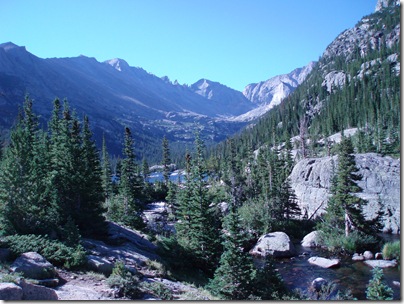
Rocky Mountain National Park (2007)

Lost
by David Wagoner, from Traveling Light 

Stand still. The trees ahead and bushes beside you
Are not lost. Wherever you are is called Here,
And you must treat it as a powerful stranger,
Must ask permission to know it and be known.
The forest breathes. Listen. It answers,
I have made this place around you.
If you leave it, you may come back again, saying Here.
No two trees are the same to Raven.
No two branches are the same to Wren.
If what a tree or a bush does is lost on you,
You are surely lost. Stand still. The forest knows
Where you are. You must let it find you.

The Most Fruitful Type of Mind Wandering

Excerpt from “Stop Paying Attention: Zoning Out Is a Crucial Mental State,” by Carl Zimmer, Discover (June 2009):

When our minds wander, we lose touch with the outside world. We don’t actually black out, of course, but we are more likely to make mistakes, fail to encode memories, or miss a connection. Zoning out makes us particularly prone to these errors. Schooler and Smallwood, along with Merrill McSpadden of the University of British Columbia, tested the effect of zoning out by having a test group read a Sherlock Holmes mystery in which a villain used a pseudonym. As people were reading the passages discussing this fact, the researchers checked their state of attentiveness. Just 30 percent of the people who were zoning out at the key moments could give the villain’s pseudonym, while 61 percent of the people who weren’t zoning out at those moments succeeded.

These results are shocking when you stop to think about them. Each of us has a magnificent hive of billions of neurons in our head, joined to each other by trillions of connections. The human brain is arguably the most complex organ in the natural world. And yet studies on mind wandering are showing that we find it difficult to stay focused for more than a few minutes on even the easiest tasks, despite the fact that we make mistakes whenever we drift away.

The fact that both of these important brain networks become active together suggests that mind wandering is not useless mental static. Instead, Schooler proposes, mind wandering allows us to work through some important thinking. Our brains process information to reach goals, but some of those goals are immediate while others are distant. Somehow we have evolved a way to switch between handling the here and now and contemplating long-term objectives. It may be no coincidence that most of the thoughts that people have during mind wandering have to do with the future.

Even more telling is the discovery that zoning out may be the most fruitful type of mind wandering. In their fMRI study, Schooler and his colleagues found that the default network and executive control systems are even more active during zoning out than they are during the less extreme mind wandering with awareness. When we are no longer even aware that our minds are wandering, we may be able to think most deeply about the big picture.

More…

[See also: Shinzen Young’s Focus Out strategy]

A Little Flower

“Just living is not enough. One must have sunshine, freedom, and a little flower.”

~ Hans Christian Andersen

Crocus vernus

Snowdrops

Crocus vernus

Steven Cox Flowers

[Thanks Kirstin!]

Thursday, March 11, 2010

The Selection Process Creating Your Reality

From “The Focused Life,” by Winifred Gallagher, from her book, Rapt: Attention and the Focused Life:

Rapt: Attention and the Focused Life Like consciousness or mind, attention is a complex neurological and behavioral business. There’s no tidy “attention center” in the brain. Instead, an ensemble of alerting, orienting, and executive networks collaborate to attune you to what’s going on in your inner or outer world in a coherent way that points you toward an appropriate response.

Neuroscience’s truly groundbreaking insight into attention is the discovery that its basic mechanism is a process of selection. This two-part neurological sorting allows you to focus by enhancing the most compelling, or “salient,” physical object or “high-value” mental subject in your ken and suppressing the rest. Outside of an elite scientific circle, however, this finding’s implications for everyday life have been stunningly unremarked.

When you focus, you’re spending limited cognitive currency that should be wisely invested, because the stakes are high. At any one moment, your world contains too much information, whether it is objects, subjects, or both, for your brain to depict clearly for you. Your attentional system selects a chunk of what’s there, which gets valuable cerebral real estate and, therefore, the chance to affect your behavior. This thin slice of life becomes part of your reality, and the rest is consigned to the shadows.

Attention’s selective nature confers tremendous benefits, chief of which is enabling you to comprehend what would otherwise be chaos. You couldn’t take in the totality of your own experience, even for a moment. Whether it’s noise on the street, ideas at the office, or feelings in a relationship, you’re potentially bombarded with stimuli vying for your attention. New electronic information and communications technology continually add to the overload. By helping you to focus on some things and filter out others, attention distills the universe into your universe.

Along with performing the Apollonian task of organizing your world, attention enables you to have the kind of Dionysian experience beautifully described by the old-fashioned term rapt—completely absorbed, engrossed, fascinated, perhaps even “carried away”—that underlies life’s deepest pleasures, from the scholar’s study to the carpenter’s craft to the lover’s obsession. Some individuals slip into it more readily, but research shows that with some reflection, experimentation, and practice, all of us can cultivate this profoundly attentive state and experience it more often. Paying rapt attention, whether to a trout stream or a novel, a do-it-yourself project or a prayer, increases your capacity for concentration, expands your inner boundaries, and lifts your spirits, but more important, it simply makes you feel that life is worth living.

A Journey into Worthy Perception

Barry Hannah

"Reading and writing train our people for logic, grace, and precision of thought, and begin a lifelong study of the exceptional in human existence. I think literature is the history of the soul. Writing should be a journey into worthy perception."

~ Barry Hannah, who died last week at his home in Mississippi

[Thanks Jonathan Carroll!]

In the Absence of that Conversation

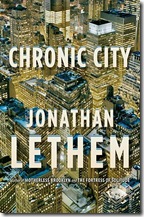
Jonathan Lethem, discussing his most recent novel, Chronic City, with Michael Silverblatt on KCRW’s Bookworm (January 28, 2010):

“I was very interested in thinking about the condition of an actor, someone who’s learned to operate within scripts that are handed to them — whether the scripts are worth anything or not. It seemed to me that, in a way, stood for the problem of a lot of us as we get through our days. The scripts right now aren’t very good, but we don’t know how to step outside them very readily or at all.”

*     *     *

Chronic City“A writer, a social satirist, looking for ways to exemplify the hypocrisies of contemporary economic disparities — the unacknowledged class system — it’s almost impossible not to find easy targets. It’s so near at hand that you only have to turn your hand and it falls into your grasp. And so I couldn’t be terribly interested with looking for those kinds of symbols. Instead I wanted to talk about what happens when you and I and everyone we know lives with them right in front of our face — two inches from our face — and yet they’re not spoken of. It’s the denial. It’s the fact that symbols of this kind of reality proliferate wildly in books and in life.

Every day you open the newspaper and you find another allegory that would’ve made Karl Marx’s jaw drop — or Roland Barthes’s jaw drop. And yet we all go on reading that newspaper. We all go on moving through our days and this is the subject of the book: what we do instead, what we think about, and how we behave in the absence of that conversation. When everything is as exaggerated and hysterically out of whack and yet somehow the machine tumbles forward day-to-day. We wake up and take our positions inside it. Well, that’s an interesting subject and an elusive one. The social satire is not elusive at all.

All you have to do is take it to the ultimate degree and then you’ve got John Carpenter’s They Live or Idiocracy. Then you’ve said it as stridently as you possibly can. You’ve made the cartoon of reality into a cartoon and then it can be shrugged off again. I was trying not to shrug it off. I was trying to inhabit it with these characters. It’s the fact that we all live in a situation that is patently absurd in many ways and yet we we have no opportunity to take it lightly. We’re living real lives. It’s tragic…I don’t mean to fall into the trap of saying there can be a non-ideological space, but you do the best you can. You meet what’s before you. You try to solve the cartoon conundrums that come your way with as much real sincerity as you can bring to them. ”  

Wednesday, March 10, 2010

Not Beyond Your Imagination

James Cameron, in conversation with Elvis Mitchell for a special online edition of The Treatment, recorded live at a benefit for the Natural Resources Defense Council:


“I’ve always believed in exploration. I’ve always believed in that sense of going beyond and looking where we haven’t looked. I think the film connects that way in a number of different ways. There’s one line I hate and studios love to use: Beyond your imagination. It’s not beyond your imagination. People have great imaginations. They have great dreams when they’re kids. You can fly when you’re a kid in your dreams. As you grow up, your dreams somewhat diminish and you don’t fly as much in your dreams. I wanted to go back to that childlike dream state in this movie because I think we all kind of connect at that level. And so I wanted to create essentially a lucid dream that would connect us all at some kind of unconscious level.”

*     *     *

“We were tasked with designing all these creatures and plants and everything for this movie. And every time we thought we had a great idea somebody would bring in a photograph or some bit of nature here had beat us to the idea. Ultimately, at the end of a two-year design process, we had to just admit with great humility that nature’s imagination was better than the combined imagination of the best visual artists on the planet that I had gathered to make Avatar. And it’s true.”

*     *     *

In his talk at TED 2010, James Cameron “reveals his childhood fascination with the fantastic — from reading science fiction to deep-sea diving — and how it ultimately drove the success of his blockbuster hits Aliens, The Terminator, Titanic and Avatar.”

Tuesday, March 09, 2010

To See What Was Going On

Margaret Phelan Taylor

"I did it for the fun. I was a young girl and everybody had left and it was wartime. You didn't want to get stuck in a hole in Iowa; you wanted to see what was going on."

~ Margaret Phelan Taylor, on her experience as a Women Airforce Service Pilot, “Female WWII Pilots: The Original Fly Girls,” Morning Edition (3/9/10)

Give and Take

Excerpt from “Chopin’s ‘Soul and Heart’,” by Byron Janis, The Wall Street Journal (March 9, 2010):

No word is more important in describing the playing of Chopin's music than rubato. It comes from the Italian word robare, to rob, but in music it means "give and take." If you steal a little time here, you've got to give it back. For example, in playing a melodic phrase, if you go forward in the first two bars, you must pull back in the next two so that the freedom you took does not break the rhythmical pulse. The classic feeling will come from the left hand, which Chopin insisted should be played as evenly as possible. Then the right hand can have its romance and play as freely as the left hand will allow. Every performer will use that freedom differently, and that is the beauty of the "disciplined freedom" that makes Chopin Chopin.

Chopin said the Polish word zal—a "bittersweet melancholy"—best described much of his music. Paradoxically, it can also mean anger, even rage, an emotion also found in Chopin's musical vocabulary. Schumann agreed, describing Chopin's music as "cannons buried in flowers." For example, listen to the Ballade in G-minor and the Scherzo in C-sharp minor.

Massimiliano Ferrati plays Chopin's Ballade in G-minor

Artur Rubinstein plays Chopin's Scherzo No. 3 in C sharp minor

Monday, March 08, 2010

Something That We Use Rather Than Something That Uses Us

Soren Gordhamer, from “Happiness — There’s an App for That,” Buddhist Geeks Podcast #161 (March 1, 2010):

Wisdom 2.0: Ancient Secrets for the Creative and Constantly Connected There probably are people on the planet today who can actually live fully present in every waking moment of their life, right? 24/7. Like, somehow their ego and their old patterns have completely gone. But for the rest of us, we’re somewhere in the middle, right? There’s a certain level of awakening, but there’s not kind of a full level of awakening. And so for us, I think it particularly helps to have some time each day where we’re just quiet. We’re not taking in new information. We’re kind of emptying our cup. You know the old Zen story where the professor goes to the Zen master and says, “I know all this information about Zen,” and starts telling the Zen master all the information he has. And the Zen master responds by saying, “Would you like some tea?” And the professor says, “Yes.” And he starts pouring him tea, but even as the cup is full, he just keeps pouring and pouring and pouring. And the professor says, “Stop pouring. The cup won’t take any more tea.” And he says, of course, “Just like the cup, your mind is so full of information, it can’t take any more.”

So I think that for those of who are trying to balance this life of mindfulness and technology, it’s extremely important to have some time where we’re not taking in information and we’re bringing attention to our breath and our internal world. And we’re not as focused on our external world. But then the challenge, of course, is to not become a good meditator. The challenge is to become awake, right? And to bring that sense of awareness and full engagement no matter what we’re doing. And if we’re checking email, can we do that fully? If we’re tweeting, can we do that fully? Whatever it is, can we bring our full attention to that? And that whatever we imagine our life is going to be in the next moment, we never know. We don’t even know what the next five seconds is going to be like, much less the next day. And I think that if we can use or engage with technology that’s fully engaged in the moment, I think then technology can be something that we use rather than something that uses us. And I think for millions of people in our culture right now, technology actually feels like something that uses them rather than something they kind of creatively engage with.

[See also: Soren Gordhamer’s contributions to The Huffington Post]

Leaving the Outside World Behind

Excerpt from “All-Nighters: Failing to Fall,” by Siri Hustvedt, New York Times Opinionator (March 3, 2010):

In sleep we leave behind the sensory stimulation of the outside world. A part of the brain called the thalamus, involved in the regulation of sleeping and waking, plays a crucial role in shutting out somatosensory stimuli and allowing the cortex to enter sleep. One theory offered to explain hypnogogic hallucinations is that the thalamus deactivates before the cortex in human beings, so the still active cortex manufactures images, but this is just a hypothesis. What is clear is that going to sleep involves making a psychobiological transition. Anxiety, guilt, excitement, a racing bedtime imagination, fear of dying, pain or illness can keep us from toppling into the arms of Morpheus. Depression often involves sleep disturbances, especially waking up early in the morning and not being able to get back to sleep. Weirdly enough, keeping a depressed patient awake for a couple of nights in the hospital can alleviate his symptoms temporarily. They return as soon as he begins to sleep normally again.

The Neuronal Switches for Waking and Sleeping

Keep Your Temper

Excerpt from “Algebra in Wonderland,” by Melanie Bayley, New York Times (March 7, 2010):

Alice has slid down from a world governed by the logic of universal arithmetic to one where her size can vary from nine feet to three inches. She thinks this is the root of her problem: “Being so many different sizes in a day is very confusing.” No, it isn’t, replies the Caterpillar, who comes from the mad world of symbolic algebra. He advises Alice to “Keep your temper.”

In Dodgson’s day, intellectuals still understood “temper” to mean the proportions in which qualities were mixed — as in “tempered steel” — so the Caterpillar is telling Alice not to avoid getting angry but to stay in proportion, even if she can’t “keep the same size for 10 minutes together!” Proportion, rather than absolute length, was what mattered in Alice’s above-ground world of Euclidean geometry.

Scene from Jan Švankmajer's Alice.

Friday, March 05, 2010

Seeing Stuff that Makes Real Change in the Real World


“You know, all I wanted to do was draw pictures of horses when I was little. My mother said, Well let's do a picture of something else. They've got to learn how to do something else. let's say the kid is fixated on Legos. Let's get him working on building different things. The thing about the autistic mind is it tends to be fixated. Like if a kid loves race cars, let's use race cars for math. Let's figure out how long it takes a race car to go a certain distance. In other words, use that fixation in order to motivate that kid, that's one of the things we need to do. I really get fed up when they, you know, the teachers, especially when you get away from this part of the country, they don't know what to do with these smart kids. It just drives me crazy…I get satisfaction out of seeing stuff that makes real change in the real world. We need a lot more of that, and a lot less abstract stuff.”

~ Temple Grandin, from “The World Needs All Kinds of Minds," TED Talks (February 2010)

What We Get to Keep from Our Experiences


“There is an experiencing self, who lives in the present and knows the present, is capable of re-living the past, but basically it has only the present. It's the experiencing self that the doctor approaches -- you know, when the doctor asks, Does it hurt now when I touch you here? And then there is a remembering self, and the remembering self is the one that keeps score, and maintains the story of our life, and it's the one that the doctor approaches in asking the question, How have you been feeling lately? or How was your trip to Albania? or something like that. Those are two very different entities, the experiencing self and the remembering self and getting confused between them is part of the mess of the notion of happiness.

Now, the remembering self is a storyteller. And that really starts with a basic response of our memories -- it starts immediately. We don't only tell stories when we set out to tell stories. Our memory tells us stories, that is, what we get to keep from our experiences is a story.”

~ Daniel Kahneman, from “The Riddle of Experience vs. Memory,” TED Talks (February 2010)

[Thanks Kit!]

Thursday, March 04, 2010

Josh Rouse Live in Barcelona

Josh Rouse
La Blogotheque Take-Away Shows

She’s the Moon


Flume
by Bon Iver

I am my mother's only one
It's enough

I wear my garment so it shows
Now you know

Only love is all maroon
Gluey feathers on a flume
Sky is womb and she's the moon

I am my mother on the wall, with us all
I move in water, shore to shore;
Nothing's more

Only love is all maroon
Lapping lakes like leary loons
Leaving rope burns --
Reddish ruse

Only love is all maroon
Gluey feathers on a flume
Sky is womb and she's the moon

[From Scratch My Back. Download "Flume" for free at http://petergabriel.com/]

On Your Way to Wonderful

Still Bill


"It's okay to head out for wonderful, but on your way to wonderful, you're going to have to pass through all right, and when you get to all right, take a good look around and get used to it, because that may be as far as you're gonna go."

~ Bill Withers, from “Still Bill: Documenting a Soul Icon,” All Things Considered (March 4, 2010)

Full Grown Before I Knew

On Coming From a Broken Home (Part 1)
by Gil Scott-Heron

[Listen]

I want to make this a special tribute
To a family that contradicts the concepts
Heard the rules but wouldn't accept
And women-folk raised me
And I was full grown before I knew
I came from a broken home

Sent to live with my grandma down south
When my uncles was leaving
And my grandfather had just left for heaven
They said and as every-ologist would certainly note
I had no strong male figure right?
But lily Scott was absolutely not your mail order
Room service type cast black grandmother
I was moved in with her; temporarily, just until things were patched,
Til this was patched and til that was patched
Until I became at 3, 4, 5, 6, 7, 8, 9 and 10
The patch that held lily Scott who held me and like them 4
I become one more and I loved her
From the absolute marrow of my bones
And we was holdin on,
I come from a broken home
She had more then the 5 senses
She knew more then books could teach
And raised everyone she touched just a little bit higher
And all around her there was a natural sense
As though she sensed what the stars say what the birds say
What the wind and the clouds say
A sensual soul and self that African sense
And she raised me like she raised 4 of her own
And I was hurt and scared and shocked
When lily Scott left suddenly one night
And they sent a limousine from heaven to take her to god,
If there is one.
So I knew she had gone; and
I came from a broken home

Twitter Wisdom

tony-hsieh“The biggest (& hardest) lesson Ive learned in life is that the external world is just a reflection of the world w/in.” ~Tony Hsieh, @zappos

The Same Enlightenment

Filmed in Nov. 2009 at Mt. Carmel Spiritual Centre in Niagara Falls.

Wednesday, March 03, 2010

Just These People

mirror
by Lucille Clifton, from Voices

one day
we will look into the mirror
and the great nation standing there
will shake its head and frown
the way babies do who
are just born
and cant remember
why they asked for just
these people     just this chance
and when we close our eyes
against regret
we will be left alone
in the wrong image     not understanding
what we are or what we
had hope to be

*     *     *

Changing Face of America
A sociological study of the changing face of America, based on demographic research from the Pew Research Center. The first grid represents an exact breakdown of the current ethnicity of young Americans. The second grid's collection of faces and ethnicities is a projection of where America will be in 2050, with far fewer Caucasians and a significant increase in Asians and Hispanics. In 2050, the minority will be the majority.

~ Ben Baker Photo, from American Youth Book

GRID 1: 13 Caucasian, 3 Hispanic, 3 African American, 1 Asian

GRID 2: 9 Caucasian, 6 Hispanic, 3 African American, 2 Asian

Tuesday, March 02, 2010

A Beguiling Call to Death

Johnny Quid’s (Toby Kebbell) cigarette monologue from RocknRolla (2008):

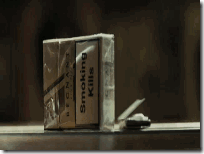
You see that pack of Virginia killing sticks on the end of the piano? All you need to know about life is retained within those four walls.

You will notice that one of your personalities is seduced by the illusions of grandeur. A gold packet of king size with a regal insignia. An attractive implication toward glamour and wealth. A subtle suggestion that cigarettes are indeed your royal and loyal friends. And that, Pete, is a lie.

Your other personality is trying to draw your attention to the flip side of the discussion.  Written in boring, bold, black and white, is the statement that these neat little soldiers of death, are, in fact, trying to kill you. And that, Pete, is the truth.

Oh, beauty is a beguiling call to death and I'm addicted to the sweet pitch of its siren.

That that starts sweet ends bitter. And that which starts bitter ends sweet.

Monday, March 01, 2010

An Adaptive Response to Affliction

Excerpt from “Depression’s Upside,” by Jonah Lehrer, New York Times Sunday Magazine (February 25, 2010):

The mystery of depression is not that it exists — the mind, like the flesh, is prone to malfunction. Instead, the paradox of depression has long been its prevalence. While most mental illnesses are extremely rare — schizophrenia, for example, is seen in less than 1 percent of the population — depression is everywhere, as inescapable as the common cold. Every year, approximately 7 percent of us will be afflicted to some degree by the awful mental state that William Styron described as a “gray drizzle of horror . . . a storm of murk.” Obsessed with our pain, we will retreat from everything. We will stop eating, unless we start eating too much. Sex will lose its appeal; sleep will become a frustrating pursuit. We will always be tired, even though we will do less and less. We will think a lot about death.

The persistence of this affliction — and the fact that it seemed to be heritable — posed a serious challenge to Darwin’s new evolutionary theory. If depression was a disorder, then evolution had made a tragic mistake, allowing an illness that impedes reproduction — it leads people to stop having sex and consider suicide — to spread throughout the population. For some unknown reason, the modern human mind is tilted toward sadness and, as we’ve now come to think, needs drugs to rescue itself.

The alternative, of course, is that depression has a secret purpose and our medical interventions are making a bad situation even worse. Like a fever that helps the immune system fight off infection — increased body temperature sends white blood cells into overdrive — depression might be an unpleasant yet adaptive response to affliction. Maybe Darwin was right. We suffer — we suffer terribly — but we don’t suffer in vain.


Sunday, February 28, 2010

It Won’t Be Long

Goodbye
by Robert Creeley, from Life & Death

Now I recognize
it was always me
like a camera
set to expose

itself to a picture
or a pipe
through which the water
might run

or a chicken
dead for dinner
or a plan
inside the head

of a dead man.
Nothing so wrong
when one considered
how it all began.

It was Zukofsky's
"Born very young into a world
already very old..."
The century was well along

when I came in
and now that it's ending,
I realize it won't
be long.

But couldn't it all have been
a little nicer,
as my mother'd say. Did it
have to kill everything in sight,

did right always have to be so wrong?
I know this body is impatient.
I know I constitute only a meager voice and mind.
Yet I loved, I love.

I want no sentimentality.
I want no more than home.

The Breath of Awareness

From the opening pages of Intimate Stranger by Breyten Breytenbach:

Intimate Stranger: A Writing Book Listen, this process called poetry is an exercise in imagining memory, and then having that memory snare and cherish imagination. Yet, every poem is and will be a capsule of territory in the perpetual present tense, a vessel taking on the ever-changing colors of the sea.

Poetry is the breath of awareness and the breathing thereof. I even mean this literally, for underlying the flow and the fall of verses are ‘natural units’ of consciousness sculpted by rhythm, by recall, by movement reaching for the edges of meaning and of darkness. One could illustrate by averring that the poem is a membrane, rippling, thrumming; reminding us that we are breathing organisms continually translating the space around us, continually translating ourselves into spaces of the known and thus drawing circumferences around locations of the unknown. From this one could extrapolate that the practice and process of remembering /evoking /awakening events and our selves lead quite naturally to questioning the polarities of other and I, to writing (and un-writing) the self, and toward rewriting the world. The boat changes the water.

Poetry is also the wind of time and thus the movement and singing of being…For when you hold a poem to your ear you hear the deep-sound, the movements we are part of, conveying not so much a literal meaning as an existential sense. It constitutes the spinal chord of remembering. And it reminds us that remembering is movement.

Wolves of the Forest

Vilkas miške - wolf in the forest

“However much you feed a wolf, it always looks to the forest. We are all wolves of the dense forest of Eternity.”

~ Marina Tsvetaeva

There’s No One Way to Be

Julianne-Moore

“A lot of people think that how you behave is a given or that behavior is character. When you move around a lot, you learn that behavior is mutable. I would change, depending on where I was. I would go to one school and everyone would dance one way and, then, at a new school, you’d notice that no one picked up their feet when they danced. You’re like, O.K. — I’ll shuffle my feet like them. You learn that there’s no one way to dance or be. For some reason, a lot of actors come from these peripatetic backgrounds — army kids, missionary kids, kids of salesmen. It teaches you to watch, to reinvent, that character can change.”

~ Julianne Moore, from “Julianne of the Spirits,” by Lynn Hirschberg, New York Times T Magazine (February 28, 2010)

*     *     *

frecklefacex-large Julie Anne Smith

Saturday, February 27, 2010

Willing to Think Little

Excerpt from Think Little by Wendell Berry from A Continuous Harmony: Essays Cultural & Agricultural (1972):

Wendell Berry For most of the history of this country our motto, implied or spoken, has been Think Big. I have come to believe that a better motto, and an essential one now, is Think Little. That implies the necessary change of thinking and feeling, and suggests the necessary work. Thinking Big has led us to the two biggest and cheapest political dodges of our time: plan-making and law-making. The lotus-eaters of this era are in Washington, D.C., Thinking Big. Somebody comes up with a problem, and somebody in the government comes up with a plan or a law. The result, mostly, has been the persistence of the problem, and the enlargement and enrichment of the government.

But the discipline of thought is not generalization; it is detail, and it is personal behavior. While the government is "studying" and funding and organizing its Big Thought, nothing is being done. But the citizen who is willing to Think Little, and, accepting the discipline of that, to go ahead on his own, is already solving the problem. A man who is trying to live as a neighbor to his neighbors will have a lively and practical understanding of the work of peace and brotherhood, and let there be no mistake about it — he is doing that work. A couple who make a good marriage, and raise healthy, morally competent children, are serving the world's future more directly and surely than any political leader, though they never utter a public word. A good farmer who is dealing with the problem of soil erosion on an acre of ground has a sounder grasp of that problem and cares more about it and is probably doing more to solve it than any bureaucrat who is talking about it in general. A man who is willing to undertake the discipline and the difficulty of mending his own ways is worth more to the conservation movement than a hundred who are insisting merely that the government and the industries mend their ways.

One of Many Hoops

Black Elk with wife and daughter, circa 1890-1910. “Then I was standing on the highest mountain of them all , and round about beneath me was the whole hoop of the world. And while I stood there I saw more than I can tell and I understood more than I saw; for I was seeing in a sacred manner the shapes of all things in the spirit, and the shape of all shapes as they must live together like one being. And I saw that the sacred hoop of my people was one of many hoops that made one circle, wide as daylight and as starlight, and in the center grew one mighty flowering tree to shelter all the children of one mother and one father. And I saw that it was holy.”

~ Black Elk Speaks: Being the Life Story of a Holy Man of the Oglala Sioux, as told to John Neihardt

Why Should It Be Easy?

TOLSTOY
I’ve become convinced that all the world’s religions have a
single organizing principle. Can you guess what it is? Love! Love! Simple...


TOLSTOY
I didn’t come for more recrimination. Despite good cause for alienation between us, I have never stopped loving you.

SOFYA
Of course...

TOLSTOY
God knows you don’t make it easy.

SOFYA
Why should it be easy? I’m the work of your life. You’re the work of mine. It’s what love is.

From The Last Station, based on the novel by Jan Parini, screenplay by Michael Hoffman.

Friday, February 26, 2010

Being Alive and Being Together

From “Mindfulness in 2 Minutes,” by Chade-Meng Tan, Huffington Post (February 24, 2010):

Most evenings, before we sleep, my young daughter and I sit in Mindfulness together for two minutes. I like to joke that two minutes is optimal for us because that is the attention span of a child and an engineer. For two minutes a day, we quietly enjoy being alive and being together. More fundamentally, for two minutes a day, we enjoy being. Just being. To "just be" is simultaneously the most ordinary and the most precious experience in life.

As usual, I let my experience with a child inform how I teach adults. This daily two-minutes experience is the basis of how I introduce the practice of Mindfulness in an introductory class for adults.

More…

Overwhelming the Prefrontal Cortex

Jonah Lehrer discussing his book, How We Decide, which is now out in paperback, “The Paralysis Of Analysis,” Fresh Air (January 22, 2010):

First chapter and New York Times review. One of the studies I talk about in the book concerns a study done by Stanford psychologists. They had two groups of people. One group they had memorize a two-digit number. The other group they had memorize a seven-digit number. Then they marched these two groups down the hall and gave them a choice between two snacks.

One snack was a rich, gooey slice of chocolate cake. The other snack was a responsible fruit salad. The people who memorized a two-digit number were twice as likely to choose the fruit salad as the people who memorized the seven-digit number, who were twice as likely to choose the chocolate cake. And the reason is that those extra five digits — doesn't seem like very much information at all, just five extra numbers — so overwhelmed the prefrontal cortex that there wasn't enough processing power left over to exert self-control.

So that gives us a sense of just how limited in capacity our brain actually is and, I think, points to the fact that we should absolutely be aware of these limitations.

Thursday, February 25, 2010

Never Be Ashamed of Kindergarten

Instructions to the Artist
by Billy Collins, from Questions About Angels

I wish my head to appear perfectly round
and since the canvas should be of epic dimensions,
please trace the circle with a dinner plate
rather than a button or a dime

My face should be painted with
an ant-like sense of detail;
pretend you are executing a street map
of Rome and that all citizens
can lift thirty times their own weight

The result should be a strained
but self-satisfied expression,
as if I am lifting a Volkswagen with one foot.

The body is no great matter;
just draw some straight lines
with a pencil and ruler.
I will not be around to hear the voice
of posterity calling me Stickman.

The background I leave up to you
but if there is to be a house,
lines of smoke rising from the chimney
should be mandatory.
Never be ashamed of kindergarten--
it is the alphabet's only temple.

Also, have several kangaroos grazing
and hopping around in the distance,
an allusion to my world travels.

Some final recommendations:
I should like to appear hatless.
Kindly limit your palette to a single
primary color, any one but red or blue.
Sign the painting on my upper lip
so your name will always be my mustache.

Discovering the Fully Authentic Self in the Endless Wilderness of the Mind

Durs Grünbein explores unpopular answers to popular poetry Q&A questions in “Why Live Without Writing,” Poetry Foundation (February 1, 2010):


Durs Grünbein In the first place, I would say, you write to escape your dread of the sheer present. You fill page after page, as Nietzsche once put it, with angry yearning, not to cozy up to your nearest, but out of love of those farthest away from you, and because the contemporary and the day-to-day will be all the more precious to you when you return to them in a wide arc over unknown terrain. Hence many people’s habit of getting drunk in company: at close quarters only a maximum of inner distance can create moments of ease and relaxation. Hence the silent conversations everyone has with themselves, or locking yourself up in the bathroom to read undisturbed, or the distancing look in the mirror as soon as you know you’re unobserved. Hence too the recurring need of lovers to go to the cinema and stare together at the magic screen, which for a precious hour and a half will make them forget their bodies. In writing, it is one’s innermost being that tries to assert itself, paradoxically, by self-exposure. But publicity, as will soon become apparent, is nothing but a particularly tough protective shield.


And the second reason is a dilemma that concerns each individual psyche. You write, I believe, because you can’t quite shake the suspicion that as a mere contemporary and biological cell mate, hopelessly trammeled up in your own limited lifespan, you would always remain incomplete, half a man, so to speak. Someone must have put you onto the idea that only your most individual expression gives you the least chance of one day being seen in any way other than in your mortal sheath—say, as a kind of ghost. Ever since that tormenting voice (whoever it may be) first challenged you in the name of metaphysics, you’ve been trying by all the laws of glass-blowing, aka poetry, to fix a little window in your own diminishing time, in the hope that tomorrow, or whenever, you may be seen through that little peephole. If you happen to succeed in making your sweetheart, or one or two of your friends, or yourself in your peculiarity visible—the way Vermeer, say, showed his pregnant letter-reader—then it will have been worth the effort. Writing, the voice whispers to you, is the least circumstantial method of breaking out of the given and the immediate. Its only requirement is a mastery of the alphabet, which, thanks to universal education, may generally be relied on, at least hereabouts. You don’t have to be able to draw or set down notes like Bach, and yet, once you’ve passed your spelling exam, you’ve mastered the only method by which consciousness can be recorded.


From which it follows, thirdly and lastly: you write because the brain is an endless wilderness, whose roughest terrain can only be traveled with a pencil. As soon as we are in the innermost dreamy connections, all other art forms are dependent on verbal synthesis. The dream, as you discover when you write, is the fully authentic self. You will never have amounted to more. The world will not appear any more variegated. Which means the notion of what really exists can, with writing, be comfortably extended by a dimension or two.


[Thanks Jeanne!]

Wednesday, February 24, 2010

How Things Are and Which Things Matter

Excerpt from Everybody’s Story: Wising Up to the Epic of Evolution by Loyal Rue:

The most fundamental sources of self-understanding are found at the level of story. To put the thesis even more directly: if we are to respond effectively to the global problematique then we must attend to our stories, for in the story of a culture we find its most profound expression of wisdom.

Perhaps this thesis exaggerates the case. Is it possible that stories can make a decisive difference in the viability of our species? Is story that fundamental to human existence? It is difficult to believe otherwise once we stop to consider the many ways in which our lives are shaped by stories.

We legitimate institutions and values in their name, we wage wars in their defense, we judge ourselves and others by their standards, we take pains that our children will learn them well, we draw inspiration from their examples, we construct our hopes and fears under their influence, and so on. It would not be extreme to say that we negotiate our way through life by the guidance of our stories.

We humans are the only species to tell stories, and so far as anyone knows every recognizable human community has fostered storytelling traditions. Thus we appear to be in the presence of a trait that is both universally and exclusively human, suggesting that what humans are has something to do with their stories.

If these ideas hold up – that is, if storytelling is an essential human activity bestowing substance and form on the lives we have – then it follow that changes at this level of human thought will be among the most profound and far-reaching we can imagine. Thus we have good reason to believe that appropriate changes at the level of story might hold the power of reorientation needed for enhancing human solidarity and cooperation…

…I want to suggest that the profound sense of story bears a deep relation to the basic functions of the central nervous system. I am saying that if we can picture what the brain does for an individual organism then we shall have a way to think about what story does for a cultural tradition.

All brains (human or otherwise) do essentially the same thing, that is, they take some measure of how things are in the external environment and then use this information to devise behaviors that will be more or less conducive to the interests of the organism. Brains that have become specialized for symbolic interaction do not suddenly depart from this basic function, they just continue it in a new domain, the domain of culture.

Indeed, human culture just is the result of assessing and addressing the environment with the aid of symbols. In every particular human culture, therefore, we may expect to find (and do find) two basic types of ideas: ideas about how things are in the world, and ideas about which things matter for human existence.

This principle may be extended by the assertion that a culture exists as a coherent entity to the extent that its members share common ideas about how things are and which things matter. A further implication is that the important difference between cultures may be measured in terms of incompatible ideas about reality and value.

Tuesday, February 23, 2010

The Season of Lint

Lint
by Gary Metras, from American Life in Poetry: Column 257

It doesn’t bother me to have
lint in the bottoms of pant pockets;
it gives the hands something to do,
especially since I no longer hold
shovel, hod, or hammer
in the daylight hours of labor
and haven’t, in fact, done so
in twenty-five years. A long time
to be picking lint from pockets.
Perhaps even long enough to have
gathered sacks full of lint
that could have been put
to good use, maybe spun into yarn
to knit a sweater for my wife’s
Christmas present, or strong thread
whirled and woven into a tweedy jacket.
Imagine entering my classroom
in a jacket made from lint.
Who would believe it?
Yet there are stranger things—
the son of a bricklayer with hands
so smooth they’re only fit
for picking lint.