Sunday, February 27, 2011

Web Freedom isn’t Free

From “Living Singles,” by Virginia Heffernan, New York Times Sunday Magazine, Feb. 27, 2011:

The market for narrative nonfiction shrank not because people got dumber or lost their attention spans; narrative nonfiction, like so many 20th-century forms, fell on hard times when the Web came along, and readers stopped paying for content…

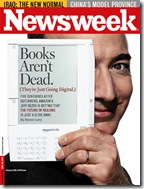
…When the iPhone first appeared, followed by the Kindle and then the iPad, it became clear that e-books and apps provided a way to siphon the resources of the Internet to individuals, who could now sample that energy without having to be vulnerable to the Web’s commercialism. That was an enormous breakthrough. Anyone who’s honest with herself knows that the Web stopped being a great place for consumers of culture a year or two ago. You think you’re reading the Web these days, but it’s reading you — gathering data on you, trying to sell you stuff, pushing you to other links. On the Web, reading is shopping. And sometimes you don’t want to shop.

kindle-coffee The Kindle in particular brought me the first moment of peace from Web noise that I’d had in a long time. True, I thought I loved the Web noise when the only alternative was to recede into analog culture — but I have adored the silence I’ve found on the Kindle.

I never thought I’d back off the Web, but I have. The once-glorious freedom of the Web was not free. Its price is a bone-deep commercialism that cannot yet be circumvented. For convenience, comprehensiveness and social life, I still visit, but now I see these visits as at least as risky and irritating as they are liberating and exhilarating.

Read the whole essay here…

PS I’ve really enjoyed this column and am sad to see it go. Visit ArtsBeat to keep an eye on Virginia Heffernan’s eyewitness traffic reports from the intersection of media and technology.

Saturday, February 26, 2011

The Bright Home in Which I Live

Winter 2010

The House of Belonging
by David Whyte, from The House of Belonging

I awoke
this morning
in the gold light
turning this way
and that

thinking for
a moment
it was one
day
like any other.

But
the veil had gone
from my
darkened heart
and
I thought

it must have been the quiet
candlelight
that filled my room,

it must have been
the first
easy rhythm
with which I breathed
myself to sleep,

it must have been
the prayer I said
speaking to the otherness
of the night.

And
I thought
this is the good day
you could
meet your love,

this is the black day
someone close
to you could die.

This is the day
you realize
how easily the thread
is broken
between this world
and the next

and I found myself
sitting up
in the quiet pathway
of light,

the tawny
close grained cedar
burning round
me like fire
and all the angels of the housely
heaven ascending
through the first
roof of light
the sun has made.

This is the bright home
in which I live,
this is where
I ask
my friends
to come,
this is where I want
to love all the things
it has taken me so long
to learn to love.

This is the temple
of my adult aloneness
and I belong
to that aloneness
as I belong to my life.

There is no house
like the house of belonging.

No Other Way to Be Human

Excerpts from "Telling Stories of Our Shared Humanity," Chris Abani, TED Talks, Feb. 2008:

What I've come to learn is that the world is never saved in grand messianic gestures, but in the simple accumulation of gentle, soft, almost invisible acts of compassion, everyday acts of compassion. In South Africa they have a phrase called ubuntu. Ubuntu comes out of a philosophy that says, the only way for me to be human is for you to reflect my humanity back at me.

But if you're like me, my humanity is more like a window. I don't really see it, I don't pay attention to it until there's a bug that's dead on the window. Then suddenly I see it, and usually, it's never good. It's usually when I'm cussing in traffic at someone who is trying to drive their car and drink coffee and send emails and make notes. So what ubuntu really says is that there is no way for us to be human without other people. It's really very simple, but really very complicated.


During the Biafran war, we were caught in the war. It was my mother with five little children. It takes her one year, through refugee camp after refugee camp, to make her way to an airstrip where we can fly out of the country. At every single refugee camp, she has to face off soldiers who want to take my elder brother Mark, who was nine, and make him a boy soldier. Can you imagine this five foot two woman, standing up to men with guns who want to kill us?

All through that one year, my mother never cried one time, not once. But when we were in Lisbon, in the airport, about to fly to England, this woman saw my mother wearing this dress, which had been washed so many times it was basically see through, with five really hungry-looking kids, came over and asked her what had happened. And she told this woman. And so this woman emptied out her suitcase and gave all of her clothes to my mother, and to us, and the toys of her kids, who didn't like that very much, but—

That was the only time she cried. And I remember years later, I was writing about my mother, and I asked her, 'Why did you cry then?"

And she said, "You know, you can steel your heart against any kind of trouble, any kind of horror. But the simple act of kindness from a complete stranger will unstitch you."

See also:

Chant:
by Chris Abani, from Dog Woman

It was the hornbill that spoke it.
In the nothing, becoming nothing,
begetting nothing; this is everything.

The world is old, the world is new

How does the darkness hide?
In the nothing, becoming nothing,
begetting nothing; this is everything.

The world is old, the world is new

The sun is no bigger than a crab.
In the nothing, becoming nothing,
begetting nothing; this is everything.

The world is old, the world is new

Hot soup is devoured from the edges.
In the nothing, becoming nothing,
begetting nothing; this is everything.

The world is old, the world is new

The blood sign is red; burning like fire.
In the nothing, becoming nothing,
begetting nothing; this is everything.

The world is old, the world is new

It has no name; silence is its name.
In the nothing, becoming nothing,
begetting nothing; this is everything.

The world is old, the world is new.

Love What You Are

Feb. 25, 2011

Lines for Winter
by Mark Strand, from New Selected Poems

Tell yourself
as it gets cold and gray falls from the air
that you will go on
walking, hearing
the same tune no matter where
you find yourself—
inside the dome of dark
or under the cracking white
of the moon’s gaze in a valley of snow.
Tonight as it gets cold
tell yourself
what you know, which is nothing
but the tune your bones play
as you keep going. And you will be able
for once to lie down under the small fire
of winter stars.
And if it happens that you cannot
go on or turn back
and you find yourself
where you will be at the end,
tell yourself
in that final flowing of cold through your limbs
that you love what you are.

See also: Lines for Winter recited by Mary Louise Parker

@JSCarroll

Friday, February 25, 2011

Instinctual and Repressed Kindness Let Loose

Haiti (January 2010)

“There is approaching—and it is not so far off as it seems—a world arranged by the wisdom hid in the human heart; a world that is the organization of a strong and universal kindness; a world redeemed from the fear of institutions and of poverty. Even now, derided and discouraged as it is, socially untrained and inexperienced as it is, if the instinctual and repressed kindness of mankind were suddenly let loose upon the earth, sooner than we think would we be members one of another, sitting around one family hearthstone, and singing the song of the new humanity.”

~ George D. Herron, from The Cry for Justice: An Anthology of the Literature of Social Protest (1915)


[Thanks, Pat!]

Managing Dissent

“We need to create the space for what I call managed dissent. If we are to shift paradigms, if we are to make breakthroughs, if we are to destroy myths, we need to create an environment in which expert ideas are battling it out, in which we're bringing in new, diverse, discordant, heretical views into the discussion, fearlessly, in the knowledge that progress comes about, not only from the creation of ideas, but also from their destruction—and also from the knowledge that, by surrounding ourselves by divergent, discordant, heretical views, all the research now shows us that this actually makes us smarter.

Encouraging dissent is a rebellious notion because it goes against our very instincts, which are to surround ourselves with opinions and advice that we already believe or want to be true. And that's why I talk about the need to actively manage dissent.

Google CEO Eric Schmidt is a practical practitioner of this philosophy. In meetings, he looks out for the person in the room—arms crossed, looking a bit bemused—and draws them into the discussion, trying to see if they indeed are the person with a different opinion, so that they have dissent within the room. Managing dissent is about recognizing the value of disagreement, discord and difference.”

~ Noreena Hertz, from “How to Use Experts and When Not to,” TED Talks, Nov. 2010

Wednesday, February 23, 2011

Feel Everything

Feb. 22, 2011

“Equanimity does not mean you feel nothing; it means you feel everything and let it be.”

~ Judith Lasater, from A Year of Living Your Yoga: Daily Practices to Shape Your Life

[Thanks, Kit!]

Sunday, February 20, 2011

The Impulse to Exist

Brandywine Fallsp schmitt 

Excerpt from A Short History of Nearly Everything by Bill Bryson:

"Like most things that thrive in harsh environments, lichens are slow-growing. It may take a lichen more than half a century to attain the dimensions of a shirt button. Those the size of dinner plates, write David Attenborough, are therefore ‘likely to be hundreds if not thousands of years old.’ It would be hard to imagine a less fulfilling existence. ‘They simply exist,’ Attenborough adds, ‘testifying to the moving fact that life even at its simplest level occurs, apparently, just for its own sake.’ 

It is easy to overlook this thought that life just is. As humans we are inclined to feel that life must have a point. We have plans and aspirations and desires. We want to take constant advantage of the intoxicating existence we’ve been endowed with. But what’s life to a lichen? Yet its impulse to exist, to be, is every bit as strong as ours—arguably even stronger. If I were told that I had to spend decades being a furry growth on a rock in the woods, I believe I would lose the will to go on. Lichens don’t. Like virtually all living things, they will suffer any hardship, endure any insult, for a moment’s additional existence. Life, in short just wants to be. But—here’s an interesting point—for the most part it doesn’t want to be much."

Strangers No More

This 39-minute film about a school in south Tel Aviv gets my vote for best Oscar-nominated documentary short subject. The principal and teachers of Bialik-Rogozin School enthusiastically embrace the challenges of educating children from all over the world, many of whom have experienced extraordinary violence, loss, and displacement. It is a remarkable and inspiring study of resilience nurtured by providing a safe environment, finding common ground in the midst of dizzying diversity, and igniting passion for learning.

Strangers No More Movie Trailer - Bialik Rogozin School from Simon & Goodman Picture Co. on Vimeo.

Feeling Secure

“We respond to the feeling of security and not the reality. Most of the time that works…So it’s important for us, those of us who design security, who look at security policy, or even look at public policy in ways affect security [to realize that] it’s not just reality it’s feeling and reality. What’s important is that they be about the same. If our feelings match reality we make better security trade-offs.”

~ Bruce Schneier

Common cognitive biases related to risk perception:

  • We tend to exaggerate spectacular and rare risks and downplay common risks
  • The unknown is perceived to be riskier than the familiar
  • Personified risks are perceived to be greater than anonymous risks
  • People underestimate risks in situations they do control and overestimate them in situations they don’t control
  • We estimate the probability of something by how easy it is to bring instances of it to mind [availability heuristic]
  • We respond to stories more than data

Books by Bruce Schneier:

Saturday, February 19, 2011

Our Minds Create the Medicine

Professor Funk’s YouTube Channel

Spectacularly Complex

Whole ColumnComputer model of a single neocortical column from a rat's brain (Photo: IBM)

Excerpt from Portraits of the Mind: Visualizing the Brain from Antiquity to the 21st Century by Carl Schoonover:

This image shows the three-dimensional configuration of ten thousand simulated neurons that constitute a single neocortical column—an anatomical unit barely wider than the head of a pin. The neocortical column, believed to be a building block of the cerebral cortex, is a mere millimeter cubed, and is repeated countless times across the expanse of the human neocortex.

Since there is simply no way to gain full experimental insight into a process at this large a scale, the Blue Brain Project was launched in 2005 in collaboration with IBM to produce a computer simulation of it. It is so spectacularly complex that a dedicated state-of-the-art supercomputer is required to keep track of all the phenomena as they recurrently influence one another; even with this computational firepower, it still takes about one hundred seconds to simulate a single second of activity.

In order to make it as realistic as possible, a wide variety of factors in included in the simulation: genetics, the shape of the dendrites, and the neurophysiological characteristics imparted by their ion channel composition. Here we see the Blue Brain’s cortical column in action: Each dendrite is simulated individually and rendered so that its color (ranging from blue to red) represents its voltage at one moment in time.

The long-term goal of the project is to uncover the broad principles of the brain function and dysfunction by simulating the entire brain of mammals, including that of humans.

<a href="http://www.macromedia.com/go/getflashplayer">Click to install the plugin</a>

Zooming Out, Highlighting a Single Neuron
Blue Brain Project video

Friday, February 18, 2011

What You Can Plan is Too Small

Brandywine Falls p schmitt 

What to Remember When Waking
by David Whyte, from The House of Belonging

In that first
hardly noticed
moment
in which you wake,
coming back
to this life
from the other
more secret,
moveable
and frighteningly
honest world
there is a small opening
into the new day
which closes
the moment
you begin
your plans.

What you can plan
is too small
for you to live.

What you can live
wholeheartedly
will make plans
enough
for the vitality
hidden in your sleep.

To be human
is to become visible
while carrying
what is hidden
as a gift to others.

To remember
the other world
in this world
is to live in your
true inheritance.

You are not
a troubled guest
on this earth,
you are not
an accident
amidst other accidents
you were invited
from another and greater
night
than the one
from which
you have just emerged.

Now, looking through
the slanting light
of the morning
window toward
the mountain
presence
of everything
that can be,
what urgency
calls you to your
one love? What shape
waits in the seed
of you to grow
and spread
its branches
against a future sky?

Is it waiting
in the fertile sea?
In the trees
beyond the house?
In the life
you can imagine
for yourself?
In the open
and lovely
white page
on the waiting desk?

Thursday, February 17, 2011

Rising to the Virtue of Compassion

“Our culture is obsessed with perfection and with hiding problems. But what a liberating thing to realize that our problems, in fact, are probably our richest sources for rising to this ultimate virtue of compassion. Towards bringing compassion towards the joys and sufferings of others…Compassion can’t be reduced to sainthood any more than it can be reduced to pity…Compassion is equally at home in the secular as well as in the religious. So I will paraphrase Einstein and say that the future of humanity needs [the technology of compassion] as much as it needs all the others that have now connected us and set before us the terrifying and wondrous possibility of actually becoming one human race.”

~ Krista Tippett, from “Reconnecting with Compassion,” TED, Nov. 2010 

Wednesday, February 16, 2011

Everything Changes All the Time

From Real Happiness: The Power of Meditation by Sharon Salzberg:

Again and again I’ve seen novice meditators begin to transform their lives—even if they were initially resistant or skeptical. As I’ve learned through my own experience, meditation helps us to find greater tranquility, connect to our feelings, find a sense of wholeness, strengthen our relationships, and face our fears. That’s what happened to me.

Because of meditation, I’ve undergone profound and subtle shifts in the way I think and how I see myself in the world. I’ve learned that I don’t have to be limited to who I thought I was when I was a child or what I thought I was capable of yesterday, or even an hour ago. My meditation practice has freed me from the old, conditioned definition of myself as someone unworthy of love. Despite my initial fantasies when I began meditating as a college student, I haven’t entered a steady state of glorious bliss. Meditation has made me happy, loving, and peaceful—but not every single moment of the day. I still have good times and bad, joy and sorrow. Now I can accept setbacks more easily, with less sense of disappointment and personal failure, because meditation has taught me how to cope with the profound truth that everything changes all the time.”

Be Still While You are Still Alive

Year-End Retreat 2009, Rancho Palos Verdes

In Silence
by Thomas Merton, from The Strange Islands

Be still.
Listen to the stones of the wall.
Be silent, they try
to speak your

name.
Listen
to the living walls.

Who are you?
Who
are you? Whose
silence are you?

Who (be quiet)
are you (as these stones
are quiet). Do not
think of what you are
still less of
what you may one day be.

Rather
be what you are (but who?)
be the unthinkable one
you do not know.

O be still, while
you are still alive,
and all things live around you

speaking (I do not hear)
to your own being,
speaking by the unknown
that is in you and in themselves.

“I will try, like them
to be my own silence:
and this is difficult. The whole
world is secretly on fire. The stones
burn, even the stones they burn me.
How can a man be still or
listen to all things burning?
How can he dare to sit with them
when all their silence is on fire?”

Monday, February 14, 2011

A Crash of Territorial Cultures

Excerpts from “Demonstrations, Hopes, and Dreams,” Being, Feb. 10, 2011:

Dr. Scott Atran: If you take these polls like the Gallup and Pew polls, you find that about 7 percent of the Muslim world has some sympathy for bin Laden. That's about 100 million people out of 1.3 or 1.4 billion Muslims in the world. But then if you look who actually is willing to do something violent, you find that it's an extremely, extremely small number of people. But when you look at of those thousands out of the 100 million who actually do anything, you find that the greatest predictor has nothing to do with religion.

The greatest predictor is whether they belong to a soccer club or some action-oriented group of friends. In fact, almost none of them had any religious education whatsoever. They're all born again, sort of between the ages of 18 and 22. So if it's not religious inculcation, if it's not religious training, if it's not even religious tradition, what could it possibly be? And again, it's first of all who your friends are. That's the greatest predictor of everything. Then there's a sort of geopolitical aspect to it. I mean, people talk about a clash of civilizations. I think that's dead wrong. There's a crash of territorial cultures across the world.

Krista Tippett: Yeah. I want you to talk about that. I think that's a very intriguing distinction you draw that it's not a clash of civilizations, but you've also said a crash of civilizations. So tell me what you're describing there.

Dr. Atran: Well, globalization, of course, has provided access to large masses of humanity to a better standard of living, better health, better education. But it has also left in its wake many traditional societies that are falling apart, that just can't compete. So what you have is young people especially sort of flailing around looking for a sense of social identity. These traditional territorial cultures and their influence disappears and it's happening across all of this sort of middle attitudes of Eurasia and they're trying to hook up with one another peer to peer.

And this is paralleling another new development in history of humanity and that is this massive media-driven global political awakening where, again, for the first time in human history, you've got someone in New Guinea who can see the same images as someone in the middle of the Amazon. And so you've got these young people paradoxically focusing in on a smaller and smaller bandwidth in this sort of global media trying to hook up with one another and make friends and give themselves a sense of significance. And the Jihad comes along.

I mean, the Jihad — you know, I interviewed this guy in prison in France who wanted to blow up the American Embassy and I asked him, "Why did you want to do this?" and he says to me, "Well, I was walking along the street one day and someone spit at my sister and called her sale Arabe, a dirty Arab, and I just couldn't take it anymore and I realized that this injustice would never leave French society or Western society, so I joined the Jihad." I said, "Yeah, but that has been going on for years." And he goes, "Yes, but there was no Jihad before."

So it's a sort of receptacle. You find it's especially appealing to young people in transitional stages in their lives — immigrants, students, people in search of jobs or mates and between jobs and mates, and it gives a sense of empowerment that their own societies certainly don't. I mean, the message of the Jihad is, look, you, any of you, any of you out there, you too can cut off the head of Goliath with a paper cutter. That's what we did. We changed the world with paper cutters. That's all you need. All you need is will and truth and meaning, and you will correct injustice in the world and you'll be heroic and you'll have the greatest adventure of your lives. That's surely powerful.

*     *     *     *     *

Ms. Tippett: You know, at the beginning of your book, which is called Talking to the Enemy: Faith, Brotherhood, and the (Un)Making of Terrorists, right before the table of contents, you have this absolutely beautiful picture of children. It looks like they're either coming out of school or going to school. They're beautiful children. It's kind of a heartbreaking picture in a lovely way.

Then I read underneath that it's a school that you mentioned early on. You say, school's out at this school in Morocco from which five of the seven plotters of the Madrid train bombing who blew themselves up attended, as did several volunteers for martyrdom in Iraq. Tell me why you put that picture at the beginning of your book and what you would like a reader or someone coming to these ideas to see in that picture.

Dr. Atran: Because those are the terrorists. Those are those who would be terrorists or would be us or our friends. And it is up to us and how we deal with the political world and the hopes and dreams that emerge in their own societies that will decide whether they go one way or the other. It's not, again, the fact that there are good or bad ideologies out there. It's not the fact of lack of presence of economic opportunities per se. It's whether there are paths in life that can lead them to something that's more congenial to the way we live in the world. I think we have many things to offer, but not in the way we're doing it.

I mean, I'm reminded very much of Maximilien Robespierre's statement to the Jacobin Club in the French Revolution, a statement he promptly forgot, which was, "No one loves armed missionaries." No one loves armed missionaries. No one loves the fact that we have troops out there in the world trying to preserve or push democracy or whatever. As Jefferson said, "The way we're going to change the world is by our example. Never, never can it be by the sword." Now sometimes you have to fight things. When people want to kill you, when people want to blow you up, then you have to fight them. There may be at the time no opportunity.

But that's not the case with the vast majority of people who could possibly become tomorrow's terrorists. That's where the fight for the world will be. It will be in the next generation of these young people, the ones caught between should we go the path of happiness as martyrdom or should we go to the path of yes, we can. They're both very enticing paths. I think one has a lot more to offer, but we have to show them it has more to offer, and we have to show them now. And that's what they're asking for right now.

Listen to the entire conversation on Being…

Saturday, February 12, 2011

Engaged in the Normal Process of Living

Excerpt from Twelve Steps to a Compassionate Life by Karen Armstrong:

armstrong-12-steps The purpose of mindfulness…is to help us detach ourselves from the ego by observing the way our minds work. You might find it helpful to learn more about the neurological makeup of the brain and the way that meditation can enhance your sense of peace and interior well-being…but this is not essential. Practice is more important than theory, and you will find that it is possible to work on your mental processes just as you work out in the gym to enhance your physical fitness.

Mindfulness is a form of meditation that we perform as we go about our daily lives…Just as musicians have to learn how to manipulate their instruments and an equestrienne requires an intimate knowledge of the horse she is training, we have to learn to use our mental energies more kindly and productively. This is not a meditation that we should perform in solitude, apart from our ordinary routines. In mindfulness we mentally stand back and observe our behavior while we are engaged in the normal process of living in order to discover more about the way we interact with people, what makes us angry and unhappy, how to analyze our experiences, and how to pay attention to the present moment. Mindfulness is not meant to make us morbidly self-conscious, scrupulous, or guilty; we are not supposed to pounce aggressively on the negative feelings that course through our minds. Its purpose is simply to help us channel them more creatively.

With mindfulness, we use our new analytical brain to step back and become aware of the more instinctive, automatic mental processes of the old brain. So we live in the moment, observing the way we speak, walk, eat, and think. The Tibetan word for meditation is gom: “familiarization.” Mindfulness should give us greater familiarity with the Four Fs that are the cause of so much pain (feeding, fighting, fleeing, and—reproduction). We will become aware of how suddenly these impulses arise in response to stimuli that make us irrationally angry, hostile, greedy, rampantly acquisitive, lustful, or frightened, and how quickly they overturn the more peaceful, positive emotions. But instead of being overly distressed by this, we should recall that it is what nature intended and that the strong instinctual passions are simply working through us. Over time and with practice, we can learn how to become more aloof and refuse to identify with them: “This is not mine; this is not what I really am; this is not my self.” But it will not happen overnight; we have to be patient and understand that there is no quick fix.

Yet we should also take note of how unhappy these primitive emotions make us. When you are engrossed in thoughts of anger, hatred, envy, resentment, or disgust, notice the way your horizons shrink and your creativity diminishes…In the grip of these hostile preoccupations, we become focused on ourselves, can think of little else, and lose all wider perspective. We tend to assume that other people are the cause of our pain; with mindfulness, over time, we learn how often the real cause of our suffering is the anger that resides within us. When we are enraged, we tend to exaggerate a person’s defects—just as when we are seized by desire we accentuate somebody’s attractions and ignore her faults, even though at some level we may know that this is a delusion.

Similarly, we become aware that the acquisitive drive, which originally motivated our search for food, is never satisfied. As you progress, you will notice that once a desire is fulfilled, you almost immediately start to want something else. if the object of your desire turns out to be disappointing, you become frustrated and unsettled. You soon realize that nothing lasts long. An irritation, idea, or fantasy that seemed all-consuming a moment ago tends to pass quite quickly, and before long you are distracted by a startling noise or a sudden drop in temperature, which shatters your concentration. We humans rarely sit absolutely still but are constantly shifting our position, even when we sleep. We suddenly get it into our heads to wander into another room, make a cup of tea, or find somebody to talk to. One minute we are seething over a colleague’s inefficiency; the next we are daydreaming about our summer vacation. Gradually, as you become conscious of your changeability, you will find that you are beginning to sit a little more lightly to your opinions and desires. Your current preoccupation is not really “you,” because in a few moments you will almost certainly be obsessing about something else.

This Everything Dance

Rocky Mountain Nationa Park (2007)

"I like to live in the sound of water, in the feel of the mountain air. A sharp reminder hits me: this world still is alive; it stretches out there shivering toward its own creation, and I'm part of it. Even my breathing enters into this elaborate give-and-take, this bowing to sun and moon, day and night, winter, summer, storm, still—this tranquil chaos that seems to be going somewhere. This wilderness with a great peacefulness in it. This motionless turmoil, this everything dance."

~ William Stafford


[@WhiskeyRiver]

Learning How to See Again Using Sound

| Artists Wanted | In Focus : Pete Eckert from Artists Wanted on Vimeo.

Even though he can’t see, Pete Eckhert demonstrates that he is a visual person through photography. He was the Grand Prize recipient of Artists Wanted: Exposure 2008, an international photography competition, and was awarded $2,008 with a formal reception at Leo Kesting Gallery in New York City on Thursday August 7, 2008.

Check out Artists Wanted and visit the program on Facebook.