Tuesday, December 02, 2008

Everything Flowers

Poems by Galway Kinnell:

Wait

Wait, for now.
Distrust everything, if you have to.
But trust the hours. Haven't they
carried you everywhere, up to now?
Personal events will become interesting again.
Hair will become interesting.
Pain will become interesting.
Buds that open out of season will become lovely again.
Second-hand gloves will become lovely again,
their memories are what give them
the need for other hands. And the desolation
of lovers is the same: that enormous emptiness
carved out of such tiny beings as we are
asks to be filled; the need
for the new love is faithfulness to the old.

Wait.
Don't go too early.
You're tired. But everyone's tired.
But no one is tired enough.
Only wait a while and listen.
Music of hair,
Music of pain,
music of looms weaving all our loves again.
Be there to hear it, it will be the only time,
most of all to hear,
the flute of your whole existence,
rehearsed by the sorrows, play itself into total exhaustion.

St. Francis And The Sow

The bud
stands for all things,
even those things that don't flower,
for everything flowers, from within, of self-blessing;
though sometimes it is necessary
to reteach a thing its loveliness,
to put a hand on its brow
of the flower
and retell it in words and in touch
it is lovely
until it flowers again from within, of self-blessing;
as St. Francis
put his hand on the creased forehead
of the sow, and told her in words and in touch
blessings of earth on the sow, and the sow
began remembering all down her thick length,
from the earthen snout all the way
through the fodder and slops to the spiritual curl of
the tail,
from the hard spininess spiked out from the spine
down through the great broken heart
to the blue milken dreaminess spurting and shuddering
from the fourteen teats into the fourteen mouths sucking
and blowing beneath them:
the long, perfect loveliness of sow.

Pulitzer Prize-winning poet Galway Kinnell reads selections from his work, and discusses his influences and working methods. From the Museum of Contemporary Art San Diego series, "Artists on the Cutting Edge."

Monday, December 01, 2008

Over the Rainbow


Eva Cassidy was an American vocalist known for her interpretations of jazz, blues, folk, gospel, country and pop classics. She released her first album The Other Side, a set of duets with go-go musician Chuck Brown in 1992 followed by a live solo album, Live at Blues Alley in 1996. Cassidy was virtually unknown outside her native Washington, DC when she died of melanoma in 1996.” ~ Wikipedia

Friday, November 28, 2008

An Illusion of Continuity

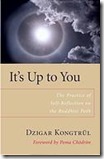
From It’s Up to You: The Practice of Self-Reflection on the Buddhist Path by Dzigar Kongtrül:

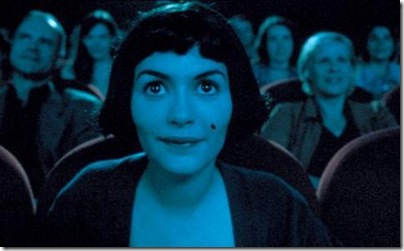
It's Ups to You: The Practice of Self-Reflection on the Buddhist Path When we’re watching a movie in the theater, we can relax and enjoy the show because we know it’s an illusion. This magical display that we’re watching is the result of a projector, film, light, screen, and our perceptions coming together. In separate momentary flashes of color, shapes, and sound, they create an illusion of continuity, which we perceive as characters, scenery, movement, and language. What we call “reality” works much the same way. Our ability to know, our sense perceptions, the seed of our past karma (the residue of our past actions), and the phenomenal world all come together to create our life’s “show.” All of these elements have a dynamic relationship, which keeps things moving and interesting. This is known as interdependence.
When we look around us, we can see that nothing exists in isolation, which is another way of saying that everything is interdependent. Everything depends upon an infinite number of causes and conditions to come into being, arise, and fall away moment by moment. Because they are are interdependent, things don’t possess a true existence of their own. For instance, how could we separate a flower from the many causes and conditions that produce it—water, soil, sun, air, seed, and so forth? Can we find a flower that exists independently from these causes and conditions? Everything is so intricately connected it is hard to point to where one thing starts and another ends. This is what is meant by the illusory or empty nature of phenomenon.

The outer world in all its variety and our inner world of thoughts and emotions are not as they seem. All phenomenon appear to exist objectively, but their true mode of existence is like a dream: apparent yet insubstantial. The experience of emptiness is not found outside the world of ordinary experience, as many people mistakenly assume. In truth, we experience emptiness when the mind is free of grasping at appearance.

Seeing the emptiness of the phenomenal world relieves us of the heavy notion of things being solid or intrinsic. When we understand that nothing exists independently, everything that does arise seems more dreamlike and less threatening. This brings a deep sense of relaxation, and we feel less need to control our mind and circumstances. Because the nature of everything is emptiness, it is possible to view our life the way we would view a movie. We can relax and enjoy the show.

[Thanks Sue!]

Le Fabuleux destin d'Amélie Poulain

Wednesday, November 26, 2008

Immersion


What We Watch and How We Watch It
The New York Times Sunday Magazine

“The Screens Issue”
11.23.2008

A Day Comes

By Jane Hirshfield, from After: poems

After: poems A day comes
when the mouth grows tired
of saying “I.”

Yet it is occupied
still by a self which must speak.
Which still desires,
is curious.
Which believes it has also a right.

What to do?
The tongue consults with the teeth
it knows will survive
both mouth and self,

which grin—it is their natural pose—
and say nothing.

Tuesday, November 25, 2008

Hints of a Hunger

Mary Gordon “Writing and prayer both involve a lot of waiting, and I think that's a very important discipline. The experience of prayer and the experience of creation are very similar, and there is this kind of, again, attentiveness mixed with an openness that is necessary for both the creation of art and for prayer.”

“This desire for beauty and the desire for meaning are very mysterious, and for me they're hints of something. They're hints of a hunger for something that is not reachable except through something transcendent, some transcendent person. Why do we want meaning? It is ridiculous. Children suffer. Bad people do very well. There shouldn't be a desire for meaning. Life should have told us that there is no meaning, and we keep searching for it, and we keep being angry when we don't have it. So what is that hunger? What is that appetite? I don't know. It's very mysterious to me. But it seems to me an important way of understanding, or at least framing the question, what is it to be human?”

~ Mary Gordon, from “Profile: Mary Gordon,” Religion and Ethics  Newsweekly (10.26.07)

From Mary Gordon’s prayers for the un-prayed for
For those whose work is invisible; for those who paint the undersides of boats; makers of ornamental drains on roofs too high to be seen; for cobblers who labor over inner soles; for seamstresses who stitch the wrong sides of lining; for scholars whose research leads to no obvious discovery. Grant them perseverance for the sake of your love, which is humble, invisible, and heedless of reward.

The Ability to Accept the Mess

Jhumpa Lahiri from "Jhumpa Lahiri's Struggle To Feel American," Morning Edition, NPR (11.25.08):

Jhumpa Lahiri I think that what has happened over the years that I've been writing is that with each new story or book, I do feel that I'm able to confront the truth of my life with a little more honesty.

I think that a lot of my upbringing was a lot about denying and hiding and evading and fretting and wanting to make everything fit and make everything easy and wanting to pretend that I wasn't this person or that person or wishing that I were otherwise. Wishing that I looked another way, that I had a different name, and wishing my parents weren't torn between two parts of the globe. And all of that stuff, all of that mess of life, of my life, of my upbringing that I for so long just wanted to put into a box and make it still and make it not what it was. To deny my life in some fundamental way. To pretend that it was something else.

I think that in the years that I've been writing, it has helped me to look the truth in the eye a little bit better each time. And I think that has helped me as a person, the ability to accept the mess, to accept and to understand that I will never be able to fit it into a box. That it will never sit still. That my parents will always be tied to two different parts of the earth and that that is a difficult experience. That is a painful experience. It can be a very enriching experience as well. I think it has been liberating and brought me some peace to just confront that truth, if not to be able to solve it or answer it.

Sunday, November 23, 2008

The Biggest Screen of All

David Lynch photographed by Justin Stephens for The New York Times"So many things these days are made to look at later. Why not just have the experience and remember it?...Some things we forget. But many things we remember on the mental screen, which is the biggest screen of all."

~ David Lynch, from "The Visionary," interview by Deborah Solomon, The New York Times (11.23.08)

How to Subsume Yourself

From “Singing: The Key To A Long Life,” by Briano Eno, This I Believe (11.23.08):

I believe that singing is the key to long life, a good figure, a stable temperament, increased intelligence, new friends, super self-confidence, heightened sexual attractiveness and a better sense of humor. A recent long-term study conducted in Scandinavia sought to discover which activities related to a healthy and happy later life. Three stood out: camping, dancing and singing.

Well, there are physiological benefits, obviously: You use your lungs in a way that you probably don't for the rest of your day, breathing deeply and openly. And there are psychological benefits, too: Singing aloud leaves you with a sense of levity and contentedness. And then there are what I would call "civilizational benefits." When you sing with a group of people, you learn how to subsume yourself into a group consciousness because a capella singing is all about the immersion of the self into the community. That's one of the great feelings — to stop being me for a little while and to become us. That way lies empathy, the great social virtue.

Spontaneous a capella version of Bon Hiver's "For Emma" in a Paris hallway before the house show. From the album "For Emma, Forever Ago."


La Blogothèque Take-Away Shows

Friday, November 21, 2008

The Only Idea Worth the Fuss

“Despite its slippery way with time and space and narrative and Mr. Kaufman’s controlled grasp of the medium, Synecdoche, New York is as much a cry from the heart as it is an assertion of creative consciousness. It’s extravagantly conceptual but also tethered to the here and now, which is why, for all its flights of fancy, worlds within worlds and agonies upon agonies, it comes down hard for living in the world with real, breathing, embracing bodies pressed against other bodies. To be here now, alive in the world as it is rather than as we imagine it to be, seems a terribly simple idea, yet it’s also the only idea worth the fuss, the anxiety of influence and all the messy rest, a lesson hard won for Caden [Cotard]. Life is a dream, but only for sleepers.”

~ Manohla Dargis, “Dreamer, Live in the Here and Now,” New York Times (10.24.08)

synecdoche-ny-poster-big

A Deer in the Target

By Robert Fanning

I only got a ten-second shot,
grainy footage of the huge deer
caught in the crosshairs
of a ceiling security camera, a scene
of utter chaos in a strip mall store,
shown on the late local news.
The beautiful beast clearly scared
to death in this fluorescent forest,
its once graceful legs giving out
on mopped floors, think Bambi
as a faun its first time standing.
Seeing the scattering shoppers,
you'd think a demon had barged
into this temple of commerce,
as they sacrificed their merchandise,
stranded full carts and dove for cover.
And when the aisles were emptied
of these bargain hunters, who was left
but an army of brave red-shirted
team members, mobilized by
the store manager over the intercom
to drive this wild animal out.
I wager there's nothing on this
in the How to Approach
an Unsatisfied Shopper

section in the Target employee handbook,
but there they were: the cashiers
and stockers, the Floor Supervisor,
the Assistant Floor Supervisor,
the Store Manager,
the Assistant Store Manager,
the District Associate Manager,
the District Supervisor,
the District Assistant Supervisor
and visiting members from
the Regional Corporate Office,
running after it, it running after
them, bull's eye logos on their red golf shirts,
everyone frenzied and panting: razor hooves
clattering on the mirror-white floor tiles,
nostrils heaving, its rack clearing
off-season clothes from clearance racks.
All of them, in Target,
chasing the almighty buck.


[Thanks Garrison Keillor!
More by Robert Fanning.]

Our Most Basic Imperative

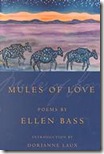
After Our Daughter’s Wedding by Ellen Bass, from Mules of Love


Mules of Love While the remnants of cake and half-empty champagne glasses lay on the lawn like sunbathers lingering in the slanting light, we left the house guests and drove to Antonelli's pond. On a log by the bank I sat in my flowered dress and cried. A lone fisherman drifted by, casting his ribbon of light. "Do you feel like you've given her away?" you asked. But no, it was that she made it to here, that she didn't drown in a well or die of pneumonia or take the pills. She wasn't crushed under the mammoth wheels of a semi on highway 17, wasn't found lying in the alley that night after rehearsal when I got the time wrong. It's animal. The egg not eaten by a weasel. Turtles crossing the beach, exposed in the moonlight. And we have so few to start with. And that long gestation— like carrying your soul out in front of you. All those years of feeding and watching. The vulnerable hollow at the back of the neck. Never knowing what could pick them off—a seagull swooping down for a clam. Our most basic imperative: for them to survive. And there's never been a moment we could count on it.


[Thanks Garrison Keillor! More by Ellen Bass.]

Wednesday, November 19, 2008

Life Unfolds in the Present

Psychology TodayFrom “The Art of Now: Six Steps to Living in the Moment,” by Jay Dixit, Psychology Today (Nov-Dec 2008):

We live in the age of distraction. Yet one of life's sharpest paradoxes is that your brightest future hinges on your ability to pay attention to the present…Life unfolds in the present. But so often, we let the present slip away, allowing time to rush past unobserved and unseized, and squandering the precious seconds of our lives as we worry about the future and ruminate about what's past.

  1. To improve your performance, stop thinking about it (unselfconsciousness).
  2. To avoid worrying about the future, focus on the present (savoring).
  3. If you want a future with your significant other, inhabit the present (breathe).
  4. To make the most of time, lose track of it (flow).
  5. If something is bothering you, move toward it rather than away from it (acceptance).
  6. Know that you don't know (engagement).

[Thanks Janine!]

Tuesday, November 18, 2008

Then Something Moves Me

"We write so much of our songs in, how do you say, improvising sort of thing. Well, if you call it improvising. I think its more just when you get into a flow with somebody. We always go into a studio…And he starts playing. We hit record straight away. And then I just sort of sit around doing nothing and then something happens that moves me. And I kind of react to that and it's something very beautiful that happens. Because sometimes, you know, one wants to go up and the other one wants to go down and so it's a clash and you have to stop and go back, and you know, write the song. And sometimes both are just completely there and it's like, when that happens, it's like some kind of tunnel vision happens. And you almost feel like you don't have a body at all. There's this panoramic view of things happening and it's kind of explaining that -- what you're seeing. It's a beautiful feeling. You get really addicted to it."

~ Emiliana Torrini, discussing her writing the songs on her latest album, Me and Armini, with David Dye on the World Café (11.18.08)

Happy 80th Birthday, Mickey!

Steamboat Willie first appeared on November 18, 1928 at New York’s Colony Theater.

“The cartoon featured a soundtrack synchronized to follow the visual animation of the story, which was new at the time….Within a decade, Mickey had appeared in more than 100 cartoons, and during these 10 years, he underwent some changes. White oval eyes with little black pupils replaced solid black ones, and his face became less angular and more rounded, to make him look friendlier. His personality became less cunning and more winsome. He was a commercial hit right away, and even during the Great Depression, Mickey merchandise sold well…Mickey Mouse has also become a standard write-in name on U.S. election ballots as a protest vote. Mickey has been a contender in nearly all the American presidential elections since his birth.”

~ From The Writer’s Almanac (11.18.08)

Sunday, November 16, 2008

2 x 4 Landscape

"Without preaching, I'm interested in getting people to visualize what is below the surface. We tend not to pay attention to that which is invisible."

~ Maya Lin

Maya Lin, 2 X 4 Landscape, 2006. Wood. 36’ x 53’ x 10’ Courtesy of the artist and Gagosian Gallery. Photo by Colleen Chartier.

Saturday, November 15, 2008

Oh, My God!

By Billy Collins, from Ballistics

Ballistics Not only in church
and nightly by their bedsides
do young girls pray these days.

Wherever they go,
prayer is woven into their talk
like a bright thread of awe.

Even at the pedestrian mall
outbursts of praise
spring unbidden from their glossy lips.

Friday, November 14, 2008

Poetry in Motion

Animated interpretations of poems written and read by Billy Collins:

The Country


The Best Cigarette


Budapest


More…

Redefining Success

A Little More About Me

From A Little More About Me, by Pam Houston:

“I am walking along Muir Beach, twenty miles north of San Francisco, with my friend the poet Jane Hirshfield. It is a windy day, sunny and cold, the sea full of memory of a storm that blew through last night.

My friendship with Jane is two years and a few dozen beach walks, horseback rides, and mud baths old. The relationship is deeply successful, like, she would say, the relationship between these huge dark rocks and the silver waves that crash all around them. I bring Jane my wild tales of failed love and adventure, my passion and spontaneity, my questions about how to live my life. She meets these with hard-won wisdom as rich and as peaceful as the pear trees in her garden, a wisdom gained from years of sitting on a small pillow in a huge Buddhist monastery, a calm I can only covet while my life tosses itself from storm to storm.

When I moved to San Francisco, I was running, in the same moment both toward and away. Away from a life that had become stale and repetitive, away from a place where when I said ‘creative writing’ everyone thought I meant calligraphy, away from a desert landscape that I loved more deeply than any I had loved before. What I ran toward was less certain: a big city, a new love, an imagined community of artists, the Pacific Ocean, organic vegetables, and exotic food.

But the love went bad and the ocean was frigid, and in less than a year in the land of milk and honey I was stalked, sued, threatened, abandoned, and mugged, twice. For the first time in my life I was afraid to go home at night, and I found myself alone as I had never been, in the way we never are until we are alone in the midst of five million people. it was from that city-solitude I began the tough work of reinventing my life, and now each talk with Jane clears a little more fog away.

Today we are talking about redefining success. I am telling her about my first notion of success, which came from my parents and involved country clubs, clothing, and cars. As I became and adult I replaced that list with a list of my own, no less arbitrary: a Ph.D., a book of short stories, a place on a best-seller list, a film.

But now I am coming to the understanding that success has less to do with the accumulation of things and more to do with the accumulation of moments, and that creating a successful life might be as simple as determining which moments are the most valuable, and seeing how many of those I can string together in a line."

[Found on Jonathan Carroll’s blog]

Flying Paper Lanterns

Matt and I got to launch paper lanterns during Loy Krathong when we visited Thailand in 2004. It was just like this. We were in a small village up north called Pai. There were just a few lanterns filling the sky like constellations. 

The crowds for this festival are much larger in the bigger cities such as Chiang Mai.