Monday, May 19, 2008

The Universe on a String

Physicist Brian Greene explains superstring theory, the idea that minscule strands of energy vibrating in 11 dimensions create every particle and force in the universe.

"You see, our universe is kind of like a finely tuned machine. Scientists have found that there are about 20 numbers, 20 fundamental constants of nature that give the universe the characteristics we see today. These are numbers like how much an electron weighs, the strength of gravity, the electromagnetic force and the strong and weak forces. Now, as long as we set the dials on our universe machine to precisely the right values for each of these 20 numbers, the machine produces the universe we know and love.

But if we change the numbers by adjusting the settings on this machine even a little bit... the consequences are dramatic.

For example, if I increase the strength of the electromagnetic force, atoms repel one other more strongly, so the nuclear furnaces that make stars shine break down. The stars, including our sun, fizzle out, and the universe as we know it disappears.

So what exactly, in nature, sets the values of these 20 constants so precisely? Well the answer could be the extra dimensions in string theory. That is, the tiny, curled up, six-dimensional shapes predicted by the theory cause one string to vibrate in precisely the right way to produce what we see as a photon and another string to vibrate in a different way producing an electron. So according to string theory, these miniscule extra-dimensional shapes really may determine all the constants of nature, keeping the cosmic symphony of strings in tune."

~ Brian Greene, from The String's the Thing (Hour 2 of Nova's The Elegant Universe)

Body Maps

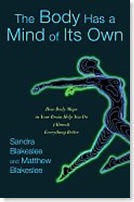
From The Body Has a Mind of Its Own: How Body Maps in Your Brain Help You Do (Almost) Everything Better, by Sandra Blakeslee and Matthew Blakeslee:

Just as a road atlas is full of maps that represent real-world locations, your brain is full of maps that represent all aspects of your physical self, inside and out. Your brain is teeming with maps that underlie your ability to touch things, move about, act freely, feel emotion, and interact with others. But unlike road maps, your body maps are dynamic: They grow, shrink, and morph to suit your needs.

Each of your body parts is faithfully mapped based on the touch receptors embedded throughout your skin. This is your primary touch map. You also have a primary motor map, for making movements. Instead of receiving information from your skin, this map sends signals from your brain out to your muscles. Together, these two primary maps are the foundation of your mind-body interface.

body-mind Elsewhere in your brain you have maps of the space around your body, out to the end of your fingertips. These personal space maps can extend even further, morphing like an amoeba's pseudopod to include any physical tool you pick up, any item of clothing or sporting equipment you put on, or even any virtual extension of yourself that you control with a mouse or a joystick, into your own bodily self-representation.

Some of your most amazing body maps are made up of special brain cells called mirror neurons. These cells fire when you observe someone doing an action—say, scratching their chin—and when you scratch your own chin. As a result, you may feel a desire to scratch your chin, or even develop a genuine itch there. Mirror neurons map the actions, intentions  and emotions of others directly into your own system of body maps, creating as close to a telepathic link as the known laws of nature allow. They allow you to understand and empathize with the minds of others, not through conceptual reasoning, but through direct simulation via your own body maps. They reveal how children learn, why you respond to certain types of sports, dance, music and art, why media and video game violence can be harmful, the appeal of pornography, and may even help explain homophobia.

Your brain also has a set of maps of your internal organs. Present in all mammals, these visceral maps are uniquely super- developed in the human brain. Evolution has extended these maps' functions far beyond their original purpose of just letting you know you are hungry, thirsty, horny, or need air. These maps afford you a level of access to the ebb and flow of your internal sensations unrivaled anywhere else in the animal kingdom, and they are fundamental to the uniquely rich emotional inner life of our species. They are important in empathy, moral judgment, social intercourse, and many aspects of mental and physical health.

All these body maps are profoundly plastic—capable of significant reorganization in response to damage, experience or practice. Concert pianists have enlarged hand maps. Veteran meditators have enlarged visceral maps. Golfers with the yips and musicians with musician's cramp have blurred body maps. Autistic people have scrambled body maps.

...It comes down to the body maps in your brain. As science would have it, the mind is what the brain does. And the brain is intimately connected to the body, as studies of its sprawling network of body maps are revealing in ever greater detail. All your emotions, feelings, and your sense of individual selfhood stem from the interaction of these maps in your brain, the body in your brain, your embodied brain.

Sunday, May 18, 2008

Befriending

"Mindfulness is moment-to-moment, non-judgmental awareness, cultivated by paying attention. Mindfulness arises naturally from living. It can be strengthened through practice. This practice is sometimes called meditation. But meditation is not what you think.

Meditation is really about paying attention, and the only way in which we can pay attention is through our senses, all of them, including the mind. Mindfulness is a way of befriending ourselves and our experience. Of course, our experience is vast, and includes our own body, our mind, our heart, and the entire world."

~ Jon Kabat-Zinn, Arriving at Your Own Door: 108 Lessons in Mindfulness (Excerpts from Coming to Our Senses)

Holding Back

“You can hold back from suffering of the world, you have permission to do so, and it is in accordance with your nature, but perhaps this very holding back is the one suffering you could have avoided."

~ Franz Kafka, The Great Wall of China

Love after Love

The time will come
when, with elation
you will greet yourself arriving
at your own door, in your own mirror
and each will smile at the other's welcome,

and say, sit here. Eat.
You will love again the stranger who was your self.
Give wine. Give bread. Give back your heart
to itself, to the stranger who has loved you

all your life, whom you ignored
for another, who knows you by heart.
Take down the love letters from the bookshelf,

the photographs, the desperate notes,
peel your own image from the mirror.
Sit. Feast on your life.

~ Derek Walcott

Friday, May 16, 2008

MUTO

BLU

I See Who You Are


Pipa (Chinese lute) virtuoso Min Xiao-Fen performing with Björk at Madison Square Garden on September 24, 2007.

I see who you are
behind the skin and the muscles
I see who you are
and when you'll get older later

I will see the same girl
the same soul
lioness, fireheart
passionate lover

and afterwards
later this century
when you and I have
become corpses

let's celebrate now
all this flesh on our bones
let me push you
up against me
tightly
and enjoy every bit of you

la la la-la la la...

let's celebrate now
all this flesh on our bones
let me push you
up against me
tightly

let's celebrate now
all this flesh on our bones
and enjoy every bit of you

la la la-la la la...

I see who you are

Listen to a Studio 360 interview with Min Xiao-Fen (5.9.08).

Learning from the Masters

"I see us as a very young species and eventually natural selection will judge the rightness of our innovations. The thing that's different about us is that we can choose to learn from the masters...It's really interesting. I look at the scientific method and it's quite different than the method that biomimics use. In the scientific method, you go to your observation with a hypothesis and then people try to find the exception to the rule. In biomimicry, you're training yourself to observe and to pull out the universal. You're sitting and observing in a way that says teach me.

~ Janine Benyus, from "Biomimicry," Studio 360 (5.9.08)

Thursday, May 15, 2008

The Neural Buddhists

Excerpt from a New York Times editorial (5.13.08) written by David Brooks:

Researchers now spend a lot of time trying to understand universal moral intuitions. Genes are not merely selfish, it appears. Instead, people seem to have deep instincts for fairness, empathy and attachment.

Scientists have more respect for elevated spiritual states. Andrew Newberg of the University of Pennsylvania has shown that transcendent experiences can actually be identified and measured in the brain (people experience a decrease in activity in the parietal lobe, which orients us in space). The mind seems to have the ability to transcend itself and merge with a larger presence that feels more real.

This new wave of research will not seep into the public realm in the form of militant atheism. Instead it will lead to what you might call neural Buddhism.

If you survey the literature (and I’d recommend books by Newberg, Daniel J. Siegel, Michael S. Gazzaniga, Jonathan Haidt, Antonio Damasio and Marc D. Hauser if you want to get up to speed), you can see that certain beliefs will spread into the wider discussion.

First, the self is not a fixed entity but a dynamic process of relationships. Second, underneath the patina of different religions, people around the world have common moral intuitions. Third, people are equipped to experience the sacred, to have moments of elevated experience when they transcend boundaries and overflow with love. Fourth, God can best be conceived as the nature one experiences at those moments, the unknowable total of all there is.

In their arguments with Christopher Hitchens and Richard Dawkins, the faithful have been defending the existence of God. That was the easy debate. The real challenge is going to come from people who feel the existence of the sacred, but who think that particular religions are just cultural artifacts built on top of universal human traits. It’s going to come from scientists whose beliefs overlap a bit with Buddhism.

Wednesday, May 14, 2008

There is Nothing Like Fiction

"I do believe that you can never know yourself, let alone the person next to you, let alone the person halfway across the world. Yet at the same time, I believe there is nothing like fiction to fully thrust you into someone else's consciousness."

Nam Le

[From Jonathan Carroll's blog]

An Old, Unmarked Path

My daughter's high school is closed today because of a "Columbine-style" threat with some reference to grenades. I am thrilled that it was a threat of violence instead of an actual act, yet it was fascinating to watch my mind as it tried to stir up strong emotions by creating narratives and dramatic scenes. I saw several vivid cinematic images with the specific details of my daughter's face and the faces of her friends. I heard sounds which I've heard countless times in movies, chaos exploding in familiar hallways and classrooms.

It was effortless for my mind to begin filling in all the details. Haven't I been practicing imagining these very things every time there has been news of a school shooting somewhere else? Don't we automatically flesh the actual tragic scenes out with pieces from our own worlds every time we hear about them?

And yet, in this instance, it was all potential, imagined, speculated, and unreal. The only real thing was the thin waft of potential threat -- which most of us understand to represent a wide range of possible realities. I am grateful that nobody was actually hurt and for the opportunity to peer directly into my mind's reflexive mechanism for triggering alarm.

The poem featured on The Writer's Almanac today overlaps with these observations: 

Borrowed Time
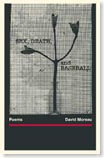
by David Moreau from Sex, Death and Baseball

Sex, Death and Baseball by David Moreau I will not die tonight
I will lie in bed with
my wife beside me,
curled on the right
like an animal burrowing.
I will fit myself against her
and we will keep each other warm.

I will not die tonight.
My son who is seven
will not slide beneath the ice
like the boy on the news.
The divers will not have to look
for him in cold water.
He will call, "Daddy, can I get up now?"
in the morning.

I will not die tonight.
I will balance the checkbook,
wash up the dishes
and sit in front of the TV
drinking one beer.

For the moment I hold a winning ticket.
It's my turn to buy cold cuts
at the grocery store.
I fill my basket carefully.

For like the rain that comes now
to the roof and slides down the gutter
I am headed to the earth.
And like the others, all the lost
and all the lovers, I will follow
an old path not marked on any map.

Monday, May 12, 2008

Mother Night

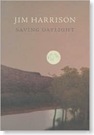
Saving Daylight by Jim HarrisonWhen you wake at three AM you don't think
of your age or sex and rarely your name
or the plot of your life which has never
broken itself down into logical pieces.
At three AM you have the gift of incomprehension
wherein the galaxies make more sense
than your job or the government. Jesus at the well
with Mary Magdalene is much more vivid
than your car. You can clearly see the bear
climb to heaven on a golden rope in the children's
story no one ever wrote. Your childhood horse
named June still stomps the ground for an apple.
What is morning and what if it doesn't arrive?
One morning Mother dropped an egg and asked
me if God was the same species as we are?
Smear of light at five AM. Sound of Webber's
sheep flock and sandhill cranes across the road,
burble of irrigation ditch beneath my window.
She said, "Only lunatics save newspapers
Jim Harrisonand magazines," fried me two eggs, then said,
"If you want to understand mortality look at birds."
Blue moon, two full moons this month,
which I conclude are two full moons. In what
direction do the dead fly off the earth? Rising sun. A thousand blackbirds pronounce day.

~ by Jim Harrison, Saving Daylight. Check out "Called to Be a Poet," Weekend America (1.27.07) for an interview with the poet.

Sunday, May 11, 2008

A Day of Sentiment

From The Writer's Almanac:

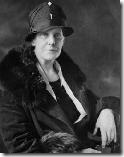
Photograph of Anna M. Jarvis, founder of Mother’s Day, taken in Westchester, Pennsylvania, in 1907. It's the second Sunday in May, which is Mother's Day here in the United States. It's Mother's Day in other countries, too, including Denmark, Italy, Venezuela, Turkey, Australia, and Japan. It's the biggest day of the year for long-distance telephone calls.
A woman named Anna Jarvis was the person behind the official establishment of Mother's Day. Her mother, Anna Reeves Jarvis, had a similar idea, and in 1905 the daughter swore at her mother's grave to dedicate her life to the project. She campaigned tirelessly for the holiday. In 1907, she passed out 500 white carnations at her mother's church, St. Andrew's Methodist Episcopal Church in Grafton, West Virginia — one for each mother in the congregation. In 1912, West Virginia became the first state to adopt an official Mother's Day, and in 1914 President Woodrow Wilson made it a national holiday.

Anna Jarvis became increasingly concerned over the commercialization of Mother's Day. She said, "I wanted it to be a day of sentiment, not profit." She was against the selling of flowers, and she called greeting cards "a poor excuse for the letter you are too lazy to write." Nevertheless, Mother's Day has become one of the best days of the year for florists. When Anna Jarvis lived the last years of her life in nursing home without a penny to her name, her bills were paid, unbeknownst to her, by the Florist's Exchange.

Thursday, May 08, 2008

Happiness By Design

"Renowned for the album covers he created for the likes of Lou Reed, Talking Heads and the Rolling Stones, Austrian-born, New York City-dwelling designer Stefan Sagmeister invariably has a slightly different way of looking at things."


A list of things Stefan Sagmeister has learned in his life so far:

  • Complaining is silly. Either act or forget.
  • Thinking life will be better in the future is stupid. I have to live now.
  • Being not truthful works against me.
  • Helping other people helps me.
  • Organizing a charity group is surprisingly easy.
  • Everything I do always comes back to me.
  • Drugs feel great in the beginning and become a drag later on.
  • Over time I get used to everything and start taking if for granted.
  • Money does not make me happy.
  • Traveling alone is helpful for a new perspective on life.
  • Assuming is stifling.
  • Keeping a diary supports my personal development.
  • Trying to look good limits my life.
  • Worrying solves nothing.
  • Material luxuries are best enjoyed in small doses.
  • Having guts always works out for me.

Wednesday, May 07, 2008

Standing Up to Reason

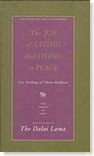
The Joy of Living and Dying in Peace (1997)"If this [scientific finding] contradicts some aspect of Buddhist doctrine as contained in the scriptures, we have no other choice but to accept that that teaching is in need of interpretation. Thus, we cannot accept it literally simply because it has been taught by the Buddha; we have to examine whether it is contradicted by reason or not. If it does not stand up to reason, we cannot accept it literally. We have to analyze such teachings to discover the intention and purpose behind them and regard them as subject to interpretation. Therefore, in Buddhism great emphasis is laid on the importance of investigation."

~ The Dalai Lama, from The Joy of Living and Dying in Peace

Tuesday, May 06, 2008

Entering the Kingdom

The crows see me.
They stretch their glossy necks
In the tallest branches
Of green trees. I am
Possibly dangerous, I am
Entering the kingdom.

The dream of my life
Is to lie down by a slow river
And stare at the light in the trees-
To learn something by being nothing
A little while but the rich
Lens of attention.

But the crows puff their feathers and cry
Between me and the sun,
And I should go now.
They know me for what I am.
No dreamer,
No eater of leaves.

~ Mary Oliver

Monday, May 05, 2008

Secret Gratification

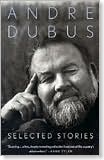
Selected Stories by Andre Dubus In her seventh month, with a delight reminiscent of climbing the stairs to Richard's apartment before they were married, she returned to her world of secret gratification. She began hiding candy in her underwear drawer. She ate it during the day and at night while Richard slept, and at breakfast she was distracted, waiting for him to leave.

She gave birth to a son, brought him home, and nursed both him and her appetites. During this time of celibacy she enjoyed her body through her son's mouth; while he suckled she stroked his small head and back. She was hiding candy but she did not conceal her other indulgences: she was smoking again but still she ate between meals, and at dinner she ate what Richard did, and coldly he watched her, he grew petulant, and when the date marking the end of their celibacy came they let it pass. Often in the afternoons her mother visited and scolded her and Louise sat looking at the baby and said nothing until finally, to end it, she promised to diet. When her mother and father came for dinners, her father kissed her and held the baby and her mother said nothing about Louise's body, and her voice was tense. Returning from work in the evenings Richard looked at a soiled plate and glass on the table beside her chair as if detecting traces of infidelity, and at every dinner they fought.

~ From "The Fat Girl" by Andre Dubus

Sunday, May 04, 2008

A Connection with the Audience

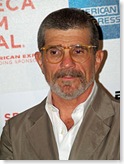
"People, and I count myself as one of them, don't know how to respond to the celebrated. That if I see somebody whose work I admire, or whose work or accomplishments I stand in awe, I feel like I have a connection with them. But I don't. It's an illusion. And so I, just like anyone else, am probably going to be David Mamet by David Shankboneor feel awkward or tongue-tied or incompetent or even envious. And sometimes that's going to express itself in some sort of reserve or even antagonism. Because it seems that there's a connection, but there isn't.

...Then it occurred to me last year that the opposite's always true. That someone who is celebrated thinks that he or she has a connection with their audience. So when people come up to you and say, Oh my gosh, I loved your show or Dave, I love that play, that feels great. And you say, Oh, they really understood, they really understood. But there can't be anything beyond that because there really isn't a connection. The only connection is the work. So that someone in the public eye is almost constantly saddened and disappointed by an interaction with the audience because the audience exists as a whole, but it doesn't exist as individuals. It's an illusion."

~ David Mamet, on KCRW's The Treament (4.05.08)

Saturday, May 03, 2008

The Better Story

Zoetrope All-Story Spring 2008"The neighborhood kids remember Missy. She bit when she was angry and pinched no matter what. They don't feel sorry for her ghost self. They remember the funeral they were forced to attend, how her mother threw herself on the coffin, wailing, how they thought she'd been kidding and so laughed out loud and got shushed. The way the neighborhood kids tell the story, the coffin was lowered into the ground and Missy Goodby's grieving mother leapt down and then had to be yanked from the hole like a weed. Everyone always believes the better story eventually. Really, Pamela Goodby just thumped the coffin at the graveside service. Spanked it: two spanks. She knew that pleading would never budge her daughter, not because she was dead but because she was stubborn. All her life, the more you pleaded with Missy, the more likely she was to do something to terrify you. Pamela Goodby spanked the coffin and walked away and listened for footsteps behind her. She walked all the way home, where she took off her shoes, black pumps with worn stones of gray along the toes. "Done with you," she told them.

From "Something Amazing," by Elizabeth McCracken (Zoetrope All-Story, Spring 2008) whose memoir, An Exact Replica of a Figment of My Imagination, will be published in September by Little, Brown and Company.

Merely Decent

May Sarton

Quotes from May Sarton 
(May 3, 1912-July 16, 1995)

"One thing is certain, and I have always known it--the joys of my life have nothing to do with age."

"One must think like a hero to behave like a merely decent human being."

"Help us to be ever faithful gardeners of the spirit, who know that without darkness nothing comes to birth, and without light nothing flowers."

"It always comes to the same necessity: go deep enough and there is a bedrock of truth, however hard."

"Most people have to talk so they won't hear."

"The creative person, the person who moves from an irrational source of power, has to face the fact that this power antagonizes. Under all the superficial praise of the 'creative' is the desire to kill. It is the old war between the mystic and the non-mystic, a war to the death."

"The hardest thing we are asked to do in this world is to remain aware of suffering, suffering about which we can do nothing."

I Want to be Older

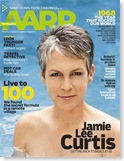
jamieleecurtis “I want to be older. I actually think there’s an incredible amount of self-knowledge that comes with getting older. I feel way better now than I did when I was 20. I’m stronger, I’m smarter in every way, I’m so much less crazy than I was then.

Years ago my husband and I were at the Golden Globes. I was wearing some borrowed dress that wasn’t me, my hair was done in a way that I never wear my hair, and I had earrings on. And my husband said, ‘You know who is the most beautiful woman in the room?’ And I was hoping he was going to say me. And he pointed across the room at Jessica Tandy. She was sitting at a table wearing a cream-colored silk-shantung pantsuit. Single strand of pearls, short white hair, a little lipstick—nothing else. And I thought, ‘He’s totally right.’ There was none of the pretense, none of the trying so hard.

...The same way that mid-century modern architecture was in the ’50s, I want to be as a human being. New. Different. Challenging the old. Function over frivolity. Clean living. Clean lines."

~ Jamie Lee Curtis, AARP Magazine May & June 2008

Wednesday, April 30, 2008

Stay Hungry, Stay Foolish

"You can't connect the dots looking forward, you can only connect them looking backwards."

~ Steve Jobs, from his 2005 Stanford Commencement Address

[Thanks JC!]

Telling Them Films

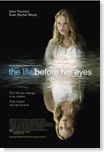
The Life Before Her Eyes "When I was a kid, I went to a camp. Because I have a heart condition I was stuck with that were literally blue, kids my age that had to walk with a walker and being supported and all that. And I just have a small heart condition that I've compensated for, it's no problem in my life. I felt such a kinship with these kids at the time that I would read a book and then lie on a bunk late at night as we were supposed to sleep and tell them stories from that book. And invariably, they were condensed visual versions of the book. And so unknowingly, completely, without having any kind of film, I was kind of telling them films at that time."

~ Vidam Perleman, discussing his recent adaptation of The Life Before Her Eyes into a film on KCRW's The Treatment (4.23.08). His first film was an adaptation of The House of Sand and Fog. Other projects in the works include an adaptation of Ayn Rand's Atlas Shrugged starring Angelina Jolie. 

Winning Is Many Things

The Paris Review #165 (Spring 2003)Now began the part of her life where she was just very beautiful. Except for nothing. Only winners will know what this feels like. Have you ever wanted something very badly and then gotten it? Then you know that winning is many things, but it is never the thing you thought it would be. Poor people who win the lottery do not become rich people. They become poor people who won the lottery. She was a very beautiful person who was missing something very ugly. Her winnings were the absence of something, and this quality hung around her. There was so much potential in the imagined removal of the birthmark, any fool on the bus could play the game of guessing how perfect she would look without it. Now there was not this game to play, there was just a spent feeling. And she was not an idiot, she could sense it. In the first few months after the surgery she received many compliments, but they were always coupled with confusion.
~ Miranda July, from "Birthmark," The Paris Review #165 (Spring 2003)

Tuesday, April 29, 2008

Slum Lords

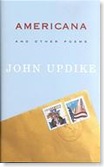
Americana: and Other Poems by John Updike

The superrich make lousy neighbors—
they buy a house and tear it down
and build another, twice as big, and leave.
They're never there; they own so many
other houses, each demands a visit.
Entire neighborhoods called fashionable,
bustling with servants and masters, such as
Louisburg Square in Boston or Bel Air in L.A.,
are districts now like Wall Street after dark
or Tombstone once the silver boom went bust.
The essence of superrich is absence.
They like to demonstrate they can afford
to be elsewhere. Don't let them in.
Their riches form a kind of poverty.

~ by John Updike, from Americana: and Other Poems

Saturday, April 26, 2008

Dreaming Constrained by Sensory Input

"Whether awake or asleep, the brain constructs a model of reality—consciousness from the best available sources of information. During waking, those sources are external sensory input in combination with internal contextual and motivational information. During sleep, little external information is available, so consciousness is constructed from internal sources. These include expectations derived from past experience, and motivations-wishes, such as Freud observed, but also fears. The resulting experiences are what we call dreams. In these terms, dreaming is perception free from external sensory constraint, while perception is dreaming constrained by sensory input—hallucinations that happen to be true."

~ Stephen LaBerge, in response to the question Does Everybody Dream? (Information about dream recall and lucid dreaming at The Lucidity Institute.)

Friday, April 25, 2008

Art Garfunkel's Library

"Art Garfunkel ...a chronological index of the thousand and twenty-three books that he has read since June, 1968. He has been recording their particulars neatly on sheets of loose-leaf paper—forty or so titles to a page—for nearly forty years. About a decade ago, he posted the list on his web site (which he pays a fan in Levittown to maintain). It begins with Rousseau’s “Confessions” and ends with Booth Tarkington’s “The Magnificent Ambersons,” which he finished before Christmas. In between, the list ticks off, at a rate of 2.16 books a month, a dazzling syllabus that’s a testament to steroidal self-improvement, as well as to the magical time-furnishing powers of royalty checks. Foucault, Balzac, Chesterton, Heidegger, Spinoza, Hazlitt, Milton, Proust: he has slayed them all, and let us know."

From "The King of Reading," by Nick Paumgarten in The New Yorker (Jan. 28, 2008)

[Thanks Carolyn!]

Wednesday, April 23, 2008

Unaltered State of Consciousness

True Meditation by Adyashanti"So many people associate meditation with altered states of consciousness. Yet this is a profound misunderstanding about the potential of meditation. The potential I'm talking about is spiritual awakening, awakening to the realization of what you and everything actually is, the oneness of all. We are taught, or we assume, that to perceive everything as one and to perceive yourself as not separate is to enter an altered state of consciousness. And yet, it turns out, the truth is just the opposite. To perceive everything as one is not an altered state of consciousness. It's an unaltered state of consciousness; it's the natural state of consciousness. By comparison, everything else is an altered state."

~ Adyashanti, from True Meditation

Sunday, April 20, 2008

Believing is Seeing

“They say that seeing is believing. But the opposite is true. Believing is seeing."

"I may focus your attention on a small and perhaps irrelevant detail, which I think is not so irrelevant. But there’s always an imposition of point of view in anything. There’s this crazy thinking that style guarantees truth. You go out with a hand-held camera, use available light, and somehow the truth emerges."

“The only thing I do that’s different from other people is I call attention to the fact that I have a point of view. I call attention to the fact that how we see, what we see, is constructed, and that looking at how it’s constructed is often a useful exercise.

“I think people want the appearance of truth. They don’t necessarily want the truth.”

~ Errol Morris, discussing his new film, Standard Operating Procedure in "Of Crime and Perception at Abu Ghraib," (New York Times, 4/20/08)

Relax into Time

tobias_wolff "The one thing I would say to a young writer who wanted counsel is to be patient. Time, which is your enemy in almost everything in this life, is your friend in writing. It is. If you can relax into time, not fight it, not fret at its passing, you will become better. You probably won’t be very good at the beginning, but you will become better and eventually you may become good."

~ Tobias Wolff, "The Art of Fiction No. 183," The Paris Review (No. 171, Fall 2004)

Friday, April 18, 2008

We Need to Hear Other People

"People need to talk. And often, a willingness to sit and listen is the greatest kindness one person can offer another. One of the first lessons of childhood is to be wary of strangers. And while this is good counsel to guard against the world's very small nefarious element, it also teaches us to block out the large majority of those who just have something on their minds they'd like to say. We are taught to be suspicious, especially of anyone who might not look like us or What Now? by Ann Patchettshare our beliefs. By the time we reach adulthood, many have perfected the art of isolation. Of being careful. Of not listening in the name of safety. But the truth is that we need to hear other people—all people—especially in those moments when we don't know exactly where we're going ourselves. When it comes to finding our way, we're better off taking in as much information from as many sources as possible...For the most part, wisdom comes in chips rather than blocks. You have to be willing to gather them constantly and from sources you never imagined to be probable. No one chip gives you the answer for everything. No one chip stays in the same place throughout your entire life. The secret is to keep adding voices, adding ideas, and moving things around as you put together your life. If you're lucky, putting together your life is a process that will last through every single day you're alive."

~ Ann Patchett, from What Now? an essay based on the commencement address she gave at Sarah Lawrence in May 2006

Thursday, April 17, 2008

Fix

No Heaven by Alicia Suskin Ostriker The puzzled ones, the Americans, go through their lives
Buying what they are told to buy,
Pursuing their love affairs with the automobile,

Baseball and football, romance and beauty,
Enthusiastic as trained seals, going into debt, struggling —
True believers in liberty, and also security,

And of course sex — cheating on each other
For the most part only a little, mostly avoiding violence
Except at a vast blue distance, as between bombsight and earth,

Or on the violent screen, which they adore.
Those who are not Americans think Americans are happy
Because they are so filthy rich, but not so.

They are mostly puzzled and at a loss
As if someone pulled the floor out from under them,
They'd like to believe in God, or something, and they do try.

You can see it in their white faces at the supermarket and the gas station
— Not the immigrant faces, they know what they want,
Not the blacks, whose faces are hurt and proud —

The white faces, lipsticked, shaven, we do try
To keep smiling, for when we're smiling, the whole world
Smiles with us, but we feel we've lost

That loving feeling. Clouds ride by above us,
Rivers flow, toilets work, traffic lights work, barring floods, fires
And earthquakes, houses and streets appear stable

So what is it, this moon-shaped blankness?
What the hell is it? America is perplexed.
We would fix it if we knew what was broken.

by Alicia Suskin Ostriker, from No Heaven

Wednesday, April 16, 2008

Thank You

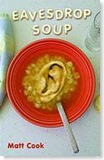
Eavesdrop Soup by Matt Cook My body temperature was below normal; it was like 97.5—
It was like I was turning into a radio station,
Which was fine, because my radio had stopped working—
The batteries had died, beautifully, with dignity, in their sleep.

The morning paper seemed beyond me, but it was below me.
A piece of gunk fell out of my eye
And landed on an Associated Press photograph.
Russian business leaders with faces like water balloons—
Then a story about children hiding in a leaf pile who were hit by a van.

Then the photograph of the demonstrator outside the Federal building—
It was impossible to tell if he was shouting or yawning.

Thank you Walt Whitman, for doing whatever it was you did
So that we don't have to write like they did before you came along.

~ Matt Cook, from Eavesdrop Soup

Modern Times


"Life is a tragedy when seen in close-up, but a comedy in long-shot."

~ Charlie Chaplin

Monday, April 14, 2008

Mixed Feelings


"Nearly a half-century ago, maverick neuroscientist Paul Bach-y-Rita discovered that it was possible to "rewire" the adult brain, connecting regions in ways no one ever had imagined. Today, his ideas have given a handful of blind people the ability to see for the first time—using their tongues."

Wired Science

[Thanks Nancy!]

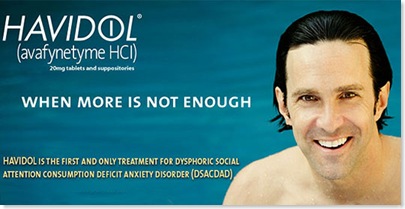
When More Is Not Enough

havidol

"If you believe that despite the opportunities, achievements and acquisitions you already have, something is still missing, then Havidol may be right for you."

The Weakness of Violence

"The ultimate weakness of violence is that it is a descending spiral, begetting the very thing it seeks to destroy. Instead of diminishing evil, it multiplies it. Through violence you may murder the liar, but you cannot murder the lie, nor establish the truth. Through violence you murder the hater, but you do not murder hate. In fact, violence merely increases hate. Returning violence for violence multiplies violence, adding deeper darkness to a night already devoid of stars. Darkness cannot drive out darkness; only light can do that. Hate cannot drive out hate. Only love can do that."

~ Martin Luther King, Jr., Where Do We Go From Here? Chaos or Community

Sunday, April 13, 2008

Form and Space

"When the eye finds nothing to see, that no-thingness is perceived as space. When the ear finds nothing to hear, that no-thingness is perceived as stillness. When the senses, which are designed to perceive form, meet an absence of form, the formless consciousness that lies behind perception and makes all perception, all experience, possible, is no longer obscured by form. When you contemplate the unfathomable depth of space or listen to the silence in the early hours before sunrise, something within you resonates with it as if in recognition. You sense that vast depth of space as your own depth, and you know that precious stillness that has no form to be more deeply who you are than any of the things that make up the content of your life."

...

"A sane, balanced, and fruitful human life is a dance between the two dimensions that make up reality: form and space. Most people are so identified with the dimensions of form, with sense perceptions, thoughts, and emotions, that the vital hidden half is missing from their lives. Their identification with form keeps them trapped in ego."

~ Eckhart Tolle, A New Earth: Awakening to Your Life's Purpose

Jack LaLanne Dharma Talk

Thursday, April 10, 2008

Classical Unities

"That's the revelation of twentieth-century drama. You can apply the Aristotelian unities to a microcosm, to a very, very small human interchange. You can take it apart. It didn't have to be about conquering France. It can be about who did or did not turn on the gas on the stove."

~ David Mamet, discussing the influences of Beckett and Pinter on his dramatic technique

Antimatter

     On the other side of a mirror there's an inverse world,
where the insane go sane; where bones climb out of the
earth and recede to the first slime of love.

     And in the evening the sun is just rising.

     Lovers cry because they are a day younger, and soon
childhood robs them of their pleasure.

    In such a world there is much sadness which, of course,
is joy.

~ Russell Edson

Wednesday, April 09, 2008

Divertimento

The bird wedges its voice
into the silent crevices
between raindrops.

The shower fades and slips by
like the last time my daughter
came running from the playground to greet me,
her entire body smiling,
her face full of light,
to leap into my arms.

She is running toward me now,
again and again,
but first and last are as lost
as individual drops of rain.

When was the early bird
joined by the other members of the ensemble,
all gossiping now on the risers?

When did the air’s perfume
begin to drift away?

Taking the small hand of my attention,
which has again wandered back into
what was and what might be,
I gently guide it back to all this silence
which all this music seems to be written on.

Tuesday, April 08, 2008

How Quick

Dazzling and tremendous how quick the sun-rise would kill me,
If I could not now and always send sun-rise out of me.

~ Walt Whitman, Leaves of Grass

Trying to Tell Their Own Story

Elvis Mitchell: In your movies there's a lot of vanity that the characters have. The characters pay a lot of attention to their looks, which is also really the province of young people, too, isn't it? I mean you're constantly sort of aware of the way you appear superficially. They like looking at themselves. They look really cool in those uniforms and that's a big part of it, too, these guys, so many of them have the flag tattooed on the bicep --

Kimberly Peirce finds herself back in the director's role with Stop-Loss. (Suzanne kreiter/Boston Globe staff) Kimberly Peirce: So there's two things there. One is masculinity, which I find really interesting because you really do have to perform masculinity in order to sustain it. It doesn't kind of just come naturally, even for men in a way...I originally got a hold of twenty soldier videos and they were putting cameras on sandbags, on gun turrets, inside Humvees, and--unfiltered—just recording their experience. But that wasn't enough. Then they were going back to their barracks and they were cutting them into, in a way, what was a fantasy of themselves.

So they would take Toby Keith, I'm an American Soldier—I mean the words in the Toby Keith song are heartbreaking and great, it's kind of like, I'm just an average guy, but I happen to be at war, and I can't go home at night, and look at the sacrifices I go through—it's total heroism...Or it's the thrill kill stuff which is, Look at me, I'm powerful [Linkin Part, AC/DC, Rage Against the Machine]...It's like, Wow, America is powerful, don't screw with us...So when you talk about that narcissism or that sense of one's own image, when I look at these videos, I see, Wow, they're really trying to tell their own story, but in a way that really makes them look both heroic and strong and patriotic.

Discussing her film Stop-Loss on KCRW's The Treatment (4.02.08)

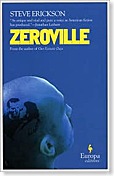
Zeroville

Is it possible he's traveled three thousand miles to the Movie Capital zerovilleof the World only to find people who don't know the difference between Montgomery Clift and James Dean, who don't know the difference between Elizabeth Taylor and Natalie Wood? A few blocks north of Philippe's, the city starts to run out and Vikar turns back. He asks a girl with straight blond hair in a diaphanous granny dress where Hollywood is. Soon he notices that all the girls in Los Angeles have straight blond hair and diaphanous granny dresses.

~ From Zeroville by Steve Erickson

Learning, Forgetting

Never be ashamed of kindergarten--
it is the alphabet's only temple.

~ Billy Collins, "Instructions to the Artist," from Questions About Angels: poems

Monday, April 07, 2008

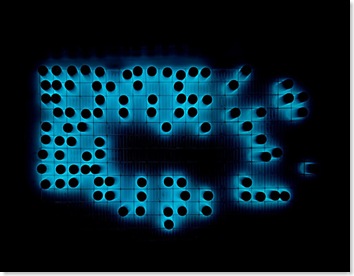
Secrets Within Our Borders

Nuclear Waste Encapsulation and Storage Facility Cherenkov, Radiation, Hanford Site, U.S. Department of Energy, Southeastern Washington State

"I produced this work in the last five years which was a time when our country was invested in finding secrets outside of its borders, whether it be weapons of mass destruction or to understand other cultures. And I wanted to look inward and find those hidden secrets within our borders."

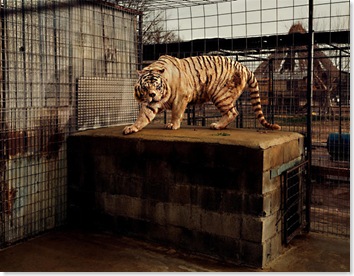
~ Taryn Simon, talking about the idea behind her collection of photographs, An American Index of the Hidden and Unfamiliar 

White Tiger (Kenny), Selective Inbreeding, Turpentine Creek Wildlife Refuge and Foundation, Eureka Springs, Arkansas

The Individual and the Institution

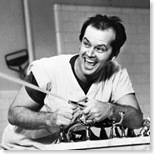
Jack Nicholson in One Flew Over the Cuckoo's Nest "We invent institutions to help make the world more just, more rational. Life in society would not be possible without orphanages, schools, courts, government offices, and mental hospitals, yet no sooner do they spring into being than they start to control us, regiment us, run our lives. They encourage dependency to perpetuate themselves and are threatened by strong personalities."

~ Miloš Forman, from Turnaround: a memoir

Recital

Spangled little girls take the stage,
choreographed to songs about
flirting, flaunting, and finding love.

The smallest ones don't yet know 
the distinction between performer and audience,
but they are beginning to learn.

Their eyes are on each other,
their teachers tapping along silently in the wings,
and the tape glowing against the black floor.

They seem to remember best
the moves which involve holding hands
and forming lines,

the comfort of reaching out,
finding another set of searching fingers,
closing the circle.

The audience roars whenever
most of them spin clockwise
while one turns counter,

and when another stops dancing altogether,
puts her hand up to her forehead,
and peers out into the darkness.

A white ribbon
floats to the floor,
as they gather to form the final tableau.

One at a time,
each girl spots it and
reaches up to see if it belongs to her.

Sunday, April 06, 2008

Equations that Describe Enlightenment

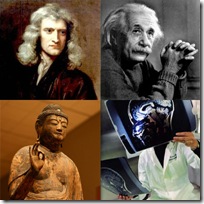
"Let's put it this way, Newton was incredible, but relativistic and quantum physics take it to a whole other level. They don't exactly replace Newton, but they're based on Newton. But they show us things that Newton could never have dreamed of.
"If you had told Newton the results of relativity—I mean he could have eventually understood it—but upon first hearing something like E=mc² or that its essentially chance that's responsible for these forces, OK? Or the quantum view? Upon first hearing the relativistic or quantum view of physics, Newton would have freaked. Totally freaked. And yet, of course, eventually he'd understand it. But it takes it to a whole other thing.

"I believe that the Buddha was the Sir Isaac Newton of spirituality. Absolutely sui generis—in a class by himself. Now, what we need is an Albert Einstein and a Richard Feynman all trained in western science—neuroscience—to say, Oh and yes, by the way, here are the equations that describe enlightenment and here's some alternative interventions that can really speed the process along for the average person in this world."

~ Shinzen Young speaking with David Van Nuys on The Wise Counsel Podcast (April 1, 2008)

Waiting for a Bus on a Nice Day

Sleeping in Flame There are long quiet periods in life that are very much like waiting for a bus on a nice day. You don’t mind being there so much because the weather is sunny and nice, and you’re in no hurry. But after a while you start looking at your watch because there are more interesting things you could be doing, and it really is time the bus came.

~ From Sleeping in Flame by Jonathan Carroll

[first chapter]

Saturday, April 05, 2008

Sky Dining

Dinner in the Sky

[Thanks Kit!]

Taking Off

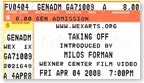
wexnerstub We had the unexpected treat of watching the first American film by Miloš Forman, Taking Off, at the Wexner Center last night as part of a traveling retrospective of his work.

The director was present to discuss this satire from the early seventies about parents struggling to make sense of the counterculture which seemed to be driving their children away from them.

Mr. Forman told the audience about one of his earliest memories of the cinema. When he was a little boy living in Czechoslovakia, his parents took him to the city on a Saturday evening to see a film. It was a documentary about The Bartered Bride, an opera by Bedřich Smetana. But the film was silent. The way the singers mouths opened wide reminded him of fish. The opera was so familiar to the audience that they gradually began to sing the songs until the room was filled with their voices and emotion.

[Fresh Air interview from Feb. 15, 2008]

Friday, April 04, 2008

The Shock of the Old

Lt. Calley

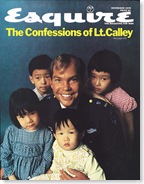
Kurt Andersen: Lt. Calley who was in the army in Vietnam was charged and prosecuted for killing civilian children, and that was one of those covers that was really shocking at the time. And I'm sure people said, Aw, this is in bad taste. We had those breakthroughs. I don't know that you can go to a newsstand today and find any cover among the hundreds of magazines there that are even attempting that kind of thing.

George Lois: Well, the point is, I think, that they're all infatuated with or they all believe that celebrity—pure celebrity—sells copies. And of course it might be true, but not when there's eighty magazines and they all got the same flavor of the month...

...

GL: What I try to teach young people...it's not just that  Iconic America: A Roller-Coaster Ride through the Eye-Popping Panorama of American Pop Cultureexperience of life, you have to have experience of—literally—art. When I say to them, When's the last time anybody here's been to the Metropolitan Museum of Art? and they look at you blankly. It's frightening. It's not just the shock of the new, it's the shock of the old. We have ten thousand years of visual experience that we can look at. It makes you what you are and feeds what you do in your work. It's very hard to get kids to understand that.

From Studio 360 (Jan. 4, 2008)

Thursday, April 03, 2008

Experiencing the Process of Creativity

"Automatization eats away at things, at clothes, at furniture, at our wives, and at our fear of war. If the complex life of many people takes place entirely on the level of the unconscious, then it's as if this life had never been.

"And so, in order to return sensation to our limbs, in order to make us feel objects, to make a stone feel stony, man has been given the tool of art. The purpose of art, then, is to lead us to a knowledge of a thing through the organ of sight instead of recognition.

"By enstranging objects and complicating form, the device of art makes perception long and laborious. The perceptual process in art has a purpose all its own and ought to be extended to the fullest. Art is a means of experiencing the process of creativity. The artifact itself is quite unimportant."

~ Victor Shklovsky, "Art as Device"

[Thanks Linda!]

intersection hums

pigeon strolls
wing fails
path veers

iridescent neck
red stare
amber eye
green blind

dust stirs
heart thrums
hope clings
light turns

end imagined 
life snuffed
cars stopped 
curb reached

Wednesday, April 02, 2008

Schweppervescence

Born Again

Dear old friend, you continue to try to love me in spite of everything because you hold on to the hope that I might still be saved. I continue to try to love you in spite of everything because I hold onto the hope that I might be saved over and over again.

Taken Lightly

"How can lightness insist? I don't know why lightness isn't talked about, more valued, more pursued in poetry. I suspect it is out of the fear that one will be 'taken lightly.' But I ask, is there a sensation more exquisite than the feeling of having the burden of oneself borne off by a poem? The burden only, note; not the self. One's atoms are mysteriously distanced from one another. That is to say, one still has all one's atoms, but for the moment they are not the trouble they were."

~ Kay Ryan

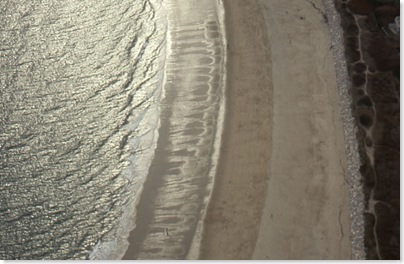
 Singing Beach, Manchester by the Sea (Fall 93) taken close to low tide.

The Edges of Time by Kay Ryan

It is at the edges
that time thins.
Time which had been
dense and viscous
as amber suspending
intentions like bees
unseizes them. A
humming begins,
apparently coming
from stacks of
put–off things or
just in back. A
racket of claims now,
as time flattens. A
glittering fan of things
competing to happen,
brilliant and urgent
as fish when seas
retreat.

Scratch the Surface

"From the beginning, I would always object when people would say, 'It's the pet cemetery movie.' No, no, no, no! It's not about pet cemeteries. And the next question is always, 'If it's not about pet cemeteries, what is it about?' Well, that's tricky! In essence, it embodies many of the ideas that are in every single film I've made. The obsession with language. Eye contact. An interest in accounts of subjective experience rather than objective reporting. The fundamental belief that if you scratch the surface of any person, you will find a world of the insane, very close to that surface."

~ Errol Morris, talking about his film Gates of Heaven

[Commercials by Errol Morris]

Tuesday, April 01, 2008

Grounded by Mechanical Problems

A fuel leak in one of the engines.
Strangers become familiar, 
united in a common obstacle, 
the bittersweetness of unrealized dreams
never getting off the ground.

We are steered with smiles,
from the cramped seats we’d settled into,
friendships of compromise,
and abandoned into stagnant lines where
we can’t find a single uniformed person
who will look us in our eyes.

A membrane forms around our transitory clan, 
bound by the surprising sting of being culled by chance. 
Our coat of arms could feature a suitcase consumed by clouds.

Fingers fly madly over keyboards, 
then hand us back-up plans typed out in secret code
on green paper that seems to have traveled from the past.

How could we have been so naïve
to trust the fickle seductions of flight?

Our rooms have been shunned
by people who are going places
and some of us have to ask for toothbrushes 
designed specifically for
travelers who fail to expect the worst.

Our meal vouchers have no value
in this place with no restaurant
so we walk, where there are no sidewalks, 
in clusters to nearby chains,
exactly like the ones from where we tried to leave
earlier in the day.

I enter the McDonald’s with a young man from China
who uses a name manufactured to make things easier on me,
but after a couple tries,
I still can’t quite make it out.

Back home, he says, most guys his age prefer KFC.
I feel embarrassed,
as if I am personally accountable
for the economies of scale that have
brought us to this hollowness of unlimited choices.

He studies computer science (materials) in East Lansing.
He tries to pay for his combo meal with the vouchers.

He tells me Shanghai is like New York City,
but Beijing is a better place to visit
because it has both the traditional and modern
at the same time.

The next morning,
they carefully search the grandma from Michigan among us
who is so nervous that she reacts to the metal detector
as if it were a trick question akin to a hole of miniature golf.

I chat over breakfast with a woman whose two daughters
are both single mothers living in California.
The one who is an oncology nurse is doing better
than the one whose husband passed away,
even though she,
the one who is doing better, 
has been divorced twice.

Nurses Syndrome, she tells me, 
means being attracted to men
who have a lot of needs.
Her daughter helped her find a good doctor to treat her cancer.
So far so good.

Back home, she and her husband run a furniture store.
They used to travel out west to buy merchandise,
but shipping rates have increased so much.
Now they just go to Chicago.

Soon they will be selling the business.
It doesn’t make as much money now
with so much competition from the bigger places.

And as we separate for our different gates,
there is a small ache braided into the comfort
of being back on course.