Friday, July 31, 2009

The Hidden Discipline of Familiarity

Everything is Waiting for You
by David Whyte

Everything is Waiting for You Your great mistake is to act the drama
as if you were alone. As if life
were a progressive and cunning crime
with no witness to the tiny hidden
transgressions. To feel abandoned is to deny
the intimacy of your surroundings. Surely,
even you, at times, have felt the grand array;
the swelling presence, and the chorus, crowding
out your solo voice You must note
the way the soap dish enables you,
or the window latch grants you freedom.
Alertness is the hidden discipline of familiarity.
The stairs are your mentor of things
to come, the doors have always been there
to frighten you and invite you,
and the tiny speaker in the phone
is your dream-ladder to divinity.

Put down the weight of your aloneness and ease into
the conversation. The kettle is singing
even as it pours you a drink, the cooking pots
have left their arrogant aloofness and
seen the good in you at last. All the birds
and creatures of the world are unutterably
themselves. Everything is waiting for you.

[Thank you Prema!]

Thursday, July 30, 2009

No One But You

Shrink Rap Radio "The most important thing is to cut out the noise of your life and be quiet with yourself for a while. The thing that helped me [was to ask myself] How do I feel? What do I miss? What do I yearn for? What am I going to do with my one and only precious life that I know of? How do I want to spend it? Do I like the people I'm with now? How do I want to feel when I get up in the morning?

Most of the time we're all so busy completing tasks that we don't have any space to think about those things. And many, many people in history have sat down and done that -- whether you're van Gogh or just a regular guy -- and gone, You know, I don't want to live this life anymore, I want to live that life.

And it is, I think, important for everyone to take seriously. If you have a yearning, to take a pilgrimage away from the life you're living now to one that you think will be more fulfilling. You owe your life to no one but you."

~ Dennis Palumbo, discussing changing careers with Dr. Dave on Shrink Rap Radio (Episode #159 - Therapist to The Hollywood Stars). Explore Mr. Palumbo’s writing.

Shatner Does Palin

From The Late Show with Conan O’Brien (July 27, 2009)

Growing Questions

"The outcome of any serious research can only be to make two questions grow where only one grew before."
~ Thorstein Veblen

Wednesday, July 29, 2009

We Remember that We Forget

A Friend’s Umbrella
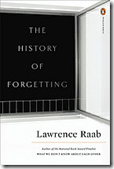
by Lawrence Raab, from The History of Forgetting

History of Forgetting Ralph Waldo Emerson, toward the end
of his life, found the names
of familiar objects escaping him.
He wanted to say something about a window,
or a table, or a book on a table.

But the word wasn't there,
although other words could still suggest
the shape of what he meant.
Then someone, his wife perhaps,

would understand: "Yes, window! I'm sorry,
is there a draft?" He'd nod.
She'd rise. Once a friend dropped by
to visit, shook out his umbrella
in the hall, remarked upon the rain.

Later the word umbrella
vanished and became
the thing that strangers take away.

Paper, pen, table, book:
was it possible for a man to think
without them? To know
that he was thinking? We remember
that we forget
, he'd written once,
before he started to forget.

Three times he was told
that Longfellow had died.

Without the past, the present
lay around him like the sea.
Or like a ship, becalmed,
upon the sea. He smiled

to think he was the captain then,
gazing off into whiteness,
waiting for the wind to rise.

[From The Writer’s Almanac with Garrison Keillor]

Tuesday, July 28, 2009

Our Ideas of Success

“We are highly open to suggestion. So what I want to argue for is not that we should give up on our ideas of success, but we should make sure that they are our own. We should focus in on our ideas and make sure that we own them, that we are truly the authors of our own ambitions. Because it’s bad enough not getting what you want, but it’s even worse to have an idea of what it is you want and find out at the end of the journey that it isn’t in fact what you wanted all along.”

Alain de Botton, from“A Kinder, Gentler Philosophy of Success,”  TED Talks, July 2009


[Thanks Kit!]

To Experience the Delight and Awe that Scientists Feel

From PowellsBooks.Blog (July 20, 2009):

why-does-e Why Does E=mc2? is in some ways a simple book with a simple aim: we (Jeff Forshaw and Brian Cox) wanted to see whether we could actually derive E=mc2 in a way that any interested non-mathematical reader could understand. By derive, I mean follow a series of small steps that are well-motivated and hopefully obvious, or at least plausible, and arrive at the equation itself, assuming no prior knowledge and making the minimum possible number of assumptions. In other words, we behave exactly as we would in our professional life as research scientists, searching for equations that describe nature.

In doing this, we hope to do much more than simply present and describe the equation, however. If the reader follows the argument, we hope that he or she will experience the delight and awe that scientists feel when they explore nature and reveal its underlying simplicity and beauty. One often hears scientists describe equations as "beautiful," and we believe the best way to understand what this means is to actually see how the most iconic and simple equation of all came to be written down. We don't in fact follow Einstein's route to E=mc2, because we believe that 100 years of teaching and understanding has provided a more profound and transparent route to it — we aren't writing a history book.

There is an element of polemic in the book. We very firmly believe that science, which is synonymous with rational thought as far as we are concerned, is the route to a better future. Woolly thinking and superstition are rife, and we should strive to reduce their place in public discourse. By showing how something as useful and, as far as we can tell, correct, as E=mc2 emerges from simple thought processes that we believe are open to every interested reader, we hope to make our case for an increased respect for and use of the scientific method in everyday life.

collider We also describe what E, m, and c actually are. Why is the speed of light special? What is energy, and what is mass? The question of mass leads us to the Large Hadron Collider at CERN, where we both work. One of the key goals of this machine is to answer this question definitively for the first time. It is remarkable that Einstein could be led to the equation that describes how mass and energy can be interchanged freely, without actually knowing what mass is. Such is the wonder of physics!


Fundamental Reality

From “Buddhism and Quantum Physics,” by Christian Thomas  Kohl, The Buddhist Channel (July 22, 2009):

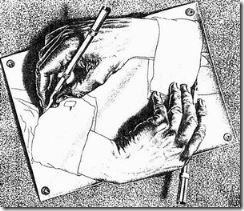
Drawing Hands, a 1948 lithograph by M. C. Escher

If you don’t believe in a creator, nor in the laws of nature, nor in a permanent object, nor in an absolute subject, nor in both, nor in any of it, in what do you believe then? What remains that you can consider a fundamental reality? The answer is simple; it is so simple that we barely consider it being a philosophical statement: things depend upon other things. For instance, a thing is dependent upon its cause. There is no effect without a cause and no cause without an effect. There is no fire without fuel, no action without an actor and vice versa. Things are dependent upon other things; they are not identical with each other, nor do they break up into objective and subjective parts.

This Buddhist concept of reality is often met with disapproval and considered incomprehensible. But there are modern modes of thought with points of contact. For instance, there is a discussion in quantum physics about fundamental reality. What is fundamental in quantum physics: particles, waves, field of force, law of nature, mindsets or information? Quantum physics came to a result that is expressed by the key words of complementarity, interaction and entanglement.

According to these concepts there are no independent quantum objects, just complementary ones; they are at the same time waves and particles. Quantum objects interact with others, and they are entangled even when they are separated at a far distance. Without being observed philosophically, quantum physics has created a physical concept of reality. According to that concept, the fundamental reality is an interaction of systems that interact with other systems and with their own components.

Gary Larson, March 23, 1984

"Ohhhhhhh...Look at that, Schuster...Dogs are so cute when they try to comprehend quantum mechanics."

Sunday, July 26, 2009

Sailing Home

From Authors@Google (October 10, 2008):

Sailing Home: Using the Wisdom of Homer's Odyssey to Navigate Life's Perils “In Sailing Home, renowned Zen teacher Norman Fischer deftly incorporates Buddhist, Judaic, Christian, and popular thought, as well as his own unique and sympathetic understanding of life, in his reinterpretation of Odysseus's familiar wanderings as lessons that everyone can use. We see how to resist the seduction of the Sirens' song to stop sailing and give up; how to bide our time in a situation and wait for the right opportunity; and how to reassess our story and rediscover our purpose and identity if, like the Lotus-Eaters, we have forgotten the past. With meditations that yield personal revelations, illuminating anecdotes from Fischer's and his students' lives, and stories from many wisdom traditions, Sailing Home shows the way to greater purpose in your own life.”

 
“So this is the mystery and the pain of our lives: every one of us is exactly where we need to be, but we don’t know it. We’re looking for somewhere else to be. The spiritual odyssey, life’s deepest and most significant undertaking, involves a great effort and inevitably it leads us on through many disasters and troubles in the checkered course of our living and growing. And where to we end up? Back where we started from. Back to ourselves. Only now maybe with more wisdom.” ~ Norman Fischer 

Reverse Engineering of Religion

"...religions are an important natural phenomenon. We should study them with the same intensity that we study all the other important natural phenomena...Today's religions are brilliantly designed. They're immensely powerful social institutions and many of their features can be traced back to earlier features that we can really make sense of by reverse engineering. And, as with the cow, there's a mixture of evolutionary design, designed by natural selection itself, and intelligent design -- more or less intelligent design -- redesigned by human beings who are trying to redesign their religions."

~ Dan Dennett, from TED Talks (February 2006)

Mr. Dennet't’s book Breaking the Spell: Religion as a Natural Phenomenon was reviewed by Leon Wieseltier in “The God Genome,” New York Times (February 19, 2006).

The Humor and Poetry and Drama

“I’m not scared that I don’t have a finished script, because I can very quickly find the humor and poetry and drama in situations. It’s there all the time in life.”

~ Roy Andersson, from “Calling It as He Sees It, in Great Detail,” by Dave Kehr, New York Times Sunday Magazine (July 26, 2009)

Saturday, July 25, 2009

Everything is Alive

Keeping Quiet
by Pablo Neruda, from Full Woman, Fleshly Apple, Hot Moon, translated by Stephen Mitchell

Now we will all count to twelve
and we will all keep still.

This one time upon the earth,
let’s not speak any language,
let’s stop for one second,
and not move our arms so much.

It would be a delicious moment,
without hurry, without locomotives,
all of us would be together
in a sudden uneasiness.

The fisherman in the cold sea
would do no harm to the whales
and the peasant gathering salt
would look at his torn hands.

Those who prepare green wars,
wars of gas, wars of fire,
victories without survivors,
would put on clean clothing
and would walk alongside their brothers
in the shade, without doing a thing.

What I want shouldn’t be confused
with final inactivity:
life alone is what matters,
I want nothing to do with death.

If we weren’t unanimous
about keeping our lives so much in motion,
if we could perhaps do nothing for once,
perhaps a great silence would interrupt this sadness,
this never understanding ourselves
and threatening ourselves with death,
perhaps the earth is teaching us
when everything seems to be dead
and everything is alive.

Now I will count to twelve
and you keep quiet and I’ll go.

As If It Were the Only One

Elias Canetti "There is no such thing as an ugly language. Today I hear every language as if it were the only one, and when I hear of one that is dying, it overwhelms me as though it were the death of the earth."

~ Elias Canetti

Friday, July 24, 2009

Maybe It’s Not Too Late to Grow Up

From Forever Young, and essay written and read by Kurt Anderson of Studio 360 (July 17, 2009):

"Waiting to get what you want is a definition of maturity. Demanding satisfaction right this instant is the definition of a seven year old. But instant satisfaction has been driving our economy and our culture for a while.

Send a message now! Get an answer now! Pick your airline seat now! Buy anything you want right now!

The web, cell phones, FedEx: they all indulge the impulsive child in every one of us.

Save? Why? For what?

Wait till I can afford it? No…Fooey!

Fuel efficient? Lame.

I don't mean to be a crank and I don't mean to condemn fun. I'm committed to rubber soles for life and I cherish The Simpsons. I'm even a convert to Twitter -- the official medium of back-of-the-class wisecracks.

Yes, the economic collapse had everything to do with credit policy and financial regulation. But I really, truly think that this forty-year-long celebration of our inner child helped lead us to the spree that we've just come off.

But with this crisis and now the rebuilding and reshaping of America we're required to do, we Boomers have maybe our last, best shot to suck it up and get serious and help straighten out the messes that we helped make. Maybe it's not too late to grow up a little.”

Equanimity Does Not Mean Fairness

justice “To practice equanimity is to understand that everything everybody ever does — I repeat, everything everybody ever does — is because at that moment, he or she feels that their action will improve their world. In other words he or she is just trying to be happy. The actions may be, and often are, tragically, catastrophically self-defeating, but that is the motivation at the moment of action. Equanimity, then, is a profound acceptance of each person's humanity. Fairness may be the result of equanimity, but it's not the practice of equanimity.”

~ Ken McLeod, from Rules for the Road

Try to Love the Questions

“Be patient towards all that is unsolved in your heart and try to love the questions themselves like locked rooms and like books that are written in a very foreign tongue. Do not now seek the answers, which cannot be given you because you would not be able to live them. And the point is, to live everything. Live the questions now. Perhaps you will then gradually, without noticing it, live along some distant day into the answer.”

~ Rainer Maria Rilke

Thursday, July 23, 2009

Benign Contagion

[Thanks Kimberly!]

Tuesday, July 21, 2009

A Little Out of Scale

Norman Fischer speaking with Vince Horn on Buddhist Geeks (Episode129 -- Buddhism May Need a Plan B):

BG ...twenty-five years ago nobody went to the gym. Now we've well established through research in our society that exercise is really important so there's a gym on every corner. Well, why isn't there a meditation hall on every corner? Haven’t we established the fact that some spiritual endeavor is just as important for inner health as exercise is for the body? So there ought to be meditation halls on every corner and people should know how important this is and feel like it makes sense to access it and pay for it so that there could be people to offer it.

I mean that there is tremendous spike in research on meditation. Just in last three or four years. It’s exponentially increased and all the research is always showing the same thing that meditation is actually a effective, that it really works, and that it has all kind of benefits. So people seem to believe in research and scientific data, but just talk to your friends who do this practice and that’s probably enough to convince you even without the scientific data.

...It's funny, you know? I'm gone do a retreat for the army for Norman Fischer      caregivers and chaplains. So the Army's going to spend fifty cents to pay me to do the retreat and then a million dollars to study the effects of the retreat over time. So...it’s very expensive to conduct research. Very expensive. A million dollar research grant is not an unusual grant. A million dollar gift to a dharma center or for a teacher training or something like that is very, very rare. So it’s a little out of scale.

[The conversation continues in Episode 130 -- Buddhism and the Evolution of Religion. Check out Norman Fischer’s article, “Why We Need a Plan B,” in the summer issue of Buddhadharma.]

Wishing Well

“The better part of happiness is to wish to be what you are.”

~ Desiderius Erasmus

Ce Soir


Ce Soir is Montreal-based band Monogrenade's first music video. Directed by Christophe Collette, the video is entirely made in stop-motion.

See also Vidéomusique

[Thanks again JC!]