The Commercialization of Childhood



Excerpts from When the Towers Fell
by Galway Kinnell
From our high window we saw the towers
with their bands and blocks of light
brighten against a fading sunset,
saw them at any hour glitter and live
as if the spirits inside them sat up all night
calculating profit and loss, saw them reach up
to steep their tops in the until then invisible
yellow of sunrise, grew so used to them
often we didn’t see them, and now,
not seeing them, we see them.
…
Some died while calling home to say they were O.K.
Some died after over an hour spent learning they would die.
Some died so abruptly they may have seen death from within it.
Some broke windows and leaned out and waited for rescue.
Some were asphyxiated.
Some burned, their very faces caught fire.
Some fell, letting gravity speed them through their long moment.
Some leapt hand in hand, the elasticity in last bits of love-time letting—I wish
I could say—their vertical streaks down the sky happen more lightly.
In our minds the glassy blocks
succumb over and over into themselves,
slam down floor by floor into themselves.
They blow up as if in reverse, exploding
downward and outward, billowing
through the streets, engulfing the fleeing.
As each tower goes down, it concentrates
into itself, transforms itself
infinitely slowly into a black hole
infinitesimally small: mass
without space, where each light,
each life, put out, lies down within us.
…
From “Mindfulness meditation being used in hospitals and schools,” by Marilyn Elias, USA TODAY (6.8.09):

Ryan, 35, sits on a floor cushion, closes his eyes, focuses on his breath and tries to detach from any thoughts, just observing them like clouds moving across the sky — a practice he learned at a retreat. "I find it makes me a better listener, and my concentration is sharper. I get less distracted when I'm reading," he says. "It's like you see through the clutter of life and can penetrate to what's really going on."
…As research expands, scientists expect to unlock more of the mysteries around meditation. Meanwhile, for those such as Ryan, proof of benefit is already evident. "I'm much more aware now than I used to be," he says. "I enjoy my life more because you notice, and you really appreciate."
From “How to Get Smarter, One Breath at a Time,” by Lisa Takeuchi Cullen, Time.com (1.10.06):
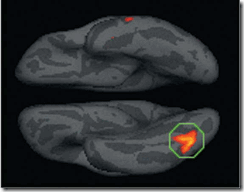
Everyone around the water cooler knows that meditation reduces stress. But with the aid of advanced brain scanning technology, researchers are beginning to show that meditation directly affects the function and structure of the brain, changing it in ways that appear to increase attention span, sharpen focus and improve memory.
[Thanks Kit!]
“Consider for a moment that sound does have form and we’ve seen that it can affect matter and cause form within matter. Then take a leap and think about the universe forming and think about the immense sound of the universe forming. Perhaps cymatics had an influence on the formation of the universe itself.”
~ Evan Grant, from “Making Sound Visible Through Cymatics,” TED Talks, July 2009

Excerpts from Ray Kurzweil’s “Introduction to 9”:
Our emotional intelligence is not just a sideshow to human intelligence, it’s the cutting edge. The ability to be funny, to get the joke, to express a loving sentiment represent the most complex things we do. But these are not mystical attributes. They are forms of intelligence that take also place in our brains. And the complexity of the design of our brains – including our emotional and moral intelligence – is a level of technology that we can master. There are only about 25 million bytes of compressed design information underlying the human brain (that’s the amount of data in the human genome for the brain’s design). That’s what accounts for our ability to create music, art and science, and to have relationships.
Mastering these capabilities is the future of AI. We will want our future AI’s to master emotional intelligence and the movie 9 shows us why. We want our future machines to be like the stitchpunk creations, not like the rampaging machines.

My view of the future is that we will work hand-in-hand with friendly machines, just as we do today. Indeed we will merge with them, and that process has already started, with machines like neural implants for Parkinson’s patients and cochlear implants for the deaf. But my vision of the future is not utopian. While I don’t foresee the end of conflict, future conflict will not simply be man-versus-machine. It will be among different groups of humans amplified in their abilities by their machines, just as we see today.
The stitchpunk creations succeed not despite their emotionalism and bickering with each other, but because of it. We will want our future machines to be emotionally, socially, and morally intelligent because we will become the machines. That is, we will become the rag dolls. We will extend our reach physically, mentally, and emotionally through our technology. This is the only way we can avoid the apocalyptic world that 9 wakes up to.

Excerpts from “The University’s Crisis of Purpose,” by Drew Gilpin Faust, New York Times (September 1, 2009):

…
Universities are meant to be producers not just of knowledge but also of (often inconvenient) doubt. They are creative and unruly places, homes to a polyphony of voices. But at this moment in our history, universities might well ask if they have in fact done enough to raise the deep and unsettling questions necessary to any society.
…
Since the 1970s there has been a steep decline in the percentage of students majoring in the liberal arts and sciences, and an accompanying increase in preprofessional undergraduate degrees. Business is now by far the most popular undergraduate major, with twice as many bachelor’s degrees awarded in this area than in any other field of study. In the era of economic constraint before us, the pressure toward vocational pursuits is likely only to intensify.
As a nation, we need to ask more than this from our universities. Higher learning can offer individuals and societies a depth and breadth of vision absent from the inevitably myopic present. Human beings need meaning, understanding and perspective as well as jobs. The question should not be whether we can afford to believe in such purposes in these times, but whether we can afford not to.

~ Chögyam Trungpa, The Myth of Freedom and the Way of Meditation
“An object is not so possessed by its own name that one could not find another or better therefore.”

The Listening Room by René Magritte.
Excerpts from “On Enlightenment: An Interview with Shinzen Young,” from Har-Prakash Khalsa’s blog (September 5, 2009):
Enlightenment is not yet another thing that you have to get. And meditation as a path to enlightenment could be described as merely setting the stage for Nature/Grace to eliminate from you what needs to be eliminated.
Sakkaya-ditthi is the perception that there is an entity, a thing inside us called a self. That goes away.The ambiguity is the word perception. The actual word is ditti in Pali, or drishti in Sanskrit, which means “view”, literally. In this context ditti or drishti refers to a fundamental paradigm, or concept about something.
So in this case perception is perhaps not the best word. It’s more like the fundamental conviction that there is a thing inside us called a self disappears—according to the traditional formulation, after enlightenment—that never comes back. However, if by perception of self we mean momentarily being caught in one’s sense of self, that happens to enlightened people over and over again, but less and less as enlightenment deepens and matures.
So if we take “self” to mean “the perception self-is-a-thing in me”, that is gone forever. But if we take “self” to mean: A) mental image, internal talk and emotional feeling arising within, and B) one’s clarity and equanimity around them are not sufficient in that moment, then even a somewhat enlightened person may get caught in self, for awhile. Certainly that is going to happen over and over again.
I like to analyze subjective experience into three sensory elements: feel (emotional-type body sensations), image (visual-thinking) and talk (auditory-thinking). Those sensory elements continue to arise for an enlightened person forever. Sometimes when the feel-image-talk arises the enlightened person is momentarily caught in them but even though they’re caught in that, some part of them still knows it’s not a thing called self. That knowing never goes away. The frequency, duration and intensity of identifying with feel-image-talk diminishes as the months and years go on as you go through deeper and deeper levels of enlightenment. There are exceptions, but typically it takes months, years, indeed decades learning how not to get caught in feel-image-talk when it arises.
You can have a “no-self experience” even when there is the arising of feel-image-talk as long as there is so much clarity and equanimity that you’re not caught in them. Furthermore, as the process of enlightenment deepens you find you experience longer and longer durations during which little or no subjective activity needs to arise.
So enlightened people have three kinds of no-self experiences. In the first subjective elements of self simply don’t arise. Subjective space vanishes. In the second emotion in the body and visual thinking and verbal thinking all arise, perhaps even intensely, but you don’t get caught in them because they never tangle or coagulate. In the third the subjective elements arise and you do get caught in them but some part of you still knows this experience is a wave called body-mind, not a particle called self.
So to sum it up, what disappears at enlightenment is a viewpoint or perception that there is a thing inside this body-mind process called self.
Excerpts from “College Advice, From People Who Have Been There Awhile,” Week in Review, New York Times (September 6, 2009):

I give this advice with some trepidation because too many writing courses today teach everything but the craft of writing and are instead the vehicles of the instructor’s social and political obsessions. In the face of what I consider a dereliction of pedagogical duty, I can say only, “Buyer beware.” If your writing instructor isn’t teaching writing, get out of that class and find someone who is.


From “Change We'd Rather Do Without,” by Michael Kinsley, The Washington Post (August 28, 2009):
The reason Americans have turned against health-care reform, after electing President Obama in part for promising it, is simple: Despite protestations to the contrary, Americans don't like change. You wouldn't know it, of course, if you 
[More…]
From “My Basic Philosophy (as it comes to writing),” by Po Bronson:
We want authenticity in what we read. Authenticity is the post-modern elixir. In an age of lies and corruption—an age of irony and mass-marketed pop product—we have a longing, a craving, for authentic work, for authentic people. As a lazy shortcut, we've made the mistake of looking to the author's biography on the dust jacket as the stamp of authenticity. Authenticity is only properly earned on the written page.
When we tie a work's authenticity to a writer's autobiography, we are severely limiting our creativity. We cannot restrict our curiosity or creativity to that narrow spectrum of "things we've already experienced." Creative expression should never be handcuffed.
[Thanks Dyan!]

~ Alan Fogel, from “Embodied Exercise,” Psychology Today’s Body Sense Blog (August 24, 2009)
Radiolab presents 16: Moments by Will Hoffman. This film is a celebration of life that was inspired by David Eagleman's book, Sum.
Samar Jarrah of Port Charlotte, Florida describes the benefits she sees in experiencing Ramadan in the United States:
I just got back from Jordan…and my family was telling me, Why can’t you just stay a bit longer and spend a week of Ramadan in 
[More…]
Listen to more voices at Revealing Ramadan from Speaking of Faith.
From “A Q&A with Agent Georges Borchardt,” by Jofie Ferrari-Adler, Poet & Writers (September/October 2009):

I think you're an artist because you have to be an artist. I don't think it's ever been easy. It's not easy for musicians. It's not easy for painters. But it has never been easy for those people. When Cézanne showed his first paintings, people laughed at him. They thought they were ludicrous. Van Gogh only sold one painting in his lifetime. To be an artist has always been difficult. To be an artist in the United States has been probably even more difficult than elsewhere because the arts are not considered all that valuable here.
If somebody asks you what you do and you say, "I'm a writer," the next question will be, "But what do you do for a living?"

David Teie has been developing a theory to explain why music plays on human emotions. His theory is that music relates to the most primitive sounds we make and respond to, like laughter, heartbeats, or a mother's cooing.
Fearful monkey music:
Happy monkey music:
He says, "the paradox is that I distinctly remember thinking once that when they figure out why Puccini makes me cry, I hope I die the day before the news gets out. But the great news about this exploration into music is it's actually more magical and wonderful once you realize how it works."

See also: Music for Cats
“In this soaring demonstration, deaf percussionist Evelyn Glennie illustrates how listening to music involves much more than simply letting sound waves hit your eardrums.”
From TED Talks (Filmed 2/2003; Posted 4/2007)

From “Happiness: A Buyer’s Guide,” by Drake Bennett, The Boston Globe (August 23, 2009):

Any attempt to put these findings into practice, however, has to contend with the subtle but powerful ways money itself channels our thinking, and the ways it plays on human attitudes about sharing and scarcity. Recent studies have suggested that merely thinking about money makes us more solitary and selfish, and steers us away from the spending that promises to make us happiest.
“Forrest Bird’s invention, the respirator, has saved millions of lives and, at 86, he’s still living his life to the fullest, flying his airplanes and working 12-hour days.”
"I am not anti-gun. I'm pro-knife. Consider the merits of the knife. In the first place, you have to catch up with someone in order to stab him. A general substitution of knives for guns would promote physical fitness. We'd turn into a whole nation of great runners. Plus, knives don't ricochet. And people are seldom killed while cleaning their knives."

Excerpt from “Youtopia and the Bubble of American Egos,” by Theo Horesh, Beyond Growth (Aug. 26, 2009):
What happens when a whole society of people learns to project an image of success and capability that few members of that society actually possess? Let us create for ourselves an imaginary world—we’ll call it Youtopia—and explore what might happen there…
In a socially mobile society like that of the US, in which individuals craft their own lives for themselves and must regularly recreate their own social worlds as they move from place to place and from one social class to another, the ability to project an image of success and capability can mean the difference between success and failure in almost any endeavor. So let us travel to Youtopia and see what happens when all of us do this?
First of all, it becomes difficult to distinguish who is actually successful and capable on Youtopia. For everyone will appear successful and capable whether or not he or she really is. And while new indicators of success and capability might be discovered, those indicators would be quickly learned by others on YouTopia, for if everyone possessed the ability to project an image of success and capability, whatever the indicators of success and capability were, they would learn them.
Excerpts from “Depression's Evolutionary Roots,” By Paul W. Andrews and J. Anderson Thomson, Jr., Scientific American Mind, August 25, 2009:
Depressed people often have trouble performing everyday activities, they can’t concentrate on their work, they tend to socially isolate themselves, they are lethargic, and they often lose the ability to take pleasure from such activities such as eating and sex. Some can plunge into severe, lengthy, and even life-threatening bouts of depression.

This analytical style of thought, of course, can be very productive. Each component is not as difficult, so the problem becomes more tractable. Indeed, when you are faced with a difficult problem, such as a math problem, feeling depressed is often a useful response that may help you analyze and solve it...Analysis requires a lot of uninterrupted thought, and depression coordinates many changes in the body to help people analyze their problems without getting distracted...
Sometimes people are reluctant to disclose the reason for their depression because it is embarrassing or sensitive, they find it painful, they believe they must soldier on and ignore them, or they have difficulty putting their complex internal struggles into words.
But depression is nature’s way of telling you that you’ve got complex social problems that the mind is intent on solving. Therapies should try to encourage depressive rumination rather than try to stop it, and they should focus on trying to help people solve the problems that trigger their bouts of depression. (There are several effective therapies that focus on just this.) It is also essential, in instances where there is resistance to discussing ruminations, that the therapist try to identify and dismantle those barriers.
Andrews, P. W., & Thomson Jr, J. A. (2009). The bright side of being blue: Depression as an adaptation for analyzing complex problems. Psychological Review. 116 (3), 620.

La Porte de l'Enfer
Auguste Rodin
Helping My Daughter Move into Her First Apartment
by Sue Ellen Thompson
This is all I am to her now:
a pair of legs in running shoes,
two arms strung with braided wire.
She heaves a carton sagging with CDs
at me and I accept it gladly, lifting
with my legs, not bending over,
raising each foot high enough
to clear the step. Fortunate to be
of any use to her at all,
I wrestle, stooped and single-handed,
with her mattress in the stairwell,
saying nothing as it pins me,
sweating, to the wall. Vacuum cleaner,
spiny cactus, five-pound sacks
of rice and lentils slumped
against my heart: up one flight
of stairs and then another,
down again with nothing in my arms
"Spend some time living before you start writing. What I find 
~ Annie Proulx, from The Writer’s Almanac (8.23.09)

From “A Georgia County Shares a Tale of One Man’s Life and Death,” by Drew Jubera, The New York Times, August 22, 2009.

~ Jeanette Winterson, from Art Objects: Essays on Ecstasy and Effrontery

~ Frank Bruni, discussing his memoir Born Round: The Secrect History of a Full-Time Eater on The Book Bench: The New Yorker (August 19, 2009)
First Grade 
Until then, every forest
had wolves in it, we thought
it would be fun to wear snowshoes
all the time, and we could talk to water.
So why is this woman with the gray
breath calling out names and pointing
to the little desks we will occupy
for the rest of our lives?
Excerpts from “How American Health Care Killed My Father,” by David Goldhill, The Atlantic (September 2009)

How would the health-care reform that’s now taking shape solve these core problems? The Obama administration and Congress are still working out the details, but it looks like this generation of “comprehensive” reform will not address the underlying issues, any more than previous efforts did. Instead it will put yet more patches on the walls of an edifice that is fundamentally unsound—and then build that edifice higher.
…I hope that whatever reform is finally enacted this fall works—preventing people from slipping through the cracks, raising the quality standard of the health-care industry, and delivering all this at acceptable cost. But looking at the big picture, I fear it won’t. So I think we should at least begin to debate and think about larger reforms, and a different direction—if not for this round of reform, then for the next one. Politics is, of course, the art of the possible. If our health-care crisis does not abate, the possibilities for reform may expand beyond their current, tight limits.
The most important single step we can take toward truly reforming our system is to move away from comprehensive health insurance as the single model for financing care. And a guiding principle of any reform should be to put the consumer, not the insurer or the government, at the center of the system. I believe if the government took on the goal of better supporting consumers—by bringing greater transparency and competition to the health-care industry, and by directly subsidizing those who can’t afford care—we’d find that consumers could buy much more of their care directly than we might initially think, and that over time we’d see better care and better service, at lower cost, as a result.
A more consumer-centered health-care system would not rely on a single form of financing for health-care purchases; it would make use of different sorts of financing for different elements of care—with routine care funded largely out of our incomes; major, predictable expenses (including much end-of-life care) funded by savings and credit; and massive, unpredictable expenses funded by insurance.
From “Those Aren’t Fighting Words, Dear,” by Laura A. Munson, The New York Times, July 31, 2009:

His words came at me like a speeding fist, like a sucker punch, yet somehow in that moment I was able to duck. And once I recovered and composed myself, I managed to say, “I don’t buy it.” Because I didn’t.
He drew back in surprise. Apparently he’d expected me to burst into tears, to rage at him, to threaten him with a custody battle. Or beg him to change his mind.
So he turned mean. “I don’t like what you’ve become.”
Gut-wrenching pause. How could he say such a thing? That’s when I really wanted to fight. To rage. To cry. But I didn’t.
Instead, a shroud of calm enveloped me, and I repeated those words: “I don’t buy it.”
You see, I’d recently committed to a non-negotiable understanding with myself. I’d committed to “The End of Suffering.” I’d finally managed to exile the voices in my head that told me my personal happiness was only as good as my outward success, rooted in things that were often outside my control. I’d seen the insanity of that equation and decided to take responsibility for my own happiness. And I mean all of it.
Kathleen Hall Jamieson in conversation with Bill Moyers and Drew Altman on Bill Moyers Journal (8.14.09):

...But when people are shouting at each other, the answer doesn't get through. And when you're impugning the integrity of the person who's answering the questions, the member of Congress, that person's response isn't going to be believed if it is able to be articulated and isn't simply shouted down.
And so it's not creating context in which misinformation on both sides can be corrected. And that's the problem. We don't have a deliberative process here taking place in public to inform public opinion.
Instead, we're potentially distorting it.
From Homer & Langley by E.L. Doctorow:

I said, Langley, people aren’t all the same like dumb bison, we are each a person. A genius like Beethoven cannot be replaced.
But, you see, Homer, Beethoven was a genius for his time. We have the notations of his genius but he is not our genius. We will have our geniuses, and if not in music then in science or art, though it may take a while to recognize them because geniuses are usually not recognized right away. Besides, it’s not what any of them achieve but how they stand in relation to the rest of us. Who is your favorite baseballer? he said.
Walter Johnson, I said.
And what is he if not a replacement for Cannonball Titcomb, Langley said. You see? It’s social constructions I’m talking about. One of the constructions is for us to have athletes to admire, to create ourselves as an audience of admirers for baseballers. This seems to be a means of cultural communizing that creates great social satisfaction and possibly ritualizes, what with baseball teams of different towns, our tendency to murder one another. Human beings are not bison, we are a more complex species, living in complicated social constructions, but we replace ourselves just as they do. There will always be in America for as long as baseball is played someone who serves youth still to be born as Walter Johnson serves you. It is a legacy of ours to have baseball heroes and so there will always be one. Well you are saying everything is always the same as if there is no progress, I said.
I’m not saying there’s no progress. There is progress while at the same time nothing changes. People make things like automobiles, discover things like radio waves. Of course they do. There will be better pitchers than your Walter Johnson, as hard as that is to believe. But time is something else than what I’m talking about. It advances through us as we replace ourselves to fill the slots.
Solving the Puzzle
by Stephen Dunn, from Loosestrife

So I threw one away.
No expectations of success now,
None of that worry.
The remaining pieces seemed
to seek their companions.
A design appeared.
I could see the connection
Between the overgrown path
And the dark castle on the hill.
Something in the middle, though,
was missing.
It would have been important once.
I wouldn’t have been able to sleep
without it.
[Spotted on Jonathan Carroll’s blog 8.13.09]

Me
by Paula Cole
I am not the person who is singing
I am the silent one inside
I am not the one who laughs at people's jokes
I just pacify their egos
I am not my house, my car, my songs
They are only just stops along my way
I am like the winter
I'm a dark cold female
With a golden ring of wisdom in my cave
And it’s me who is my enemy
Me who beats me up
Me who makes the monsters
Me who strips my confidence
I am carrying my voice
I am carrying my heart
I am carrying my rhythm
I am carrying my prayers
But you can't kill my spirit
It's soaring and it's strong
Like a mountain
I'll go on and on
But when my wings are folded
The brightly colored moth
Blends into the dirt into the ground
And it's me who's too weak
And it's me who's too shy
To ask for the thing I love
And it's me who's too weak
And it's me who's too shy
To ask for the thing I love
That I love
I am walking on the bridge
I am over the water
And I'm scared as hell
But I know there's something better
Yes I know there's something
Yes I know, I know, yes I know
That I love
But it's me
And it's me
But it's me
Glen Hansard and Marketa Irglova perform a live set as part of NPR’s Tiny Desk Concerts series. Their new CD, Strict Joy, is due to be released at the end of October.
[Thanks Suzie!]
From Mastering the Core Teachings of the Buddha (the blook) by Daniel Ingram:
Try this little exercise the next time some kind of strong and seemingly useless or unskillful emotion arises. First, stabilize precisely on the sensations that make it up and perhaps even allow these to become stronger if this helps you to examine them more clearly. Find where these are in the body, and see as clearly as possible what sorts of images and story lines are associated with these physical sensations. Be absolutely clear about the full magnitude of the suffering in these, how long each lasts, that these sensations are observed and not particularly in one’s control.
Now, find the compassion in it. Take a minute or two (no more) to reflect on why this particular pattern of sensations seems to be of some use even though it may not seem completely useful in its current form. Is there a wish for yourself or others to be happy in these sensations? Is there a wish for the world to be a better place? Is there a wish for someone to understand something important? Is there a wish for things to be better than they are? Is there a wish to find pleasure, tranquility, or the end of suffering? Sit with these questions, with the sensations that make them up, allowing them to be strong enough for you to see what is going on but not so strong that you become completely overwhelmed by them.
Notice that fear has in it the desire to protect us or those about whom we care. Anger wants the world to be happy and work well or for justice to be done. Frustration comes from the caring sensations of anger being thwarted. Desire is rooted in the wish to be happy. Judgment comes from the wish for things to conform to high standards. Sadness comes from the sense of how good things could be. I could go on like this for a whole book.
Actively reflecting along these lines, sit with this compassionate wish, acknowledge it, and feel the compassionate aspect of it. Allow the actual sensations that seem to be fundamental to wanting to be directly understood as and where they are. Remember that this same quality of compassion is in all beings, in all their unskillful and confused attempts to find happiness and the end of suffering. Sit for a bit with this reflection as it relates directly to your experience.
Then, examine the mental sensations related to the object that you either wish for (attraction), wish to get away from (aversion), or wish would just be able to be ignored (ignorance). Examine realistically if this will fundamentally help yourself and others and if these changes are within your power to bring about. If so, then plan and act with as much compassion and kindness as possible.
Remember then that all the rest of the suffering of that emotional pattern is created by your mind and its confusion, and vow to channel its force into developing morality, concentration, and wisdom.
“There's this being called the thing that made the things for which there is no known maker and that causes and directs the events we can't otherwise explain and that doesn't need to have been made and is the one thing from which to ask for things that no human can give and without whom we can't be fully happy and is unlimited by all the laws of physics and never began and will never finish and is invisible but actually everywhere at once and who is so perfect that even if he killed millions of people, including babies, he'd still would be perfect and who is so powerful and magical that he can even make a virgin pregnant if he wanted to."

Walking to Oak-Head Pond, and Thinking of the Ponds I Will Visit in the Next Days and Weeks
by Mary Oliver, from What Do We Know

as tomorrow?
Not love,
not the wind,
not the inside of stone.
Not anything.
And yet, how often I'm fooled—
I'm wading along
in the sunlight—
and I'm sure I can see the fields and the ponds shining
days ahead—
I can see the light spilling
like a shower of meteors
into next week's trees,
and I plan to be there soon—
and, so far, I am
just that lucky,
my legs splashing
over the edge of darkness,
my heart on fire.
I don't know where
such certainty comes from—
the brave flesh
or the theater of the mind—
but if I had to guess
I would say that only
what the soul is supposed to be
could send us forth
with such cheer
as even the leaf must wear
as it unfurls
its fragrant body, and shines
against the hard possibility of stoppage—
which, day after day,
before such brisk, corpuscular belief,
shudders, and gives way.
“I long for the narrative arc and true storytelling,” Mr. [Alec] Soth said. When he’s on the road he tries to let each picture lead him to the next; taped to his steering wheel is a list of things to watch for while he’s driving. A list composed for his current project included beards, birdwatchers, mushroom hunters, men’s retreats, after the rain, figures from behind, suitcases, tall people (especially skinny), targets, tents, treehouses and tree lines. Thus the photo of the tall bearded monk standing amid a forest of soaring barren tree trunks and the image of a giantlike man with a suitcase walking away on an overgrown path.
~ From “Trolling for Strangers to Befriend,” by Hilarie M. Sheets, New York Times (August 2, 2009)

High Museum of Art Atlanta
August 8, 2009, through January 3, 2010
"Neuroscientists have discovered that a brain centre involved in sensing emotion and fear called the amygdala kicks into action when volunteers listen to scary music with eyes closed...Shutting your eyes heightens people's emotional responses to the outside world, suggests previous research—not to mention everyday experience."
~ From “Scary Music is Spookier with Eyes Shut," by Ewen Callaway, New Scientist (July 28, 2009)
From Taking the Leap: Freeing Ourselves from Old Habits and Fears by Pema Chödrön:

In order to make this choice skillfully, many of us turn to spiritual practices of various kinds with the wish that our lives will lighten up and that we’ll find the strength to cope with our difficulties. Yet in these times it seems crucial that we also keep in mind the wider context in which we make choices about how to live: this is the context of our beloved earth and the rather rocky condition it’s in.
For many, spiritual practice represents a way to relax and a way to access peace of mind. We want to feel more calm, more focused; and with our frantic and stressful lives, who can blame us? Nevertheless, we have a responsibility to think bigger than that these days. If spiritual practice is relaxing, if it gives us some peace of mind, that’s great—but is this personal satisfaction helping us to address what’s happening in the world? The main question is, are we living in a way that adds further aggression and self-centeredness to the mix, or are we adding some much-needed sanity?
[More…]
The breeze at dawn has secrets to tell you.
Don’t go back to sleep.
You must ask for what you really want.
Don’t go back to sleep.
People are going back and forth across the doorsill
Where the two worlds touch.
The door is round and open.
Don’t go back to sleep.
~ Rumi
[Thanks Elisha Goldstein!]
 Diane Winston in conversation with Krista Tippett, "TV and
Parables of Our Time," Speaking of Faith (July 16, 2009):
"...something that really strikes me if I watch both Battlestar
Galactica and Lost is that you see those characters grow from
victims to survivors. And the interesting thing is, is can we
take this in better as entertainment than as news?
If we read another article in Newsweek about Israeli and
Palestinian children at a summer camp getting along is that
going to make us believe that change is possible? Or maybe you
need that and you need shows like Battlestar Galactica and Lost
to show you that change is possible.
I guess that I think we underestimate the power of entertainment narratives to influence the way we look at the
world and I think storytelling, when it's good storytelling,
you know, orients us to possibilities and helps us structure
the way we look at things. So the power of the narrative is
that it takes on a life of its own for folks. But I don't know.
Maybe if Ronald D. Moore took over the UN we'd all be getting
along better. You think?"

Daron Larson
Freelance Contemplative