Friday, August 28, 2009

What Could Be Useful About Depression?

Excerpts from “Depression's Evolutionary Roots,” By Paul W. Andrews and J. Anderson Thomson, Jr., Scientific American Mind, August 25, 2009:

Depressed people often have trouble performing everyday activities, they can’t concentrate on their work, they tend to socially isolate themselves, they are lethargic, and they often lose the ability to take pleasure from such activities such as eating and sex. Some can plunge into severe, lengthy, and even life-threatening bouts of depression.

Matt exploring Musée Rodin (2005) So what could be so useful about depression? Depressed people often think intensely about their problems. These thoughts are called ruminations; they are persistent and depressed people have difficulty thinking about anything else. Numerous studies have also shown that this thinking style is often highly analytical. They dwell on a complex problem, breaking it down into smaller components, which are considered one at a time.

This analytical style of thought, of course, can be very productive. Each component is not as difficult, so the problem becomes more tractable. Indeed, when you are faced with a difficult problem, such as a math problem, feeling depressed is often a useful response that may help you analyze and solve it...Analysis requires a lot of uninterrupted thought, and depression coordinates many changes in the body to help people analyze their problems without getting distracted...

Sometimes people are reluctant to disclose the reason for their depression because it is embarrassing or sensitive, they find it painful, they believe they must soldier on and ignore them, or they have difficulty putting their complex internal struggles into words.

But depression is nature’s way of telling you that you’ve got complex social problems that the mind is intent on solving. Therapies should try to encourage depressive rumination rather than try to stop it, and they should focus on trying to help people solve the problems that trigger their bouts of depression. (There are several effective therapies that focus on just this.) It is also essential, in instances where there is resistance to discussing ruminations, that the therapist try to identify and dismantle those barriers.

More…

Andrews, P. W., & Thomson Jr, J. A. (2009). The bright side of being blue: Depression as an adaptation for analyzing complex problems. Psychological Review. 116 (3), 620.

La-Porte The Gates of Hell
La Porte de l'Enfer
Auguste Rodin

Monday, August 24, 2009

Nothing in My Arms

Helping My Daughter Move into Her First Apartment
by Sue Ellen Thompson

This is all I am to her now:
a pair of legs in running shoes,

two arms strung with braided wire.
She heaves a carton sagging with CDs 

at me and I accept it gladly, lifting
with my legs, not bending over,

raising each foot high enough
to clear the step. Fortunate to be 

of any use to her at all,
I wrestle, stooped and single-handed, 

with her mattress in the stairwell,
saying nothing as it pins me, 

sweating, to the wall. Vacuum cleaner,
spiny cactus, five-pound sacks 

of rice and lentils slumped
against my heart: up one flight 

of stairs and then another,
down again with nothing in my arms

From American Life in Poetry: Column 231

Sunday, August 23, 2009

Coiling Tighter into Our Boring Little Selves

"Spend some time living before you start writing. What I find annie_proulxto be very bad advice is the snappy little sentence, 'Write what you know.' It is the most tiresome and stupid advice that could possibly be given. If we write simply about what we know we never grow. We don't develop any facility for languages, or an interest in others, or a desire to travel and explore and face experience head-on. We just coil tighter and tighter into our boring little selves. What one should write about is what interests one."

~ Annie Proulx, from The Writer’s Almanac (8.23.09)

Weary Traveler

Photo by Russell Kaye for The New York Times. Keith Gragg at a funeral home in Clayton, Ga., on Thursday for services for Sammy Green. Mr. Green lived with the Gragg family. “Only about a dozen people attended [Sammy] Green’s funeral on Thursday afternoon in these fog-wrapped mountains, tucked into the northeast corner of [Georgia]. None were relatives — they are all dead — and most hardly knew Mr. Green, if they knew him at all. The boys who built the coffin never met him. Yet it was the people of the county who made the funeral possible.”

From “A Georgia County Shares a Tale of One Man’s Life and Death,” by Drew Jubera, The New York Times, August 22, 2009.

Friday, August 21, 2009

The True Artist

Art Objects “The true artist is connected. The true artist studies the past not as a copyist nor as a pasticheur will study the past, those people are interested only in the final product, the art object, signed sealed and delivered to a public drugged on reproduction. The true artist is interested in the art object as an art process, the thing in being, the being of the thing, the struggle, the excitement, the energy, that have found expression in a particular way. The true artist is after the problem. The false artist wants it solved [by somebody else].”

~ Jeanette Winterson, from Art Objects: Essays on Ecstasy and Effrontery

Wednesday, August 19, 2009

Bad Writing


“Filmmaker Celebrates the Best of Bad Writing,” by Ani Vrabel, Paste Magazine (May 29, 2009)

Food Pleasure in Overdrive

Born Round “What my grandmother and my mother imbued in me was a love of food. And a sense of the joy of food, a firm conviction that food mattered, and that food was a vehicle for pleasure. In my case, I sometimes drove that vehicle at about a hundred and thirty miles an hour. And sometimes ended up in a ditch on the side of the road. Though I believe that food is a vehicle of pleasure, and a glorious vehicle at that, I felt like every time someone who’s a recognized food writer wrote a memoir, it was madly romantic, gauzy. And the truth of the matter is, one’s love of food can get out of hand. My story is not only about the joy of food, but also about the danger of food. I wanted to write about disordered food behavior, about food demons, but to not demonize food.”

~ Frank Bruni, discussing his memoir Born Round: The Secrect History of a Full-Time Eater on The Book Bench: The New Yorker (August 19, 2009)

Tuesday, August 18, 2009

Until Then

First Grade
appleby Ron Koertge

Until then, every forest
had wolves in it, we thought
it would be fun to wear snowshoes
all the time, and we could talk to water.

So why is this woman with the gray
breath calling out names and pointing
to the little desks we will occupy
for the rest of our lives?


From American Life in Poetry: Column 230

Sunday, August 16, 2009

Putting the Consumer at the Center of the System

Excerpts from “How American Health Care Killed My Father,” by David Goldhill, The Atlantic (September 2009)

Illustration by Mark Hooper A wasteful insurance system; distorted incentives; a bias toward treatment; moral hazard; hidden costs and a lack of transparency; curbed competition; service to the wrong customer. These are the problems at the foundation of our health-care system, resulting in a slow rot and requiring more and more money just to keep the system from collapsing.

How would the health-care reform that’s now taking shape solve these core problems? The Obama administration and Congress are still working out the details, but it looks like this generation of “comprehensive” reform will not address the underlying issues, any more than previous efforts did. Instead it will put yet more patches on the walls of an edifice that is fundamentally unsound—and then build that edifice higher. 

…I hope that whatever reform is finally enacted this fall works—preventing people from slipping through the cracks, raising the quality standard of the health-care industry, and delivering all this at acceptable cost. But looking at the big picture, I fear it won’t. So I think we should at least begin to debate and think about larger reforms, and a different direction—if not for this round of reform, then for the next one. Politics is, of course, the art of the possible. If our health-care crisis does not abate, the possibilities for reform may expand beyond their current, tight limits.

The most important single step we can take toward truly reforming our system is to move away from comprehensive health insurance as the single model for financing care. And a guiding principle of any reform should be to put the consumer, not the insurer or the government, at the center of the system. I believe if the government took on the goal of better supporting consumers—by bringing greater transparency and competition to the health-care industry, and by directly subsidizing those who can’t afford care—we’d find that consumers could buy much more of their care directly than we might initially think, and that over time we’d see better care and better service, at lower cost, as a result.

A more consumer-centered health-care system would not rely on a single form of financing for health-care purchases; it would make use of different sorts of financing for different elements of care—with routine care funded largely out of our incomes; major, predictable expenses (including much end-of-life care) funded by savings and credit; and massive, unpredictable expenses funded by insurance.

Saturday, August 15, 2009

Taking Responsibility for Our Own Happiness

From “Those Aren’t Fighting Words, Dear,” by Laura A. Munson, The New York Times, July 31, 2009:

“I don’t love you anymore. I’m not sure I ever did.”

His words came at me like a speeding fist, like a sucker punch, yet somehow in that moment I was able to duck. And once I recovered and composed myself, I managed to say, “I don’t buy it.” Because I didn’t.

He drew back in surprise. Apparently he’d expected me to burst into tears, to rage at him, to threaten him with a custody battle. Or beg him to change his mind.

So he turned mean. “I don’t like what you’ve become.”

Gut-wrenching pause. How could he say such a thing? That’s when I really wanted to fight. To rage. To cry. But I didn’t.

Instead, a shroud of calm enveloped me, and I repeated those words: “I don’t buy it.”

You see, I’d recently committed to a non-negotiable understanding with myself. I’d committed to “The End of Suffering.” I’d finally managed to exile the voices in my head that told me my personal happiness was only as good as my outward success, rooted in things that were often outside my control. I’d seen the insanity of that equation and decided to take responsibility for my own happiness. And I mean all of it.

More…

A Context for Correcting Misinformation

Kathleen Hall Jamieson in conversation with Bill Moyers and Drew Altman on Bill Moyers Journal (8.14.09):

unSpun : Finding Facts in a World of Disinformation People who are angry and frustrated and not necessarily well informed in part driven by people who are on the other side of the reform effort. And it's driving into news evocative visuals that are leading the public, I think, to overgeneralize the extent to which there is principal, reasoned dissent from health care reform.

...But when people are shouting at each other, the answer doesn't get through. And when you're impugning the integrity of the person who's answering the questions, the member of Congress, that person's response isn't going to be believed if it is able to be articulated and isn't simply shouted down.

And so it's not creating context in which misinformation on both sides can be corrected. And that's the problem. We don't have a deliberative process here taking place in public to inform public opinion.

Instead, we're potentially distorting it.

Friday, August 14, 2009

Langley’s Theory of Replacements

From Homer & Langley by E.L. Doctorow:

Homer & Langley I have a theory, he said to me. Everything in life gets replaced. We are our parents’ replacements just as they were replacements of the previous generation. All these herds of bison they are slaughtering out west, you would think that was the end of them, but they won’t all be slaughtered and the herds will fill back in with replacements that will be indistinguishable from the ones slaughtered.

I said, Langley, people aren’t all the same like dumb bison, we are each a person. A genius like Beethoven cannot be replaced.

But, you see, Homer, Beethoven was a genius for his time. We have the notations of his genius but he is not our genius. We will have our geniuses, and if not in music then in science or art, though it may take a while to recognize them because geniuses are usually not recognized right away. Besides, it’s not what any of them achieve but how they stand in relation to the rest of us. Who is your favorite baseballer? he said.

Walter Johnson, I said.

And what is he if not a replacement for Cannonball Titcomb, Langley said. You see? It’s social constructions I’m talking about. One of the constructions is for us to have athletes to admire, to create ourselves as an audience of admirers for baseballers. This seems to be a means of cultural communizing that creates great social satisfaction and possibly ritualizes, what with baseball teams of different towns, our tendency to murder one another. Human beings are not bison, we are a more complex species, living in complicated social constructions, but we replace ourselves just as they do. There will always be in America for as long as baseball is played someone who serves youth still to be born as Walter Johnson serves you. It is a legacy of ours to have baseball heroes and so there will always be one. Well you are saying everything is always the same as if there is no progress, I said.

I’m not saying there’s no progress. There is progress while at the same time nothing changes. People make things like automobiles, discover things like radio waves. Of course they do. There will be better pitchers than your Walter Johnson, as hard as that is to believe. But time is something else than what I’m talking about. It advances through us as we replace ourselves to fill the slots.

More…

No Expectations of Success Now

Solving the Puzzle
by Stephen Dunn, from Loosestrife

Loosestrife: poems I couldn’t make all the pieces fit,
So I threw one away.

No expectations of success now,
None of that worry.

The remaining pieces seemed
to seek their companions.
A design appeared.

I could see the connection
Between the overgrown path
And the dark castle on the hill.

Something in the middle, though,
was missing.

It would have been important once.
I wouldn’t have been able to sleep
without it.

[Spotted on Jonathan Carroll’s blog 8.13.09]

I Know that I Love

Me
by Paula Cole

I am not the person who is singing
I am the silent one inside
I am not the one who laughs at people's jokes
I just pacify their egos
I am not my house, my car, my songs
They are only just stops along my way
I am like the winter
I'm a dark cold female
With a golden ring of wisdom in my cave

And it’s me who is my enemy
Me who beats me up
Me who makes the monsters
Me who strips my confidence

I am carrying my voice
I am carrying my heart
I am carrying my rhythm
I am carrying my prayers
But you can't kill my spirit
It's soaring and it's strong
Like a mountain
I'll go on and on
But when my wings are folded
The brightly colored moth
Blends into the dirt into the ground

And it's me who's too weak
And it's me who's too shy
To ask for the thing I love
And it's me who's too weak
And it's me who's too shy
To ask for the thing I love
That I love

I am walking on the bridge
I am over the water
And I'm scared as hell
But I know there's something better
Yes I know there's something
Yes I know, I know, yes I know

That I love

But it's me
And it's me
But it's me

Tuesday, August 11, 2009

Strict Joy

Glen Hansard and Marketa Irglova perform a live set as part of NPR’s Tiny Desk Concerts series. Their new CD, Strict Joy, is due to be released at the end of October.

[Thanks Suzie!]

How Good Things Could Be

From Mastering the Core Teachings of the Buddha (the blook) by Daniel Ingram:

Try this little exercise the next time some kind of strong and seemingly useless or unskillful emotion arises. First, stabilize precisely on the sensations that make it up and perhaps even allow these to become stronger if this helps you to examine them more clearly. Find where these are in the body, and see as clearly as possible what sorts of images and story lines are associated with these physical sensations. Be absolutely clear about the full magnitude of the suffering in these, how long each lasts, that these sensations are observed and not particularly in one’s control.

Now, find the compassion in it. Take a minute or two (no more) to reflect on why this particular pattern of sensations seems to be of some use even though it may not seem completely useful in its current form. Is there a wish for yourself or others to be happy in these sensations? Is there a wish for the world to be a better place? Is there a wish for someone to understand something important? Is there a wish for things to be better than they are? Is there a wish to find pleasure, tranquility, or the end of suffering? Sit with these questions, with the sensations that make them up, allowing them to be strong enough for you to see what is going on but not so strong that you become completely overwhelmed by them.

Notice that fear has in it the desire to protect us or those about whom we care. Anger wants the world to be happy and work well or for justice to be done. Frustration comes from the caring sensations of anger being thwarted. Desire is rooted in the wish to be happy. Judgment comes from the wish for things to conform to high standards. Sadness comes from the sense of how good things could be. I could go on like this for a whole book.

Actively reflecting along these lines, sit with this compassionate wish, acknowledge it, and feel the compassionate aspect of it. Allow the actual sensations that seem to be fundamental to wanting to be directly understood as and where they are. Remember that this same quality of compassion is in all beings, in all their unskillful and confused attempts to find happiness and the end of suffering. Sit for a bit with this reflection as it relates directly to your experience.

Then, examine the mental sensations related to the object that you either wish for (attraction), wish to get away from (aversion), or wish would just be able to be ignored (ignorance). Examine realistically if this will fundamentally help yourself and others and if these changes are within your power to bring about. If so, then plan and act with as much compassion and kindness as possible.

Remember then that all the rest of the suffering of that emotional pattern is created by your mind and its confusion, and vow to channel its force into developing morality, concentration, and wisdom.

I Don’t Ever Want to Have to Say “I Don’t Know” Ever Again

“There's this being called the thing that made the things for which there is no known maker and that causes and directs the events we can't otherwise explain and that doesn't need to have been made and is the one thing from which to ask for things that no human can give and without whom we can't be fully happy and is unlimited by all the laws of physics and never began and will never finish and is invisible but actually everywhere at once and who is so perfect that even if he killed millions of people, including babies, he'd still would be perfect and who is so powerful and magical that he can even make a virgin pregnant if he wanted to."

NonStampCollector

The Theater of the Mind

Walking to Oak-Head Pond, and Thinking of the Ponds I Will Visit in the Next Days and Weeks
by Mary Oliver, from What Do We Know

What Do We Know What is so utterly invisible
as tomorrow?
Not love,
not the wind,

not the inside of stone.
Not anything.
And yet, how often I'm fooled—
I'm wading along

in the sunlight—
and I'm sure I can see the fields and the ponds shining
days ahead—
I can see the light spilling

like a shower of meteors
into next week's trees,
and I plan to be there soon—
and, so far, I am

just that lucky,
my legs splashing
over the edge of darkness,
my heart on fire.

I don't know where
such certainty comes from—
the brave flesh
or the theater of the mind—

but if I had to guess
I would say that only
what the soul is supposed to be
could send us forth

with such cheer
as even the leaf must wear
as it unfurls
its fragrant body, and shines

against the hard possibility of stoppage—
which, day after day,
before such brisk, corpuscular belief,
shudders, and gives way.

[From Garrison Keillor’s The Writer’s Almanac]

Monday, August 10, 2009

Trolling for Strangers

“I long for the narrative arc and true storytelling,” Mr. [Alec] Soth said. When he’s on the road he tries to let each picture lead him to the next; taped to his steering wheel is a list of things to watch for while he’s driving. A list composed for his current project included beards, birdwatchers, mushroom hunters, men’s retreats, after the rain, figures from behind, suitcases, tall people (especially skinny), targets, tents, treehouses and tree lines. Thus the photo of the tall bearded monk standing amid a forest of soaring barren tree trunks and the image of a giantlike man with a suitcase walking away on an overgrown path.

~ From “Trolling for Strangers to Befriend,” by Hilarie M. Sheets, New York Times (August 2, 2009)

F.P., Resaca, Georgia, 2006 Alec Soth: Black Line of Woods
High Museum of Art Atlanta
August 8, 2009, through January 3, 2010

Closed Eyes Intensify Emotions

"Neuroscientists have discovered that a brain centre involved in sensing emotion and fear called the amygdala kicks into action when volunteers listen to scary music with eyes closed...Shutting your eyes heightens people's emotional responses to the outside world, suggests previous research—not to mention everyday experience."

~ From “Scary Music is Spookier with Eyes Shut," by Ewen Callaway, New Scientist (July 28, 2009)

Adding Sanity

From Taking the Leap: Freeing Ourselves from Old Habits and Fears by Pema Chödrön:

Taking the Leap As human beings we have the potential to disentangle ourselves from old habits, and the potential to love and care about each other. We have the capacity to wake up and live consciously, but, you may have noticed, we also have a strong inclination to stay asleep. It’s as if we are always at a crossroad, continuously choosing which way to go. Moment by moment we can choose to go toward further clarity and happiness or toward confusion and pain.

In order to make this choice skillfully, many of us turn to spiritual practices of various kinds with the wish that our lives will lighten up and that we’ll find the strength to cope with our difficulties. Yet in these times it seems crucial that we also keep in mind the wider context in which we make choices about how to live: this is the context of our beloved earth and the rather rocky condition it’s in.

For many, spiritual practice represents a way to relax and a way to access peace of mind. We want to feel more calm, more focused; and with our frantic and stressful lives, who can blame us? Nevertheless, we have a responsibility to think bigger than that these days. If spiritual practice is relaxing, if it gives us some peace of mind, that’s great—but is this personal satisfaction helping us to address what’s happening in the world? The main question is, are we living in a way that adds further aggression and self-centeredness to the mix, or are we adding some much-needed sanity?

[More…]

Don’t Go Back to Sleep

The breeze at dawn has secrets to tell you.
Don’t go back to sleep.

You must ask for what you really want.
Don’t go back to sleep.

People are going back and forth across the doorsill
Where the two worlds touch.

The door is round and open.
Don’t go back to sleep.

~ Rumi

[Thanks Elisha Goldstein!]

Thursday, August 06, 2009

We Underestimate the Power of Entertainment Narratives

Diane Winston in conversation with Krista Tippett, "TV and
Parables of Our Time
," Speaking of Faith (July 16, 2009):

"...something that really strikes me if I watch both Battlestar
Galactica
and Lost is that you see those characters grow from
victims to survivors. And the interesting thing is, is can we
take this in better as entertainment than as news?

If we read another article in Newsweek about Israeli and
Palestinian children at a summer camp getting along is that
going to make us believe that change is possible? Or maybe you
need that and you need shows like Battlestar Galactica and Lost
to show you that change is possible.

I guess that I think we underestimate the power of entertainment narratives to influence the way we look at the
world and I think storytelling, when it's good storytelling,
you know, orients us to possibilities and helps us structure
the way we look at things. So the power of the narrative is
that it takes on a life of its own for folks. But I don't know.
Maybe if Ronald D. Moore took over the UN we'd all be getting
along better. You think?"

Wednesday, August 05, 2009

Little People

Little People in the City
by Slinkachu

The Unwanted Ones, Slinkachu, Westferry London, 2008

All is Wild, All is Silent

remembrance // balmorhea // all is wild, all is silent from Jared Hogan on Vimeo.

Spotted on minutiae.

Tuesday, August 04, 2009

The Pleasures of the Door

Kings do not touch doors.

They know nothing of this pleasure: pushing before one gently or brusquely one of those large familiar panels, then turning back to replace it—holding a door in one’s arms.

The pleasure of grabbing the midriff of one of these tall obstacles to a room by its porcelain node; that short clinch during which movement stops, the eye widens, and the whole body adjusts to its new surrounding.

With a friendly hand one still holds on to it, before closing it decisively and shutting oneself in—which the click of the tight but well-oiled spring pleasantly confirms.

~ Francis Ponge

Legislators

Percy-Bysshe-Shelley

"Poets are the unacknowledged legislators of the world."

~Percy Bysshe Shelley

Monday, August 03, 2009

President of the Association for Random Desire

The Mysterious Human Heart
by Matthew Dickman, from All-American Poem

The produce in New York is really just produce, oranges
and cabbage, celery and beets, pomegranates
with their hundred seeds, carrots and honey,
walnuts and thirteen varieties of apples.
On Monday morning I will walk down
to the market with my heart inside me, mysterious,
something I will never get to hold
in my hands, something I will never understand.
Not like the apricots and potatoes, the albino
asparagus wrapped in damp paper towels, their tips
like the spark of a match, the bunches of daisies, almost more
a weed than a flower, the clementine,
the sausage links and chicken hung
in the window, facing the street where my heart is president
of the Association for Random Desire, a series
of complex yeas and nays,
where I pick up the plantain, the ginger root, the sprig
of cilantro that makes me human, makes me
a citizen with the right to vote, to bear arms, the right
to assemble and fall in love.

Sunday, August 02, 2009

Making an Effort to Be Understood and to Understand Others

"In the award-winning documentary Children Full of Life, a fourth-grade class in a primary school in Kanazawa, northwest of Tokyo, learn lessons about compassion from their homeroom teacher, Toshiro Kanamori. He instructs each to write their true inner feelings in a letter, and read it aloud in front of the class. By sharing their lives, the children begin to realize the importance of caring for their classmates."


[Thanks Jonathan Carroll!]

Saturday, August 01, 2009

Our Dream of Safety Has to Disappear

George Tooker, Cornice, (circa 1949). Egg tempera on gesso panel 24 x 15 inches.

Leap Before You Look
by W.H. Auden 

The sense of danger must not disappear:
The way is certainly both short and steep,
However gradual it looks from here;
Look if you like, but you will have to leap.

Tough-minded men get mushy in their sleep
And break the by-laws any fool can keep;
It is not the convention but the fear
That has a tendency to disappear.

The worried efforts of the busy heap,
The dirt, the imprecision, and the beer
Produce a few smart wisecracks every year;
Laugh if you can, but you will have to leap.

The clothes that are considered right to wear
Will not be either sensible or cheap,
So long as we consent to live like sheep
And never mention those who disappear.

Much can be said for social savoir-faire,
But to rejoice when no one else is there
Is even harder than it is to weep;
No one is watching, but you have to leap.

A solitude ten thousand fathoms deep
Sustains the bed on which we lie, my dear;
Although I love you, you will have to leap;
Our dream of safety has to disappear.

Secrecy

He had two lives: an open one, seen and known by all who needed to know it, full of conventional truth and conventional falsehood, exactly like the lives of his friends and acquaintances; and another life that went on in secret. And through some strange, perhaps accidental, combination of circumstances, everything that was of interest and importance to him, everything that was essential to him, everything about which he felt sincerely and did not deceive himself, everything that constituted the core of his life, was going on concealed from others; while all that was false, the shell in which he hid to cover the truth—his work at the bank, for instance, his discussions at the club, his references to the "inferior race," his appearances at anniversary celebrations with his wife—all that went on in the open. Judging others by himself, he did not believe what he saw, and always fancied that every man led his real, most interesting life under cover of secrecy as under cover of night. The personal life of every individual is based on secrecy, and perhaps it is partly for that reason that civilized man is so nervously anxious that personal privacy should be respected.

~ Anton Chekhov, from The Lady with the Dog

Friday, July 31, 2009

The Hidden Discipline of Familiarity

Everything is Waiting for You
by David Whyte

Everything is Waiting for You Your great mistake is to act the drama
as if you were alone. As if life
were a progressive and cunning crime
with no witness to the tiny hidden
transgressions. To feel abandoned is to deny
the intimacy of your surroundings. Surely,
even you, at times, have felt the grand array;
the swelling presence, and the chorus, crowding
out your solo voice You must note
the way the soap dish enables you,
or the window latch grants you freedom.
Alertness is the hidden discipline of familiarity.
The stairs are your mentor of things
to come, the doors have always been there
to frighten you and invite you,
and the tiny speaker in the phone
is your dream-ladder to divinity.

Put down the weight of your aloneness and ease into
the conversation. The kettle is singing
even as it pours you a drink, the cooking pots
have left their arrogant aloofness and
seen the good in you at last. All the birds
and creatures of the world are unutterably
themselves. Everything is waiting for you.

[Thank you Prema!]

Thursday, July 30, 2009

No One But You

Shrink Rap Radio "The most important thing is to cut out the noise of your life and be quiet with yourself for a while. The thing that helped me [was to ask myself] How do I feel? What do I miss? What do I yearn for? What am I going to do with my one and only precious life that I know of? How do I want to spend it? Do I like the people I'm with now? How do I want to feel when I get up in the morning?

Most of the time we're all so busy completing tasks that we don't have any space to think about those things. And many, many people in history have sat down and done that -- whether you're van Gogh or just a regular guy -- and gone, You know, I don't want to live this life anymore, I want to live that life.

And it is, I think, important for everyone to take seriously. If you have a yearning, to take a pilgrimage away from the life you're living now to one that you think will be more fulfilling. You owe your life to no one but you."

~ Dennis Palumbo, discussing changing careers with Dr. Dave on Shrink Rap Radio (Episode #159 - Therapist to The Hollywood Stars). Explore Mr. Palumbo’s writing.

Shatner Does Palin

From The Late Show with Conan O’Brien (July 27, 2009)

Growing Questions

"The outcome of any serious research can only be to make two questions grow where only one grew before."
~ Thorstein Veblen

Wednesday, July 29, 2009

We Remember that We Forget

A Friend’s Umbrella
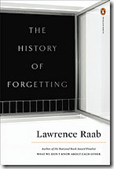
by Lawrence Raab, from The History of Forgetting

History of Forgetting Ralph Waldo Emerson, toward the end
of his life, found the names
of familiar objects escaping him.
He wanted to say something about a window,
or a table, or a book on a table.

But the word wasn't there,
although other words could still suggest
the shape of what he meant.
Then someone, his wife perhaps,

would understand: "Yes, window! I'm sorry,
is there a draft?" He'd nod.
She'd rise. Once a friend dropped by
to visit, shook out his umbrella
in the hall, remarked upon the rain.

Later the word umbrella
vanished and became
the thing that strangers take away.

Paper, pen, table, book:
was it possible for a man to think
without them? To know
that he was thinking? We remember
that we forget
, he'd written once,
before he started to forget.

Three times he was told
that Longfellow had died.

Without the past, the present
lay around him like the sea.
Or like a ship, becalmed,
upon the sea. He smiled

to think he was the captain then,
gazing off into whiteness,
waiting for the wind to rise.

[From The Writer’s Almanac with Garrison Keillor]

Tuesday, July 28, 2009

Our Ideas of Success

“We are highly open to suggestion. So what I want to argue for is not that we should give up on our ideas of success, but we should make sure that they are our own. We should focus in on our ideas and make sure that we own them, that we are truly the authors of our own ambitions. Because it’s bad enough not getting what you want, but it’s even worse to have an idea of what it is you want and find out at the end of the journey that it isn’t in fact what you wanted all along.”

Alain de Botton, from“A Kinder, Gentler Philosophy of Success,”  TED Talks, July 2009


[Thanks Kit!]

To Experience the Delight and Awe that Scientists Feel

From PowellsBooks.Blog (July 20, 2009):

why-does-e Why Does E=mc2? is in some ways a simple book with a simple aim: we (Jeff Forshaw and Brian Cox) wanted to see whether we could actually derive E=mc2 in a way that any interested non-mathematical reader could understand. By derive, I mean follow a series of small steps that are well-motivated and hopefully obvious, or at least plausible, and arrive at the equation itself, assuming no prior knowledge and making the minimum possible number of assumptions. In other words, we behave exactly as we would in our professional life as research scientists, searching for equations that describe nature.

In doing this, we hope to do much more than simply present and describe the equation, however. If the reader follows the argument, we hope that he or she will experience the delight and awe that scientists feel when they explore nature and reveal its underlying simplicity and beauty. One often hears scientists describe equations as "beautiful," and we believe the best way to understand what this means is to actually see how the most iconic and simple equation of all came to be written down. We don't in fact follow Einstein's route to E=mc2, because we believe that 100 years of teaching and understanding has provided a more profound and transparent route to it — we aren't writing a history book.

There is an element of polemic in the book. We very firmly believe that science, which is synonymous with rational thought as far as we are concerned, is the route to a better future. Woolly thinking and superstition are rife, and we should strive to reduce their place in public discourse. By showing how something as useful and, as far as we can tell, correct, as E=mc2 emerges from simple thought processes that we believe are open to every interested reader, we hope to make our case for an increased respect for and use of the scientific method in everyday life.

collider We also describe what E, m, and c actually are. Why is the speed of light special? What is energy, and what is mass? The question of mass leads us to the Large Hadron Collider at CERN, where we both work. One of the key goals of this machine is to answer this question definitively for the first time. It is remarkable that Einstein could be led to the equation that describes how mass and energy can be interchanged freely, without actually knowing what mass is. Such is the wonder of physics!


Fundamental Reality

From “Buddhism and Quantum Physics,” by Christian Thomas  Kohl, The Buddhist Channel (July 22, 2009):

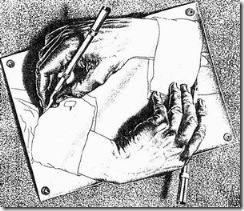
Drawing Hands, a 1948 lithograph by M. C. Escher

If you don’t believe in a creator, nor in the laws of nature, nor in a permanent object, nor in an absolute subject, nor in both, nor in any of it, in what do you believe then? What remains that you can consider a fundamental reality? The answer is simple; it is so simple that we barely consider it being a philosophical statement: things depend upon other things. For instance, a thing is dependent upon its cause. There is no effect without a cause and no cause without an effect. There is no fire without fuel, no action without an actor and vice versa. Things are dependent upon other things; they are not identical with each other, nor do they break up into objective and subjective parts.

This Buddhist concept of reality is often met with disapproval and considered incomprehensible. But there are modern modes of thought with points of contact. For instance, there is a discussion in quantum physics about fundamental reality. What is fundamental in quantum physics: particles, waves, field of force, law of nature, mindsets or information? Quantum physics came to a result that is expressed by the key words of complementarity, interaction and entanglement.

According to these concepts there are no independent quantum objects, just complementary ones; they are at the same time waves and particles. Quantum objects interact with others, and they are entangled even when they are separated at a far distance. Without being observed philosophically, quantum physics has created a physical concept of reality. According to that concept, the fundamental reality is an interaction of systems that interact with other systems and with their own components.

Gary Larson, March 23, 1984

"Ohhhhhhh...Look at that, Schuster...Dogs are so cute when they try to comprehend quantum mechanics."

Sunday, July 26, 2009

Sailing Home

From Authors@Google (October 10, 2008):

Sailing Home: Using the Wisdom of Homer's Odyssey to Navigate Life's Perils “In Sailing Home, renowned Zen teacher Norman Fischer deftly incorporates Buddhist, Judaic, Christian, and popular thought, as well as his own unique and sympathetic understanding of life, in his reinterpretation of Odysseus's familiar wanderings as lessons that everyone can use. We see how to resist the seduction of the Sirens' song to stop sailing and give up; how to bide our time in a situation and wait for the right opportunity; and how to reassess our story and rediscover our purpose and identity if, like the Lotus-Eaters, we have forgotten the past. With meditations that yield personal revelations, illuminating anecdotes from Fischer's and his students' lives, and stories from many wisdom traditions, Sailing Home shows the way to greater purpose in your own life.”

 
“So this is the mystery and the pain of our lives: every one of us is exactly where we need to be, but we don’t know it. We’re looking for somewhere else to be. The spiritual odyssey, life’s deepest and most significant undertaking, involves a great effort and inevitably it leads us on through many disasters and troubles in the checkered course of our living and growing. And where to we end up? Back where we started from. Back to ourselves. Only now maybe with more wisdom.” ~ Norman Fischer 

Reverse Engineering of Religion

"...religions are an important natural phenomenon. We should study them with the same intensity that we study all the other important natural phenomena...Today's religions are brilliantly designed. They're immensely powerful social institutions and many of their features can be traced back to earlier features that we can really make sense of by reverse engineering. And, as with the cow, there's a mixture of evolutionary design, designed by natural selection itself, and intelligent design -- more or less intelligent design -- redesigned by human beings who are trying to redesign their religions."

~ Dan Dennett, from TED Talks (February 2006)

Mr. Dennet't’s book Breaking the Spell: Religion as a Natural Phenomenon was reviewed by Leon Wieseltier in “The God Genome,” New York Times (February 19, 2006).

The Humor and Poetry and Drama

“I’m not scared that I don’t have a finished script, because I can very quickly find the humor and poetry and drama in situations. It’s there all the time in life.”

~ Roy Andersson, from “Calling It as He Sees It, in Great Detail,” by Dave Kehr, New York Times Sunday Magazine (July 26, 2009)

Saturday, July 25, 2009

Everything is Alive

Keeping Quiet
by Pablo Neruda, from Full Woman, Fleshly Apple, Hot Moon, translated by Stephen Mitchell

Now we will all count to twelve
and we will all keep still.

This one time upon the earth,
let’s not speak any language,
let’s stop for one second,
and not move our arms so much.

It would be a delicious moment,
without hurry, without locomotives,
all of us would be together
in a sudden uneasiness.

The fisherman in the cold sea
would do no harm to the whales
and the peasant gathering salt
would look at his torn hands.

Those who prepare green wars,
wars of gas, wars of fire,
victories without survivors,
would put on clean clothing
and would walk alongside their brothers
in the shade, without doing a thing.

What I want shouldn’t be confused
with final inactivity:
life alone is what matters,
I want nothing to do with death.

If we weren’t unanimous
about keeping our lives so much in motion,
if we could perhaps do nothing for once,
perhaps a great silence would interrupt this sadness,
this never understanding ourselves
and threatening ourselves with death,
perhaps the earth is teaching us
when everything seems to be dead
and everything is alive.

Now I will count to twelve
and you keep quiet and I’ll go.

As If It Were the Only One

Elias Canetti "There is no such thing as an ugly language. Today I hear every language as if it were the only one, and when I hear of one that is dying, it overwhelms me as though it were the death of the earth."

~ Elias Canetti

Friday, July 24, 2009

Maybe It’s Not Too Late to Grow Up

From Forever Young, and essay written and read by Kurt Anderson of Studio 360 (July 17, 2009):

"Waiting to get what you want is a definition of maturity. Demanding satisfaction right this instant is the definition of a seven year old. But instant satisfaction has been driving our economy and our culture for a while.

Send a message now! Get an answer now! Pick your airline seat now! Buy anything you want right now!

The web, cell phones, FedEx: they all indulge the impulsive child in every one of us.

Save? Why? For what?

Wait till I can afford it? No…Fooey!

Fuel efficient? Lame.

I don't mean to be a crank and I don't mean to condemn fun. I'm committed to rubber soles for life and I cherish The Simpsons. I'm even a convert to Twitter -- the official medium of back-of-the-class wisecracks.

Yes, the economic collapse had everything to do with credit policy and financial regulation. But I really, truly think that this forty-year-long celebration of our inner child helped lead us to the spree that we've just come off.

But with this crisis and now the rebuilding and reshaping of America we're required to do, we Boomers have maybe our last, best shot to suck it up and get serious and help straighten out the messes that we helped make. Maybe it's not too late to grow up a little.”

Equanimity Does Not Mean Fairness

justice “To practice equanimity is to understand that everything everybody ever does — I repeat, everything everybody ever does — is because at that moment, he or she feels that their action will improve their world. In other words he or she is just trying to be happy. The actions may be, and often are, tragically, catastrophically self-defeating, but that is the motivation at the moment of action. Equanimity, then, is a profound acceptance of each person's humanity. Fairness may be the result of equanimity, but it's not the practice of equanimity.”

~ Ken McLeod, from Rules for the Road

Try to Love the Questions

“Be patient towards all that is unsolved in your heart and try to love the questions themselves like locked rooms and like books that are written in a very foreign tongue. Do not now seek the answers, which cannot be given you because you would not be able to live them. And the point is, to live everything. Live the questions now. Perhaps you will then gradually, without noticing it, live along some distant day into the answer.”

~ Rainer Maria Rilke

Thursday, July 23, 2009

Benign Contagion

[Thanks Kimberly!]

Tuesday, July 21, 2009

A Little Out of Scale

Norman Fischer speaking with Vince Horn on Buddhist Geeks (Episode129 -- Buddhism May Need a Plan B):

BG ...twenty-five years ago nobody went to the gym. Now we've well established through research in our society that exercise is really important so there's a gym on every corner. Well, why isn't there a meditation hall on every corner? Haven’t we established the fact that some spiritual endeavor is just as important for inner health as exercise is for the body? So there ought to be meditation halls on every corner and people should know how important this is and feel like it makes sense to access it and pay for it so that there could be people to offer it.

I mean that there is tremendous spike in research on meditation. Just in last three or four years. It’s exponentially increased and all the research is always showing the same thing that meditation is actually a effective, that it really works, and that it has all kind of benefits. So people seem to believe in research and scientific data, but just talk to your friends who do this practice and that’s probably enough to convince you even without the scientific data.

...It's funny, you know? I'm gone do a retreat for the army for Norman Fischer      caregivers and chaplains. So the Army's going to spend fifty cents to pay me to do the retreat and then a million dollars to study the effects of the retreat over time. So...it’s very expensive to conduct research. Very expensive. A million dollar research grant is not an unusual grant. A million dollar gift to a dharma center or for a teacher training or something like that is very, very rare. So it’s a little out of scale.

[The conversation continues in Episode 130 -- Buddhism and the Evolution of Religion. Check out Norman Fischer’s article, “Why We Need a Plan B,” in the summer issue of Buddhadharma.]

Wishing Well

“The better part of happiness is to wish to be what you are.”

~ Desiderius Erasmus

Ce Soir


Ce Soir is Montreal-based band Monogrenade's first music video. Directed by Christophe Collette, the video is entirely made in stop-motion.

See also Vidéomusique

[Thanks again JC!]