Monday, June 30, 2008

America

"What splendor! What poverty! What humanity! What inhumanity! What mutual good will! What individual isolation! What loyalty to the ideal! What hypocrisy! What a triumph of conscience! What perversity!"

~ Czeslaw Milosz on American life, from Milosz's A B C's

Sunday, June 29, 2008

Classical Music with Shining Eyes

"Benjamin Zander has two infectious passions: classical music, and helping us all realize our untapped love for it -- and by extension, our untapped love for all new possibilities, new experiences, new connections."

From TED Talks

Friday, June 27, 2008

Uncertainty

From "Surprises on the Way," by John Tarrant (Shambhala Sun, May 2008):

John Tarrant The core of all navigation is probably uncertainty: tolerating not knowing makes it possible to find your way. Not knowing means embracing what is not known rather than fighting with yourself over it. Since the mind always strives to know, not knowing is disorienting in a useful way. Uncertainty and not knowing teach you not to believe the stories your mind feeds you day in and day out. If you allow your own course to be mysterious, then even the hard things can become easy. This is the beginning of awakening.

...the most heartbreaking thing is not heartbreak; it's avoiding heartbreak. Inside the transience of life is the thusness of everything, of the tree with forty crows on it in the winter, the sound of death-metal drums from the kids in the barn, and the feeling of sadness when you lose someone. A lot of suffering is resistance to the life of feeling. If you surrender, you are surrendering to what is really going on. This is just to notice that nothing beyond your life is more important than your life.

Obstacles can be the gate. If your diagnosis is cancer or you lose people you love, there is no alternative but surrender. You can't rewind to yesterday when you were innocent. Meditation at such a moment might not take you back to the surface; it might take you down and through. Getting more emotional might be indicated; falling apart might happen. The practice is what tows you through. It doesn't take the rough crossing away from you but it give you a degree of safety in the passage.

Once when I lost a friend, I realized that I was weeping since my hands were wet. I was giving a talk at the time, being wise and all that, and it was a revelation--I couldn't trust myself not to weep in public. I also couldn't trust myself to sleep at night, either. At a time like that we have to surrender. We are facing something vast and, really, we have always known that we would have to face it. It is an enormous, shaggy beast blocking the way. And there is something exhilarating about the inevitable when at last it arrives; awakening is not a choice or a matter of technique anymore, it's the only place left. The huge animal rolls over us, and suddenly we find that we are riding on its back. It has become a vehicle. The obstacles really have become gates.

Things Get Better

"I like playing with ideas that invite people to think. I also like old-fashioned, upbeat themes and happy endings. Although life doesn't always seem that way, I believe that in the long term things get better. I don't think we're about to overpopulate the planet, blow ourselves into oblivion, poison ourselves into extinction, degenerate into Nazis, or disappear under our own garbage. For ten thousand years the power of human reason and creativity has continued to build better tomorrows, and nothing says it has to change now."

~ James Patrick Hogan

Thursday, June 26, 2008

Creative Writing 101

Here are the basic rules of creative writing according to Kurt Vonnegut. It appears in the preface to his short story collection Bagombo Snuff Box.

  1. bagombo Use the time of a total stranger in such a way that he or she will not feel the time was wasted.
  2. Give the reader at least one character he or she can root for.
  3. Every character should want something, even if it is only a glass of water.
  4. Every sentence must do one of two things—reveal character or advance the action.
  5. Start as close to the end as possible.
  6. Be a sadist. No matter how sweet and innocent your leading characters, make awful things happen to them—in order that the reader may see what they are made of.
  7. Write to please just one person. If you open a window and make love to the world, so to speak, your story will get pneumonia.
  8. Give your readers as much information as possible as soon as possible. To heck with suspense. Readers should have such complete understanding of what is going on, where and why, that they could finish the story themselves, should cockroaches eat the last few pages.

Vonnegut also noted,"The greatest American short story writer of my generation was Flannery O’Connor (1925-1964). She broke practically every one of my rules but the first. Great writers tend to do that."

Inner Truths

Charles Baxter "Writers may be practiced liars on the page, but they usually have a great respect for inner truths. There are, of course, exceptions, many of them famous. But writers tend to respect the truth of things and the otherness of other people, which makes them very poor liars. Very few writers are successful sociopaths. This is not the case with literary critics, who are often very good at lying."

~ Charles Baxter

[Thanks Linda!]

Wednesday, June 25, 2008

Boogie Man

Boogie Man: The Lee Atwater Story

"My illness helped me to see that what was missing in society is what was missing in me: a little heart, a lot of brotherhood. The '80s were about acquiring -- acquiring wealth, power, prestige. I know. I acquired more wealth, power, and prestige than most. But you can acquire all you want and still feel empty. What power wouldn't I trade for a little more time with my family? What price wouldn't I pay for an evening with friends? It took a deadly illness to put me eye to eye with that truth, but it is a truth that the country, caught up in its ruthless ambitions and moral decay, can learn on my dime. I don't know who will lead us through the '90s, but they must be made to speak to this spiritual vacuum at the heart of American society, this tumor of the soul."

~ Lee Atwater, from a February 1991 article for Life Magazine.

Sunday, June 22, 2008

Paying Attention

From "The Myth of Multitasking," Christine Rosen, The New Atlantis (Spring 2008):

When we talk about multitasking, we are really talking about attention: the art of paying attention, the ability to shift our attention, and, more broadly, to exercise judgment about what objects are worthy of our attention. People who have achieved great things often credit for their success a finely honed skill for paying attention. When asked about his particular genius, Isaac Newton responded that if he had made any discoveries, it was “owing more to patient attention than to any other talent.”

The Principles of Pscyhology William James, the great psychologist, wrote at length about the varieties of human attention. In The Principles of Psychology (1890), he outlined the differences among “sensorial attention,” “intellectual attention,” “passive attention,” and the like, and noted the “gray chaotic indiscriminateness” of the minds of people who were incapable of paying attention. James compared our stream of thought to a river, and his observations presaged the cognitive “bottlenecks” described later by neurologists: “On the whole easy simple flowing predominates in it, the drift of things is with the pull of gravity, and effortless attention is the rule,” he wrote. “But at intervals an obstruction, a set-back, a log-jam occurs, stops the current, creates an eddy, and makes things temporarily move the other way.”

To James, steady attention was thus the default condition of a mature mind, an ordinary state undone only by perturbation. To readers a century later, that placid portrayal may seem alien—as though depicting a bygone world. Instead, today’s multitasking adult may find something more familiar in James’s description of the youthful mind: an “extreme mobility of the attention” that “makes the child seem to belong less to himself than to every object which happens to catch his notice.” For some people, James noted, this challenge is never overcome; such people only get their work done “in the interstices of their mind-wandering.” Like Chesterfield, James believed that the transition from youthful distraction to mature attention was in large part the result of personal mastery and discipline—and so was illustrative of character. “The faculty of voluntarily bringing back a wandering attention, over and over again,” he wrote, “is the very root of judgment, character, and will.”

[Thanks New York Times!]

Drudgery

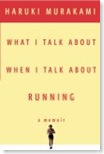
What I Talk About When I Talk About Running: A memoir "Writers who are blessed with inborn talent can write easily, no matter what they do—or don't do. Like water from a natural spring, the sentences just well up, and will little or no effort these writers can complete a work. Unfortunately, I don't fall into that category. I have to pound away at a rock with a chisel and dig out a deep hole before I can locate the source of my creativity. Every time I begin a new novel, I have to drudge out another hole. But, as I've sustained this kind of life over many years, I've become quite efficient, both technically and physically, at opening those holes in the rock and locating new water veins. As soon as I notice one source drying up, I move on to another. If people who rely on a natural spring of talent suddenly find they've exhausted their source, they're in trouble.

"In other words, let's face it: life is basically unfair. But, even in a situation that's unfair, I think it's possible to seek out a kind of fairness."

~ Haruki Murakami, from "The Running Novelist," The New Yorker (June 9, 2008). His memoir, What I Talk About When I Talk About Running, will be released in July.

Some Core Truth

"What I'd finally say about truth and autobiography is that all writers are probably trying to get at some core truth of life, at some configuration that is enduring and truthful. I just haven't found the truth to be my vehicle."

~ Mona Simpson

Friday, June 20, 2008

O + (N xS) + Cpm/T + He

Psychologist Cliff Arnall arrived at this formula for predicting happiness in an effort to "get people talking about what makes them happy."

O = Being Outdoors
N =  Connecting with Nature
S = Social interaction
Cpm = Childhood positive memories
T = Temperature
He = Holiday expected (vacations in America)

According to his calculations, June 20 is the happiest day of 2008. He notes that "the feeling of optimism caused by the combination of lighter evenings, the prospect of holidays and memories of childhood summers" tend to be highest each year around the summer solstice.

This is only a measure of external factors, however. To approximate how much subjective satisfaction one is able to derive from ideal conditions, consider this formula from Shinzen Young:

Satisfaction = Pleasure ÷ Grasping

He observes that a person’s subjective sense of satisfaction is inversely proportional to the degree to which the pleasure is subject to grasping. Conversely, a person’s subjective sense of satisfaction is directly proportional to the intensity of pleasure present and the degree to which one can monitor that pleasure with specificity.

In other words:

  • When grasping goes up, satisfaction tends to decrease.
  • When mindfulness goes up, satisfaction tends to increase.

Thursday, June 19, 2008

The Great Defeat

Excerpt from a Zoetrope: All-Story (Summer 2008) essay by John Hughes about the beginning of his satirical writing and Hollywood career:

For a vacation-themed issue, I proposed a piece set in the days when toddlers stood on the front seats of cars and parents' cigarettes blew into the faces of the children standing in the back (or hanging out the open rear windows of station wagons). I had no story but enough anecdotes to get the assignment.

In my bedroom office during the snowstorm, I wrote "Vacation '58." My outline was a Rand McNally Road Atlas I had dug out of the trunk of my car. I plotted the shortest route from Detroit to the most distant continental U.S. destination: Disneyland in Anaheim, California. I determined how many stops a family would have to make on such a trip, and where those stops might be.

I wrote the first sentence -- "If Dad hadn't shot Walt Disney in the leg, it would have been our best vacation ever!" -- and the rest was automatic. I used the voice of a boy to cover my lack of skill, and to flatten the big moments. In Rusty's prosaic language, a ruined vacation and an assault with a deadly weapon upon an entertainment legend enjoyed comparable importance. I called to mind a clamor of relatives, situations, catchphrases, and behaviors. I was mindful of my feelings as a child witnessing phony pop inventions go to hell. I understood that the dark side of my middle-class, middle American, suburban life was not drugs, paganism, or perversion. It was disappointment. There were no gnawing insects beneath the grass. Only dirt. I also knew that trapped inside every defeat is a small victory, and inside that small victory is the Great Defeat. This knowledge -- along with a cranky old lady; strange, needy relatives; a vile dog; and everything that could possibly go wrong on a highway --was enough to make a story, plug a hole in the magazine, and get on to the next issue.

...Despite my finishing the story in time for the FedEx pick-up, it was ultimately bumped from the vacation issue to an annual edition comprised of pieces that didn't make their intended issues.

Wednesday, June 18, 2008

Without Further Complications

Mindfulness itself does not condemn or condone any particular emotional reaction. Rather, it is the practice of honestly being aware of what happens to us and how we react to it. The more aware and familiar we are with our reactions, the easier it will be to have, for example, uncomplicated grief or straightforward joy, not mixed up guilt, anger, remorse, embarrassment, or judgement. Emotional maturity comes, not from the absence of emotions, but from seeing them clearly. Mindfulness helps us to be as we are without further complications. If we can be accepting of ourselves in this way, then it is much easier to know how to respond appropriately with choice rather than habit.”

~ Gil Fronsdal

[Thanks Kit!]

Beauty and Truth in Physics

"Wielding laypeople's terms and a sense of humor, Nobel Prize winner Murray Gell-Mann drops some knowledge about particle physics, asking questions like, Are elegant equations more likely to be right than inelegant ones? Can the fundamental law, the so-called 'theory of everything' really explain everything? His answers will surprise you."


After speaking at TED2007 on elegance in physics, the amazing Murray Gell-Mann gives a quick overview of another passionate interest: finding the common ancestry of our modern languages.

Experience by Proxy

From Richard Serra 's commencement address to this year's graduates of Williams College:

I have no problem with the virtual reality on your screens as long as you are aware that it is virtual. My concern is that experience by proxy is a poor substitute for the reality of the interactive space we inhabit.

As a sculptor I believe that perception structures thought and that to see is to think and conversely to think is to see.

The virtual reality of the media, be it television or Internet, limits our perception in that it affects our sense of space. It immobilizes our ability to apprehend actual physical space. Don’t let the rhetoric of simulation steal away the immediacy of your experience.

Keep it real, keep it in the moment. No one perceives anything alike; we only perceive as we are and it is our individual reality that counts.

Richard Serra's Torqued Ellipse IV (1998) and Intersection II (1992) being installed in the Abby Aldrich Rockefeller Sculpture Garden at The Museum of Modern Art in preparation for Richard Serra Sculpture: Forty Years (June 3 - September 10, 2007).

Monday, June 16, 2008

The Ego's Fear of Humiliation

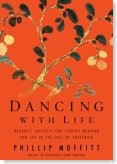
From Dancing with Life by Phillip Moffitt:

dancingwithlife When you collapse into suffering, it is because your ego sees suffering as a personal failure and feels humiliated. This sense of failure is based on the ego's mistaken idea that winning in life means no suffering. Your ego may well be under the delusion that the opposite of suffering is happiness. When your ego believes this, then every moment of suffering is felt as a personal defeat, insult, indignity, or proof of your inadequacy or of life being unfair. This is subjective suffering, self-centered and neurotic.

Your subjective dukkha is your ego suffering from its own ideas about how things are supposed to be. When things go wrong, your ego may feel humiliated even though you may not consciously realize it. Such suffering is your ego's narcissistic and mistaken, self-centered reaction to life's challenges. The ego collapses, becomes depressed, or grieves for itself. Or it becomes resentful and refuses to participate, or helpless and frozen with dread. Or the ego contracts into anger and lashes out. In its delusion the ego is unwilling to voluntarily carry the darkness of life. When suffering is penetrated by mindfulness and compassion, the ego dies a thousand deaths and yet ends up healthier for it. Your ego isn't bad, nor are you a bad person because you have an ego. The ego is a result of causes and conditions and, in my view, is necessary for a healthy, whole life. I tell students don't leave home without it, but don't let it drive the vehicle on your spiritual journey.

The idea of being willing to bear your suffering like a carriage carrying a heavy load is a hopeful, comforting image. But if the opposite of your suffering isn't happiness, then what is it? Nonsuffering is having a relaxed, composed mind that is fully present with whatever is occurring in the moment. And it is the capacity to be in relationship to whatever is arising such that you're able to respond from your deepest intentions. And it is a feeling of relatedness in your life that is free from aversion to suffering.

Be Present

From Jessica Lange's commencement address to the graduates of Sarah Lawrence College:

jessica_lange Be present. I would encourage you with all my heart — just to be present. Be present and open to the moment that is unfolding before you. Because, ultimately, your life is made up of moments. So don’t miss them by being lost in the past or anticipating the future.

Don’t be absent from your own life. You will find that life is not governed by will or intention. It is ultimately the collection of these sense memories stored in our nerves, built up in our cells. Simple things: A certain slant of light coming through a window on a winter’s afternoon. The sound of spring peepers at twilight. The taste of a strawberry still warm from the sun. Your child’s laughter. Your mother’s voice.

These are the things that shape our lives and settle into the fiber of our beings. Don’t take them for granted.

Friday, June 13, 2008

Becoming

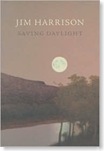
Saving Daylight by Jim Harrison Nowhere is it the same place as yesterday.
None of us is the same person as yesterday.
We finally die from the exhaustion of becoming.
This downward cellular jubilance is shared
by the wind, bugs, birds, bears and rivers,
and perhaps the black holes in galactic space
where our souls will all be gathered in an invisible
thimble of antimatter. But we're getting ahead of ourselves.
Yes, trees wear out as the wattles under my chin
grow, the wrinkled hands that tried to strangle
a wife beater in New York City in 1957.
We whirl with the earth, our soft brains ill-trained
except to watch ourselves disappear into the distance.
Still, we love to make music of this puzzle.

~ by Jim Harrison, from Saving Daylight.

Thursday, June 12, 2008

A Mystery to Solve

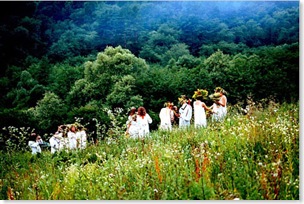
"I think there is a kind of slippery slope where once you've stopped believing that the mainstream discourse, whether that be that of science or whatever else, you've stopped going along with that discourse, then you become open to everything else. And if you're not careful and if you're not judicious, then you'll just kind of start believing that all those other things must therefore be true. So there's that tendency, which you find with social movements that are on the fringes. Young women from Poland celebrate the night of Kupala (Photo: Marek Kosior) And I've been fascinated by all of it because I think that even the extraterrestrial thing, how many millions of people claim to have been abducted by aliens in American society?...What do you do with that fact? Do you just say that they're all deluded or do you start getting interested in why it is that, you know, there's some kind of gap that people are filling with using that imagery of aliens. Why aliens? Well, because there aren't any fairies left so they got to come from off planet. Why are there no fairies left? Because we know...what happens in the natural world...So it becomes a kind of mystery to solve. And rather than rejecting the things that people say, I think, as an ethnographer of religion, one of the first principles is that you don't treat people as idiots for what they believe and that, in fact, by treating them seriously, you might get some insights that you wouldn't get to otherwise. And I think, for me, it's led to insights about myself as well."

~ Adrian Ivakhiv, "Pagans Ancient and Modern," Speaking of Faith, (6.12.08)

Awake at Night

New Yorker

"When I can't sleep, I find that it sometimes helps
to get up and jot down my anxieties."