Friday, October 24, 2008

You Will Never Know

Excerpt from "Never Say Die: Why We Can't Imagine Death," by Jesse Bering, Scientific American Mind (October 2008):

The brain is like any other organ: a part of our physical body. And the mind is what the brain does—it’s more a verb than it is a noun. Why do we wonder where our mind goes when the body is dead? Shouldn’t it be obvious that the mind is dead, too?

And yet people in every culture believe in an afterlife of some kind or, at the very least, are unsure about what happens to the mind at death. My psychological research has led me to believe that these irrational beliefs, rather than resulting from religion or serving to protect us from the terror of inexistence, are an inevitable by-product of self-consciousness. Because we have never experienced a lack of consciousness, we cannot imagine what it will feel like to be dead. In fact, it won’t feel like anything—and therein lies the problem.

...our ancestors suffered the unshakable illusion that their minds were immortal, and it’s this hiccup of gross irrationality that we have unmistakably inherited from them. Individual human beings, by virtue of their evolved cognitive architecture, had trouble conceptualizing their own psychological inexistence from the start.

iceberg Consider the rather startling fact that you will never know you have died. You may feel yourself slipping away, but it isn’t as though there will be a “you” around who is capable of ascertaining that, once all is said and done, it has actually happened. Just to remind you, you need a working cerebral cortex to harbor propositional knowledge of any sort, including the fact that you’ve died—and once you’ve died your brain is about as phenomenally generative as a head of lettuce.

Check out Jesse Bering's Psychology Today blog, Quirky Little Things.

Wednesday, October 22, 2008

Benediction

While your name continues to be scribbled
onto lists along with addicts,
embezzlers, unfaithful spouses,
and others in need of divine intervention,
by well-meaning people
who refuse to rest until
arrangements have been made
to spend eternity together
in spite of having little to talk about over dinner,
you might be surprised when
a cranky, hard drinking, gnarled,
retired iron worker pushing ninety,
takes your hand and the hand
of the son of his son,
the person who shares your groceries
your gender,
your heart,
and wishes you not only a safe trip home,
but a good life together.

Tuesday, October 21, 2008

Art/Work

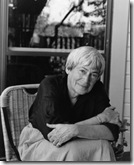
Photo by Marian Wood Kolisch "I am going to be rather hard-nosed and say that if you have to find devices to coax yourself to stay focused on writing, perhaps you should not be writing what you're writing. And if this lack of motivation is a constant problem, perhaps writing is not your forte. I mean, what is the problem? If writing bores you, that is pretty fatal. If that is not the case, but you find that it is hard going and it just doesn't flow, well, what did you expect? It is work; art is work."

~ Ursula LeGuin

Friday, October 17, 2008

Poetry

"I love poetry for the unemployment it causes, for how it constrains one to work always beyond one's own intelligence, for its not requiring one to rise socially."

~ Les Murray

Thursday, October 16, 2008

No Intention

“The subject is very serious. It’s ever-present and I think it’s obviously everybody’s life and everybody’s experience: Everybody deals with the continuum of getting older and death and the regret that comes with more and more life passing by…It’s a person’s life, and it takes it to the end, and all that comes with that. It doesn’t have a happy ending, but I don’t know if it has a sad ending, either. It’s a curious ending, and there are things to think about, and there are things that happen toward the end of the movie that are odd and, I think, raise questions. Questions about what it means to be an individual, or what it means to be old or what it means to lose yourself or find a connection or all those things that are part of a person’s life. You don’t necessarily have to come out of it feeling devastated. It wasn’t my intention. I really had no intention at all.”

~ Charlie Kaufman, talking about his new film, Synecdoche, New York, in Paste Magazine (Nov. 2008)

Outhuman the Humans

"Autists are described by others — and by themselves — as aliens among humans. But there's an irony to this, for precisely the opposite is true. They are us, and to understand them is to begin to understand what it means to be human. Think of it: a disability is usually defined in terms of what is missing. But autism is as much about what is abundant as what is missing, an overexpression of the very traits that make our species unique. Other animals are social, but only humans are capable of abstract logic. The autistic outhuman the humans, and we can scarcely recognize the result."

~ Paul Collins, from Not Even Wrong: Adventures in Autism

Willing to be Lost

Excerpt from Ron Carlson Writes a Story:

Ron Carlson Writes a Story

The single largest advantage a veteran writer has over the beginner is this tolerance for not knowing. It’s not style, skill, or any other dexterity. An experienced writer has been in those woods before and is willing to be lost; she knows that being lost is necessary for the discoveries to come. The seasoned writer waits, is patient, listens to her story as it talks to her. Now I’ve started being a little mystical here, and I want to avoid the sense that writing is magic and not work. The story isn’t going to talk to you, but things are going to happen in the heat of writing that cannot be predicted from outside the act itself. Much of a writer’s work is exploration, and that involves so many things he cannot know from the outside. And we all agree that it is more comfortable to be outside the story considering it, than inside the story struggling to see it. Comfort isn’t an issue.

Daughter

A daughter is not a passing cloud, but permanent,
holding earth and sky together with her shadow.
She sleeps upstairs like mystery in a story,
blowing leaves down the stairs, then cold air, then warm.
We who at sixty should know everything, know nothing.
We become dull and disoriented by uncertain weather.
We kneel, palms together, before this blossoming altar.

~ James Lenfestey, from American Life in Poetry: Column 186

Wednesday, October 15, 2008

A Good Thing No Matter How Small

“When something bad happens, we have to do a good thing no matter how small otherwise the bad things pile up and up.”

~ Claire (Laura Linney) from the film Jindabyne, an adaption of Raymond Carver’s short story, “So Much Water So Close to Home.”

Tuesday, October 14, 2008

Meditation and Stress

From “Compassion Meditation May Improve Physical and Emotional Responses to Psychological Stress,” Woodruff Health Sciences Center, Emory University (10.08.08):

Data from a new study suggests that individuals who engage in compassion meditation may benefit by reductions in inflammatory and behavioral responses to stress that have been linked to depression and a number of medical illnesses.

"While much attention has been paid to meditation practices that emphasize calming the mind, improving focused attention or developing mindfulness, less is known about meditation practices designed to specifically foster compassion," says Geshe Lobsang Tenzin Negi, PhD, who designed and taught the meditation program used in the study. Negi is senior lecturer in the Department of Religion, the co-director of Emory Collaborative for Contemplative Studies and president and spiritual director of Drepung Loseling Monastery, Inc.

This study focused on the effect of compassion meditation on inflammatory, neuroendocrine and behavioral responses to psychosocial stress, and evaluated the degree to which engagement in meditation practice influenced stress reactivity.

"Our findings suggest that meditation practices designed to foster compassion may impact physiological pathways that are modulated by stress and are relevant to disease," explains Charles L. Raison, MD, clinical director of the Mind-Body Program, Emory University's Department of Psychiatry and Behavioral Sciences, Emory School of Medicine, and a lead author on the study.

Monday, October 13, 2008

Katie Reider

I was moved last night by the story of a young folk singer from the area who died this summer after a two-year battle with cancer. Katie’s family set up a memorial project to spread the word about her life and music. Their goal is to introduce 500,000 people to her music over the next year

Saturday, October 11, 2008

The Audience is Always Right

Director William Friedkin discussing what makes films successful (from the special features included on the Bug DVD):

William Friedkin “The week after Sorcerer came out, Star Wars opened and completely changed the kind of films that audiences wanted to see – by the multimillions. Sorcerer was almost a dividing point between the past and the future. That’s one reason why it didn’t do better. But always, when a film does well or badly, it’s always the fault of the film and the audience is always right. Which is not to say anything about the quality of the film, but about what the audience wants or doesn’t want. They know what they want.

The directors or filmmakers or producers who have been successful over and over again are those that have an inherent feeling of the zeitgeist. I at one time had that so I know what it is. Around the time I made The French Connection and The Exorcist, that was the zeitgeist and I just rode along with it. Those were the films that I wanted to see. I felt if somebody could make a film like that, I would see it. And that’s how the audience felt. And I know what the zeitgeist is now, but I’m not interested in any way in pursuing it.”

Real Life

Kristin Scott Thomas "Everything should be as in real life."

~ Anton Chekhov to the cast of the first production of The Seagull, St. Petersburg, 1896

Friday, October 10, 2008

Use the Internet to Get Off the Internet


Unplug Your Friends!
From Meetup

Wednesday, October 08, 2008

Adding It Up

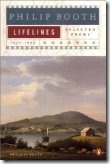
by Phillip Booth, from Lifelines: Selected Poems, 1950-1999

lifelines My mind's eye opens before
the light gets up. I
lie awake in the small dark,
figuring payments, or how
to scrape paint; I count
rich women I didn't marry.
I measure bicycle miles
I pedaled last Thursday
to take off weight; I give some
passing thought to the point
that if I hadn't turned poet
I might well be some other
sort of accountant. Before
the sun reports its own weather
my mind is openly at it:
I chart my annual rainfall.
or how I'll plant seed if
I live to be fifty. I look up
words like "bilateral symmetry"
in my mind's dictionary; I consider
the bivalve mollusk, re-pick
last summer's mussels on Condon Point,
preview the next red tide, and
hold my breath: I listen hard
to how my heart valves are doing.
I try not to get going
too early: bladder permitting,
I mean to stay in bed until six;
I think in spirals, building
horizon pyramids, yielding to
no man's flag but my own.
I think of Saul Steinberg:
I play touch football on one leg,
I seesaw on the old cliff, trying
to balance things out: job,
wife, children, myself.
My mind's eye opens before
my body is ready for its
first duty: cleaning up after
an old-maid Basset in heat.
That, too, I inventory:
the Puritan strain will out,
even at six a.m.; sun or no sun,
I'm Puritan to the bone, down to
the marrow and then some:
if I'm not sorry I worry,
if I can't worry I count.

The Places We Have Known

Swann's Way “What a contradiction it is to search in reality for memory’s pictures, which would never have the charm that comes to them from memory itself and from not being perceived by the senses. The reality I had no longer existed. That Mme. Swann did not arrive exactly the same at the same moment was enough to make the Avenue different. The places we have known do not belong solely to the world of space in which we situate them for our greater convenience. They were only a thin slice among contiguous impressions which formed our life at that time; the memory of a certain image is but regret for a certain moment; and houses, roads, avenues are as fleeting, alas, as the years.”

~ Marcel Proust, Swann’s Way

Monday, October 06, 2008

Intrinsically Comic

Alphabet Juice"Language seems to me intrinsically comic — noises of the tongue, lips, larynx, and palate rendered in ink on paper with the deepest and airiest thoughts in mind and the harshest and tenderest feelings at heart."

~ Roy Blount Jr.

Sunday, October 05, 2008

Chosen

From "Emotional Buildup," by Jake Halpern, New York Times Real Estate Magazine (10.05.08):

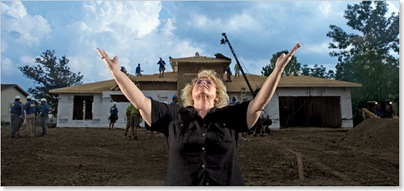
In theory, the Akerses didn’t know we were coming. They were told only that they were one of five families from the Cincinnati area who had been chosen as finalists. This, in itself, was a coup. Endemol USA, the production company that makes the show, receives as many as 1,000 applications a week either from or about families who have suffered a tragedy or hardship and are seeking a new home.

Bobby Fletcher photographed by Andreanna Seymore for The New York Times.

...The only spectators allowed on this day were neighbors, a handful of local volunteers and the Akerses’ extended family. I chatted with Judy ‘‘Bobby’’ Fletcher, the 65-year-old grandmother of the Akers children. She told me she had been here since before dawn, on her knees in a neighbor’s driveway, repeating a simple prayer: ‘‘Please allow ABC to be led to this family.’’ For more than two years, the congregants at Fletcher’s church had maintained a ‘‘prayer chain’’ in which they took turns praying — 24 hours a day, 365 days a year — for the executives at ABC to select the Akerses. Several local churches had similar prayer appeals.

Eventually the bus carrying Pennington rounded the corner. The crowd let out a collective gasp, several volunteers began to sob and virtually everyone took out a camera-equipped cellphone to document the moment. I glanced over at Fletcher, who was standing next to me, looking faint. ‘‘I saw the bus, heard the screams, and I went into an out-of-body experience,’’ she later told me. ‘‘I was watching it, but I wasn’t a part of it.’’

A Visceral Need for Order

From Talk of the Nation and All Things Considered (10.03.08):

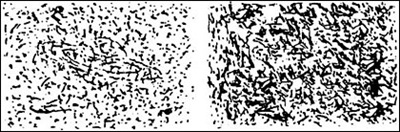
New research shows that when people perceive they have no control over a given situation, they are more likely to see illusions, patterns where none exist and even believe in conspiracy theories. The study suggests that people impose imaginary order when no real order can be perceived.

"People see false patterns in all types of data," says Jennifer Whitson, one of the authors of the report, "This suggests that lacking control leads to a visceral need for order — even imaginary order."

Whitson is an assistant professor of management at the McCombs School of Business in the University of Texas-Austin.

Jennifer Whitson and Adam Galinsky

In short, people who felt that the world was beyond their control became so hungry for patterns and connections that their minds started just making them up.

But Whitson also found one way to help people who are feeling powerless to see the world the way it really is. In a different experiment, she asked volunteers who were feeling a lack of control to talk about a personal value that they consider important.

When these people were shown fuzzy, meaningless images, they did not see imaginary objects.

Maybe this could help in real life, Whitson says. When you're feeling powerless, maybe you should stop and think about what you really care about — something you do have control over.

Nothing Less Than the World Itself

Below is an excerpt from a beautiful essay, "The Ambition of the Short Story," written by Steven Millhauser whose recent collection of short stories, Dangerous Laughter, was reviewed back in February:

In a world ruled by swaggering novels, smallness has learned to make its way cautiously. We will have to intuit its secret. I imagine the short story harboring a wish. I imagine the short story saying to the novel: You can have everything — everything — all I ask is a single grain of sand. The novel, with a careless shrug, a shrug both cheerful and contemptuous, grants the wish.

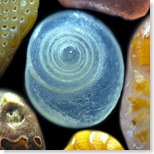
But that grain of sand is the story’s way out. That grain of sand is the story’s salvation. I take my cue from William Blake: “All the world in a grain of sand.” From A Grain of Sand: Nature's Secret Wonder by Gary Greenberg.Think of it: the world in a grain of sand; which is to say, every part of the world, however small, contains the world entirely. Or to put it another way: if you concentrate your attention on some apparently insignificant portion of the world, you will find, deep within it, nothing less than the world itself. In that single grain of sand lies the beach that contains the grain of sand. In that single grain of sand lies the ocean that dashes against the beach, the ship that sails the ocean, the sun that shines down on the ship, the interstellar winds, a teaspoon in Kansas, the structure of the universe. And there you have the ambition of the short story, the terrible ambition that lies behind its fraudulent modesty: to body forth the whole world. The short story believes in transformation. It believes in hidden powers.

Friday, October 03, 2008

The Body Electric

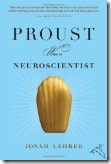
From Proust Was a Neuroscientist by Jonah Lehrer:

Modern neuroscience is now discovering the anatomy underlying Whitman's poetry. It has taken his poetic hypothesis--the idea that feelings begin in the flesh--and found the exact nerves and brain regions that make it true. Antonio Damasio, a neuroscientist who has done extensive work on the etiology of feeling, calls this process the body loop. In his view, the mind stalks the flesh; from our muscles we steal our moods.

How does the brain generate our metaphysical feelings from the physical body? According to Damasio, after an "emotive stimulus" (such as a bear) is seen, the brain automatically triggers a wave of changes in the "physical viscera," as the body prepares for action. The heart begins to pound, arteries dilate, the intestines contract, the adrenaline pours into the bloodstream. These bodily changes are then detected by the cortex, which connects them to the scary sensation that caused the changes in the first place. The resulting mental image—an emulsion of thought and flesh, body and soul—is what we feel. It is an idea that has passed through the vessel of the body.

Over the course of his distinguished career, Damasio has chronicled the lives of patients whose brains have been injured and who, as a result, are missing this intricate body-brain connection. Although they maintain full sensory awareness, these patients are unable to translate their sensations into emotions. The pounding of the heart never becomes a feeling of fear. Because the mind is divorced from the flesh, the patient lives in a cocoon of numbness—numb even to his or her own tragedy.

Damasio's research has elaborated on the necessity of our carnal emotions. His conclusions are Whitmanesque. "The body contributes more than life support," Damasio writes. "It contributes a content that is part and parcel of the workings of the normal mind." In fact, even when the body does not literally change, the mind creates a feeling by hallucinating a bodily change. Damasio calls this the as-if body loop, since the brain acts as if the body were experiencing a real physical event. By imagining a specfic bodily state—like a fast heartbeat, or a surge of adrenaline—the mind can indue its own emotions.

One of Damasio's most surprising discoveries is that the feelings generated by the body are an essential element of rational thought. Although we typically assume that our emotions interfere with reason, Damasio's emotionless patients proved incapable of making reasonable decisions. After suffering their brain injuries, all began displaying disturbing changes in behavior. Some made terrible investments and ended up bankrupt; others became dishonest and antisocial; most just spent hours deliberating over irrelevant details. According to Damasio, their frustrating lives are vivid proof that rationality requires feeling, and feeling requires the body. (As Nietzsche put it, "There is more reason in your body than in your best wisdom.")

Life's Redemption

Wallace Stevens"After one has abandoned a belief in God, poetry is that essence which takes its place as life's redemption."

~ Wallace Stevens

Tuesday, September 30, 2008

The Messed Up Thing About Art

Ear Drum "When I'm critical of the art form, I do it within the art form. I make the songs that can be the examples for how we can do it. I try not to be too critical of artists expressing themselves, but I try to express myself to show the balance, so there's a different way you can do it...It's not the artist's job to be politically correct or morally upstanding, it's the artist's job to be honest with how they express they self. At some times, an artist being less moral makes them a better artist and that's the messed up thing about art, that sometimes you can have real jerks create great art and you just gotta deal with it."

~ Rapper Talib Kweli speaking with Kurt Andersen on Studio 360 (9.5.08 originally recorded 8.17.07)

Monday, September 29, 2008

Noticing

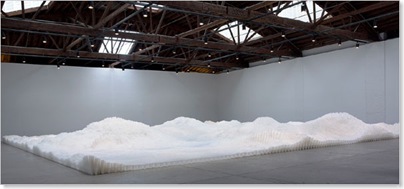
Untitled (Plastic Cups) 2000 by Tara Donovan. Photo by Kerry Ryan McFate/Courtesy PaceWildenstein, New York

“So much about the art-making process is about paying attention. It’s about looking and noticing things.”

~ Tara Donovan, from "The Genius of Little Things," New York Times (9.23.08)

Saturday, September 27, 2008

Cross Your Fingers

Laura Marling
Alas I Cannot Swim

[See also: music video Cross Your Fingers / Crawled Out of the Sea]

Creating a Scene

Excerpt from The Art of Subtext: Beyond Plot by Charles Baxter:

subtext "The particular dark reflecting pool that literature presents to us quite possibly has no purpose at all, any more than great music does. The pointlessness of art is not an argument against it. It is simply a proposition that pragmatists worry over. Consequently, as a way to stave off pointlessness and the specter of a profitless activity, we—Americans particularly—tend to moralize and pragmatize the practice of literature. We sometimes try to avoid in our own writing and reading what me may find troubling in our lives. But what is good when encountered in life is often not good for literature, and the reverse: what's good for fiction is not always good when instrumentalized in life.

The distorting effect of wishes in the writing of fiction can hardly be overestimated. In fiction the force of a wish can result in the formal characteristics of fantasy writing. The story becomes the stage, not for truth, but self-actualization. We try to imagine the person as we would like ourselves to be and as a result write a banal and lifelessly idealistic story. Stories of this type commit a number of sins against literature, among them, first, the distortion of events in the service of a positive self-image, and, second, the habit of making people out to be better than they actually are.

In fiction we want to have characters create scenes that in real life we would typically avoid. Writers might want to have happy lives, but they fear the revenge of the genteel community if their writings are too lively. If they do, they give up their writerly badge of honor. Stories often require sparkplug characters--radically unpleasant types--as focusing agents. The refusal of a story to grant a wish, its refusal to be polite, genteel, or useful, offers manifold opportunities for the messy self-reproaches and grotesqueries characteristic of fiction."

Friday, September 26, 2008

Leading Extras

"There are millions of people in the world and none of those people is an extra.They're all leads in their own stories."


Tuesday, September 23, 2008

We Bring the Sentience

Here is an excerpt from a fascinating, two-part conversation with Nova Spivak, CEO and Founder of Twine.com, on the Buddhist Geeks podcast:

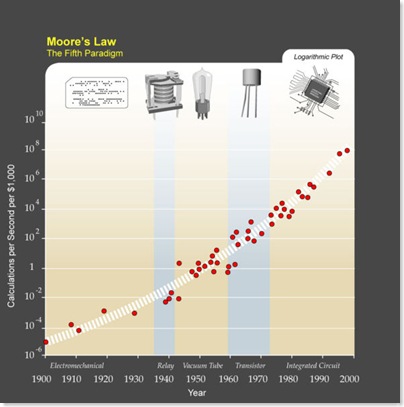
Researchers such as Ray Kurzweil, who's a big thinker, [and] Vernor Vinge, who's a science fiction author, have been talking about a concept called the singularity. Basically, if you plot the increase in computing power, you can see that it's increasing exponentially while the cost is decreasing exponentially.

MooresLaw

So by the year 2029, according to their projections, the computing power necessary to simulate a human brain will cost about one dollar. That's pretty amazing. Even if they're a little aggressive and it's 2040, that's amazing.

They're actually projecting that in 2040, artificial intelligence or computer intelligence will be a billion times more powerful than all human intelligence combined. So, we're entering a world which is going to be quite different from the world we're in.

The notion of the singularity is, when this happens, when we reach this point where essentially computing power becomes infinite or essentially infinite, or it's infinitely affordable, at least, we can't predict what's going to happen next. Now these guys, because they don't believe in anything beyond the scientific material worldview, their vision of what happens after the singularity is that machines become intelligent and sentient and they're the next step in evolution and they replace humans.

I think that's wrong. What's much more likely is a form of symbiosis, where humans and machines merge such that the machines really amplify us and we amplify the machines. We bring the sentience, the machines bring this vast computational capability, and essentially the web becomes and extension of our brain.

That doesn't help us become enlightened. That makes our delusion more functional.

What People Look Like

Director Courtney Hunt discussing her first feature film, Frozen River, with Elvis Mitchell on KCRW's The Treatment (8.6.08):

"I think it's easy to forget we're all a few steps away from that, but it's still out there that we have to rely on these very basic things like food, and shelter, and transportation--especially when you're out in the middle of nowhere. And you start taking those away and people get pretty desperate pretty fast."

"You know, I was never super poor. My mother and I were always just gettin' by, you know. But you do have that fear and that burdened feeling that [the main character's older son] has, that burdened look of the kid who's worried about more than he ought to be worried about...That was me. In a lot of ways, I know that kid well. That sort of worry that kids take on, especially with a mom out there and no dad."

"In this situation, the dad is not available. You take that away and women are on their own, they're standing up on their own and they're doing what they need to do. Although we do have little men, you know, the sons sort of routing for their mother and kind of mad at their mother and What happened to Dad? and Did you drive him away?

"So her loneliness is really important in the movie. But then we're with her right from the get-go. Right from the first shot, we're with her. And people have given me a hard time, like That's a punishing close-up! That's not a punishing close-up. That's what people look like when that stuff happens. Why's that bad to show?" 

A Complete Experience

Excerpt from a talk given by Shinzen Young on January 3, 2008:

To have a complete experience is to love something to death and to know it to death. Whether it’s your self or any sensory event, big or small.

When you love it to death and know it to death, you’re too busy experiencing it to make an object out of it, so in a sense it’s not there. But it’s not there because you’re so busy knowing it, so it’s more there.

It’s both more there and less there than normal human experience. Therefore it's a kind of todo and a kind of nada, a kind of completeness and a kind of nothingness at exactly the same time. Which sounds paradoxical, sort of ridiculous actually, logically speaking.

But I would have to say that most people, from my point of view, are half-alive and half-dead and they call that living. The spiritual path, or the path to enlightenment, is about being completely alive and completely dead at exactly the same time. And that’s what might be called real living, true living.

So knowing it to death is both rich and — at the same time — vacuous. And loving it to death, it’s through this absolute affirmation for it to be just as it is that its vacuity becomes experienced directly.

Forever to Reach


by Pictures & Sound

There's a long line in front of me
Stretching out into infinity
And behind me it's the same thing

It takes a lot of strength to not collapse
As endless moments endlessly pass
And to make the most of where you're at
And realize…

It took forever to reach and a moment to pass
Forever to reach and a moment to pass
It took forever to reach and a moment to pass
And now forever to vanish

We all travel at the speed of life
Hoping someday that we might arrive
But we're arriving all the time, all the time

The seasons turn and the rivers run
What we do now is what we will become
The young grow old and the old grow young
It's called life

It took forever to reach and a moment to pass
Forever to reach and a moment to pass
It took forever to reach and a moment to pass
And now forever to vanish

Close your eyes right now and count to ten
You're a different person than you were just then
We'll never get this chance again

It took forever to reach and a moment to pass
And now forever to vanish

It took forever to reach and a moment to pass
And now forever to vanish

Monday, September 22, 2008

The One Reality Science Cannot Reduce

From Proust Was a Neuroscientist by Jonah Lehrer:

Proust Was a Neuroscientist Every brilliant experiment, like every great work of art, starts with an act of imagination.

Unfortunately, our current culture subscribes to a very narrow definition of truth. If something can't be quantified or calculated, then it can't be true. Because this strict scientific approach has explained so much, we assume that it can explain everything. But every method, even the experimental method, has limits. Take the human mind. Scientists describe our brain in terms of its physical details; they say we are nothing but a loom of electrical cells and synaptic spaces. What science forgets is that this isn't how we experience the world. (We feel like the ghost, not like the machine.) It is ironic but true: the one reality science cannot reduce is the only reality we will ever know. This is why we need art. By expressing our actual experience, the artist reminds us that our science is incomplete, that no map of matter will ever explain the immateriality of our consciousness.

The moral of this book is that we are made of art and science. We are such stuff as dreams are made on, but we are also just stuff. We now know enough about the brain to realize that its mystery will always remain. Like a work of art, we exceed our materials. Science needs art to frame the mystery, but arts needs science so that not everything is a mystery. Neither truth alone is our solution, for our reality exists in plural.

Meditation: The Myths

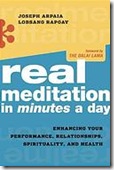
These myths from Real Meditation in Minutes a Day by Joseph Arpaia and Lobsang Rapgay are the same ones I'm on a mission to debunk in my mindfulness classes. Plain talk and practical application are what it's all about. This book is full of strategies you can put to use in your everyday life which contribute to getting more satisfaction out of the good stuff and feeling less overwhelmed by the challenging stuff.

Real Meditation in Minutes a Day Myth 1: Meditation is Eastern.

Meditation has been practiced by Christians for almost two thousand years, and Jews, Muslims, and those of other traditions have meditative practices as well. Even if many meditation techniques come from Eastern traditions, there is nothing to prevent others from adopting those techniques to develop their minds.

Myth 2: Meditation is for religious people.

You do not have to be religious to benefit from meditation, just as you do not have to be an athlete in order to benefit from physical exercise. Meditation is exercise for the mind. You can use it for spiritual development. You can also use it to improve your health, your effectiveness at work, and your relationship with others.

Myth 3: Meditation takes hours per day.

If you have hours to spend, then you can certainly spend them meditating. But you don’t need hours to benefit from meditating. In fact, even fifteen or twenty minutes per day will help you significantly.

Myth 4: Meditation is relaxation.

Meditation can help you learn to relax. However, sometimes you need to feel more energized. There are meditations that can help you speed up when you need to speed up, and meditations that can help you slow down when you need to slow down.

Myth 5: Meditation is stopping thoughts.

Meditation teaches you how to change your usual thoughts so you can think differently, and more effectively. Meditation also develops mental activities such as perceiving or imagining, which are different from thinking.

Myth 6: Meditation is blanking out the mind.

Meditation is training the mind. You meditate in order to develop your mind, not blank it out.

Myth 7: Meditation is used by cults.

Cults use the myth that meditation involves blanking out the mind to disguise brainwashing techniques as meditation. Since meditation strengthens the mind, and the mind’s ability to inquire and analyze, meditation is, in fact, a good antidote to cult techniques.

Myth 8: I need a guru or teacher to learn meditation.

A good teacher can and certainly will help. However, one of the most important teachers is your own experience. As you continue to practice, you’ll learn to evaluate the effects of the techniques and find those that work best for you.

Windows is Shutting Down

Windows is shutting down, and grammar are
On their last leg. So what am we to do?
A letter of complaint go just so far,
Proving the only one in step are you.

Better, perhaps, to simply let it goes.
A sentence have to be screwed pretty bad
Before they gets to where you doesnt knows
The meaning what it must of meant to had.

The meteor have hit. Extinction spread,
But evolution do not stop for that.
A mutant languages rise from the dead
And all them rules is suddenly old hat.

Too bad for we, us what has had so long
The best seat from the only game in town.
But there it am, and whom can say its wrong?
Those are the break. Windows is shutting down.

by Clive James

Sunday, September 21, 2008

Thinking Reeds

"Man is only a reed, the weakest in nature; but he is a thinking reed. There is no need for the whole universe to take up arms to crush him: a vapor, a drop of water is enough to kill him. But even if the universe were to crush him, man would still be nobler than his slayer, because he knows that he is dying and the advantage the universe has over him. The universe knows nothing of this."

~ Blaise Pascal (1623 - 1662)

"Man is a thinking reed but his great works are done when
he is not calculating and thinking. 'Childlikeness' has to be
restored with long years of training in the art of self-forgetfulness.
When this is attained, man thinks yet he does not think. He
thinks like the showers coming down from the sky; he thinks
like the waves rolling on the ocean; he thinks like the stars
illuminating the nightly heavens; he thinks like the green foliage
shooting forth in the relaxing spring breeze. Indeed, he is the
showers, the ocean, the stars, the foliage."

~ D.T. Suzuki (1870 - 1966)

Friday, September 19, 2008

Chronophage

"It is terrifying, it is meant to be...Basically I view time as not on your side. He'll eat up every minute of your life, and as soon as one has gone he's salivating for the next. It's not a bad thing to remind students of. I never felt like this until I woke up on my 70th birthday, and was stricken at the thought of how much I still wanted to do, and how little time remained."

~ John Taylor, inventor of The Corpus Clock

Thursday, September 18, 2008

We Make Reality Inaccessible

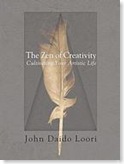
Excerpt from The Zen of Creativity: Cultivating your artistic life by John Daido Loori:

The Zen of Creativity"Whole body and mind seeing," as Master Dogen refers to it, is the total merging of subject and object, of seer and seen, of self and other. This is, essentially, the experience of enlightenment. In "seeing with the whole body and mind" one goes blind. In "hearing with the whole body and mind" one goes deaf. And there is no way to describe this state of consciousness.

...All creatures experience the universe through drops on webthe senses. And at every moment, a different universe is being created by each being. A spider, for example, feels the universe through its legs, which touch the key strands of its web. It knows when it's raining, or when food is available. It doesn't think to itself, "That's not a fly on the web. That's rain." Yet it knows. The spider doesn't deliberate about what kind of fly it would like to eat or criticize the rain for trying to deceive it. A spider just does what it does, effortlessly and spontaneously.

For most of us, however, our habitual way of perceiving is not so simple. Our universe is filled with internal dialogue, analysis, evaluation, classification. We choose knowing over direct experience. Yet, in knowing, we kill reality, or, at least, we make it inaccessible. We live and create out of our ideas, out of the apparent comfort of certainty that they offer.

The Common Source

"This oceanic feeling of wonder is the common source of religious mysticism, of pure science and art for art's sake."

~ Arthur Koestler

Wednesday, September 17, 2008

We Stop Seeing

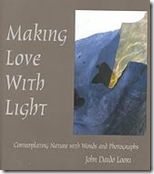
light "Light has the ability to reveal the many layers, the myriad faces contained in each form. Most often, we tend to see just the surface of a subject. We name it, identify it, and forget about it. And we stop seeing. Yet when the light changes, the subject changes, and what the subject has to show us changes. Unless we are ready to be patient and sit with our subjects, allowing the light to transform them, we see little more than their superficial aspects, and our lives reflect that shallowness. If we are patient, letting go of thoughts, and letting the mind settle down, then the hidden faces rise to the surface, and subtlety and richness return. A shift takes place, resonance appears. This allows for real intimacy with the subject."

~ John Daido Loori, from Making Love with Light: Contemplating Nature with Words and Photographs

Progress Comes in Unexpected Leaps

Excerpt from "Accomplishing Big Things in Small Pieces," by William Wissemann, This I Believe (9.14.08):

cube Solving the Rubik’s Cube has made me believe that sometimes you have to take a few steps back to move forward. This was a mirror of my own life when I had to leave public school after the fourth grade. It’s embarrassing to admit, but I still couldn’t consistently spell my full name correctly.

As a fifth-grader at a new school, specializing in what’s called language processing disorder, I had to start over. Memorizing symbols for letters, I learned the pieces of the puzzle of language, the phonemes that make up words. I spent the next four years learning how to learn and finding strategies that allowed me to return to my district’s high school with the ability to communicate my ideas and express my intelligence.

It took me four weeks to teach myself to solve the cube—the same amount of time it took the inventor, Ernő Rubik. Now, I can easily solve the 3x3x3, and the 4x4x4, and the Professor’s Cube, the 5x5x5. I discovered that just before it solves, a problem can look like a mess, and then suddenly you can find the solution. I believe that progress comes in unexpected leaps.

A Different Level of Acceptance to What Is

"I talk about God all the time in class, and I'm pretty confident in my relationship with God. And therefore, I'm comfortable using the word. But when I define spirit, it's that which exists within that's of truth and love. And so when I refer to grace or to spirit or to God, I'm talking of truth and love."

"It comes down to this for me: You can't get to God through your head, at least in my experience. I might come back in 20 years and say, you know, 'Remember everything I was saying at 41? I was totally wrong.' But how I've experienced it is that you can't get to God through your head, because it's determined by your five senses, so therefore we're limited to what we know, what we see, what we've experienced here on earth."

"For me, I've only been able to get to God through my heart, not through what I know but through what I feel because feelings lead to surrender. Surrender allows you to step into that unknown state where there's a different level of acceptance to what is rather than what you're choosing it to be. So for me, you release the tension, it opens you up to feelings, feelings connect you to surrender, and suddenly you're hearing with a new ear that moves beyond human interpretation but to spiritual perception which is infinite and limitless."

~ Seane Corn, from "Yoga: Meditation in Action," Speaking of Faith (9.11.08)

Monday, September 15, 2008

Divided into Two Cultures

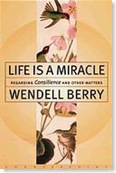
From LIfe is a Miracle: An essay against modern superstition by Wendell Berry:

life_is_a_miracle It is clearly bad for the sciences and the arts to be divided into "two cultures." It is bad for scientists to be working without a sense of obligation to cultural tradition. It is bad for artists and scholars in the humanities to be working without a sense of obligation to the world beyond the artifacts of culture. It is bad for both of these cultures to be operating strictly according to "professional standards," without local affection or community responsibility, much less any vision of an eternal order to which we all are subordinate and under obligation...

The badness of all this is manifested first in the loss even of the pretense of intellectual or academic community...Without...a vigorous conversation originating in the universities and emanating from them, we get what we've got: sciences that spread their effects upon the world as if the world were no more than an experimental laboratory; arts and "humanities" as unmindful of their influence as if the world did not exist; institutions of learning whose chief purpose is to acquire funds and be administered by administrators; governments whose chief purpose is to provide offices to members of political parties.

The ultimate manifestation of this incoherence is loss of trust — loss, moreover, of the entire cultural pattern by which we understand what it means to give and receive trust. The general assumption now is that everybody is working in his or her own interest and will continue to do so until checked by somebody whose self-interest is more powerful. That nobody trusts the politicians or their governments is probably the noisiest of present facts. More quietly, people are withdrawing their trust from the professions, the corporations, the education system, the religious institutions, the medical industry. Perhaps no expert has yet assigned a quantitative value to trust; it is nonetheless certain that when we have finished subtracting trust from all we think we have gained, not much will be left.

...There is no reason, as I hope and believe, that science and religion might not live together in amity and peace, so long as they both acknowledge their real differences and each remains within its own competence. Religion, that is, should not attempt to dispute what science has actually proved; and science should not claim to know what it does not know, it should not confuse theory and knowledge, and it should disavow any claim on what is empirically unknowable.

Re-energizing Spirituality in a Secular Context

"I’m constantly reading texts from Christianity, Judaism, Hinduism and Islam. Art is about re-energizing spirituality in a secular context. We do religion, beyond the doctrine...I practice religion extensively, what I don’t do — like a Southern politician — is talk about it."

~ Theater and opera director Peter Sellars, from "Demon Opera," New York Times Sunday Magazine, Domains (9.14.08).

Mr. Sellars teaches Art as Social Action and Art as Moral Action at the UCLA Department of World Arts and Cultures.

Below is an excerpt of an interview from the PBS program, "The Question of God": 

For me, one of the hardest things to deal with about the 20th century — and I'm very relieved that it's finished — is that it was so absorbed in psychology and the self. Psychology is probably the least interesting thing going on in your life. At the end of the day, reducing your life to your own psychological problems is to devalue your place in history, is to devalue your political commitments, is to devalue what we're all doing here for each other. It is to devalue what overwhelming waves of spiritual energy or insight are breaking upon us, in the midst of these catastrophes, and not to get that life is difficult for a reason. It's not to get that we are actually being pushed, and pulled, and drawn out of ourselves.

This obsession with the self is of course exactly the opposite of centuries of spiritual seeking, which were all about how to escape the self. How can we finally annihilate this thing called the self, and literally transcend it?

That's what's so liberating about opera, because nobody can do it alone. The soprano is dependent on the oboe player, who is dependent on the person whose finger is on the switch on the light board, who is dependent on the person who raised the curtain, who is dependent on the person who tore the ticket, who is dependent on the person who served you your drink at intermission.

Hello! You're having this total experience. No part of it could ever be isolated — it's only possible because the whole cosmology comes into play. And human beings are doing this astounding thing, which is working together to make something that is way beyond their individual selves, or capacities, and that lifts everybody to a new place.

Sunday, September 14, 2008

We're All Asked to be Performance Artists

Excerpt from "The couple who lived in the mall," Salon.com:

They never intended to undermine the mall or its corporate structure, or to make a spectacle of themselves. [Michael]Townsend describes himself as "wired for happiness" and [Adriana] Yoto's idea of a good time is cataloguing all the items in a store and rating their desirability from "gift-worthy" to "if-it-were-the-apocalypse-and-I-was-looting-I-would-take-it." Which is precisely what they did during their stint living at the mall. Every day.

Each of them voted in one item (a flashlight, space blanket, sketchbook and facecloth) and accepted an allowance of $20. "I had a lot of tea," said Yoto. They camouflaged themselves, carrying empty Nordstrom bags and wearing mall outfits -- nice slacks and button-down shirts. At night they had to skirt through a 2-foot-wide passage to the dark space Townsend had found, its walls and ceiling coated in what Yoto described as "opaque gray oatmeal mixed with the contents of a lint trap." They made a bed of cardboard and insulation tiles where they spent cold nights, not risking capture by using the mall off-hours. They washed up -- it was dusty -- in mall bathrooms, while Yoto arrived at the porcelain sink in the Origins store each morning, sampling its face cleansers. Occasionally, they leafed through books at Borders.

They were, after four days, both completely bored and totally ecstatic. "I felt this vacation-like euphoria that I've never felt till then or since then," Townsend said. "It was better for me than any nature walk I've every taken." Let's be clear: He's not being ironic -- this is wired-for-happiness talking. They felt they had subverted the mall's reason for existence by not buying anything, yet they had achieved what it promised: a release from the burdens of everyday life, within walking distance.

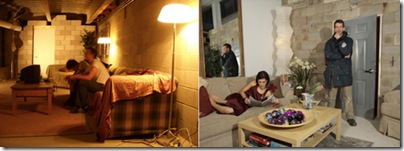
Adriana Yoto and Michael Townsend. Photographs by Stephanie Ewens. Stylist: Caroline Woodward

After their experimental week, Yoto and Townsend returned regularly for four years, attempting to transform that storage space into a luxury apartment furnished by the mall. They built a wall with 39-pound cinder blocks that they hauled in themselves -- there was plenty of hard physical labor involved in their attempt at the high life. They added sofas, tables, lamps, a TV, a china hutch and a Sony PlayStation (which was stolen while they lived there, which suggests their presence wasn't entirely secret), and stayed for days at a time. They planned to install pre-laminated wood flooring and a portable toilet.

Yoto says they played house to submit to the "demands to hyper-stylize." She's referring to the visions of decorating perfection in the Pottery Barn catalogs or Domino magazine that make their way to our mailboxes, to the pressure some internalize to make our homes match those images, to have them always ready for inspection. "We're all asked to be performance artists every day," she says. "We're all being watched."

In the mall -- perhaps the most heavily surveilled public arena we have, with security cameras and long lists of behavioral rules -- she lived a parallel existence in which she realized those hyper-stylizing dreams, performed for that invisible audience by placing tiny jars of sand on a decorative shelf and a cloth runner on the dining room table, flourishes she would excoriate in her real life, in her own loft a mile away.

Yet while Yoto and Townsend critiqued the mall as an agent of surveillance, they worked hard to make sure they were surveilled. They scanned their sketchbooks' pages onto their blogs. They uploaded handmade maps of the mall's undefined spaces. They posted video of their mall apartment on their Web site, which began to appear near the top of Google searches for Providence Place. They assume that's how security knew to search for them, finding Townsend one October afternoon behind the door they built. Townsend yelled "Surprise!" when they turned on the lights. He pleaded no contest, was sentenced to six months probation and was banned from the mall.

Friday, September 12, 2008

Where I Am With You

by Ryan Vine, from Distant Engines

Waking from a nap,
we stand at the window
watching dark clouds crawl
across the sky, whip
state-sized wisps
down and out and up.

Lights come on early,
and people below
on the street scurry
and bumble about
My arm around you, you say—
Let it rain, let it pour.

[Writer's Almanac, 9.12.08]

It's So Easy to Lose Your Head

9 Crimes
featuring Damien Rice and Lisa Hannigan


From 9

And So It Has Always Been

For the Time Being "There were no formerly heroic times, and there was no formerly pure generation. There is no one here but us chickens, and so it has always been: A people busy and powerful, knowledgeable, ambivalent, important, fearful, and self-aware; a people who scheme, promote, deceive, and conquer; who pray for their loved ones, and long to flee misery and skip death.

"It is a weakening and discoloring idea, that rustic people knew God personally once upon a time—or even knew selflessness or courage or literature—but that it is too late for us. In fact, the absolute is available to everyone in every age. There never was a more holy age than ours, and never a less."

~ Annie Dillard, from For the Time Being

Thursday, September 11, 2008

Prayer for the Dead

The light snow started late last night and continued
all night long while I slept and could hear it occasionally
enter my sleep, where I dreamed my brother
Howard Kestenbaumwas alive again and possessing the beauty of youth, aware
that he would be leaving again shortly and that is the lesson
of the snow falling and of the seeds of death that are in everything
that is born: we are here for a moment
of a story that is longer than all of us and few of us
remember, the wind is blowing out of someplace
we don't know, and each moment contains rhythms
within rhythms, and if you discover some old piece
of your own writing, or an old photograph,
you may not remember that it was you and even if it was once you,
it's not you now, not this moment that the synapses fire
and your hands move to cover your face in a gesture
of grief and remembrance.

by Stuart Kestenbaum, who "lost his brother Howard in the destruction of the twin towers of the World Trade Center" on this day seven years ago. From American Life in Poetry: Column 181.

Stains

"How do we deal with the stains of our own history? How do we take those aspects of our social history, slavery being the largest one, that we have a democratic country that was founded and based in slavery, and how do you talk about that?"

~ Ann Hamilton, from Art:21

Ann Hamilton describes myein, her installation representing the US at the 48th Venice Biennale in 1999, in the following excerpt from "Histories that Haunt," by Mary Katherine Coffey (Art Journal, Fall 2001):

I took this project very seriously and really thought about how a work can explore some of the absences that are in our historical record, or that are pervasively present, but in some ways invisible to us. Can material form be a way of looking? When I first visited the pavilion in Venice, I thought, "This neo-classical form is every bank in Iowa." This is an American form, and it sent me straight into the arms of Thomas Jefferson at Monticello. And yet the building is almost a scale model. When you get in, the facade is not fulfilled by the experience and the volume of the inside. So very early on, I decided that I wanted to take on the building as both an object and subject of the work, to make a work that was both inside and outside of the building. The first gesture of the work was to empty the space, to open the skylights to light for the first time in some fifteen years, and to make alterations architecturally that then embed the work in the structure of the building. The glass wall [in front o f the pavilion] served to distort the view into the building as well as the view out. The glass changed and liquefied the solidity and the authority of the kind of architectural history that you are looking at when you approach the pavilion.

When you first walked in and entered the small rotunda, there was a blind window that had been revealed. It was one we found as we went into the membrane of the building. It didn't offer a view back out, but rather a reflection of your backlit shadow, as you entered. You could then turn any direction within the rotunda to enter an L-shaped configuration of consecutive galleries, two on each side, each one the same, each treated the same except for the change in light.

On the walls was a text--Charles Reznikoff's Testimony: The United States 1885-1915--translated into Braille. It's a two-volume work that is based on his research in the thirties on court records from the turn of the last century. Intensely colored fuchsia powder was falling around the perimeter of each of the rooms, catching, rolling, falling off the Braille text and then accumulating on the floor. The voice that you heard was my reading of Lincoln's Second Inaugural Address in international phonetic code. So if you walked the landscape of the interior of the room and wrote out the letters that you were hearing, you would transcribe the text. Both of the references to language, in Braille and phonetic code, are veiled in such a way that language doesn't become the vehicle through which you arrive at a certain set of information. And so you had to sense your way through this.

A table, the only object in the piece, stood at the exterior and was knotted with white cloth at its surface. In part, it was an homage to my own textile heritage and sensibility, in that tying a knot in a piece of string or cloth was one of the earliest forms of record keeping. The system of government we have is based on legalistic structure. So the record-keeping reference is here in material form.


Excerpt from Testimony: The United States, 1885-1890
by Charles Reznikoff

Several white men went at night to the Negro's
house,
shot into it,
and set fire to his cotton on the gallery
his wife and children ran under the bed
and as the firing from guns and pistols went on
and the cotton blazed up, ran through a side door
into the woods.
The Negro himself, badly wounded, fled to the
house of a neighbor—
a white man--
and got inside.
He was followed,
and one of those who ran after him
put a shotgun against the white man's door
and shot a hole through it.
Justice, however, was not to be thwarted,
for five of the men who did this to the Negro
were tried:
for "unlawfully and maliciously
injuring and disfiguring"-
the white man's property.

Tuesday, September 09, 2008

A Skill You'll Actually Get To Use

Excerpt from What Now? by Ann Patchett from an essay based on the commencement address she gave at Sarah Lawrence in May 2006:

what_now In a world that is flooded with children's leadership camps and grown-up leadership seminars and bestselling books on leadership, I count myself as fortunate to have been taught a thing or two about following. Like leading, it is a skill, and unlike leading, it's one that you'll actually get to use on a daily basis. It is senseless to think that at every moment of our lives we should all be the team captain, the class president, the general, the CEO, and yet so often this is what we're being prepared for.

No matter how many great ideas you might have about salad preparation or the reorganization of time cards, waitressing is not a leadership position. You're busy and so you ask somebody to bring the water to table four. Someone else is busy and so you clear the dirty plates from table twelve. You learn to be helpful and you learn to ask for help.

It turns out that most positions in life, even the big ones, aren't really so much about leadership. Being successful, and certainly being happy, comes from honing your skills in working with other people. For the most part we travel in groups—you're ahead of somebody for a while, then somebody's ahead of you, a lot of people are beside you all the way. It's what the nuns had always taught us: sing together, eat together, pray together.

Because We Agree On So Much

Excerpts from What 'Culture War'? by Dick Meyer, Los Angeles Times (August 27, 2008):

The idea that there is vast war over the moral and spiritual compass of the nation is a dramatic narrative, and it has dominated popular political analysis for nearly two decades. It makes for potent, inflammatory political commercials. It just doesn't have the added virtue of being true.

Poll after poll, focus group after focus group show that the vast majority of Americans — the Silent Majority, perhaps? — are pragmatic, independent and un-partisan in their basic views. They are eclectic: "liberal" on some matters, "conservative" on others.

In fact, it's because we agree on so much that our elections are so close.

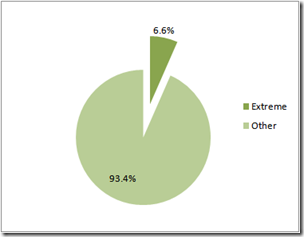
Extremists, however rare, are becoming more common and, importantly, more rabid. Analyzing survey data from the National Opinion Research Center, political scientist Arthur Brooks discovered that the percentage of people who described themselves as either "extreme liberals" or "extreme conservatives" grew a stunning 35% from 1972 to 2004. Still, as a percentage of the total population, the extremist factions — right and left combined — remain a small slice, 6.6%.

 image

The political elite and the politically engaged are, of course, much more likely to be on the extreme wings than the majority. These also happen to be the people who not only go to conventions, but whom the cable news bookers corral to argue about politics on their shows. Increasingly, they are also the people who host television and radio talk shows, who publish blogs and who make civic noise.

But they are not us. Despite the stories we will read, hear and see this week and next, Americans are a much more pragmatic, moderate and independent crowd.

Monday, September 08, 2008

Already Inside

From an interview with actress Michelle Williams in the New York Times yesterday:

Photo by by Simon Max Hill/Oscilloscope Laboratories[While portraying a character whose financial situation unravels] “I thought a lot about what you look like when you think nobody’s looking at you, when you feel completely invisible. Your entire life happens inside because you don’t think anyone notices you. Which is very different from me. Not that I don’t have any inside life, but I feel watched, all the time.”

“...Acting sometimes reminds me of therapy in that the more you talk about a traumatic or profound event, the more it loses its emotional tension. Switch on a bright light and find there is no boogeyman in the closet. So it is the same with a scene. Never tell the other actor or the director what you are doing.”

[She explained that the trick is to allow herself] “to live in so much mystery, to rely on a feeling, an instinct, on faith, really, that everything I need is already inside me, and best I just don’t block the exit.”

Thursday, September 04, 2008

What My Mind Calls Self

The Clause
by C.K. Williams from The Singing

This entity I call my mind, this hive of restlessness,
this wedge of want my mind calls self,
this self which doubts so much and which keeps reaching,
keeps referring, keeps aspiring, longing, towards some state
from which ambiguity would be banished, uncertainty expunged;

this implement my mind and self imagine they might make together,
which would have everything accessible to it,
all our doings and undoings all at once before it,
so it would have at last the right to bless, or blame,
for without everything before you, all at once, how bless, how blame?

this capacity imagination, self and mind conceive might be the "soul,"
which would be able to regard such matters as creation and
     destruction,
origin and extinction, of species, peoples, even families, even mine,

of equal consequence, and might finally solve the quandary
of this thing of being, and this other thing of not;

these layers, these divisions, these meanings or the lack thereof,
these fissures and abysses beside which I stumble, over which I reel:
is the place, the space, they constitute,
which I never satisfactorily experience but from which the fear
I might be torn away appalls me, me, or what might most be me?

Even mine, I say, as if I might ever believe such a thing;
bless and blame, I say, as though I could ever not.
This ramshackle, this unwieldy, this jerry-built assemblage,
this unfelt always felt disarray: is this the sum of me,
is this where I'm meant to end, exactly where I started out?

Tuesday, September 02, 2008

The Work of Education

maria_montessori "Establishing lasting peace is the work of education; all politics can do is keep us out of war."

~ Maria Montessori

From The Writer's Almanac (8.31.08):

"...today there are more than 5,000 Montessori schools in the United States, 300 of which are public schools. A study in 2006 published in the journal Science tested public school children in inner-city Milwaukee, some who had won a district lottery to attend the public Montessori school, and a separate control group who had entered the Montessori lottery but did not get picked. (This was to account for differences in home environment between the sorts of parents who want their children to attend Montessori; in this study, every participant's parents had wanted their child to enroll in Montessori.)"

"The study showed that five-year-olds who attended Montessori had better vocabulary and math skills, as well as better social problem-solving skills — that when presented with stories of behavior dilemmas, Montessori children used 'a higher level of reasoning by referring to justice or fairness to convince the other child' to share. Twelve-year-old Montessori children were deemed to have written essays that were 'significantly more creative' and that employed 'significantly more sophisticated sentence structures' than their non-Montessori peers, though their spelling and grammar skills were at an equal level."