
Showing posts with label Marge Piercy. Show all posts

Tuesday, May 26, 2009

A Good Job

From “The Case for Working With Your Hands,” by Matthew B. Crawford, The New York Times Sunday Magazine (May 21, 2009):

Shop Class as Soulcraft: An inquiry into the value of work The trades suffer from low prestige, and I believe this is based on a simple mistake. Because the work is dirty, many people assume it is also stupid. This is not my experience. I have a small business as a motorcycle mechanic in Richmond, Va., which I started in 2002. I work on Japanese and European motorcycles, mostly older bikes with some “vintage” cachet that makes people willing to spend money on them. I have found the satisfactions of the work to be very much bound up with the intellectual challenges it presents. And yet my decision to go into this line of work is a choice that seems to perplex many people…

A good job requires a field of action where you can put your best capacities to work and see an effect in the world. Academic credentials do not guarantee this.

Nor can big business or big government — those idols of the right and the left — reliably secure such work for us. Everyone is rightly concerned about economic growth on the one hand or unemployment and wages on the other, but the character of work doesn’t figure much in political debate. Labor unions address important concerns like workplace safety and family leave, and management looks for greater efficiency, but on the nature of the job itself, the dominant political and economic paradigms are mute. Yet work forms us, and deforms us, with broad public consequences.

The visceral experience of failure seems to have been edited out of the career trajectories of gifted Matthew B. Crawfordstudents. It stands to reason, then, that those who end up making big decisions that affect all of us don’t seem to have much sense of their own fallibility, and of how badly things can go wrong even with the best of intentions (like when I dropped that feeler gauge down into the Ninja). In the boardrooms of Wall Street and the corridors of Pennsylvania Avenue, I don’t think you’ll see a yellow sign that says “Think Safety!” as you do on job sites and in many repair shops, no doubt because those who sit on the swivel chairs tend to live remote from the consequences of the decisions they make. Why not encourage gifted students to learn a trade, if only in the summers, so that their fingers will be crushed once or twice before they go on to run the country?
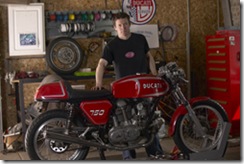
There is good reason to suppose that responsibility has to be installed in the foundation of your mental equipment — at the level of perception and habit. There is an ethic of paying attention that develops in the trades through hard experience. It inflects your perception of the world and your habitual responses to it. This is due to the immediate feedback you get from material objects and to the fact that the work is typically situated in face-to-face interactions between tradesman and customer.

*     *     *     *     *

To be of use
by Marge Piercy

The people I love the best
jump into work head first
without dallying in the shallows
and swim off with sure strokes almost out of sight.
They seem to become natives of that element,
the black sleek heads of seals
bouncing like half submerged balls.

I love people who harness themselves, an ox to a heavy cart,
who pull like water buffalo, with massive patience,
who strain in the mud and the muck to move things forward,
who do what has to be done, again and again.

I want to be with people who submerge
in the task, who go into the fields to harvest
and work in a row and pass the bags along,
who stand in the line and haul in their places,
who are not parlor generals and field deserters
but move in a common rhythm
when the food must come in or the fire be put out.

The work of the world is common as mud.
Botched, it smears the hands, crumbles to dust.
But the thing worth doing well done
has a shape that satisfies, clean and evident.
Greek amphoras for wine or oil,
Hopi vases that held corn, are put in museums
but you know they were made to be used.
The pitcher cries for water to carry
and a person for work that is real.

Saturday, May 16, 2009

Work is its Own Cure

For the young who want to
by Marge Piercy, from The Moon is Always Female

The Moon is Always Female Talent is what they say
you have after the novel
is published and favorably
reviewed. Beforehand what
you have is a tedious
delusion, a hobby like knitting.

Work is what you have done
after the play is produced
and the audience claps.
Before that friends keep asking
when you are planning to go
out and get a job.

Genius is what they know you
had after the third volume
of remarkable poems. Earlier
they accuse you of withdrawing,
ask why you don't have a baby,
call you a bum.

The reason people want M.F.A.'s,
take workshops with fancy names
when all you can really
learn is a few techniques,
typing instructions and some-
body else's mannerisms

is that every artist lacks
a license to hang on the wall
like your optician, your vet
proving you may be a clumsy sadist
whose fillings fall into the stew
but you're certified a dentist.

The real writer is one
who really writes. Talent
is an invention like phlogiston
after the fact of fire.
Work is its own cure. You have to
like it better than being loved.

Tuesday, May 05, 2009

To Have Without Holding

by Marge Piercy

Learning to love differently is hard,
love with the hands wide open, love
with the doors banging on their hinges,
the cupboard unlocked, the wind
roaring and whimpering in the rooms
rustling the sheets and snapping the blinds
that thwack like rubber bands
in an open palm.

It hurts to love wide open
stretching the muscles that feel
as if they are made of wet plaster,
then of blunt knives, then
of sharp knives.

It hurts to thwart the reflexes
of grab, of clutch; to love and let
go again and again. It pesters to remember
the lover who is not in the bed,
to hold back what is owed to the work
that gutters like a candle in a cave
without air, to love consciously,
conscientiously, concretely, constructively.

I can't do it, you say it's killing
me, but you thrive, you glow
on the street like a neon raspberry,
You float and sail, a helium balloon
bright bachelor's button blue and bobbing
on the cold and hot winds of our breath,
as we make and unmake in passionate
diastole and systole the rhythm
of our unbound bonding, to have
and not to hold, to love
with minimized malice, hunger
and anger moment by moment balanced.