




It Turns to Reveal Its Other Face
Snippets of conversation from “A Wild Love for the World,” Being, September 16, 2010:
Krista Tippett: You really work with people to hold on to grief, to take their grief seriously, right?
Joanna Macy: Or not to hold on to it so much as to not be afraid of it because that grief, if you are afraid of it and pave it over, clamp down, you shut down. And the kind of apathy and closed-down denial, our difficulty in looking at what we're doing to our world stems not from callous indifference or ignorance so much as it stems from fear of pain. That was a big learning for me as I was organizing around nuclear power and around at the time of Three Mile Island catastrophe and around Chernobyl.
Then as I saw it, it relates to everything. It relates to what's in our food and it relates to the clear-cuts of our forests. It relates to the contamination of our rivers and oceans. So that became actually perhaps the most pivotal point in, I don't know, the landscape of my life, that dance with despair, to see how we are called to not run from the discomfort and not run from the grief or the feelings of outrage or even fear and that, if we can be fearless, to be with our pain, it turns. It doesn't stay static. It only doesn't change if we refuse to look at it. But when we look at it, when we take it in our hands, when we can just be with it and keep breathing, then it turns. It turns to reveal its other face, and the other face of our pain for the world is our love for the world, our absolutely inseparable connectedness with all life.

Krista Tippett: I just want to kind of underline the connection that you repeatedly make that I think might be counterintuitive. You know, you talk about spirituality and you are also always equally talking about, you know, these are some phrases from your writing that echo things you said. Your wild love for the world or even an erotic connection with the world, that those two things go together for you.
Joanna Macy: Yeah. That's right. World is lover, world is self and that it's OK for our hearts to be broken over the world. What else is a heart for? There's a great intelligence there. We've been treating the earth as if it were a supply house and a sewer. We've been grabbing, extracting resources from it for our cars and our hair dryers and our bombs and we've been pouring the waste into it until it's overflowing, but our earth is not a supply house and a sewer. It is our larger body. We breathe it. We taste it. We are it and it is time now that we venerate that incredible flowering of life that takes every aspect of our physicality.
So when I — I'm looking at my hand right now as we talk. It's got a lot of wrinkles because I'm 81 years old, but it's linked to hands like this back through the ages. This hand is directly linked to hands that learned to reach and grasp and climb and push up on dry land and weave reeds into baskets, and it has a fantastic history. Every particle and every atom in this hand goes back to the beginning of space-time. We're part of that story.
Read or listen to the whole conversation here…
See also: Hands


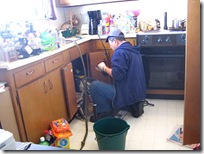 So the plumber who reaches up inside of the wall of an old building where he cannot see and he can only feel, and through feeling around the structures in there, feeling the rust, feeling moisture if there's any, feeling the way the thing is structured, he's visualizing what's back there that he can't see and then bringing a knowledge base to bear on trying to figure out what the problem may be. Think of what a complex set of mental operations are involved in that.
  job, let's say. And the stylist — and this woman said this to me when I was watching her work — she said, "The first thing I asked myself was what was that previous stylist trying to accomplish?" So what an interesting question to ask.


