Friday, August 14, 2009

Langley’s Theory of Replacements

From Homer & Langley by E.L. Doctorow:

Homer & Langley I have a theory, he said to me. Everything in life gets replaced. We are our parents’ replacements just as they were replacements of the previous generation. All these herds of bison they are slaughtering out west, you would think that was the end of them, but they won’t all be slaughtered and the herds will fill back in with replacements that will be indistinguishable from the ones slaughtered.

I said, Langley, people aren’t all the same like dumb bison, we are each a person. A genius like Beethoven cannot be replaced.

But, you see, Homer, Beethoven was a genius for his time. We have the notations of his genius but he is not our genius. We will have our geniuses, and if not in music then in science or art, though it may take a while to recognize them because geniuses are usually not recognized right away. Besides, it’s not what any of them achieve but how they stand in relation to the rest of us. Who is your favorite baseballer? he said.

Walter Johnson, I said.

And what is he if not a replacement for Cannonball Titcomb, Langley said. You see? It’s social constructions I’m talking about. One of the constructions is for us to have athletes to admire, to create ourselves as an audience of admirers for baseballers. This seems to be a means of cultural communizing that creates great social satisfaction and possibly ritualizes, what with baseball teams of different towns, our tendency to murder one another. Human beings are not bison, we are a more complex species, living in complicated social constructions, but we replace ourselves just as they do. There will always be in America for as long as baseball is played someone who serves youth still to be born as Walter Johnson serves you. It is a legacy of ours to have baseball heroes and so there will always be one. Well you are saying everything is always the same as if there is no progress, I said.

I’m not saying there’s no progress. There is progress while at the same time nothing changes. People make things like automobiles, discover things like radio waves. Of course they do. There will be better pitchers than your Walter Johnson, as hard as that is to believe. But time is something else than what I’m talking about. It advances through us as we replace ourselves to fill the slots.

More…

No Expectations of Success Now

Solving the Puzzle
by Stephen Dunn, from Loosestrife

Loosestrife: poems I couldn’t make all the pieces fit,
So I threw one away.

No expectations of success now,
None of that worry.

The remaining pieces seemed
to seek their companions.
A design appeared.

I could see the connection
Between the overgrown path
And the dark castle on the hill.

Something in the middle, though,
was missing.

It would have been important once.
I wouldn’t have been able to sleep
without it.

[Spotted on Jonathan Carroll’s blog 8.13.09]

I Know that I Love

Me
by Paula Cole

I am not the person who is singing
I am the silent one inside
I am not the one who laughs at people's jokes
I just pacify their egos
I am not my house, my car, my songs
They are only just stops along my way
I am like the winter
I'm a dark cold female
With a golden ring of wisdom in my cave

And it’s me who is my enemy
Me who beats me up
Me who makes the monsters
Me who strips my confidence

I am carrying my voice
I am carrying my heart
I am carrying my rhythm
I am carrying my prayers
But you can't kill my spirit
It's soaring and it's strong
Like a mountain
I'll go on and on
But when my wings are folded
The brightly colored moth
Blends into the dirt into the ground

And it's me who's too weak
And it's me who's too shy
To ask for the thing I love
And it's me who's too weak
And it's me who's too shy
To ask for the thing I love
That I love

I am walking on the bridge
I am over the water
And I'm scared as hell
But I know there's something better
Yes I know there's something
Yes I know, I know, yes I know

That I love

But it's me
And it's me
But it's me

Tuesday, August 11, 2009

Strict Joy

Glen Hansard and Marketa Irglova perform a live set as part of NPR’s Tiny Desk Concerts series. Their new CD, Strict Joy, is due to be released at the end of October.

[Thanks Suzie!]

How Good Things Could Be

From Mastering the Core Teachings of the Buddha (the blook) by Daniel Ingram:

Try this little exercise the next time some kind of strong and seemingly useless or unskillful emotion arises. First, stabilize precisely on the sensations that make it up and perhaps even allow these to become stronger if this helps you to examine them more clearly. Find where these are in the body, and see as clearly as possible what sorts of images and story lines are associated with these physical sensations. Be absolutely clear about the full magnitude of the suffering in these, how long each lasts, that these sensations are observed and not particularly in one’s control.

Now, find the compassion in it. Take a minute or two (no more) to reflect on why this particular pattern of sensations seems to be of some use even though it may not seem completely useful in its current form. Is there a wish for yourself or others to be happy in these sensations? Is there a wish for the world to be a better place? Is there a wish for someone to understand something important? Is there a wish for things to be better than they are? Is there a wish to find pleasure, tranquility, or the end of suffering? Sit with these questions, with the sensations that make them up, allowing them to be strong enough for you to see what is going on but not so strong that you become completely overwhelmed by them.

Notice that fear has in it the desire to protect us or those about whom we care. Anger wants the world to be happy and work well or for justice to be done. Frustration comes from the caring sensations of anger being thwarted. Desire is rooted in the wish to be happy. Judgment comes from the wish for things to conform to high standards. Sadness comes from the sense of how good things could be. I could go on like this for a whole book.

Actively reflecting along these lines, sit with this compassionate wish, acknowledge it, and feel the compassionate aspect of it. Allow the actual sensations that seem to be fundamental to wanting to be directly understood as and where they are. Remember that this same quality of compassion is in all beings, in all their unskillful and confused attempts to find happiness and the end of suffering. Sit for a bit with this reflection as it relates directly to your experience.

Then, examine the mental sensations related to the object that you either wish for (attraction), wish to get away from (aversion), or wish would just be able to be ignored (ignorance). Examine realistically if this will fundamentally help yourself and others and if these changes are within your power to bring about. If so, then plan and act with as much compassion and kindness as possible.

Remember then that all the rest of the suffering of that emotional pattern is created by your mind and its confusion, and vow to channel its force into developing morality, concentration, and wisdom.

I Don’t Ever Want to Have to Say “I Don’t Know” Ever Again

“There's this being called the thing that made the things for which there is no known maker and that causes and directs the events we can't otherwise explain and that doesn't need to have been made and is the one thing from which to ask for things that no human can give and without whom we can't be fully happy and is unlimited by all the laws of physics and never began and will never finish and is invisible but actually everywhere at once and who is so perfect that even if he killed millions of people, including babies, he'd still would be perfect and who is so powerful and magical that he can even make a virgin pregnant if he wanted to."

NonStampCollector

The Theater of the Mind

Walking to Oak-Head Pond, and Thinking of the Ponds I Will Visit in the Next Days and Weeks
by Mary Oliver, from What Do We Know

What Do We Know What is so utterly invisible
as tomorrow?
Not love,
not the wind,

not the inside of stone.
Not anything.
And yet, how often I'm fooled—
I'm wading along

in the sunlight—
and I'm sure I can see the fields and the ponds shining
days ahead—
I can see the light spilling

like a shower of meteors
into next week's trees,
and I plan to be there soon—
and, so far, I am

just that lucky,
my legs splashing
over the edge of darkness,
my heart on fire.

I don't know where
such certainty comes from—
the brave flesh
or the theater of the mind—

but if I had to guess
I would say that only
what the soul is supposed to be
could send us forth

with such cheer
as even the leaf must wear
as it unfurls
its fragrant body, and shines

against the hard possibility of stoppage—
which, day after day,
before such brisk, corpuscular belief,
shudders, and gives way.

[From Garrison Keillor’s The Writer’s Almanac]

Monday, August 10, 2009

Trolling for Strangers

“I long for the narrative arc and true storytelling,” Mr. [Alec] Soth said. When he’s on the road he tries to let each picture lead him to the next; taped to his steering wheel is a list of things to watch for while he’s driving. A list composed for his current project included beards, birdwatchers, mushroom hunters, men’s retreats, after the rain, figures from behind, suitcases, tall people (especially skinny), targets, tents, treehouses and tree lines. Thus the photo of the tall bearded monk standing amid a forest of soaring barren tree trunks and the image of a giantlike man with a suitcase walking away on an overgrown path.

~ From Trolling for Strangers to Befriend,” by Hilarie M. Sheets, New York Times (August 2, 2009)

F.P., Resaca, Georgia, 2006 Alec Soth: Black Line of Woods
High Museum of Art Atlanta
August 8, 2009, through January 3, 2010

Closed Eyes Intensify Emotions

"Neuroscientists have discovered that a brain centre involved in sensing emotion and fear called the amygdala kicks into action when volunteers listen to scary music with eyes closed...Shutting your eyes heightens people's emotional responses to the outside world, suggests previous research—not to mention everyday experience."

~ From “Scary Music is Spookier with Eyes Shut," by Ewen Callaway, New Scientist (July 28, 2009)

Adding Sanity

From Taking the Leap: Freeing Ourselves from Old Habits and Fears by Pema Chödrön:

Taking the Leap As human beings we have the potential to disentangle ourselves from old habits, and the potential to love and care about each other. We have the capacity to wake up and live consciously, but, you may have noticed, we also have a strong inclination to stay asleep. It’s as if we are always at a crossroad, continuously choosing which way to go. Moment by moment we can choose to go toward further clarity and happiness or toward confusion and pain.

In order to make this choice skillfully, many of us turn to spiritual practices of various kinds with the wish that our lives will lighten up and that we’ll find the strength to cope with our difficulties. Yet in these times it seems crucial that we also keep in mind the wider context in which we make choices about how to live: this is the context of our beloved earth and the rather rocky condition it’s in.

For many, spiritual practice represents a way to relax and a way to access peace of mind. We want to feel more calm, more focused; and with our frantic and stressful lives, who can blame us? Nevertheless, we have a responsibility to think bigger than that these days. If spiritual practice is relaxing, if it gives us some peace of mind, that’s great—but is this personal satisfaction helping us to address what’s happening in the world? The main question is, are we living in a way that adds further aggression and self-centeredness to the mix, or are we adding some much-needed sanity?

[More…]

Don’t Go Back to Sleep

The breeze at dawn has secrets to tell you.
Don’t go back to sleep.

You must ask for what you really want.
Don’t go back to sleep.

People are going back and forth across the doorsill
Where the two worlds touch.

The door is round and open.
Don’t go back to sleep.

~ Rumi

[Thanks Elisha Goldstein!]

Thursday, August 06, 2009

We Underestimate the Power of Entertainment Narratives

Diane Winston in conversation with Krista Tippett, "TV and
Parables of Our Time
," Speaking of Faith (July 16, 2009):

"...something that really strikes me if I watch both Battlestar
Galactica
and Lost is that you see those characters grow from
victims to survivors. And the interesting thing is, is can we
take this in better as entertainment than as news?

If we read another article in Newsweek about Israeli and
Palestinian children at a summer camp getting along is that
going to make us believe that change is possible? Or maybe you
need that and you need shows like Battlestar Galactica and Lost
to show you that change is possible.

I guess that I think we underestimate the power of entertainment narratives to influence the way we look at the
world and I think storytelling, when it's good storytelling,
you know, orients us to possibilities and helps us structure
the way we look at things. So the power of the narrative is
that it takes on a life of its own for folks. But I don't know.
Maybe if Ronald D. Moore took over the UN we'd all be getting
along better. You think?"

Wednesday, August 05, 2009

Little People

Little People in the City
by Slinkachu

The Unwanted Ones, Slinkachu, Westferry London, 2008

All is Wild, All is Silent

remembrance // balmorhea // all is wild, all is silent from Jared Hogan on Vimeo.

Spotted on minutiae.

Tuesday, August 04, 2009

The Pleasures of the Door

Kings do not touch doors.

They know nothing of this pleasure: pushing before one gently or brusquely one of those large familiar panels, then turning back to replace it—holding a door in one’s arms.

The pleasure of grabbing the midriff of one of these tall obstacles to a room by its porcelain node; that short clinch during which movement stops, the eye widens, and the whole body adjusts to its new surrounding.

With a friendly hand one still holds on to it, before closing it decisively and shutting oneself in—which the click of the tight but well-oiled spring pleasantly confirms.

~ Francis Ponge

Legislators

Percy-Bysshe-Shelley

"Poets are the unacknowledged legislators of the world."

~Percy Bysshe Shelley

Monday, August 03, 2009

President of the Association for Random Desire

The Mysterious Human Heart
by Matthew Dickman, from All-American Poem

The produce in New York is really just produce, oranges
and cabbage, celery and beets, pomegranates
with their hundred seeds, carrots and honey,
walnuts and thirteen varieties of apples.
On Monday morning I will walk down
to the market with my heart inside me, mysterious,
something I will never get to hold
in my hands, something I will never understand.
Not like the apricots and potatoes, the albino
asparagus wrapped in damp paper towels, their tips
like the spark of a match, the bunches of daisies, almost more
a weed than a flower, the clementine,
the sausage links and chicken hung
in the window, facing the street where my heart is president
of the Association for Random Desire, a series
of complex yeas and nays,
where I pick up the plantain, the ginger root, the sprig
of cilantro that makes me human, makes me
a citizen with the right to vote, to bear arms, the right
to assemble and fall in love.

Sunday, August 02, 2009

Making an Effort to Be Understood and to Understand Others

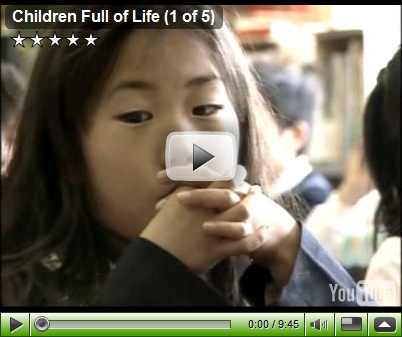
"In the award-winning documentary Children Full of Life, a fourth-grade class in a primary school in Kanazawa, northwest of Tokyo, learn lessons about compassion from their homeroom teacher, Toshiro Kanamori. He instructs each to write their true inner feelings in a letter, and read it aloud in front of the class. By sharing their lives, the children begin to realize the importance of caring for their classmates."


[Thanks Jonathan Carroll!]

Saturday, August 01, 2009

Our Dream of Safety Has to Disappear

George Tooker, Cornice, (circa 1949). Egg tempera on gesso panel 24 x 15 inches.

Leap Before You Look
by W.H. Auden 

The sense of danger must not disappear:
The way is certainly both short and steep,
However gradual it looks from here;
Look if you like, but you will have to leap.

Tough-minded men get mushy in their sleep
And break the by-laws any fool can keep;
It is not the convention but the fear
That has a tendency to disappear.

The worried efforts of the busy heap,
The dirt, the imprecision, and the beer
Produce a few smart wisecracks every year;
Laugh if you can, but you will have to leap.

The clothes that are considered right to wear
Will not be either sensible or cheap,
So long as we consent to live like sheep
And never mention those who disappear.

Much can be said for social savoir-faire,
But to rejoice when no one else is there
Is even harder than it is to weep;
No one is watching, but you have to leap.

A solitude ten thousand fathoms deep
Sustains the bed on which we lie, my dear;
Although I love you, you will have to leap;
Our dream of safety has to disappear.

Secrecy

He had two lives: an open one, seen and known by all who needed to know it, full of conventional truth and conventional falsehood, exactly like the lives of his friends and acquaintances; and another life that went on in secret. And through some strange, perhaps accidental, combination of circumstances, everything that was of interest and importance to him, everything that was essential to him, everything about which he felt sincerely and did not deceive himself, everything that constituted the core of his life, was going on concealed from others; while all that was false, the shell in which he hid to cover the truth—his work at the bank, for instance, his discussions at the club, his references to the "inferior race," his appearances at anniversary celebrations with his wife—all that went on in the open. Judging others by himself, he did not believe what he saw, and always fancied that every man led his real, most interesting life under cover of secrecy as under cover of night. The personal life of every individual is based on secrecy, and perhaps it is partly for that reason that civilized man is so nervously anxious that personal privacy should be respected.

~ Anton Chekhov, from The Lady with the Dog